SaaS Acquisition Stories w/ Daniel Ch - Founder of Simple.ink
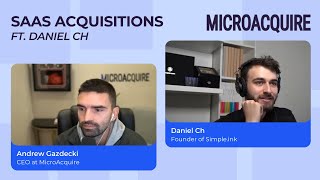
Daniel Ch, founder of Simple.ink, talks about acquiring Emojis.com and how the deal was structured. He walks through due diligence, what he learned, and his plans for growing the business after the acquisition.
Foreign.
I'm here with Daniel who recently acquired a company for five figures and excited to learn more. Thanks for joining me on this podcast.
Thank you for having me. It's an honor anytime to talk to your guests. So happy to be here.
Thanks man. Well, my first question is, so you know, there's a lot of businesses on micro acquire and this was a SaaS company I believe. And to kick things off, tell me about what attracted you to the business, what stood out, what made you feel like this was a business worth acquiring.
Yeah. Can I tell you first what put me in the mindset of acquiring something first? Yeah, there's a bit of a story there. I. My main, one of my main companies is a Notion website builder and for those of you who don't know, Notion is a big note taking app. And I started looking for separate products that I can acquire to put under this brand. Mailed a few people and I found something that was, I believed overpriced some. This person was asking for like beyond mid five figures and I thought, I thought about it for a bit and I thought it was overpriced. And then I, because I tasted the blood, I felt like getting more. So then I realized, oh, hold on a second, I've got my microacquire subscription. I don't want to make it so that, you know, when you buy something you only use it once and then you forget about it. I said I don't get myself into that because I bought it some time ago. I love what you do, Andrew. And I wanted to support the, the mission and the vision, but this was a few months ago. So I remember that I have my microacquire subscription and I said this didn't go through because I'm not agreeing on the price with this buyer with a seller who I found randomly online. Let me go look for the marketplace because I know the, all the listings that are vetted and all that. So that's how I got looking, that's how I got into this mood of looking for a business to acquire and I'm sorry, could you repeat the question? So what was it mainly what made me look for this specifically?
Just what attracted you to this business? Because there's, you know, 500 plus SaaS businesses I might acquire, I'm probably like a thousand. But out of those, how, what made this one business, you know, really stick out to you? Why did you feel like this one was worth pursuing?
Initially I didn't because I was looking to spend around those mid five figures and I thought this was not below my budget but below my needs. So initially I said nah, this isn't for me. But then I started talking to the, to the seller and they were very, very open. So this is for disclosure for you know to be transparent is the first time I've ever done this and I'm. It's not like I have any background in PE or anything like that. So I just freestyle myself to it. But because the seller looked very transparent beyond what I requested them to do, it it built a lot of trust really fast. And then I started looking into the technicals, the metrics, the perks because I feel like every business has some plus some pros and cons. I really like the pros here. So to finally get to. To your question to to the answer. I like the fact that it was set and forget. I like the fact that it looked like it's low churn once people get through the value prop. I like the possible network effect and viral loop that might kick in not at the number of customers has now because those can look great on paper but they're, they're just like a mirage early on I believe after a number of users you get to.
It's. It's a good business. I know the, that you acquired. Why don't. Can you give just like a brief explanation of you know, the company name, what you acquired and what problem solves?
Absolutely. It's called emojis emojis.com it's an online feedback tool. As a customer, you embed it either on your website or in your emails and your users get a emoji scale. They use that to give you some feedback and you also do lead generation or email collection, let's call it that you do email collection through that as well. So feedback and email, that's the two main problems it solves.
I really like that because it's a very specific problem that a lot of companies could benefit from feedback and being able to have their customers have an easy way to send that feedback to you. So that's awesome. So I guess my next question would be you locate the business. Everything looks great. Tell me more about what the buyer did that made you really comfortable. Like what could other buyer or excuse me seller. What could other sellers do to you know, position themselves or increase their chances of being micro wired. If you had any advice there.
I'll start with the practical info I have with the fact and then I'll give my opinion which might or might not be too valuable because I've never sold anything. So don't Listen to me. From that regard, what the seller did was immediately I. So I asked for a bit of info, and they've given me access to Google Analytics to chart Mogo to Stripe, so I could instantly see through their guts, so to speak. I saw every transaction. Okay, they didn't give me bank account details in the first. Sorry, a bank statement in the first conversation. They did that later, by the way, but they just looked like they had nothing to hide. What told me what the message that came with this was, okay, they're transparent. It comes from a place of probably confidence. I try to reciprocate on the other side by saying, look, I'm offering this price, but here's the big but. I'm promising a hassle free, as little headache as possible acquisition if this goes through. So unless I find something fishy, I. I want to make it simple. So to get to your questions, answer. What sellers can do, from my experience as a buyer is be transparent, but be careful. I guess it has. It matters which mindset, which headspace it comes from, because I've seen some other buyers having their shield really high saying, why would I share all this stuff? You can just go and replicate my business. I guess if you think like that, maybe my advice won't matter to you, won't help you too much. But all this transparency, build trust with me. I went in and searched. I tried to be paranoid, and I couldn't find anything that made me say, this is a deal breaker. So I guess when you're in due diligence, that's what you do. You put your paranoid head on and you try and see if you can find anything that makes you say, you know what? This isn't actually as valuable as I thought it was because of this, this, and this. Luckily, I didn't get into that situation, but that would be my number one answer for. As a piece of advice for. For buyers, sellers.
Nice. I like that. Yeah, I think, you know, one piece of advice I give to sellers is, you know, just understanding how important that first impression is. So, you know, as founders, you're a lot. I see a lot of sort of like, yeah, we're looking to sell, but, like, what's your offer like? But as a buyer, you're looking at so many other businesses, and to me, that's a yellow flag. It's just like, are you gonna be really difficult to work with? Like, are you serious about selling your business? Am I gonna put hours of my time into this? And then it goes nowhere? So the fact that the seller had you know, all the information upfront was responsive. Like, all those things right there can dramatically increase your odds of being acquired. So I. I like that. Tell me about, you know, how you structured the deal. Like, how was. What were the terms? Are you comfortable sharing that you know, you don't have?
Yeah, yeah, I am. I'm just smiling because I might not be the best example. So I'm starting with this disclaimer. I just freestyled myself into it. So you and I. I mean, you know him better than I do. Christian Friedland. I've listened to your podcast with him. I've been lucky enough to have him on my podcast. And I emailed him at one point on a separate matter, and I said, you're more of a Branson. You're more of a Richard Branson type of person. So I'll ask you. So the reason why it's mine is because I was more of a Branson move here. It was a lot of gut feeling. I checked as much as I could, but then again, I'm young, I don't have that much experience, so I had to rely on my gut feeling. But how do we structure the deal? Well, we looked at your tutorials. Thank you for those, by the way. We took your document templates and all that. I've gotten some advice, some counseling, some consultants help here and there. And the deal was all cash up front because, let me see, it just felt right, given I think the business one was undervalued. And I believe the seller believed that as well. Before starting this. I said, okay, if they believe that as well, why don't they just keep it? I even asked the person, why don't you just keep it for this multiple, this yearly multiple? And it was because of personal reasons. And this is the only thing I can't really disclose because it's their privacy. But, yeah, so I put that aside and I said, okay, trust, but. Sorry, believe, but go and find out for yourself. Technically, financially, structurally, it all seemed fine. So because I promised, and I know I was in competition as well, I know I had some other buyers right beside me on this specific company, I pretty much crunched from through the numbers in those couple of weeks that this deal required. And all my headspace was just on this. And yeah, that's it. 100% cash escrow, obviously, not just bank transfer or something like that. Is this what you meant when you ask, how do we structure the deal?
Yeah, exactly. And I guess my next question would be in terms of, you meet the buyer. You have that first call and then you finish the deal. How long did it take you from finding the business, talking to the buyer, to actually fully acquiring the business?
It was meant to take two weeks and I wouldn't do it again. But over here, as I said, that's like crunch time. Yeah, it was meant to take two weeks, it took three because of some escrow problem. Escrow.com wasn't working with my transferwise, which is now called wise US bank account. We settled for Epic. That's with a K. EPIC.com, they have a registrar as well and their escrow service worked brilliantly. So it was only because of that. Otherwise, uh, we. So I sent the LOI on day three of talking. Um, where'd you get.
Who drafted the loi?
You and your team, because we took that template.
But.
But then with. With some consultants, I've just. What's the. What's the word I'm looking for? Made it fit our situation. So we started off of that. So thank you again for that.
And can you mention the escrow service they use again? The other one?
Yeah, Epik. That's E P I K dot com. There are. They have multiple services. We just chose it because it was in your Facebook group. In the micro query Facebook group, many people recommended escrow, but it just didn't work with our bank account. One other person mentioned Epic and the reason why I went with them was because this one person was saying, look, we had a slide of slight problem, but the CEO reached out and help us directly. I still have their email. They're very nice. And we knew it worked with transferwise because we searched it. So that's why Epic.
That's so awesome. I think that's just the power of Community today where you posted it in the Facebook premium buyer group and you actually got another recommendation. I haven't heard of that escrow service provider, but I'll definitely be checking it out. So I guess, you know, probably final question is what are the plans for the future? You know, what are you looking to do with the emojis?
Yeah. Point number one in the plan is talk to Andrew Gazdecki and ask him, hey, how would you grow this? If you don't mind me, I'd love your answer on that one.
I'll take him. I'll take it like all you for sure.
Number two is. And I'll get number three to a more conventional answer. There's this person on Twitter called Adit. It's D Sh. And this guy, I follow him since April when he had like 10k followers. I know that in December last year or January last year he had like a 400 followers, something like that. Now he's at 130k. What I'm trying to do when we're making progress is get him to partner up on this with equity, not, not as an employee or something and team together on his marketing skills and see where this takes us. But if that doesn't go through, because this just came up in the last two weeks, if that doesn't go through and this is number three the more conventional answer. I mean look, I look at your tweets, they not only inspire me but they give me information. I realize through what you're sharing that this is, this has got quite a big tam total addressable market feedback to how many feedback tours are out there. We don't need to dominate it or to get to a billion something, whatever. So all we need to do is be there for some specific use cases. And some people just want emojis. Not one out of ten skills or something like that. And some people are going to search for that. I know how to do a tiny bit of search. In my main company we reach 3,400,000 unique users a month through 95% SEO. So that's not the number one outlier in the world but it's enough. If we would get these, these many people in emojis, some of them will convert and that keeps on giving SEO. Pair that with the what did I say? Probably low churn set and forget long billing cycles. Probably some very small viral loops there. I think these can combine into something nice. So search number one. Number two, I want to attach it to my name so if either of my projects grow, this one will be dragged as well. Be that Twitter.
It's, it's a nice add on product to kind of anything. One thing I'd recommend just do you want some like Andrew tips? Off the top of my head, I.
Would love double that if that's possible.
Number one, I'd see if you could maybe white label the tool or create some sort of affiliate program because this could, you know, you know you can get really narrow on the customer and it might not be, you know, the sexiest customer. What I mean by that is maybe it's on startups. Maybe it's like, you know, small businesses that just need like a fun interactive way for their customers to give them feedback. And if you white label it, you can work with web design agencies. This is like the go to market model for my first company, business apps. So that's One idea, two, I would definitely recommend, you know, building in public. I think, you know, it just kind of sharing that story brings so much attention. And then, you know, lots of the people reading that are going to be startup founders, so maybe they have a small project that could easily, you know, everyone needs feedback like you need. You need to talk to customers. So that's one. And then two, I would probably break out very specific use cases for very specific people. So, you know, the feedback that, you know, I'm going, this might not be good feedback, so take it with a grain of salt. But like, if you figured out a way for dentists to use this, like, the use case for them is probably going to be a little bit different than say, a startup or something like that. But like you said that the TAM is big. Every business needs feedback from their customers. So I'd identify. And if you look at your current customers, you might have kind of a cohort of customers that are very similar. And I would double down on those customers and maybe even create like a separate landing page, like, you know, feedback for startups or feedback for XYZ customer that you keep seeing over and over. But we'll chat more about that later. But my mind was just kind of. So I thought I'd share that.
I appreciate that. Yeah, it already has a white labeling. Like, I'm talking about the features done. And an affiliate program. They need to be taken forward. What you said about the vertical pages or the different landing pages, those are great ideas. And yeah, I'll be. I'm looking forward to exploring those. Not just by thinking, by actually doing so. Thank you for the, for the advice.
Yeah, my pleasure. I guess, you know, final questions would be, you know, we're. Where do you hope this thing. Where do you want this thing to go in 12 months? I mean, that's kind of a hard question to answer, but have you set any, you know, go. I'm a big believer in goals where just write that on a big whiteboard and look at it every single day. And those goals can be consistently marketing, it can be consistently doing xyz, acquiring XYZ number of customers. It could be. Grow it to this amount of revenue. What's kind of like the main goal you hope to achieve? If in 12 months you look back and you're able to say, that was a success, what is that?
I don't want you say about the whiteboard like the one I've seen you post the Facebook screenshot of what you had in your office in Chico. If I'm not mistaken in your first office that you wrote something on your whiteboard and you kept looking at it. Something like that.
No, the story behind that was. So there was. It was a small office, probably as big as this, like, room that I'm doing this podcast in. And when we had these goals that we would set and when we hit a million in annual career revenue, I told my team we'd get a better office because we were literally like, I could touch you if we were so close in the office. And we had another thing where I wouldn't buy Red Bull for anybody because it was too expensive. So that was another goal. We had a million in revenue. We had a new office, and I'll buy Red Bull for the company. And what I did when we hit a million revenue is, uh, we basically left all furniture in the office. Like, literally the day it happened, we saw. We were like, we did it. And then I wrote, you know, 83,333, which is, you know, multiply that by 12. That's million in annual career revenue. I did it in Sharpie too. So it was just kind of like, you can't remove this. I'm sure it's. It's obviously gone now. But yeah, goal setting is super important. We, you know, we were laser focused on that goal and it helped us hit it.
Yeah, that's interesting. To answer your question, I wouldn't think of it in 12 months, but I would say short to medium term.
I like that.
If, if. Because I don't want it to. To dawn upon me from. From above. Because I would rather have that happen in my. This is more like a side project. I've offloaded some capital that we're making from my other companies into this as a safety net. So I'm mentioning it because anybody listening to my take on it, take it with a grain of salt because this is my life situation. It is a safety net just in case a train hits and airplane wrecks and, I don't know, the servers are destroyed. For my. All my other businesses, I would rather start with this with a head start rather than from zero. But it would also be nice for Emojis to become a safety net for my platform of wealth. Hence, my answer is I'm looking to get it to 200k. ARR. If this person, Adid is joining me. So 100 each or 100k for. I'm gonna say myself, but it's actually ourselves, myself and my brother, because we're partners. So either one or the two. This is. I know it doesn't make sense mathematically, but this is what comes to mind in the short to medium term. Get it to 100, 200K. ARR. Anything else that comes on top of that is just gravy. Am I using the right expression in English?
Gravy. Yeah.
It's just a bonus. It's just a bonus if it gets to a million, sure. But that's still gravy for me. I'll consider this acquisition successful once I get to that. If I get to that number in annual recurring revenue. And that seems. Yeah, gone.
Yeah, I like that. It's always good to set realistic goals because if you don't, you won't reach them. And then you'll feel like you didn't make any progress when you actually did.
And I also plan to be part time, if not less on this, of course, unless something urgent comes up, like maybe some customer support stuff. But it's not my main, main thing for for now. Who knows what will be there in a month or two, how my priorities change. So. But in. In this headspace, this is the. The target. But yeah, I should get a whiteboard now that I'm talking to you.
Yeah, it's helpful. I mean, you look at it every day. It's hard to. Or another trick is you can just write down your goals on, like, a image and then make your laptop screensaver. We do that with, like, our product roadmap. Just so, like, we're super focused on what we're building next. But this has been great. Daniel, thanks so much for joining me on this podcast. I got. I got two last questions that I always ask everybody, and I'm sure I've asked you these in the past, but if you could meet one entrepreneur, dead or alive, who would it be? And you can't. And you can't say Elon Musk, because everyone says Elon Musk.
Or Steve Jobs.
Or Steve Jobs. You could say anybody, I guess.
Henry Ford. The first. Maybe first. Not thinking too much about just first thing that comes to mind.
Yeah, he was. He was a trailblazer I've actually been to. So I was born in Detroit, so I've been to his. He. His son has this huge mansion who's ABS. He's obviously no longer alive, but you can go to Michigan and in Grosse Pointe, there's, like, the Ford Museum, and you see this sprawling estate, and it just kind of gives you this, like, wow, this family was wealthy. Like, their daughter had, like, their own house that was like, as big as a regular house is like a Playhouse. And they have a car garage with all the, like, old Ford cars.
Yeah, that's my answer for. For dead, but for alive, you'll be I now think about it. Toto Wolff, if you're watching Formula one, he's the team principal for the Mercedes team. I'd love to speak to him. He doesn't seem very approachable, but I would really love to if. If you, if you give me that magic wand and I can pick anyone, it's him for life.
Right on. What's your. What's your favorite book?
The Power of Now. Which is. Right. You can't see it, but it is right here in my, in my. What you call this bookshelf is like my. Like my Bible, I guess. I'm not religious, but if there's anything resembling religion for me is that which. The Power of Now is, in short, in less than a sentence, Buddhism, adapted for the Western society, the Western world. So the Power of Now.
Yeah, Power of Now. I haven't, I haven't read that book. I'll. I'll definitely check that. I'm an, I'm an avid reader and I think, you know, one of the biggest, you know, skill sets entrepreneurs can adopt is just always be learning. Like, always, you know, be absorbing knowledge. That's awesome.
What are. If you try it, give it 10, 30 pages. If it doesn't catch you, drop it. It's not the right time, but it's the kind of book you can pick up and just drop if it doesn't catch you. But, yeah, that's. That's my answer for favorite book.
I like those answers. Well, Daniel, thank you so much for coming.
Can I plug something before I leave?
Yeah, plug away.
When I made this acquisition, I announced it, I mean, a bit before I said I want to make a podcast where I share every everything, all the numbers, monthly spreadsheet with revenue, number of users, kak, ltv, whatever, even my ROI percentage. So how far I am from getting my money back. And you and I chatted on Twitter a bit. I was looking for a name and you said I would call it Micro Acquired, but I'm obviously biased and I said I would do it if you don't sue me. So that's the name of it. Micro Acquired. You can find it on my Twitter profile HD D. Daniel, if what I mentioned so far, which is just the beginning of the story, sounds at least a bit interesting, it's free. It's also got a paid side, but most of the time it's free for all the episodes. I'M going to share there. I'll just be sending updates. At least a monthly update with the numbers and stuff. Like, hey, here are all the. I think that would be an interesting one. Here are all the doubts I have about this seller and all the ways I thought of through which he can screw me. Find out in the next episode if he did screw me or not. I don't think so. But if he did, if I find out in two months that he did, I'll share there. Besides all the numbers and all that. So Micro acquired the podcast. If this sounds interesting, you want to tag along?
Yeah, no, I gave you my blessing on that, on that name. I love it. Definitely, you know, share it in the Microcard, you know, premium buyer Facebook group and I'll do what I can to support it. So Daniel, rooting for you, man. Thanks for joining me on this podcast. I really enjoyed the conversation.
I appreciate it. Likewise. And you keep doing you Andrew, because you're doing great things. Thank you for having me.
Thanks, man. I appreciate it.
Cheers.
More from Andrew



The Buyers Who Made the Move: What They Bought, How They Did It, and What Happened Next






