SaaS Acquisition Stories w/ Jonathon and Elena Ringeisen, Founders of Essential Studio Manager
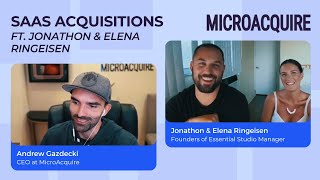
Jonathon and Elena Ringeisen built Essential Studio Manager, a CRM for photographers, and sold it through Microacquire. They walk through how the acquisition happened, what they learned building the business, and advice for founders considering a sale.
Foreign.
I am here with John Ring Eisen, who recently got Micro acquired. John, so great to have you on the podcast. How you doing?
Great, man. How are you?
Good, Neil. So I have a guest with you as well. Do you two want to maybe take a second and introduce yourself? For those listening.
I'm Elena, John's life. And over the past couple years we've kind of built things together and I handle more like the idea behind it and then he builds it. So that's kind of what we've done.
Yep. And I'm a software engineer, self taught, didn't go to college. I bootstrapped a business together and we sold it on Microfar.
That is amazing. This might be my favorite podcast. And we're two minutes into it. So you guys recently had a business acquired. It was Essential Studio Manager, is that correct? Awesome. And did you two build that together?
We did. So I do all the coding and build everything by myself and then she does all the marketing and all the other stuff.
That's so awesome. That's. I mean, you need someone to build the product, you need someone to market and sell the product. So it seems like you two make a great pair. For those who maybe might not know what, what does Essential Studio Manager do? What was the problem it was solving?
So it's a CRM for photographers, specifically.
Nice.
It basically helped photographers manage their business via invoicing, managing their clients, booking session, basically any aspect of a photographer's business that allowed you to manage it.
Awesome. I love those types of businesses. You kind of caught me up. Garden CRM for photographers because it's so clear, crisp, understandable, no jargon.
Yeah.
Um, I can already, you know, think of, you know, pain points that photographers have where maybe something like Salesforce or the hundred other CRMs might not fit. But tell me about your, your experience on Microquire. So you list on Microquire, how did, how did things go with buyers? What was the reach out like? Maybe we'll start there and then I'll have some more questions after that.
Yeah, it was good. I listed it and we did get a handful of people that would like, reach out, but then it would be crickets and we didn't hear anything. Um, but I would say there was probably more people that responded than we got crickets from. Um, and then it was listed for two weeks. Yeah, two or three weeks. And we had an individual contact us and within another two weeks it was acquired.
Wow, that's pretty fast. So two weeks from. From meeting the buyer to close. Nice. Can you walk Me through just due diligence or let's go. So how did you know that this was the right buyer? How did you. You know, there's people that reach out, they say something, we're interested, they go away. How did you kind of narrow in on this one buyer as the one to acquire your business?
So we got to talking about what his plans were with the company because we. We really didn't want to, like, sell it and then, like, someone acquire the customers and then scrap the company or the intellectual property, like the website and stuff. So he was coming on board or he was acquiring the company to merge with a company that he's built. So they kind of benefited each other, and so that was the main reason why he was acquiring it. And he kind of liked that, again, idea, and so we decided to go with him.
Nice. It's always nice when you, you know, sell to a buyer that will kind of take what you, I assume, spends a lot of, you know, blood, sweat, and hopefully not too many tears building. And, you know, you get to see it continue to grow. So you, you find the buyer. What was, what was due diligence like for you? Can you walk me through just kind of like the initial steps? What was requested? How did you handle that?
Yeah, so he, he sent a contract. I now keep in mind, I've never sold a company before. And before I found Microacquire, I was like, crap, how are we gonna. How. How are we gonna sell this? Like, I don't know anybody. I don't network. So it's. I didn't know the first step when it came to acquiring or selling a company. So I stumbled across Michael Acquire and he sent us a contract. We read the contract, and then I have a. A friend that's a. A lawyer. So a friend of a friend that's a lawyer. And so we sent the contract to him so that he could look it over. And it was a short contract. It was like. I think it was like two, three pages. And so he looked it over and he was cool with it. And so we signed it. It was good.
Very nice. And then in terms of, you know, transferring, you know, the assets and all that fun stuff. Any advice for other founders as you're going through that as you transfer? Like the website, the actual soft.
Yeah. So when I built the esm, I didn't build it with the idea of being acquired. So the one thing that I would tell people is if, if you're going to build something, I would, from the get go, try to keep it all in one, like, keep everything together and don't mix it with, like, other companies. So, for instance, I have Amazon aws, and I have one account where I keep all my. My buckets to store files in, which includes the one for the esm. So now I have to go and create another account for the ESM and then create a new bucket and then transfer all that data, whereas if I created its own account initially, I wouldn't have this issue. So, I mean, it's really not that big of a deal. It's pretty simple to do, but I would just recommend keeping everything together, like, separated from other assets.
Nice. And then, so now that you've been through, you know, the acquisition process before, if you had to give any advice to sellers looking to get acquired, what are like, maybe three big learnings that you kind of learned along the way?
That's a tough one. So, one, not to toot your horn, but I would say get listed on Microacquire. Two, networking is probably another big one, because the more people, you know, the more people that you can talk to and communicate that you're trying to sell your company with, and you can have better chances of selling your company. And number three, I would say be.
Optimistic in the process. I think, like, when you list your company or anything, trying to get fired, it's so easy to be like, oh, who's gonna. Who's gonna be injured in this? And then we were super surprised that someone found it, you know, it was the right person. So we have talked to multiple. Sometimes you just find that perfect fit for it. So I think being optimistic in the whole process is also.
I like that. I like both of those a lot, especially the just being optimistic and also patient because sometimes, you know, I hear of startups being acquired in two weeks, sometimes six months, sometimes a year.
Yeah.
You know, in my personal experience, it did not take two weeks for me to sell businesses. So just being optimistic and, you know, really just being patient in terms of finding that right buyer, because you never know when they're going to come along and then obviously during that time, continuing to focus on your business. So I guess. So you. You successfully sold the business. What are you guys working on now? I got. I got kind of a feeling you guys already have something that you've been working on.
Yeah. So to give you a little backstory, we created. My wife created. Created a company back in 2012, I think it was, and in the peak we were making roughly we were grossing 600,000 a year with that company and that company. So there were a couple issues that happened. There was some piracy going on. So now that company doesn't generate that much revenue. So we kind of pivoted and she created a, a, a like a product of that company and started bringing in. So it's a subscription model and she started bringing in revenue with that. And then I was like, why don't we build its own standalone subscription based platform? And so we ended up doing that. That's called Wordsmith. So it's use wordsmith.com and it's basically captions for like small businesses or really anybody to basically use for their social media platform.
Nice. So you've been operating that business for about a decade.
So the, that's like the, the main.
Company is like we kind of start new things underneath that main company. But since the old products were kind of stolen and posted online, we've kind of had to pivot away from those products and figure out, okay, what else can we do with it. So the main company is still open, but underneath it I'm kind of launching like new businesses within that and kind of focusing on what's taking off and what's doing well. So, so Wordsmith is one of them right now. And then I have a couple other ideas.
So yeah, we got a few things we're working on.
That's awesome. I love how you two, you know, complement each other's skill sets. That's sometimes, you know, really what it takes to build a business. Unless you could somehow do both, which is very rare. Yeah, I guess, you know, just to kind of wrap things up. It sounds like you guys have been, you know, entrepreneurs for so long, a decade. If you had to give just general advice to maybe people, you know, looking to get started building a business. What are some main things that you guys have learned or think about often or perspectives you have to be able to create these successful businesses over and over.
I would say for me, the biggest thing as an entrepreneur is to try and solve a problem for someone. I think everything I've launched has always been with the focus of, okay, this is something that I need for my business or as, or as a photographer. And if you build a product that serves something for yourself and solves a problem, there's going to be other people that have that same problem. So sometimes it can be something really simple like social media accounts. But knowing how time consuming it is to create content all the time for your business or social media and really connect to the ideal clients that you want to connect with online, it's crazy how quickly that took Off. And I think, in general, just kind of keeping an open mind when you're building things and solve a problem for it versus trying to come up with something where you see lots of money or you see a lot of attention because other people are doing it. I think solving a problem is, like, number one for me and has always been kind of like, at the core of everything that I build. Most important thing for us.
Yeah. And I would say also to new entrepreneurs to just. Just be persistent, just work hard. And, like, one of the things is that you're not always going to know the answers. And it's a learning process throughout the entire journey. I mean, we're learning all the time, and we rarely know the answers. Have we. Have. We learned a lot, and we use those things that we've learned, of course, but we always run into roadblocks and, you know, it's always a learning experience.
Yeah, that's. That's great advice. I mean, a lot of. I can see a lot of entrepreneurs. I do see a lot of entrepreneurs often building products that don't really solve a problem for, you know, maybe I think the. The. The biggest one is, you know, you may have a problem, but you want to make sure you validate that other people have that same problem. You know, it's a big misconception that I run into and give advice on is, you know, it's good to scratch your own itch, but you want to make sure other people have that same problem. Otherwise, you know, and then, you know, validate it as quickly as possible so you don't spend six months or a year building something that people still want. And then, yeah, persistence. It. You know, people think it takes a year or two to build a successful startup, and sometimes it does, but more often than not, it. You know, it's. It's. It's a journey and a ride. So. Great advice, I guess. You know, I've been asking this question on podcasts, but you guys are actually on an island, so I've been asking, if you could bring just one book and one album. Music album on an island, what would it be? But you guys are in Hawaii on an island, so I don't know how this question's gonna go, but if either of you could bring just, like one book or one album to listen to on an island, what would it be?
That's so tough.
I know. There's so many books. The first one that comes to mind for me is the 10x rule by.
Grant do the same thing.
So you're both. You're both bringing the same book.
And then music. I don't know. It would probably be something I've been listening to lately a lot. Is. What is that song? It's Dirt Road. Yeah. Yeah.
I don't know. It's some country. Country song?
Yeah, it's a country song. Dang, I forgot that. But it's something about finding. Buying dirt.
All right, well, there we have it. Well, thanks so much for joining this podcast. It's been wonderful chatting with you, and congrats again on getting micro acquired.
Yeah, anytime. Thank you.
All right, well, cheers. Enjoy your time on the island, and thanks again for chatting with me today.
More from Andrew



The Buyers Who Made the Move: What They Bought, How They Did It, and What Happened Next






