SaaS Acquisition Stories w/ Kieran Parker - Founder of Heeed
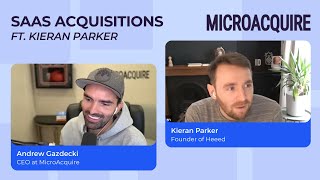
This is a YouTube video titled "SaaS Acquisition Stories w/ Kieran Parker - Founder of Heeed" containing an English podcast-style interview recorded in May 2022. The conversation features Andrew Gazdecki interviewing Kieran Parker, founder of Simple Kits, about his experience selling his product on MicroAcquire, the acquisition process, and his new projects. The discussion covers transparency in deals, advice for founders looking to sell, and insights into product development and entrepreneurship.
All right. I am super excited to have Kieran, the founder of Simple Kits, here with me today, who recently got Micro acquired. Kieran, thanks for joining the podcast with me.
Yeah, yeah, it's good to be here.
So before we dive into stuff, for those that are listening, do you want to maybe give an overview of what symbol Kits does?
Yeah, yeah. So Simple Kits is essentially a design system UI kit. They're quite popular at the moment. So the unique selling point of Simple Kits was essentially to just be as simple as possible. We can dive a little bit more into the issues with simple with design systems as we go on, but essentially I like to think of it as the Lego blocks of UI kits for design systems.
Very nice.
And so you listed on microquire and I assume you had quite a few buyers reach out, is that correct?
Yeah, yeah, I think I was getting. I actually listed it twice. I think I listed it, took it off because I was a bit disheartened when I listed it again. I had a lot of people interested. I think there was some confusion, maybe it was on my behalf as to what it was. A lot of people were asking me, and when I was like, oh, it's, you know, a design system file that you sell, you know, to typically designers or indie makers, they would kind of maybe lose interest most of the time. So I got, yeah, I got a lot of people messaging me, asking me loads of questions. And it turns out I think I had it listed for four months or something and was just passively getting messages.
Nice.
And how did you end up finding the buyer that eventually acquired the business?
Yeah, so he actually messaged me on microacquire and I didn't notice that I had a message from him. So he emailed me because he was quite eager to learn more about it. So he dropped me an email saying, hey, messed you on Micro Acquire. Haven't heard anything back. So I wanted to get in touch by email. Interested, tell me more sort of thing.
Nice.
And so at that point, I assume you start negotiating, you know, how this acquisition is going to work out. What's some of the learnings that you gained going through this acquisition process on microquire?
Yeah, I think the main thing for me was transparency, both from my end and the other person's end. You want that sort of gut feeling, right, that they're not trying to hide anything, they're not going to. Especially as a seller. My concern was they get all the products, all the information, the documents, the logins and all that, and then just sort of disappear or don't send the money or whatever it is. This guy was really upfront with me. You know, the exchange was actually very quick. He just asked me, you know, what's the revenue? Have you got proof of it? Proof of sales? What does it include? Like, what are you selling? Does it include socials? And we actually went from introduction to sale, I think been 48 hours.
Oh, wow.
Which was nice and quick. Yeah, nice.
Did you guys use like an escrow service or anything?
No, he paid me through transferwise. So he actually was probably one of the most trusting buyers. He actually, it was just before, I think it was New Year's Eve or the day before New Year's Eve that we sort of started talking. And he said, well, look, I'm gonna. I'm going away for New Year's. I'm gonna send you the money now, and you just send me it when you wake up. Because this was like one in the morning for me and it was midday for him, wherever he was located. So he sent me the money actually and said, just send me all the details and I'll get sold when I get back.
Nice.
So that was pretty nice, really.
So. So one thing I gotta recommend is for. For most deals, we highly recommend an escrow service because it protects you and the buyer is. Specifically the buyer. So, you know, using an escrow service, you would basically put the money in a, you know, third party, third party's hands, and then you transfer the assets and then you get. But I'm glad it all worked out, but I just wanted to add that tidbit for others listening is always use an escrow system because you never know what could happen. I mean, the buyer, if you weren't such a good person, you could have just walked with the money. Oh, yeah, Yeah.
I mean, he could have been burned. I mean, I'm sure there's ways. I'm not sort of against it. I'm sure there's ways he could have maybe got his money back or whatever. But I think what made me kind of not worry too much is it wasn't a huge amount of money. Right. Like, money is money. So the higher you get, the more risk you have.
Right? Yeah.
So I don't know. Maybe I am too trusting. Maybe. Yeah, use an escrow. Might be a good idea for next time.
Yeah. Well, I'm glad you found a buyer that you trusted enough to do an acquisition like that. I guess, you know, for other founders that might be looking to, you know, sell their company on microcore. What. What are like three pieces of advice you would give them?
It's a good question. I think the main ones, one that I just said, which would be transparency, just, you know, there's no point hiding any information. It's just going to waste you and there's yours and theirs time. You know, there's no point pretending that you've made more or sold more or done more with something. I mean if they're going to buy it, they're going to get all the information anyway, right? I think that'd be my top one. I think the second one as well would be. For me it was important to sell it to someone as you know, my sort of passion project for about a year or so. So for me it was important to sell it to someone who kind of understood what it was and where they wanted to take it. Uh, because this, this one was actually quite tied quite tightly to me and my social. So I don't want them to, you know, start spamming all my previous buyers or spamming the social and I start getting a bad name sort of thing. So I wouldn't, you know, you can't really protect against that too much. But he showed good intent, I guess. Um, and third, I mean I think it's just a case of just knowing your value, right? Like valuing your product nicely. Coming to a price that you both agree on or both are happy on comes a lot quicker when you know what it's worth.
Nice.
And then I guess so you've been successfully acquired. I have to assume you're working on something new. Have you, have you started a new project? It's just something every interview it's like you think you get acquired and you go and take a break but it's usually the opposite, you go right into another project. What are you working on now?
Oh, so many things. So I think my biggest one is a keeping it in a design system sort of area is a tool called Heed. And the idea is you post your typically landing page but any, any website page will do and it's a community driven feedback tool, right. So you know, there's incentives for others to leave feedback on your, on your designs and those incentives, you know, hopefully help them get jobs or get contracts, whatever it is, whilst also helping the individuals improve their designs. That was something I sort of found quite popular on Indie hackers and my initial MVP proved quite, quite, quite done quite well. So I've actually partnered up. I've decided I need a developer to help me build this one. I've got another couple little things like law of 100. I'm working with Kuvio, a sort of design development agency to build, which should be launching Monday. Actually. It's a free tool, which is a free habit tool for the web. And yeah, there's so many. There's another one. I'm working with another developer friend of mine, which is. He had, he had one. It was developer challenges help you improve your front end development skills. And he was saying it'd be great if there was a design version of that. And there are design challenges out there, but this has kind of a unique spin. So I've been designing that recently and sharing some designs on my social and he's just started building it and he's very quick. So hopefully that'll be live soon as well. Um, they're the three top ones. I mean, there's always loads of little ones in the back of my mind as well that are half finished. Um, that's the sort of pain as a designer is it's quick to design, hard to build.
Right.
Nice.
So I guess, I mean, this is, this has been awesome. And congrats again on the successful acquisition. I love hearing these stories of, you know, you have a project that maybe, you know, you're no longer interested in, or you started working on another project and you're able to sell it to someone who could, you know, breathe new life into it and potentially grow it beyond, you know, where you were interested in growing it yourself. So huge congrats on that. I guess my final questions would be just kind of like rapid fire, you know, for those looking to, you know, build a product to be successfully acquired. Do you have like a sales or marketing or product book that you would recommend all entrepreneurs read? Oh.
I think for me, there's one that I've read recently which was the One thing or something I can't remember exactly what it's called. I'm pretty sure it's called the One Thing. As an individual who has all these product ideas, I typically feel very stretched, you know, stretched thin. And I'm always asking myself if I should, you know, double down on one thing and make one thing great rather than a lot of little things. And this book basically talks to that, you know, focusing on one thing at a time, one goal at a time, that sort of thing. That's the one I've already learned the most from recently.
Nice.
And then my next question would be for those looking to, you know, get acquired. So now they. They have a product, they built it. I totally agree with focusing on one thing rather than, I always say you want to be great at one thing rather than good at a bunch of other things. Is there, is there any, like, resources or blogs or podcasts that you checked out to learn about, like, the acquisition process that you'd recommend?
Not, not necessarily the acquisition process. I think listening to the Micro Choir podcast and people on the other end, it's interesting to see what they sort of look for. So it's good to learn from what they're looking for into how you can sell your. Your product. It was also just a lot of research, you know, research into products that are listed and ones that catch your attention. Other sites. I remember a long time ago there used to be a site called Flippa or something which, which was a bit weird, but it was just another resource for, I guess, selling websites or something. I don't know what it was. It wasn't. Wasn't amazing. I think to sum it up, the best advice would just be to sort of look for inspiration in similar places. Right.
I love that. Yeah. I mean, inspiration, I mean, can come from anywhere, like Twitter, indie hackers, podcasts like this, which I greatly appreciate you joining. And then my final question is just who's your favorite entrepreneur, if you have one? Or it could be a startup favorite entrepreneur or startup.
I don't know. I think Peter Levels, I think is. How you say his second name. I think that's kind of a common one a lot. He's very well known. Just getting stuff done quick and dirty. An up and coming one would be Jim Raptis on Twitter. He's a designer who builds, so he's quite inspirational to me. Um, you build stuff really quickly, very high quality. Um, yeah, probably those two. Don't think there's anyone else. Well, there are, but come to mind.
No, those are great answers. I know both those names and yeah, both stellar entrepreneurs, if anyone wants to, you know, reach out to you and just ask you questions about what you're currently working on, your acquisition process. What's the best way to. To get a hold of you?
Yeah, it's probably just on Twitter, to be honest. My handle is kprkr.
I'll put. I'll put that in the show. Yeah, so you can just click.
That's not the easiest to say.
Yeah, mine's a Gazdecky, which is also not. Good luck trying to spell that.
Yeah, Twitter is probably the best way. Second way would be my email, which is just through my website. Um, which. Which is on my Twitter as well, so.
Awesome.
Well, Karen, thanks so much for joining me on this podcast. Congrats again on getting micro required. I'm. I'm rooting for you, man. So hope to keep in touch and thanks for your time.
Yeah, yeah, I appreciate it. Thank you.
All right. Cheers.
Cheers.
More from Andrew



The Buyers Who Made the Move: What They Bought, How They Did It, and What Happened Next






