SaaS Acquisition Stories w/ Sujan Patel - Managing Director at Ramp Ventures
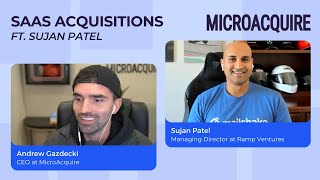
This is a YouTube video titled "SaaS Acquisition Stories w/ Sujan Patel - Managing Director at Ramp Ventures" containing an English podcast-style interview recorded in March 2022. The conversation features Sujan Patel, managing partner at Ramp Ventures and co-founder of Mailshake, discussing his experience with SaaS acquisitions, business growth strategies, valuation advice for founders, and personal interests such as cars. The interviewer engages Sujan in a detailed discussion about his acquisition criteria, favorite deals, market trends, and entrepreneurial insights. The content is a single-speaker interview rather than a multi-speaker conversation involving Andrew Gazdecki.
Foreign.
I am here with the man, the myth, the legend, Sujan Patel. He is the managing partner at Ram Ventures. Sujin, thanks so much for joining me on this podcast.
Yeah, thanks for having me. Pumped to talk to you.
So, Sujin, you got so much going on, I don't know how you do it. You're the co founder of Mailshake. You've acquired multiple companies. Do you want to maybe kick it off by just giving listeners just background on yourself and maybe some track record of Ramp Ventures and Milkshake and just all the data for sure.
So today, Ramp Ventures has four main properties with a couple other acquisitions and companies. Inside of those properties, we've got Mailshake, Voila, Norbert Write Inbox, and Zoom Shift. In the past, I would say like eight years, I've acquired 13 businesses. I've sold, I think five or six. I forgot the exact number. Now things are just moving fast every day. We've got about 75, 76 employees at the moment all around the world. Between those four organizations, each company is run independently. And a little bit how we're different than some other firms out there is that we don't have a CEO for each company. We actually, my partner and I are kind of the co CEO or like CEO, coo. I kind of break up. What we do is more of like, I'm more of the vision and customer kind of acquisition, whether it be sales, marketing, customer success. And then my partner is more of the ops and finance of things. So think about his role as, like, I want to go do all these things with the businesses where I think it can go. He helps make sure it's financially viable business and, you know, helping make sure we have all the resources needed to get there.
That's cool. I like that a term that comes to mind. It was a piece of advice on, like, the difference between like a CEO and like a CEO is like the CEO looks outward and the CEO looks inward at the business. So it sounds like you got that.
Kind of, kind of close. Yeah, I think in some cases we're both the CEO. In some cases, both the CEO. You know, we kind of share these roles. But, you know, he and I have different brains. Like, we work. We have. He's got very much analytical, financial brain. I've got a creative, you know, who cares about limitations and the numbers. The numbers will add up. I'm sure he will figure it out. Right. And it's like, how do they. How do I get these numbers to work? How do I achieve whatever result? So it's Interesting dynamic. And yeah, so we've been doing this for the last, since 2015. So I, I would say before micro PE purchases were cool, before microacquire existed, our life was a lot harder. These days we just kind of sit back and hang out and wait for your emails to kick in. Currently, yeah. Again because we don't have a CEO. We don't just deploy capital and go. We are operators. I like being that seat. I'm not a professional investor. I do some angel investing but I love operating businesses. That's fun to me. See how the sauce is made and making the sauce is the fun part and money a long way.
You're an OG man in terms of acquisitions. I guess my next question would be so with Ramp Ventures, do you have a perfect startup that you would want to acquire or what sort of criteria do you look at? Is it B2B only? Is it SaaS only? Are you, is it tech stack? Can you just give details on like if you get an email or you come across something on my require that has like this, this, this, you're like I'm on it.
Yeah. So I'd say our core focus, we only buy companies that are B2B SaaS. That's like the only thing we do. And I, I don't, I didn't have an exclusion list. We don't really sell. We don't really. Companies that sell to E Commerce owners. Nothing against that. It's just we have carved what we know we're good at and we stick to that. And then our sub requirement is really. So ideally in a perfect world we're looking at 1 to $5 million ARR companies that are in B2B SaaS. Everything else will kind of look at the details unless they sell to E Commerce. So no Shopify and no WordPress for the most part. And again like those businesses have slightly different economics and business models and valuations and we just, we don't really play with that space. The other exception is unless they're strategic to any of our four properties and we've bought, you know, we've bought probably one or two companies at each of those. Each of our properties, we typically do that. You know we're looking at one right now actually just signed an loi. So you know we're doing those small tuck in acquisitions all the time where like revenue is not the most important factor. It might be a strategic feature or functionality.
I like that that's a big advantage for you because you have so many successful companies serving I assume like a similar Customer being sales. So you can buy products and grow through acquisition, essentially.
Yeah, exactly. So, you know, that's not. That's not my favorite way to grow. Like, in the finance guys, we call it inorganic growth, you know. Yeah, exactly. The most inorganic growth you can think of. You buy your revenue. But, I mean, I do think that actually ends up working out. We bought, like, a company last year called Warm Up. Got your email, found a microacquire loi. Like, it had been out for, like, maybe six months. Didn't really have a big trail track record. And I would say from a. If this was not going into Mailshake, that was a company that bought it, I would say it's too small. It's like not. Not long enough of a track record. But I was like, oh, this is something that we're building. And so it's a build versus buy decision. And so we'll buy anytime. We'll always buy versus build because it gives us speed. And then, you know, we can update. But anyways, we literally gave it away for free to mailshade customers. And, like, did we update the product? We did no marketing on the property. We just kept it as is and we tripled revenue from it. Right. So, like, that's the best. Like, that's the best. I would say my favorite type of acquisitions are like, the ones that one plus one equals five. Right?
Yeah. It's like, you got a good company.
Yeah, exactly. We've got a good company. The properties, you know, company's good, functionality is great. We make sure there's always improvements and stuff. And then, like, those two companies together are just worth more than they are apart, and they help feed each other. So, yeah, Yeah.
I like how you're able to add, you know, you know, some strategic growth to the companies that you acquire just through your existing properties. That's badass. I guess the next thing I'd love to get just your take on. So I'm sure you look at a ton of deals, you talk to a ton of founders in terms of selling their business. If you had to give like, two top tips for founders looking to sell their business within the next year or two, what do you think it'd be?
Number one is have a realistic expectation of what your company is worth. Spend a lot of time to figure out what your actual company is worth, because it will avoid a lot of wasted time. It'll avoid a lot of emotional distress. So if I think my company's worth 20 million, but buyers think it's worth 5 million, I'm 15 million in the hole. Emotionally, like I'm just not going to get it right. Let's just say I talked to a bunch of buyers.
Welcome to my world, man.
Yeah, right.
We, we have to do that a lot. Where you know, you see companies raising at huge valuations and you know, with acquisitions you're paying for, you know, current execution when investing is, you know, you're really paying for future potential execution. Um, so totally agree with you on that. I'd say that's probably the number one reason a lot of companies don't sell Microquare is they overpriced and it just stops the conversation from. Because the gap is too big to close.
It's too big. Yeah. And, and, and that's actually, that was my first advice. And it's like I have a 1B on that, right? The 1B is like, don't look for funded companies to valuate your company. Look for private equity deals to valuate your company. The reason funded, like funding VC funding multiples are very different than exit multiples. They've always been different. And the second thing is on this particular topic is your company's not at scale. When you're at micro requirement, your company's on a scale. Unless you're at $10 million in revenue. I hate to break it to everybody here. That's the case. It's a fact. That's just what happens. There is no changing that fact. So when you're sub $10 million, your valuation is inherently different. It doesn't follow fully the public market definitely doesn't follow the public markets, it doesn't follow VC valuations and it doesn't follow exit valuations. And I think even the companies that are raising money now, if they were to sell right now, if it wasn't someone's strategic buying for something, again, they have a reason for it. They would not get the same valuation that they raised for. And so there's a decrease in valuation there. But the number two thing is spend a lot of time. Spend a month. So when you decide to sell, take the next 30 days to get everything in order to make your company sellable. What does that mean? You have an answer for all the questions you're going to get asked. What are questions you're going to get asked? Well, I think Microacquire has a good guide on that. I think you, when you walk, when you. The onboarding process will help you understand that. Take your time there. Have, spend some time getting a clean P and L. If you have add backs, okay, add some things Back, whatever. And if your numbers don't look good, great, that's okay. Now you know what you need to fix. Most buyers are looking at, you know, trailing 12 months or the last financial year or calendar year. And so let's say you invested a lot in R and D, but you don't really need to continue investing in R and D for the business to be what it is. Well, you might want to sell later on because that R and D right now you're going to go back and forth between is this an add back versus is this true cost? And so an add back would be things that you would add the cost right back into the P and L as like it's not a cost because it's not going to be happening ongoing. So, you know, having clean books I'd say is pretty, pretty easy to do, but I very, very rarely see it. So I look at about like 70 to 80 deals a month and I could tell like within two minutes, like who spent some time doing the right things and who didn't. Right. And I'm not even a finance guy.
I think another benefit of that, and I agree with you entirely, is it just shows that you're committed to selling your company as well. It's like I put time into this. I'm not just throwing it up with a crazy valuation. Yeah. Even just like if you have a lack of, if you don't have a full P now, even just like, you know, connecting metrics can go such a long way just to give like buyers, like just any sort of visibility into the financial health of your company, I think is key. So I agree with you entirely on that. Moving on to our next question. I'm really excited for this one. What has been your favorite acquisition? It doesn't have to be size or just the one that maybe you bought and you're just like, that was awesome. Or it worked out really well or.
Yeah. I think my favorite one was Voila Norbert. That was one of her.
I knew you were gonna say that one. It's such a good product.
Yeah. So it was, it was a, it was a fun one. Lots of learning from like, not that. Right. Not the areas I thought I'd get learnings from. So I think when we bought it, the business was probably doing like 8 to 10k in Mrr and I just loved it because I was like, oh my God, there's so much marketing and sales like levers here. Like, it's just all I have to do is like some conversion optimization and some, you know, a Little bit better marketing and boom, get more money instantly I think. And we almost like 3x in the first like year I think it was a little over 3x but like it was basic conversion rate optimization, like simple like button size color, like headline copy, simplifying the sign up and onboarding flow. So user activation, let's call it that, that was a huge factor that helped get more people through the door. Using it, that was the biggest hurdle. And then but the things I liked about the reason I liked it was like we learned about all like my business partner and I got a crash course and like the back end infrastructure of a business. So like at the time we bought it it was kind of a rocket ship and because we like we added, we, we optimized the flow so that more people go in and use it. The thing on the back end was right about to break. Like it was like breaking every day and you couldn't see it because like it just like break in the back end and you would see it, would fix it.
Quick question, what is for people who don't know, what does Norbert do?
I should probably say that, yeah, Walla. Norbert is an email finding tool and email verification. So if you've got someone's name and company, you can find an email address or if you've got email addresses or let's say you do you have a marketing, an email marketing newsletter or anything like that, you can run your emails through there to make sure that they're still valid. You know, get rid of the like the people who sign up on your fake email or like the people who have switched jobs and the email no longer exists. That can affect deliverability. Most commonly used by sales and recruiting firms. Right. So you're headhunting, you've got the people you want to go after. You're just looking for the email address. That's kind of the most common use case. Yeah, it was a fun, it was a fun, it was a fun project. In hindsight, right? Kyle's like holy crap, what do we buy?
That's like some complex software. That's why I wanted to let listeners know what it, what it is. I've used it, it's a great, it's a fantastic product. So anyone who needs help in that area, definitely check it out. Moving on to just the next question is, you know, last year was a pretty wild year just across the board for you know, startups, acquisitions, you know, startups looking to raise capital, bootstrapping, pretty much everything. Tech across the board. What's like one trend you're, you're really excited about for 2022.
I think just back to reality numbers and not necessarily just valuations, but like last year, last year and a half has just been everything. Everyone's been soaring high and whether it's sustainable or not will be proved out this coming year or next 12 to 18 months.
It's probably not.
I don't know that you mean it's not going to be sustainable.
Oh, I say that in the sense of, you know, markets are cyclical, they go up and they go down. I think, you know, there's been a lot of, I've seen a lot of acquisitions where I'm like, dang, you paid that. Whoa. Or you know, startups raising, you know, at a billion dollar valuation with, you know, 10 million in revenue or something like that. I think, you know things. Or maybe that's a new normal, I don't know.
Yeah, I think I have generally a little bit of a pessimistic view on that because if you look at the numbers, the number of VC deals that go public or get sold to PEs and the PE valuation of them, or like the companies that don't make it to the top that everyone else and they don't fail, they just don't, they don't become the market leader that have raised at like market leader prices. They end up as a founder and operator of that business, you end up not getting a whole lot for it. And so I think the VC game is great if you think you can win an industry, it's great if you're top three, it's bad for everyone else who doesn't become top three contender in that space. Right. So just because the valuations and the illiquidity about the deal and then the dilution that happens to shareholders, primarily the founders. So anyways, long story short, I do think the market will normalize this year. It's already had a bit of a correction and I think when I say normalize, I think it's been pretty stable. Buyers like myself have had a formula for how much we evaluate a company for a while, but the discrepancy between where the founders think it was and then the buyers is very high. Think it's going to go in the middle now or come back down a little bit more?
That would help my life a lot. Um, well, I got just, just three kind of quick questions I'd love to ask before we end this podcast. The first one, it's gotta be, dude, what's your favorite car, man?
Yeah, favorite car. I Mean, favorite car I've owned or favorite car just in general?
Both. I need both.
I mean favorite car I've owned is McLaren 600 LT. I mean just like a beast of a car. It feels like you're driving a race car behind me.
What's top speed you got in it?
One ninety, something like that. On the track.
On track. Okay, good. Yeah.
That's how you die on the highway. Yeah, yeah, no, I do most, I do mostly track driving or like kind of spirited back road stuff. But that's just hard to get to that speed in the road without, you know, without having impending death. Favorite car I think out there like driver's car, I would say a Ferrari 458. That's kind of something that's not the like it's like a 10 year old plus car but like just, it's like the last, last non turbo Ferrari. So.
Nice. So you, you, you're a naturally aspirated fan.
I just, you know I like, I like all types of cars. I'm, I'm not, I'm not pro or. And I, you know like the McLaren had, had was a turbo. Which one? Turbo. But there's a, there's a little bit of lag. I think the perfect mix would be turbo electric and you know. Oh, sorry, turbo and electric. Because the turbo, the, the electric portion would instantly spool the turbo. So removing the lag. I think BMWs, BMW and a few other manufacturers have kind of done a little bit of that. I think that's the future of these. Before all the electric, before electric cars fully take over 100% of new car production. We're going to see this turbo electric era. Turbo gas engine plus turbo plus electric. A small electric motor that's going to have the best of all worlds. That's my, that's my prediction for the car world.
Yeah. The funniest thing I think I've seen out of a car I recently drove, a BMW i8. You know the one with doors are going this. And it has a sound. It doesn't make any sound, but it has like a speaker in the car. Yeah, like a fake engine sound like it's like what the heck is this?
All BMW M cars have that. It's really weird. Really?
I thought it was. Yeah, I was in it. Cause I just sometimes me and my buddies, we go on Turo and we'll just like rent a car and that's.
The best bang for your buck. That's such, that's such a underrated thing, my friend. Just.
Yeah, I'll throw out a tip just for people. Like, for me, it's been a fun way to just catch up with friends where I'll either pick them up from the airport, like, just because you're in a car together, like so you got to talk to each other. But we'll rent cars and then we'll just go drive it somewhere and then we split the cost. So you can rent a Ferrari for like 300 bucks and 150 each. We rent like R8, but. Fastest car I've ever driven. I don't know about you, actually. I want to know what is the fastest car you've ever driven. It might be your McLaren. That's insane.
I drove like a formula two car.
Oh, man.
Formula three.
You like cheating track?
Yeah. No, that thing is like. It's like scary. It's scary fast. I just like, I don't. I can't describe it fully, but you're like, if, if you ever. Anyone watch F1, the race car drivers are laying down. They're practically laying down with their knees like bent up and they're pressing it. You can't drive a car laying down. It's just like. It's just so weird of an experience. And so by default, everything feels like a thousand times faster and scarier and you feel everything and like in. In a lot of different parts of your body, let's put it that way. Like you just kind of feel like you can't just like feel something anyways. But that was a lot of fun, I don't think. I don't think it's any faster than my McLaren that I had, but it felt like it was, you know, it was night and day difference.
Me and. Me and a buddy rented an Audi R8, and it was an older one. It was. It kind of felt like driving around with a guy who doesn't know how to drive manual. And you're really jerky.
Oh, yeah, the old single clutch ones. Yeah. Oh, my God. Yeah.
Yeah. Good looking car. We just kind of got it because of probably Iron man, but we. So we stopped by the Tesla dealership and test drove one of their cars. This is the fastest car I've ever experienced in my life. I'm.
I'm.
I like engines. I like exhaust and stuff like that. Um, but I don't know if you've ever test. Have you just driven a Tesla before?
Yeah, I've had a couple. Yeah. They're really fast. The. The ludicrous. I haven't, I haven't driven the newest, like plaid version of it. Yeah, we.
We just say in and out. And so we were like.
After that.
Yeah. And so we find, like, a straightaway to do Ludicrous Mode. And literally, it was so fast. Like, I. I had to, like, step out of the car. I almost threw up.
I was like, yeah, it's fast. Yeah.
I was not expecting that.
Well, also, the part about electric cars is that they're instant, like, power. And so it's just, like, doesn't, like, linearly grow. Like a gas car.
I couldn't believe it. I was like, like, completely through my head.
Roller coaster. Yeah. Yeah.
It literally does feel like a roller coaster, but. Okay, second question. Who would you say, you know, one of your favorite entrepreneurs is?
I know it's a little cliche, but I like Musk.
He came out big this weekend. You see that?
Yeah. It's just like, hey, stop going. Who cares about Mars? Help me with my problem right now. Boom. Done. What's next?
He literally. They're like, hey, can you help us out in Ukraine? We need Internet via your satellites. And he's like, done.
Yeah. Like three hours. Three hours later. And I shipped you a bunch of hardware. You know, it's. It's. It'll get there. Yeah, it's just cool.
He's a badass. All right, final question. Maybe best book you've read in the last year.
But I'll give you. I don't. I don't know. I've read too many books in the last 12 months.
Just favorite book in general works, too.
Good book for microcard customers. Built to Sell Life. Like, great, great book, Bo.
Something I forgot, but I think John Willows wrote that.
Okay. You know what? I might be thinking of? Finish Big. That's probably what I'm looking. Thinking about. Finish Big. Bo Something here. I'm going to pull it up, but it's a great book on really just on building a business that you can sell and how to, like, examples and stories of others who've done it and what they. Yeah, John, you're right. Built to Sell is different. I meant Finish Big by Bo Burlingham. And that book is just all about, like, examples of other companies selling their businesses. And, like, it's not just, like, the financial gain, about the emotional thing. Like, I had a friend recently sell her company about two years ago, $50 million, and you're like, oh, my God, that's crazy. That's awesome. What do you do next? Exactly. That was the problem. Like, how do you feel? One, how do you do it bigger next time? And two, what do you actually do next, like for the next five years. And the emotional, like the emotions around what you do next are a lot. And so like preparing yourself for that and it's the end. The answer is not just sit on the beach forever. Right. Because as entrepreneurs, you can only do that for so long.
Yeah, I actually, you know, kind of went through something like that when I sold my first company, Business Apps. Cause my transition was 90 days and then, then I was out, like I was not needed. Email, and then I'm playing Madden all day. And it. Yeah, it's one of those things where you got to go through it to understand it, but then you learn more about yourself because you just realize, like, I just like building and then you go back to building. So.
Yeah.
Yeah. Having a plan in place, like, what do you like? Have you thought about what you're going to do next? Cause, yeah, the beach thing kind of gets old, at least for me. But this has been great. Susan, I really appreciate your time and just you sharing all this. If people, you know, have a business, they want to get a hold of you, maybe they think it's a fit. What's the best way to get a hold of you?
Yeah, best place is my website, susanpatel.com and I kind of share a lot of helpful articles. So if you're hiring or like growing your business too, there's a bunch of stuff on, like just how to hire folks and scale up.
Right on. Well, Susan, you're a badass. Appreciate your time and really enjoyed this podcast man.
Yeah, thanks for having me. It's been fun.
All right, cheers.
Yeah.
More from Andrew



The Buyers Who Made the Move: What They Bought, How They Did It, and What Happened Next






