SaaS Acquisition Stories w/ Syed Balkhi- Founder and CEO of Awesome Motive
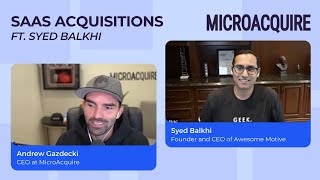
This is a YouTube video titled "SaaS Acquisition Stories w/ Syed Balkhi- Founder and CEO of Awesome Motive" containing an English podcast-style interview recorded in June 2022. The conversation features Andrew Gazdecki interviewing Syed Balkhi about his company Awesome Motive, its acquisitions, and advice for startup founders. The discussion covers topics such as acquisition strategies, company growth, and entrepreneurial insights.
Foreign.
I am here with Ced from Awesome Motive. I'm super excited about this one. I've been a big fan of Cead and everything that he's doing. So Siad, thanks for joining me on this podcast, man.
Thanks, David. Good. Good to be here. Thank you for having me.
So, to. So to kick things off, we. Do you want to give some background on Osimotive and just kind of what the firm is, what it does, how it works?
Yeah. Osimotive is a. Is my baby. I started this company with a where we build and buy software to help small businesses grow and compete with the big guys. And over the years, over the last decade have built a portfolio of companies and WordPress space, specifically some in the SaaS space and collectively are now powering over 20 million websites.
20 million websites? Are you serious?
Yeah.
Dang. Well, congrats on that. That's a few. That's a good start. My next question would be, I know you've acquired multiple companies. How many companies have you acquired up to this date?
We have over 30 different brands across the automotive bra.
Nice. So how did you get into this? So, you know, there's a lot of people buying, you know, SaaS businesses today, but you're kind of like One of the OGs that was doing this before. I think everyone else jumped in. How did you get started and if possible, maybe what was the first acquisition and how did it go?
Yeah, sure. So a lot of people may know me from my blog called WPBeginner where we create helpful WordPress tutorials to help non techie people make their websites. And that's how we got started. We saw and we were working with so many different plugins and SaaS companies and we always had unique insights to share with those software developers and founders. And then one day decided that I think we can do a better job at that with the insights that we had. First acquisition was a slider and photography solution Soliloquy and Envira Gallery and they focus primarily on the WordPress market. I found it through basically the co founder or founder of that company ended up becoming my co founder and optinmonster. His name is Thomas Griffin and he, he approached me at a WordCamp which is like, you know, WordPress specific conferences I believe it was in Atlanta. And he said, I see that you promote competitor X. I am building a killer for of that product. And I said okay, well whenever you're done, ready, come, come talk to me and we'll help you promote it. And. And then he disappeared. He launched the Product and then, you know, I mean, I never, I forgot. And then we later reconnected and ended up rolling that business in and that kind of gave it a start. And then since then we've been doing quite a bit.
That's awesome. I love how you play the long game of founders. I've heard this a few times from you where I can't remember what acquisition it was, but you had previously met the founder, so I love hearing that. My next question would just be, how do you evaluate startups? I know you alluded to specific focus on WordPress, but can you dive a little bit more into that? Like, you know, if you had to, maybe. This is kind of a harder question, but what's like a perfect fit for awesome motive? You could just like this is, you know, the exact startup I want to acquire. Size, market type, what would that look like?
Sure. So, you know, we look at a value chain. We have many different solutions that provide across the different value chain journey for the user, from landing pages to analytics to forms and so on. So we look at this user journey and see where the gaps are. For us, the perfect acquisition and software is something that fits along this line because one of our strengths is the size of our sheer network at this point. So that for us is above and beyond anything. In terms of what we look for, in terms of how we evaluate that is fairly standard. We look at where the revenue is, where the EBITDA is, what's your growth rate year over year, what's your churn? Those standard metrics are what we're using. But for us it has to be a fit into our portfolio. We're not just going to go out of our way and buy something on completely this end of the spectrum. That's software that might just only be serving 30 enterprise customers.
Yeah. I love how your approach is strategic in a sense that you've built such a strong distribution channel and then when you acquire the companies, you improve them and make that they. You take them a little bit farther than they may have gone with the original founder. So that's awesome. This, this might be a hard question, but if you could only look at one metric when acquiring a company, what would it be? Just one metric.
Probably net revenue retention.
That's a good answer. Most say churn, but I like that one. That definitely is, Yeah, a good.
Factors all of it in.
Yeah. Someone recently told me like, basically, I don't know if you would agree with this, but a good question asked is what would happen to your business if you doubled the prices which kind of shows how Churn would be affected and also net revenue retention. So I like that. So we're moving into 2022. The year's just flown by, it's already April. But there's a lot of founders looking to sell their business. And I know you probably look at a lot of businesses. If you had to give just one or two pieces of advice to founders looking to potentially get acquired, what would that be?
I've been on the founders. You. I'm a founder myself, so I've gone through this journey myself a few times and I'll say to one, know exactly what you're looking for. Right. Oftentimes when founders enter this selling cycle, they're still unsure about do they want a clean exit, do they want and are now terms where they want to stay around for three years and so on. Like, you know, don't, like, don't have this debate. I know what you're really looking for in life. Otherwise keep holding, hold on to your business. Don't sell it if you're unsure. So that's my number one advice, is to know what you really, really want. And I think that ends up being a better life, life decision long term.
I think that's a really good one because, you know, there's so many startup founders that start companies and they, they don't think about their outcome. And I think the best example is you raise a bunch of venture capital, but really maybe you would have been happy with a 3, 4, 5 million dollars exit, which is a large sum of money, but you feel like you need to build this billion dollar business when really that would have made you happy or that's really just your goal. I say that often.
You know what I find? What I find that's interesting, Andrew, is that a founder may, you know, when there's lack of clarity, you may take a business to market and you know, I mean, let's say you using microacquire, then they're already at the top 1, 1%. But if they try to go and run a traditional process and let's say they didn't get what they wanted because they were actually unsure of what they wanted in this period. A lot of times founders lose the love that they had for their own business and they, and then I've seen this happen way too many times. And I think knowing what you want ensures that you have a successful exit and you're not back to running the business and not with you being 110% in there because that negatively impacts the business. And I've seen that where we acquired something on the second go round and the business was worse than where it was in the first go around.
That's some good advice. Now I want to know, so you've been through. I love how you know, you. The way that you acquire businesses, you do it through the lens of an entrepreneur and so you understand what it's like to go through an acquisition as an entrepreneur. It's very, you know, emotional process. And also I'm, you know, assuming you've worked with a lot of founders that you kind of have to explain how the acquisition process goes. So I'm just curious, what's your favorite acquisition because you've created life changing outcomes for so many entrepreneurs. Is there one that kind of sticks out that just your favorite acquisition?
That's really broad, but yeah, that's a tough one. We've been doing acquisitions for quite some time now and we've had just about every single one have turned out quite well. I would say the one, one of the ones that we recently did about beginning of 2020, it was called all in One SEO. And I'm still very, very excited about that because we use that tool internally on all of our businesses. Just the innovation that the team has been able to do since the acquisition is quite exciting and what's coming next is very, very exciting as well. So I wouldn't say it's my like, you know, favorite is tough, but I would say this is the one I'm super excited about that we've done in maybe in the last two years or so.
Nice. Yeah, it's kind of like asking like, what's your, who's your favorite child? I guess my, my, my last question is just to kind of keep this quick is, you know, a lot of founders, you know, probably look at you and you know, see that you're, you're successful. But I know your story. You. When did you start WPbeginning?
That was 2009 when I started the blog. I was using WordPress and kind of in the community since 2006.
So you've been doing this for two decades. So that's just two decades of just, you know, great work compounding, you know, if you were just giving advice for founders, you know, looking to achieve kind of what you've achieved with your businesses, what would, what would you tell them?
You know, I think you just have to be good, consistently good for a long period of time to build something great.
I think you're living proof of that.
And I think, you know, a lot of Times, you know, if you really believe in the mission that you're serving, like, you know, I really believe in the mission. Right. We want to help level the playing field for small businesses and we can see the impact that we're having. Right. And we're literally helping shape the web for billions of people worldwide. So it's important that if you believe in that, that, you know, just aim for consistency. You know, don't try to compare your story, your chapter one to chapter 28 of somebody else's story. Right. Look at you and where you yesterday and only, only have that as you versus you all the time. And as long as you stay that, that helps you stay motivated, that helps you continue to push forward, and you are consistently good for a long period of time. And then one day you realize, oh, man, this is awesome. What we built.
Yeah. I've always admired just, you know, your. Because you made a very early bet on WordPress and then you built so much around that. Uh, so again, consistency, patience, and just focus on, you know, a singular category can pay off. Um, so congrats on all that. Okay, so last, last two questions. These are ones I just always ask and. But who. Who's an entrepreneur that, that you admire? Um, I know you got two in the back. You. But let's say you. Let's say you had the opportunity to get lunch with one entrepreneur. Maybe you've already had lunch with this entrepreneur. Who would he or she be?
I mean, you kind of nailed it. I have two amazing figurines right behind me. The bust of Warren. Warren Buffett and Charlie Munger. I've religiously read their annual newsletters, biographies, books. So you know, those, those two guys, always nice.
So I guess you kind of maybe ruined my next question, which was what. What's. What's your favorite book? Or what's a book? What's a book you'd recommend? Every entrepreneur reads?
This is, this is probably not in everybody's reading list. Lesser known book, it's called Dundu Investor by Mohnish Pabrai. If you're an entrepreneur, you know, trying to make the same leap of investments, I would say Dundu Investor by Mohnish Pabrai, but otherwise Psychology of Money by Morgan Housel is one of the top ones in my list as of late. I even paid my brother to read it.
You paid your brother to read it?
Yes. Wow. That's. I think it's a book that every entrepreneur, kid, adult needs to read, you know, from. Just to understand like what. What's the psychology behind money? It's a corny title but it has lots of practical examples in there of just compounding, you know, something that we often take for granted, man. I have a list of books but another one I would say is Atomic Habits by James Claire because that determines your habits, determine where your outcomes.
Nice. Did your brother actually read the book when you paid him?
Yes, he did.
So this has been great sied I guess, you know, for entrepreneurs listening to this and maybe they have a business they want to reach out to you to potentially talk about getting acquired by your firm. What's the best way to get in contact with you?
Yeah, they can just shoot an email through awesomeotive.com or if they want to get me personally they can go to sayadbalki.com but most of the time it will get to the same place.
Right on. Well, thanks so much for your time and congrats on everything, man.
Thank you Andrew.
Cheers.
More from Andrew



The Buyers Who Made the Move: What They Bought, How They Did It, and What Happened Next






