SaaS Acquisition Stories w/ Tim Schmidbauer - Co-Founder of Inlytics
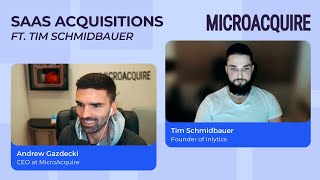
This is a YouTube video titled "SaaS Acquisition Stories w/ Tim Schmidbauer - Co-Founder of Inlytics" containing an English conversational interview recorded in June 2022. The discussion features Andrew Gazdecki interviewing Tim Schmidbauer about the journey of building and selling the LinkedIn analytics startup Inlytics, including insights on the acquisition process via Microacquire, buyer qualification, due diligence, and advice for startup founders looking to sell. The conversation also touches on Tim's future plans and networking opportunities.
Foreign.
I'm here with Tim from Olytics. I pronounce that correctly.
Yeah, absolutely. It's perfect.
We were chatting before this and recently got a mic required for five figures. So congrats on that.
Thank you.
Appreciate the time to kick things off. For those listening, tell me a little bit about what Alytics did and the problem that it was solving.
Analytics is LinkedIn based analytics platform for personal profiles with an attached scheduling tool. So what we were doing at the time is we started in 2020, we were figuring out, or I was figuring out at that time, that many people actually they want to brand themselves on LinkedIn. Some agencies are also involved, they manage a couple of accounts on LinkedIn and it's very hard for them to analyze multiple profiles and also your personal profile. You don't see much data on LinkedIn or you don't have much data on LinkedIn. So this is always or was a struggle for many people. And so we decided to build a tool where you can have all of your data in one place, see all of your polls, like more insights in your data. And in the end we did focus more and more towards agencies and also companies because they tried to analyze multiple profiles. And I was in touch with larger organizations and they had one person, you know, employed just for pulling data from LinkedIn, visualizing it in. Excellent. This, you know, this sucks. This costs a lot of time and it's also very expensive to do. And so this is like kind of the niche that we positioned ourselves in and started this venture.
Yeah, nice. And so I assume you're selling to mostly like sales teams and stuff like that?
Yeah, absolutely.
Very nice. So tell me about the acquisition. So you listed on Microacquire, what were your expectations going in and how'd it go?
Where do I start? So when we decided basically that it's time to sell or in other words find a suitable growth partner to scale our baby, we had a look at the market and also searched on Google as a how, how do they find potential buyers? How does this whole setup look like? And I did end up finding Microacquire and was immediately convinced that this platform could work for us because I saw the value proposition of the website and then clearly indicated to me that there are people involved that know how to sell a business and also they know the process, they know how things are going. And so, you know, I have to be honest, I didn't know about the acquisition process and all of that stuff in the beginning. So I'm a complete new in this relation also I did not know what to expect. So this was also like a big question, a big question mark above my or our heads, basically. How is this whole entire process looking like what to expect from buyers on a platform like this? So it was great that we had the opportunity to enlist on a platform where I cannot speak of this word. Anonymous. Anonymous.
Anonymous. It's a tough one.
You know what I'm trying to say?
Private.
Yeah, where we are private, basically. So we can enlist on the platform and see what kind of requests we are getting, what kind of people are reaching out and if also our expectations, you know, for the price and also for the fit, the strategic fits are met. So this, this entire structure that was put together by you, Andrew, really helped us in the beginning. And the structure, I mean, having a centralized place where buyers and sellers meet, seeing also or having like the conversation in one place. So we have kind of a command center in there where like these people, they reach out to us. And I can qualify them. I can see if they are serious about buying a business and if they have a vision for a product like ours. So I can do that without sharing too much information in the first place. And seeing like how a stage gate process can look like was very helpful for us in the beginning. And also kind of having a structure in place, how a data room looks like, how to present this kind of information to a buyer when you get to the next stage. So you know about just getting in touch and seeing if this is a potential buyer. The next step is logically, you know, to also share more information about the business. And so having this kind of structure really helped us in the beginning to get started.
Nice. How many buyer requests did you get?
Am I going to ask, roughly speaking, about 30 or something? Like in. In the course of two months, I would say we were in touch with maybe 15, 16, 17 with them. Some were serious, some were not. And this is also maybe I can make the transition to some of the errors or mistakes we made in the process because, you know, qualifying buyers is certainly one of them. There are a lot of people involved on the platform. They're very serious, they know exactly what they want. But some of them, and this is also fair, are not certain in terms of is this a product I would like to acquire? And I don't know, there are a lot of questions. And so it is really key, in my opinion, to find out or ask certain questions in the beginning because this did cost us a lot of time sometimes when people did not know what kind of stuff they were looking to buy?
Yeah. One piece of advice I always give to sellers is make a buyer work for you. And what I mean by that is you ask them a series of questions like have you acquired a company before or in your situation maybe do you have any experience in this space? And they slowly respond back and you get to know them and then you're kind of putting them through these hoops, so to speak, making them, they're qualifying themselves essentially. So my next question would be just, you know, out of, you know, those, those 30, 40 buyers that reached out, how did you find the right one? How did, how did that one individual, and you don't have to name the person, but how did that one person stand out to you?
I can't name it because it's public. So it's XO Capital from the United States.
That's Andrew's.
Andrew Henry. Yes. And Danny.
Yeah, Andrew, great name.
I mean these guys are very serious. They know exactly what they're doing, they know exactly what they're looking for. They are buying profitable SaaS companies. So when they did reach out to me in the first place, they told me exactly, hey, I'm looking to buy something like that. We have a 30 days timeline to do so and we can also commit. Well, when I was talking to other buyers, we had a much longer process because we had to communicate our expectations. And they also, some of them, they were clear about their expectations while others weren't clear. So this was kind of long communication and we missed also this was a fault that we did. We missed to set exactly these expectations and also to pressure these people a little bit to make clear statements. So this is exactly the piece of advice that you gave me right now and also the learning. But for these guys, for IXO Capital, they knew it from the very beginning. They had a structure in place and basically all they needed is or at that time the. They ask us specific questions. You know, I want to see your customer base. I want to know who are you targeting? What are your key like customers and so on and so forth. So they had very clear expectations and they communicated that right from the beginning. So we knew these guys are serious, they want to do business and they are interested in analytics.
Nice. I think that's, that's, that's a great tip for buyers too is just, you know, they, the more you're prepared in terms of what you're looking for from a seller, just shows your seriousness and then also just your capability to acquire a company. So that's great to hear. Good job on that. I guess my next question would be there's a lot of founders like yourself looking to sell startups ranging from five figures, six figures, seven figures. If you had to give like two pieces of advice to startup founders who maybe are selling a company for the first time, what would it be?
To be honest, if you're looking to sell unless you know exactly how much you are worth, it may be a good starting point to start with, make an offer on the platform. So also in the beginning we had a rough multiply in our heads and we put it in numbers and we put it on the platform. And so people were reaching out, some of them with complete unrealistic expectations. But it's very hard in my opinion to evaluate your own startup because you're also biased. You know, you think your startup has to be 10x at least or 20x while others like more optimistic buyers, sorry more opportunistic buyers, they have clear like limits, maybe 3, 3.5, 4, 4x on your current revenue on your ARR. And so maybe you also use that option on microquire to turn around, not start with a clear offer, but make an offer to turn around and put the question to the buyer and see what comes. And so we did that. It was pretty successful in the beginning because by the time we had 30 people interested in the business itself, 15 of them we talked to roughly. So we had a very good picture of what we're worth at that time. So many people gave us numbers and also figures and so we could decide also by the seriousness of the buyer, by their offer, their structure, their timeline, all of that stuff if somebody is really interested in making a decision. And so we could really, we had.
Something in our hands that's really good advice. And I mean just asking sometimes, yeah, just asking buyers, what do you, what do you think it's worth? Like they can come back with, I think this is priced too high. Well, what do you think it's worth it? And if you get cause valuing a startup is like part art and science. You know, it's the potential of the business. It's. Is it growing? Is it, you know, what market is it in? Do you have Microsoft on a 10 year? There's so many variables. So just getting that feedback from the market can be the difference maker. Because the number one reason that a lot of startups don't sell on Microcquire is they just price 10x annual recurring revenue. And those multiples are really reserved for when you're at scale. So when you're at 10 million revenue and above, that's when you can really start commanding those multiples. So good tips there in terms of, okay, so you found a buyer, you agree on price. Walk me through. Just on a high level, like, what did due diligence look like? You touched on it a little bit, but you signed the loi, you start moving towards closing the deal. What were like some aspects of it that you know, that you know, were easy to go through and maybe like a tip for a founder to, you know, what to expect in due diligence. That's like a. I got four headache questions. So sorry about that.
I think every due diligence is individual. So honestly, Andrew, Henry, Danny, the guys from igso, they made it pretty easy for us. So because they knew exactly what is important for them, they could ask us exactly these questions. And so we can or could deliver up on that. So just to give you an expectation of what we went through is we had an LOI and an NDA signed in the beginning and then we gave them access to the data room where they had like all of our processes mapped out, like all of our tech structure and stuff like that. And then they asked specific questions on what they want to see. So we did a deep dive in our tech stack. We did a, like really a meeting with all of the guys involved and showed them all of the tools, showed them all of the basically back end stuff, front end stuff, all of the important information that they need to make a decision. And from there on they ask specific questions like, could you show me exactly this bucket? Could you show me like the secret keys for. I don't know, I'm a tech guy, so I don't know how to structure all of that. But really they ask specific questions for these individual parts. And this also gave us the confidence that they know what they are doing. So this is really like also strong argument because I think if somebody in due diligence is really clueless what to do, what to ask for, it also kind of shows they don't have any plan on what to do with the business after that. And we always wanted to make sure that we are selling to somebody who has a clear vision for the product and knows like what is like the value of the business itself and also the value of the customer base that we have built. So by the time we had 15,000 users on the platform roughly. And so this is like a huge commitment from our side because we are giving all of these customers all of this value basically in the hands of somebody else. And I know a Lot of these persons, other people personally or these organizations, these agencies. And I want to make sure that these guys get the best possible outcome from this acquisition as well. But back to the topic. Starting LOI and the A in the beginning, then doing a couple of Q&As with the team and after two to three weeks we were basically through, they were ready to make a decision and from there it was all about, you know, the price was all about, you know, how is the deal structure, how it does it look like. And so basically PV was done.
Nice.
Sorry Andrew, I want you to add one more thing because in the beginning we said we had a deal for five figures, there was actually like six. Maybe we can also edit that after.
That gets even better.
I was kind of confused because five figures, now it's six figures.
Yeah, six figure deals like okay, right on man. Well, congrats on that. Yeah, I agree with that. Just having like working with an experienced buyer is just so much easier because you could, I mean one of my biggest fears when selling a company, depending on the size, like if you have like a full team of customers, you get to like the ninth inning and this person has no idea what they're doing and you've wasted all this time. So again, going back to like qualifying the buyer is very, very important because it just makes your life so much easier. Especially if you can kind of map out, okay, this is what due diligence is going to look like, this is what we're valuing your company at, this is how we're going to transfer assets, this is how we're going to use escrow, all that fun. So it just makes it so much easier for both parties. So that's great advice. So that's kind of all the questions I have for you, but I'd love to know. So you just got micro required for 6 figures. Congrats again on that. Super happy for you there. What are you working on next? What's next for you?
Obviously I'm a founder so I have always a couple of ideas in my head but honestly nothing is too specific right now because I'm still in the process of the handover and a couple of clients that also come up to me and make sure that they are forwarded to the right person. But I want to state that I'm very interested to start over in the tech space again in foreseeable time. I'm not quite sure what it will be, if it will be yet another SaaS or anything else. Maybe also share some of my experiences with other founders and some of the experience that I've accumulated over the past five years. I did work for a company builder as well. For Company Builder, it was an agency company builder. So I'm interested in the tech space and I'm also very open to. To get in touch with angels, with other founders that are looking to build something in the tech space, because in the end, I really believe it's all about relationships. So three things above everything else. It's the team, it's timing, and it's the idea. And if you can bring these three things to the table, you can do really great stuff. And so I'm very open. So if anybody out there listening to this podcast is interested in just be free, my LinkedIn could be in the description. I don't know how the podcast is structured, but reach out and I'm very happy to get to know you.
So I guess we'll end it on the final question. How do people get a hold of you? People want to just ask questions, jam with you, email Twitter @ LinkedIn.
LinkedIn. Absolutely. I mean, we built a LinkedIn analytics tool.
Yeah, I should have assumed that.
No, no, honestly, like, LinkedIn is the best way to reach you.
Gotcha. I'll put that in the show notes. Well, Tim, that's all I got for you. I really appreciate your time and congrats again on the acquisition. Super excited to see what you do next, and I'm written for you, man.
Thank you. Andrew, thank you so much for inviting me to this podcast today. And I really appreciate your time and also your guidance through the whole process was really outstanding. Thank you.
My pleasure, man. All right, enjoy the rest of your evening.
All right.
More from Andrew



The Buyers Who Made the Move: What They Bought, How They Did It, and What Happened Next






