SaaS Acquisition Stories w/ Zach Hendershot and Aaron Stone of Crux Digital
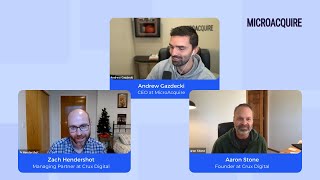
This is a YouTube video titled "SaaS Acquisition Stories w/ Zach Hendershot and Aaron Stone of Crux Digital" containing an English podcast-style conversation recorded in December 2021. Andrew Gazdecki hosts Zach Hendershot and Aaron Stone from Crux Digital, discussing their experience acquiring a startup via Microacquire, sharing insights on due diligence, asset transfer, and acquisition strategy. They also talk about their venture studio plans, ideal acquisition targets, and personal entrepreneurial inspirations and book recommendations.
Foreign.
I am joined with Zach and Aaron from Crux Digital. Thank you so much for joining me on this podcast. You guys. Recently Micro acquired a starter for quarter million dollars, is that correct? That's right. Right on. So before we dive into the details, I'd obviously love to learn about the business. What attracted you to it? Negotiation tips, due diligence tips. I got a lot of questions, but before we get into that, do you want to just give like a quick background on Crux Digital, what you guys do and how awesome you guys are?
Yeah, absolutely. I can give the quick, high level. So we're a digital product consultancy. We're doing typically build work from front end and mid tier for the Fortune 1000. And it's all things that are typically hitting customers and providing direct value. So we're a very design driven group and we work with a lot of partners to make sure that we're operationalizing good design.
Nice. And so how did you initially. So you located a company that you wanted to acquire on Microacquire? What was like, tell me, like the first step, like you reach out, how did that first conversation go? What made you say, hey, this is like a good potential acquisition target?
Yeah, we, you know what, as a part of doing that work, what we really wanted to do is we really wanted to provide a huge amount of opportunity for the staff who are building all these great digital products. And so we started to look for places for us to spend some of our own money to go and build great products and invest in great products. And so we did some early investigation on microacquire, started to do some due diligence around, you know, what are the right types of businesses that are aligned with the kind of work that we do, which is turn great design into great product. And after going through, you know, a bunch of different, you know, great businesses that existed on the Microacquire platform, we zeroed in on, on this toy box systems and, and started to go a little bit deeper, better understand, you know, the financial health of the business, you know, the, the customer base as it existed, you know, where we could add unique value to that business as well, which was important to us. Things that we thought we could bring that the business needed to help grow and go on a new path of growth. And some of the early easy things that we looked at to start to evaluate what might have been a good fit for that, that first acquisition as a part of, as a part of Crux.
Nice. And from initial reach out to actual close of the business. Tell me about the Timeline. Was it a month, two months, three months?
It. This was our first. So it went a little slower than maybe some might, but I think it took us about, you know, about three months into end to go all the way through due diligence, through kind of the transition and us running the business sort of as, as our own business. So it went pretty quick. But we did get kind of a lot of. We did have to stand up a lot of new partners and lawyers and, you know, all the different pieces and parts to make that go as smoothly as possible.
Nice. So congrats on your, your first acquisition. Being that it's, it was your first, what were maybe some of the biggest learnings or tips you would give to other buyers that are looking to acquire their first company?
Yeah, that's a really good question. I think for us, one of the things that was a luxury was that we have a lot of technical talent in house and a lot of experience working in digital products. So in the context of acquiring a digital product and being able to do due diligence in the technology stack and understanding where the landmines are going to be and where are the areas that you really do need to invest in to make that thing scalable and functional.
In the long term.
I think one of the things that we did well was we brought in an expert that was able to cover the bases that we weren't able to cover ourselves from a technical standpoint and give us a really good understanding of what's there, what needs to be done, and is it an investment that we're comfortable making and confident that we can take across the finish line. So I think that, that, that due diligence, as far as being able to spend time understanding what you're acquiring and what it's going to be like to own that thing, is a, was a, I think, a lesson learned. But we also were able to execute on that.
Well, yeah, I love that because I usually do recommend if it's your first acquisition and it's in like the six figures, it's a very small price to pay to have an expert come in and give you a second opinion and help walk you through the process. So good job on that. Are you comfortable talking about maybe, you know, the specifics of due diligence? Like where did. I think really at least gets me excited about acquiring a startup? Like, hey, if we just fix this, this, this and that, like, wow, like there's a lot of opportunity in this business and I'm sure the founder on the other end is happy because they get to move on to something else. So that's. That's fantastic. I guess. Another question I would have. So you did due diligence. You have an asset purchase agreement signed. It's time to transfer the assets. That's always a tricky part. I've seen people do it in notion docs, I've seen people just do it in Google Docs. Can you walk me through how you guys transferred the assets securely or just even any tips for buyers as they're looking to transfer assets or even to sellers? Like, hey, if a seller had this, it would have made our lives way easier.
Yeah, this was probably the hardest part, and it wasn't that difficult. So I think that, I mean, even though we were in a situation where the sellers had everything tied to Google accounts, the process of going through and even identifying all of the assets was challenging. Going through and making sure that all the accounts, some of them were linked to a Google account, some of them had a username and password, some of them were shared accounts that multiple people had access to one account. And so identifying all those, being able to see how we transfer those, and then going through the process of taking a Google Suite and moving the Google Suite, at the end of the day, it really wasn't that difficult. But there really aren't clear instructions for how you go and actually do that. So you're talking with Google support people, you're talking with the sellers, you're talking with each other, trying to figure out how you generate an internal strategy going forward for how you manage email accounts and access internally and growth when you hire and when you bring on new people. So it's. There was a lot of stuff there, and it really just took time. We just went one at a time, made sure we got the Google suite moved and added ourselves to it. And we found also that there were accounts that were buried in places we didn't have access to. And even if we tried, we couldn't get it. So Facebook is a good example for that. We still don't have ownership of that because we just can't get it because we're once removed or twice removed from the person that actually can push the button. So there are some of those things that are just sort of ongoing pain points that aren't anybody's individual fault. It just sort of is the complexity of being able to move everything from one organization to another.
There's just one big little advice I would give, especially to founders who are particularly looking to sell, like, centralize and aggregate. Like, even, even if you're not even thinking about selling. Just keep it all in one central place. It's easy to manage for yourself and any team that you build and grow around you. But it also makes selling it and transferring it a lot easier and keep good records. I think if you do that, then it just makes this process a lot simpler and easier for everybody.
Yeah, I agree. Just having a simple document that just has all the services you use, how they work, how they are interconnected, which ones you kind of use, which ones are critical. Just documenting everything. Because I assume as buyers, you are looking at multiple businesses, and so the faster you can kind of get your heads around, okay, what am I actually buying? Like, I like the product, but there's a lot of things, you know, really powering this to make it work. Yeah.
And that complexity is aligned with the complexity of the product that you're building and selling. Right. So if you. In our case, we were looking at something fairly simple. There aren't a ton of things involved in it. There aren't a ton of systems involved, so we could probably come up with a good list of those things fairly quickly. The larger that ecosystem is that you're managing, and the more complex the topology is of all of the things that are talking to one another, the more important it is to keep track of all that in a nice visual way so that you can show up to that first meeting and be able to point to the communication types, the technical details, what's involved, what technology, what skills do you need to have. All of those things are really easy to communicate visually if you have all that stuff buttoned up ahead of time.
I couldn't agree more. Just makes it easier for everybody. And it's just a good exercise for founders, like centralized, like, document even just as you onboard employees, like, just having everything, like, documented. Like, it's not that difficult, but, you know, the longer you wait, you know, the harder it is to go back and, like, make this giant list so. Well, again, congrats on the acquisition. It sounds like it went pretty smoothly. So I want to know more about Crooks Digital, though, because I got a little bit of a hint that you guys are potentially putting together a venture studio. Is that correct?
Yeah. So we've been going deep in the venture studio space. We have an idea and a passion around tools, SaaS, tools that fit into this category of how you turn great customer experience, great digital design into a product that actually drives metrics and solves customer problems. And so Toybox was the first one that we've been talking about, but we're in the market for additional acquisitions. Acquisitions to help round out a portfolio of products that are attached to our services space for big enterprises. And we see a lot of really cool opportunities between how we can bring these tools to these companies that we work with to help solve big complex technical problems and then also vice versa. Bring the insights and the knowledge and the capabilities into these tools and make these better tools and have them grow and expand their reach and capability to do really cool stuff for those customers as well. So we're trying to play this really interesting angle between these two sides of our business and how they can complement each other in a positive way.
I really like that because you have an existing customer base and so why not acquire a product that you can sell into that existing customer base? So that's just like a win win from like the get go. You don't have to go, how do I get more customers? You have potential customers ready to go.
Yeah, we have customers built in now.
Now I'm just dying to hear. I'm sorry, Aaron, were you going to say something?
Oh yeah. I think an additional point on the same topic I think is really that we experience the challenges that our customers have on a daily basis and those sort of are we have a running list of ideas that we want to be able to go execute on. Right. And they all sort of fit into that thesis. But if we can acquire something that we can, then it's not just about selling something into a client. It's we're identifying the problems we can solve and we know how we work to solve those. So if we can align product that exists with the way that we like to solve problems and help our customers solve those problems, then the value is really, really fast. Right. We can operationalize that and support our ways of working with our clients without much overhead of actually starting with a blank sheet of paper, which is a really great opportunity there.
Yeah, I always say if I didn't sell my previous company business apps, we would have been acquiring companies because we had such a large, you know, customer base of small business customers that we could have acquired. But you know, here we are, Microacquire. Glad you guys are, you know, doing, doing what I, what I at one point thought I was going to be doing.
We benefited from the pivot, right?
You definitely, definitely did. So I guess my, my next question that I'm dying to hear in this would be good probably for potential founders to hear is if you could think of like your the most perfect product for you guys to acquire, like what would it be like that's probably a very hard question that's like asking like your favorite car. But if you, if there's like what are you looking to acquire next? Like what kind of fits in your box of your acquisition zone.
So I can give you a very high level answer and I think maybe we can dial it in from there. I think that the biggest thing that gets me excited about this is supporting kind of the modern product owner. And I think that that's like a, it's a really difficult concept I think because it's evolving so quickly. But a lot of what we've seen has been subject matter experts in a space getting put into a role where they are responsible for software development lifecycle and getting product to market, which is not necessarily their sweet sp. And so if we can find product that fits into the space of being able to enable those people to be successful at the new role that they're being handed, then the sky's the limit as far as how we might be able to fit tooling together that works into an ecosystem of products to be able to make those people successful. And I know that's a very, very high level concept and I don't know necessarily. Zach, maybe you have some thoughts on more specifically how we actually dial that in.
Yeah, there's, there's a couple of things that we've been really excited about as we go into this that fit into that, that, that category and that is, you know, sort of next generation collaboration tools, right? How you get product owners and managers and designers and developers to talk and work meaningfully in a more tightly integrated way, better understanding the needs of each has the challenges, each has to make better products. So I think anything that helps that collaboration process run smoother, faster and leaner and meaner, that's what we're interested in. And then the other, you know, anything that any tool, any capability that allows us to, you know, rethink how, how digital work gets done, like task management, what you would think of as like traditional project management, anything that sort of advances the state of the art in those categories I think also serve to help that product owner deliver great product and think about new ways and more efficient ways of building and delivering those products to market.
Nice. I absolutely love this strategy and I'm rooting for you guys because again, when you have an existing company, and this is what I see the most on Microguire is existing companies acquiring great products to sell to their existing customer base. So you guys are definitely doing something right. If sellers want to get a hold of you guys just to have a conversation around an acquisition. What's the best way to get ahold of you, Aaron, and Zach as well?
Yeah, best way to do that is to find us@cruxdigital.com There's a contact form there that'll send us an email and we'd love to chat.
Awesome. Oh, I forgot. I always do this. One last question. Two, actually. Is that. Okay?
Let's do it.
All right. I'd love to know each of your favorite entrepreneurs. And you can't say Elon Musk because everyone, everyone says Elon Musk. And then one book you'd recommend to other entrepreneurs.
I'm going to go with the book right away.
I like, I like that. I'm a big reader, so I'm waiting for it.
So the, the Move Fast and Break Things, and I think I got the title right. I read this probably a year ago at this point, so I'm breaking the title. But my philosophy is always, you know, try stuff, move quickly, learn from those things, and pivot quickly.
And I think that's.
That book resonated with me because it's filled with lots of anecdotes from organizations who have done this and have been successful. And I think it gives you lots of really tactical things to like, break out of the mold of just like, you know, the same thing over and over again and, you know, toeing the line and status quo. So I think it's a great book. Just it motivated me out of my sort of every day do the same thing over and over again with the same results. So that's my book, at least.
Yeah, I'll give you my book, too. I feel like we're avoiding the entrepreneur one. I'll give you my book as well. So I've been a big fan of Gene Kim, the author. And so the Phoenix Project is one of, I think, a really interesting, cool, DevOps, centric, modern delivery, you know, novel. In that case, it's a story. But there's more kind of in his portfolio to chase down, so I've enjoyed reading his stuff.
Nice. I haven't read either of those books, so I have some Christmas presents that I'll tell people to maybe get me. So thank you for that. But now the entrepreneurs. Zach, who is your favorite entrepreneur if you had to pick just one? Sorry to put you on the spot.
Yeah, I was hoping to skirt under that one. So I'm going to be pretty generic. But, but, but I think Steve Jobs is definitely on my list. I mean, you can, you can have lots of problems with him as a person, but I think that singular vision of what he wants and how he wants it, I think is something that a lot of founders frankly can, can, can learn from. Right. Because I think we all are distracted by the 50 things around us. But if you're focused and drive towards that one vision of what you want the personal computer to be or what you want your market to be, I think there's a lot to learn there.
So yeah, he never, he never wavered. And I, we, we were, we worked with Apple a lot. A fun fact about business apps. We were the number one producer of iOS apps for a good period of time. We produced about 5% of them. So lightly changed emails from time to time. Pretty, pretty cool.
Yeah. I'll give you mine. So I've been really into following Gary Vaynerchuk. I really like a lot of his sort of the empathetic approach to leadership. I think he brings a really interesting message to building companies and building teams. And I like to think that we're taking some lessons from that and building a business where people, where culture is king and people are contributing to their own sort of their, their own existence. So that'd be my answer.
Nice. I'll give you, I'll give you mine.
Do you think that we're taking some lessons from that and in building a business where people, where culture is king and people are contributing to their own sort of their, their own existence. So that'd be my answer.
Nice. I'll give you, I'll give you mine. Right now. My favorite book is Play Bigger. My favorite entrepreneur right now is probably Simon Sinek even though he's more of an author, but he's in the same vein of Gary Vaynerchuk where, you know, culture eats strategy for breakfast. You know, if you bring a great group of people together and you really, you know, support them, encourage them and you know, lead them in a way that's positive. You know, you can have a lot of fun and build a really big company at the same time. So.
I was actually between the two of those when I was thinking about it because they both such a well aligned message that really resonates for me.
So glad to hear you say that. I'm a fan of Gary Vee too. Well, this was fun guys. Really appreciate your time and hope to see you guys back on here again when you micro acquire another company.
Love to.
Thanks for having us.
All right guys, happy holidays. Thanks for your time.
Take care.
Cheers.
More from Andrew



The Buyers Who Made the Move: What They Bought, How They Did It, and What Happened Next






