SaaS Acquisitions and What You Need to Know
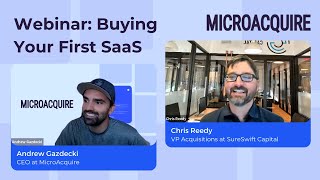
Andrew Gazdecki of Microacquire and Chris Friedy from Sureswift Capital discuss how to buy and sell SaaS businesses. They cover valuation methods, keeping teams after acquisition, legal issues, and where to find deals in the SaaS marketplace.
Foreign.
Welcome to today's webinar on buying your first SaaS business. I'm Chris Friedy. I'm vice president of acquisitions at Sureswift Capital, where all we do is buy SaaS businesses. And super excited to welcome everyone. I see folks coming in and excited to talk to Andrew Gazdecki from Microacquire. We've been fans of Andrew and what he's doing since I think before anything was public. Andrew, so, so glad to have the chance to talk to you and answer questions from folks about buying a SaaS business today.
Yeah, I'm excited to be here. One thing I don't think I've ever told you, Chris, is the day I launched Microcar, Kevin was one of the first to like retweet out Microcar and say it was a cool idea. So, yeah, excited to be here. Big fans of Sureswift and decided to answer some questions about buying SaaS businesses.
Fantastic. I know we've had a lot of signups and folks are still coming in the webinar, but we're hoping to keep it conversational and fun and real today. So as you come in, it's always fun just to hear where people are logging on from. So if you want to drop that in as well as you know, if you've got a question that you want to get to today, let's get them on the board.
So I have a question for everybody who thinks that Chris's background is a real office. I know the answer.
That's too good. If I move around and my ears disappear, then you figure out I'm actually sitting in my basement Covid style.
But your punching bag.
That's right.
So should we kick this off with one of the first questions?
Yeah, let's do it. I see folks coming in. Got people from the uk, Israel, New Jersey, Louisiana, all the way around. So we'll go to the first question. And Selena's dropped a note in the chat to everyone but Selena Carr Thomas is also helping us out and keeping things moving today, getting to all the questions. All right, so first question. Andrew. Andrew, I'm going to put this one to you. I don't see anything coming in live in the chat yet, but the first question that we noted down, what should I expect during evaluation combo? So I'm going to throw that to you first because I know that founders are often coming back to you and buyers are coming back to you and you're both sort of aware of what's going on, but letting them do their deal. What do you hear about those first valuation discussions?
Yeah, that's a good question. I would say the biggest expectation to have during a valuation conversation, especially if you're selling your business or even on the, on the buy side, is having a valuation that you can justify. Like it's not just we took this number, multiplied it by 20 and that's how we got here, but something that kind of is in line with, with market multiples and I think is justified, meaning this is how we value your business. This is why we got this valuation. And sometimes it's all the way down to, you know, a very specific number rather than like a big round, like 1.5 million or something like that. But that's probably the main thing if you're a founder, being able to justify how you're valuing your business. I think that's really important buyers because it shows that you put some thought into your valuation, you understand what your business is worth. It's always a negotiation. So what you think your business is worth might be different from what most buyers think it's worth. But being able to just justify it somehow I think is probably my best tip. But Chris, I'd love to hear your thoughts on this too because I know you deal with this a lot as well.
Yeah, totally agree with everything you said about having, you know, having some rationale, whether you're the buyer or the seller. And from my perspective, it's okay, it's okay if part of that rationale is actually sort of not numeric. And like, yes, you want to know, you want the valuation grounded in reasons, comp, and what can happen with the business, but particularly from the founder's perspective, like it's totally, it is fine and it, it quickens the process. If a founder has a number in their mind now, it's, it's ideal if that number is granted in reality. But if they know that, for instance, they will keep running the business unless they get a million dollar offer and they know that, then it's perfectly fine for the founder to share that. And sometimes I do think, sometimes founders are reluctant to share that. So one thing that I actually try and do, I try to have that valuation conversation early because, and make it low stress so that both sides are really sharing at least kind of ballpark perspective because if you push it down the road, you can burn time, both sides. And so I do think having it fairly early makes sense. And then very late in the process we will sometimes, if founders want to, we can share the details of our rationale with them and we'll be transparent.
Yeah, I would agree with that. When I sold business apps, I didn't put out the first number. And when they came back with the valuation as very like, this is how we got here. It was a multiple with even decimals in it. So just being able to as a buyer justify that. This is exactly how we got here and this is why we think your business is worth that much is crucial.
Yeah, very cool. That's a good. It's an interesting idea. We typically don't use a range like that, but I think on a larger business or if, if the timeline to close is longer, I think a range like that could make sense.
That's great.
First, so question a question from the group and as you come in, drop in where you're logging in from. See, more than 40 folks have already joined where you're logging in from and what questions you have for us today, we're just going to kind of run through them and see where the conversation goes. You want to pick one out, Andrew?
There's so many good ones. Can I take this one? Number six, what can I do to make my offer stand out when a seller is fielding multiple offers? So this is one that I get a lot of questions from buyers and I'm going to take kind of the easy route on this question. But I think building a relationship with a founder is extremely important when you're buying your business and understanding that you are doing a transaction. But this business could be their baby. It could be something they've spent years building. And not everything is in. The most important thing isn't the price, so to speak. It can be. Money is definitely. If you put out an offer that's, you know, way and above the second offer, there's a good chance you can stand out with that. But other things, like you're easy to work with, you have a reputable reputation in the market, you really understand what does the seller want to get out of this? Do they want, you know, a quick and easy transaction? Do they want an all cash transaction? Do they want to see their business live on and grow into something bigger so they can look back on it and say, hey, I built that and sold it. Now I'm working on something new. So I think building that personal relationship with a seller is probably the best way to stand out. Because when they're all kind of the same, coming from an entrepreneur's perspective, I want to work with a firm or an individual that I trust and that I feel understands me. We're aligned on, you know, how are we going to close. So just building that relationship, I think is probably the best way to stand out, at least my perspective. What do you think, Chris?
Yeah, I agree, I agree with that totally. That I think and I extend on it like in as we talk about potential acquisitions, the term we use a lot is fit. And a lot of that fit is founder fit. And some of that fit is like product fit and where the product is and how well we understand it and we feel that we could do a solid job in the next stage of the life of that business. So I think to that extent, from a buyer's perspective, the other thing you can do is be very aware of that fit. And be very aware, like if it's a stretch and the buyer doesn't, the questions you're asking are not adding credibility, then maybe it's not the best fit. So it's a little bit like a job interview. I always sort of feel like in that respect and like the questions you asked about someone's business, it's similar to the questions you ask when you're in an interview process for a job. And if you've really done your homework and it's clear to a founder that you are thinking about a vision for that business, I think it, it can really help you stand out. A big number helps too. But, but, but, but that, that credibility and seriousness and belief and fit is important.
I agree with that. Yeah. All right, Chris, you're up for a question?
All right. I see one coming in from, from Twitter. So this is from Jace via Twitter. Partners have money to invest. Real estate feels too hot and they're interested in the margins and growth potential of crash.
You can have customer sport tickets or bugs that you don't know how to fix. And if you don't have the proper team in place to help with those issues or even be aware of those issues, I think you can be setting yourself up for failure. So you know, if, if I was in real estate and I'm new to SaaS, I guess my question or my approach would be I would start small. I would start small by just kind of getting my, maybe something small just to understand the transition. What typical tools are used for SaaS? What are some of the growth letters to grow these SaaS businesses? Because when you're boss, stand out with that. But other things like you're easy to work with, you have a reputable reputation in the market. You really understand what does the seller want to get out of this? Do they want a quick and easy transaction? Do they want an all cash transaction. Do they want to see their business live on and grow into something bigger, something a micro SaaS business like sub a couple million in revenue, you're really buying it ideally with the goal of growing it most of the time. So you, you'd want to kind of go through those motions a little bit. But summary of my answer here would just be really understanding that real estate and SaaS are very different and if you're not familiar with the downsides of buying SaaS and the mistakes that you make can be detrimental and it can go to zero. Unlike real estate, it's not going to zero. So figuring out what those are and just having a plan and team in place, I think that's probably the first thing I do. And start small, not big.
Yeah. A couple things to add, I think. I totally agree. It is not SaaS is not like real estate and it's also not like an annuity. Like a good SaaS business. It takes work. The recurring revenue seems like it's going to go on forever. But churn can move up fast if you're not responding to tickets, they're taking care of the product and you got to be aware of that. However, I would like to use a real estate analogy. I think sort of like buying that first building, sort of thinking about who else should be in your buying group. To Jace, who asked the question, like I think having a technical person in a buying group, like all going into an llc, like saying, hey, we're going to, we're going to do this, who's going to be the lead on the technical piece and how do we find that, that technical partner and technical and I'd say somebody who understands customer support too, I think can be a really powerful model for folks who are just getting in because there are some great groups out there that bring different skills. They all partner. But I think without having that technical skill set sort of in the group or you know, how to get to that help cheaply, it can be the equivalent of like always calling, you know, the real estate equivalent of always having to call a, a plumber and pay emergency rates if like you don't have some of that core competence pretty tight inside your buying group.
Yeah, I would definitely agree with that. And you know, with SaaS, there's always things changing, breaking. So just being prepared for that is crucial. Just like in real estate, you know, you want to have probably someone on site to fix with the plumbing like Chris just mentioned. Cool.
Next question from the, from the chat. Thanks for dropping the questions. These are great. How do you keep legal and finance costs in small transactions to a minimum. I'll take it for a swing at that one, if you don't mind, Andrew.
Yeah, go for it.
All right, so look, it takes a little planning, but there are templates out there and I'd say, look, this is all we do is buy SaaS, but we are still very template driven. We try to keep things simple even in a few million dollar transaction. It's not fun on either side if your legal like the longer your legal docs get, the less straightforward the deal is. So I think focusing on a simple LOI template and a simple asset purchase I think is really important. And I know Andrew, you've been working on how do you reduce some of that friction when the there is fit and buyers and sellers would prefer to minimize the legal costs.
Yeah, I would agree with that. I guess my first tip would be speak to an attorney in advance and just draft the docs and you can ask for a flat fee up front and you can speak to multiple different attorneys. But yeah, anytime I've sent an LOI or an apa, it's like Chris said, it's templated. You know, general terms will change usually on the first page or something like that, but they are docs that you can draft once and use multiple times. There's nuance to every deal and the structure that you do. But for smaller SaaS deals, let's define that as under $100,000 or $50,000. You can get, you know, some pretty templated docs and use those. So I think, I think Chris is spot on in terms of, yeah, not overthinking it, but definitely, you know, bringing in legal counsel early and then letting them know what you're trying to do. I'm trying to buy, you know, a SaaS company for a hundred thousand dollars. I'd only like to spend, you know, a thousand dollars to draft these stocks. Is that feasible? That's, that's where I would start and that's what I typically recommend. So. So you don't meet someone and you meet a perfect company that you want to buy for that price range and then you have to kind of scramble to get all the legal stuff together. Having them prepared in advance I think is probably the best advice. I would give.
One last thought to add kind of the same neighborhood. I think sometimes on the smaller transactions it can be tempting to not to use escrow and to try to not have an escrow firm sitting in the middle. My own take and I think at sureswift we really think it's a better transaction all the way through. From the seller's perspective, knowing from a reputable escrow firm or third party. And Andrew, I know you all are thinking about these issues, like knowing that cash is sitting there before you start handing over keys to your code is critical. And from a buyer's perspective, like just in case there is usually an inspection period at close and just in case there's some sort of problem or full control of the code or a domain is not handed over, having an escrow firm in the middle, even on a small transaction, I recommend.
Yeah, I completely agree. And I guess to kind of build on that. Chris, what are some of the main escrow companies that you recommend? I'm sure someone's thinking, so I forgot to ask.
Yeah, yeah. So we have used escrow.com on small transactions. So it's, you know, it's a behemoth. Also, we have used. There are a few specialty kind of digital business legal firms that have escrow. And I'm trying to. Sorry, I'm blanking on the exact URL of the one, the one that we use, but maybe I'll dig it up and drop it in the chat. But there are a few who sort of specialize, so it's just worth clicking through, having a few initial conversations. And normally it's a flat fee structure and it's based off of the size of the transaction, so it's not super expensive.
Yeah. And I would recommend escrow for any sort of transaction that you do because it just kind of puts confidence on both sides for the seller and the buyer and just kind of formalizes what you're going to be transacting.
All right, let's see next up. This is a big one. I see a question in the chat from Rami. What's the expected transitional phase for founders to stay working on the business after a sale? So that's it. That's a big and varied answer. Andrew, do you want to take the first shot?
Yeah. So there's no answer to that one aside from what you negotiate during the sale. So when I sold business apps, I had a transition phase as well as pretty much everyone in the company. I think it's crucial to have some sort of transitional phase with founders to be either available for a few hours a week. One way to help with this is like, for example, I recently bought a small Shopify app with a few friends for a young entrepreneur. We staggered the payments so it was only $80,000, but we agreed to $40,000 up front. Then the additional 40,000 after 90 days, we haven't had any issues, but that kind of gives us as buyers some security, knowing that if anything goes wrong or there's just things that we didn't uncover during due diligence, we can hold back that payment if needed. So it depends on the complexity of the business. I mean, with, I mean, another example I'll bring up is chimp charge. It's a simple billing tool that I purchased. It's free. Then I want to use it. But I'm still in contact with the founder. He still makes changes all the time. And I think that goes back to building a good relationship and being an enjoyable person to work with. But I, I highly recommend having some transitional phase with founders because there's always stuff about no one knows the business better than the founder and there's nothing worse than buying a business in the first week. You have some bug and you don't know, no one knows how to fix it. You fix the bug and breaks 10 other things. I'd love to hear your thoughts on this, Chris, but yeah, yeah, my thoughts.
Are very much the same. I think, I think being aware of the founder is selling the business for a reason and it's usually not because they want to spend a lot of time on it. It's not, it's not, you know, unless it's sort of a purely financial. Often the smaller SaaS businesses are, you know, serial builders or folks who've had a side project and they're moving on. And so I think thinking clearly about on a. We actually plan it out on a week to week or month to month basis. Like how many hours are. Are we paying for as part of the purchase price and support and help from the founder. And it's not that it has to be a flat and it isn't a flat number of hours, it kind of goes down over time. But the founder's knowledge is hugely important and founders are going to pick up the phone anyway. But I think trying to pretend that you're not going to need their help after two weeks, unless you're super technical and you already know the product and the product is really, really simple is pretty unlikely. So I think sort of paying, making sure the offer sort of reflects some help from the founder down the road is important.
Yeah, I would definitely agree with that.
So real quick, I'm going to drop in a couple links to attendees. We talked about escrow options. I was blanking on the URL. It's Ecom Log Group is another option that we've Used they have a little bit of a specialty in digital escrow as well as escrow.com but the questions are still coming in. These are awesome. Let's maybe take a short break. Andrew and I think it'd be awesome for everybody to hear. We kind of jumped right into the meat. But let's it be good to hear a little more perspective from maybe from both of us. Like, how did we get to this micro SaaS acquisitions world and what trends are we seeing?
Yeah, that sounds good to me. Do you want to go first or do you want me to go first?
Well, sure. So I've got a few gray hairs in the beard. I've been around different sides of the deal table in the last 20 years, so working in tech and startups mostly, a couple different since in venture capital and have been with SureSwift now 18 months. So I came over because I was really excited about what sureswift is doing. Trying to sort of professionalize and bring trust to the bootstrap SaaS world really. And I love bootstrapped SaaS founders. So it's so much fun to be able to give a founder a cash exit. And so that's kind of how I got here. But it's from a sort of a varied career in entrepreneurship and, and on the finance side of things. So I'd say the trends I'd see, like I never would have guessed the increase in attention, volume, good deals, deals getting done that I think we've seen in the last 18 months. So it was a pretty, it was a much quieter corner of the tech world. And, and the thing I'd say I'm most excited about is I think that as much razzle dazzle as the venture, as the venture world has, and for good reason there, there's more than, you know, more than one way to build a good company. It's been super exciting for me to see more young founders. So we're now, you know, buying from young founders who have started something there and, and the thing I'd say I'm most excited about is I think that as much razzle dazzle as the venture, as the venture world has, and for good reason, there's more than one way to build a good company. It's been super exciting for me to see more young founders. So we're now buying from young founders who have started something in their dorm room and then turning it into something, getting their first exit, moving on and feeling like, you know, the bootstrapped SaaS world and digital entrepreneurship in general is just the amount of dorm room and then turning it into something, getting their first exit, moving on and feeling like of activity is even beyond what I thought it would have been when I joined Sureswift 18 months ago.
Nice. And I guess my background is definitely on the entrepreneurial side of things. I've been starting businesses since I was like 10. I'll only tell you about a few because the rest are failures and stuff like that, but I got into this, I started Microacquire after building and selling two different businesses and I just thought it was a fascinating space. And going through that, being on the sell side as an entrepreneur, not having like any idea how to sell your business. Like a lot of entrepreneurs kind of feel like Google just shows up to your door one day with a big check like congrats, billion dollars. And it just, it doesn't work like that unless you're slack and you're growing like crazy. So I just thought, you know, this could be a fun opportunity and a personally rewarding opportunity to help entrepreneurs understand how to sell their business and just create content like this. On what do buyers look for? How do buyers value SaaS businesses? What are the legal stages of an acquisition? And these are topics that three, four years ago it was really hard to learn what they were unless you worked with an investment banker or broker. And so just bringing more transparency to the market in terms of educating entrepreneurs on how to sell your business.
It.
Has been really rewarding for me. Not financially, just personally. Like Chris said, it's pretty awesome when you can help an entrepreneur seller business and that's a meaningful outcome. And in terms of micro part, for those of you that don't know, it's a marketplace where you can sell your SaaS business entirely free. Really just built it because I thought it exists in the market. It's something I wish I had when I was selling business apps specifically, just because there were so many times when I just wanted to say like, how do I sell this business? Like this is such. Because startups are so hard. And so I thought typically just because there's so many times when I just wanted to say like, how do I sell this? Other entrepreneurs could benefit from this. And I love working with entrepreneurs as well. So that's my background. I brought kind of the entrepreneurial viewpoint of selling a business is really weird and really difficult and there's many different types of buyers and just educating the market on what those buyers look for, how to position your business in the best possible way so you can increase your chances of being acquired. That's how I landed here.
Yeah. So fun. I love the motivation you've had. Andrew and Sureswift as a whole was really started because the founders of our company felt like there was a real gap in the market. So unlike in the rest of sort of traditional bricks and mortar business, there's this huge difference between the durability of A and what's possible from like corner grocery versus a Target or Walmart. But what's interesting is in the digital world, we actually don't really think that really applies. I mean, some of that, the bigger businesses, the more durable it is. But sometimes something starts small as a side project and it might sort of pretty rapidly evolve into something much bigger. And so we, you know, as a firm, we saw that sort of bringing trust and treating these digital businesses as, you know, a little higher potential and worthy of more transparency and trust was kind of the founding, founding vision.
So.
With that move down, I see a couple more questions coming in the chat. This one's really, really interesting. Something that we talk about a lot. It's what key metrics from what key metrics that you use to evaluate a B2B SaaS business and how's it different for a B2C business?
So.
There'S a lot in there. I guess I would kick off and say I'll answer it in sort of B2B SaaS and B2C SaaS and then sort of treat sort of. I think E commerce is its own. It's its own thing that I don't feel as qualified to talk about. And maybe Andrew can help out. But in terms of SaaS businesses, B2B, I think you just got to expect, if it's a B2B SaaS business should have way lower turn than a B2C SaaS business. And you just have to sort of expect that and know as a key metric know for if you're looking at a buying opportunity, try to figure out how you can figure out what a standard for that type of business is. So, you know, we've got businesses that are very technical sell, that sell to businesses and that solutions themselves are pretty technical and they're super low churn, you know, often often under 5%. But you know, sometimes a B2B business that has a lot of consumer users, yeah, it might have 10 or 15% churn and so knowing the right comparable is key.
Yeah, I would agree with Chris on that. So B2B SaaS definitely has typically much lower churn because you're selling the actual businesses and hopefully you're solving a mission critical problem problem within that business with your solution. So that's probably the first place I would look. And then also just reading for both B2B and B2C just reading what customers are saying. So with B2C you can just type in business name reviews and then just see what other customers are saying about the business. How happy are they with the solution? That's kind of an underlying thing you can see in terms of how healthy is the business, will these customers stick around? And then also you can find a lot of small pieces of feedback on how to improve the business post acquisition. Can it be for B2C? I don't have too much experience on the B2C side. I do see a lot of B2C like mobile applications or marketplaces and stuff like that on Microquiet are and really I think the focus with those types of businesses is just the usage of like how many users are there, how many monthly active users, daily active users and how are they being monetized? Is it a subscription model, is it a one time model? But I don't really see too much B2C SaaS to be candid. But when I do, like Chris said, the churn is typically higher because you're selling to an individual rather than a business. So B2B SaaS, if I had to pick apples to oranges, B2B SaaS is my expertise and what I would focus on acquiring.
Next question from Jake Carpenter from Alaska. How do cross border issues play into purchasing a SaaS business? So in other words, in wildly different legal environments and languages, it seems like at the lower end of the market doing a cross border deal could cause things to break down. So Jake's looking for suggestions to mitigate some of this. It's a really important question. There are a lot of bootstrap SaaS businesses that are cross border from almost day one in terms of the team on them. So a lot of businesses we look at the, maybe even the founder or if it's technical founder, it's not an issue. But if they have any other developers on it, they might be in a different country than the founder and the support team could be in a third country. So Jake, I think my answer to that is it's less important on the actual transaction because that's one of the beauties of an asset purchase agreement is that you know you're not buying stock in somebody else's company. So it's pretty easy to sort of figure out how the purchase agreement can can buy those assets regardless of where the founder is, if language is an issue, obviously you'd have to figure out some way through that. But I think the, having a cross border team on a really small business can present some issues frankly. So I mean it's something that we've, we've had to continue to sort of think about how do we innovate and how do we, how do we address it. And it can be a challenge if even if everybody communicates the same way, which people don't, across borders, just the time zones can make it more complicated to run a very small business. So we try to do as much as possible asynchronously and sort of intentional about how we communicate if the team is cross border. But then even getting the money, getting the money out there can be a little complicated without running afoul of, of banking rules. So I don't, unfortunately I don't have an easy answer for that. But if the founder has figured out some of those basics, I would say listen to the founder, like how can you, how did the founder figure out a way to make it work?
Yeah, I like that. Just add a little bit of kind of personal experience. I before Microcquire I looked at acquiring a business in uk. We were going to buy the UK entity and then bring the entity into. Long story short, it was going to be a pretty fairly complex corporate structure. Don't recommend that. Recommend asset purchases for international deals and then also making sure that to Chris's point, you have a good relationship with the team, understanding who's on the team, who's going to remain post acquisition depending on if any of them are mission critical. And another suggestion I would have is speaking with an attorney up front again about what you're looking to do. Like you're looking to buy a company in the UK and this is the reason why I didn't do the transaction is because the complexity they wanted to do a stock sale, asset sale only made sense. And so before even getting to an LI or anything like that, I, you know, try to deeply understand how could we make this work. We ultimately decided we couldn't, so we didn't. Besides, lawyering up is probably, you know, the best suggestion I have to mitigate this because that's how I probably, if I had acquired this business without speaking with proper legal counsel, I probably would have regretted was a great business. But again, just the structure in which the founder wanted to do it was too expensive, too complicated. So that's, I hope that's helpful. But I agree with Chris on everything you said.
Yeah, the international pieces. I think the other thing to keep in mind is if you own a SaaS business, it's not just US regulation on privacy and security that is relevant. So you might be buying a US SaaS business that has customers in Europe. And so just be aware that, you know, to Andrew's point, you probably will have to talk to a lawyer about a few things. So. But it can be done. We, we do it all the time. It's just takes a little extra work. The other, I guess the last thing I would say on this, in case any founders are in the group and to buyers as well, like make sure the founder, you're clear with the founder that if you're going to do an asset purchase, that that's the plan all the way along. There are some countries where because of the taxation, a founder might think they want to sell, but what they actually need is a stock sale to save a ton of money on taxes. And so they are, you know, they are not interested in an asset sale. And so, you know, frankly there are a lot of first conversations I have with founders in some countries who are like, sorry, it's not a fit because we're not set up to, to own a stock based company in every country worldwide.
Yeah. One last thing I'll add to that, Kristin, also just to explain the difference between an asset sale and a stock sale. An asset sale is where you're just buying the assets of the business, stock sales, where you're buying the whole corporate entity. So that's usually the bank account, that's whatever entity they're registered in and whatever country. So that's where it can get really complex and you're carrying a lot of legal liability when you do that. But the second thing I wanted to add as well, when it comes to international deals, and this is just what I've personally been seeing is there's a lot of good ones. And I think a function of that is it's harder to raise capital in Europe. And so I guess just by, you know, that's the only way to build a software business over in Europe, they have to bootstrap. And so I've been seeing some really, really, really good businesses ran by some really sharp entrepreneurs in other countries. So even though there is a little bit of additional complexity if you're willing to work with proper legal counsel and figure out a plan to acquire those businesses, I think there's a lot of opportunity there.
Yeah, totally agree. They're great. There are some great businesses for sure. So next question I'd Highlight is actually from Viola in Berlin says, what do you think about keeping the team when buying a SaaS business? What kind of team members like to keep and how's that established? What's experience with retention? I'll take a first swing in that and from our perspective, sure. So we really want to keep the team and that's I'd say 100% of time. That's, that's the intention. We, we do buy from solo founders who are pushing every bit of code and touching the only ones touching customers. We, we can buy from solo founders and we do, but that's the intention. You know, we are getting better over time at figuring out onboarding and how to that part of the transition to make sure that it's hard if you're a, it's hard when you find out your company is being sold. Right. So it's. If there's a broader team beyond the founder. I think talking through with the founder, like how to make that announcement, how to get to know the rest of the team, how to answer their questions is really important. Try to reduce the drama. But it's always a little, to be frank. It's these people's lives and there are folks on our team who come on through acquisitions and they know what that's like. When you're on it, you're on it, you're on a team and suddenly the founder, your boss, who maybe you've worked for for years, says, you know, we're under loi. We're gonna, I'm gonna sell the business. You're gonna, you're gonna be part of a different company. And so I think just being as empathetic as possible and planful about your communications is important.
Yeah, I would agree with that from Chris. And another thing I would add is, you know, don't expect the team to come over. I think you should, you know, focus on earning their trust and earning, you know, make them want to work for you because they don't have to. Everyone's equal opportunity employees. And so it's your job to show them like, hey, this is my plans for the business, things aren't going to change. Or this is like some bigger vision I have for the business. Focus on getting them excited. I think again, I see a lot of entrepreneurs treating SaaS acquisitions as very transactional. This is the price team comes and works with me. But there's such a human element. There's so much emotion in all of this, not just for the founder, but for the team as well. To Chris's point being Empathetic and explaining that some things will change, some things won't. Some, some things will get a lot better. And let me explain those to you. So if you really want to keep any team member, I think this applies for just any business is just being respectful, building a relationship with them, getting them excited and motivated and kind of showing them that this is a change in the business. But these are all the awesome things that are going to come with it. So again, focusing on building those relationships can really go a long ways with retention.
Next one. I get to answer in one word, Andrew. Yep, one word. I'll see if you have the same word. This is from Jordan. The depreciation rules are different as well for stock versus asset sales, correct? Yes. We're not accountants, but that is, that is true. The depreciation rules are different for asset sales versus stock sales. And I still failed at the one word test.
Yeah. And then tax implications are wildly different as well.
Yep. Even both on the buyer and seller side, Right. Andrew? Like depending on the country that the buyer and the seller on that picture, on asset versus stock sale, the actual economics of the money flowing can be pretty different.
Yeah. Like when I sold business apps, it was a stock purchase and that was part of the negotiation and the difference between taxation on that was substantial. So I remember earlier in this webinar, someone asked, how do you stand out? I don't recommend stock purchases unless you are a very sophisticated buyer and you're familiar with liability that you can be bringing on. But that could be another way to stand out as a buyer by giving more favorable terms, especially when you can offer the same price but the seller is taxed at a much lower rate, so their take home is higher. Yeah.
All right, next question. Don't have a name on this one, but how do you quickly evaluate the code base of a product, particularly if you're not technical? And what if the seller doesn't give full access to the code base? It's a really important question. And on the first answering from the seller's perspective, totally understandable and expected that the seller should not want to give give access to their code base to someone they don't know before they meet with them and there's some sort of likelihood of a deal. So I think that's my own perspective, like it's totally understandable if a founder would hold back on that code access. All that said around an loi, either right before or right after, totally reasonable to get read only access to that code base. If you're not technical, I think before even thinking about writing an loi, you've got to figure out what are the resources in your network, you know, friends hired or paid. Like how do you do that, that code review? Because it is, it is really important. I think you can, you know, there could be a deal can close. That would be a bad fit. If you're not able to, if you're not able to review the code, it's not a good sign for you being able to take care of customers.
Yeah, I would agree with that. And one thing I would add too is as a fire, use the product, go through everything, click every button, try to find bugs. That's a way of, you know, testing the product without actually getting access. And then yeah, it's very uncommon for a seller to just, here's the server keys, go through everything. When I sold business apps, it wasn't until close that we actually gave access to the servers, but we did do side by side kind of code reviews or we did high level discussions where we're just kind of sharing videos. Every deal is different. But I agree with Chris in terms of that being the expectation is don't expect and I honestly wouldn't ask a seller for access to code before you've actually really gotten to, at least you've closed or you've gotten very close to it and you're going to do this deal. And then if you're not technical, I recommend hiring an agency, just, you know, let them know what you're doing. You're looking to acquire a SaaS business, obviously friends are better or recommendations from other people for quick code reviews. But if you don't have those in your network, you could probably find an agency that can do either third party due diligence or they can be the ones that, you know, interface with the founder to understand the code base and then you can utilize them to build further features if you wanted to.
All right, next, next one from Rami. Shopify app store is now a good place to look for SaaS businesses to buy. Are there other platforms to recommend for buyers?
I have one on that.
Go for it, Andrew.
So Shopify apps are great if you're a first time buyer. I highly recommend them just because the transfer is so easy. Transfer is always difficult, but Shopify has billing, integrated, analytics integrated. So it's kind of like just transferring over an account with the Shopify team. I recently went through it and was very surprised at how simple it was. But the other places I would look and if I was buying SaaS companies right now is I would Be looking at the Stripe Store. I have one app in the Stripe Store, but other marketplaces like the Slack Store or I haven't looked at the Zoom Store, but I'm sure they have something good in there. Some good apps, but those are other good places to potentially look as well.
Yeah, I'd add in. We haven't done as much, but I'd add in the QuickBooks apps and for a little bit bigger, in case anybody's out there who's bought one and has grown it and is ready to sell. It's a shameless plug. Would love to buy some Salesforce apps. So I think that's a really big ecosystem with a lot of room for high average revenue, freestanding products. So love that platform to buy in.
Yeah, I haven't seen a Salesforce app, But I would 100% agree with that.
All right, From Ontario, Pooja says, what are some of the top reasons you've come across why people sell their business, and at what stage are most founders selling? This is interesting for Microacquire, Andrew, because it's pretty varied, right?
Yeah. The number one reason is I'm moving on to something else. Like either I have another. And I think this is why I personally love Microfire so much, is some people are looking to build really big businesses, and that's great. They want to build, you know, the $100 million SaaS unicorn, and that's amazing. And so they build these businesses and they get, let's say, 100, 200,000 in revenue. And it's becoming clear it's more of a business, not a startup. A business is something that is profitable. You focus on cash flow. You're not in this war to take over the market. And so that's the main reason I see is founders create these interesting products, but they're not the next company to go public or raise a bunch of venture capital. So they sell those businesses to go focus on something new. That's the number one reason I see is they always have something new they're working on, and then a lot of people just like to build products. Like, they just like to kind of do the 0 to 1, and then they sell it and they go back to doing what they love, and then they sell it to someone who likes to try to take it from one to two or whatever. So that's what I see. I haven't seen anything like founder disputes or anything like that. I'm sure I will over time, but that's the main reason is I have some other thing that I'm working on and this is just taking that time.
Yeah, yeah. I'd agree that, you know, the reasons can be different but I think I would add in it's a good question to ask. You're on the buy side and it's an important question for us is you know, why are you selling? And you know it actually tells you a fair amount about the business and the stage it might be at.
I would agree with that wholeheartedly. Just a candid why are you looking to sell this business? Can tell you so much about and it also might help you find red flags too in case maybe a large supplier just I'm making up reasons but like an API just broke or there's something but that can really help give you a lens into is there something I should be concerned about or do you truly have like a very valid reason and you're just looking to sell this business to someone who can bring some more energy into it? So yeah, that question alone why are you selling? And really looking for an honest answer can tell you a lot about not just the founder but also again, the reason why they're selling and if there's any red flags you should maybe dig into. Yep.
Awesome. All right, five minute warning, five minutes left. So I did want to tell everybody that we will share out recording and keep the conversation going on Twitter, but we'll get to as many in the next five minutes as we possibly can. Let's see, next question looks like can you and how do you estimate steady state customer acquisitions costs if you're buying an early stage SaaS that only has initial traction? That is super hard. And that's where I feel like having seen some other businesses at that stage will help you if it's your first time of buying that type of business or something at that stage I think it can be really hard. So that, that said, the more open ended questions you can ask a founder is like what have you tried and what have you seen? Sometimes founders haven't had the time or the inclination to test different methods for customer acquisition. And so then you just know that's part of your early plan.
Yeah, I would agree with that. And if you're buying a business that doesn't have a clear repeatable customer acquisition strategy or there's just initial traction, I would only recommend buying that business. If you have experience growing SaaS businesses, if you can look at it and say there's four opportunities to grow this business, otherwise you might be buying it and then you're stuck thinking what do I do with it? How do I grow it? But those are great acquisitions for people that have previously grown businesses or you have an existing customer base that you can sell the product to. But I think what I'm trying to say is just if there's not a lot of traction on the business, you want to have an idea or a plan on how you're going to grow that business, because you're not going to see a return on investment from just letting it sit and just trying to see profits coming in every single month.
Next question. How long do we typically run business as is before we start making changes to grow it? I think our answer, sureswift, is we've gotten faster over time and how quickly we start to do new things because we're a bigger company and we've gotten smarter with a few bruises and bumps along the way. But overall, we still think the first job is don't screw it up like the founders built something of value. So don't come in like day two and start making changes until you're sort of firmly understand how the product works. You can do bug fixes, you can answer tickets, and don't rush things because ultimately that will slow down future growth.
Yeah, I would agree with that, too.
All right, buying via an asset purchase agreement. Any options for debt options to aid acquisition? I think there are options, Andrew, but I think you're going to know more about what those are. I don't think asset purchase versus stock, I don't think. Is that relevant to the debt options?
Yeah, I think that question could be reframed as what sort of financing options are available for SaaS acquisitions. I've been doing a lot of discussions with a lot of different firms in the market. The short answer there is typically you're going to need to look at businesses at least a million and above. So for lower, let's call it 100k or 50k. Hey, your options are going to be pretty limited in terms of finding a debt provider for that. That might change, though. I'm not sure.
Well, should we do a couple more, Andrew, and then call it a wrap and keep it going on Twitter?
Yeah, let's do it.
All right, so next one. I think I saw that from Sam Miles. Does tech stack play a large factor in deals? So how important is that making a company attractive or not? It is super important, but I think it's different for different buyers. So I think as a buyer, if you're out there, like knowing where you have personal expertise or contacts or confidence in that tech stock, it'll help you sift through a lot of opportunities on the buy side. I don't think it's hugely important the particulars. It's just from the buy side, knowing what you're comfortable with. And if it's an unusual tech stack, it may take you longer to be able to fill the founder's seat, but it might still be possible.
Yeah, I would agree with that. I hear from a lot of buyers that are looking for specific applications built on a specific framework because that's what their existing development team is familiar with. So it's going to depend on the buyer. Some buyers, it won't be as much of a sticking point, but for some buyers, they will not buy a certain type of application built on a language that their team isn't familiar with. And for good reason, because they would have to then hire an engineer and they don't. They aren't able to utilize the team that they already have. So it just depends. But I wouldn't be concerned that if I build it this way, normal one the of fine.
All right, well, I think we're. I think we're at time. Andrew is so much fun to get to meet and talk through some of these questions with everybody. I'm sorry, we. I see more questions than we had time for, but we will pick it up on Twitter and keep it going. It's been. Been fun.
Yeah, Chris, thanks for having me. And thank you everybody for joining. These are great questions, so if you want to just keep putting them out on Twitter, we'll be happy to answer them.
Awesome. Thanks, everyone.
See you.
More from Andrew



The Buyers Who Made the Move: What They Bought, How They Did It, and What Happened Next






