SaaS Acquisitions Stories w/ Grace McBride, Founder of Lucia
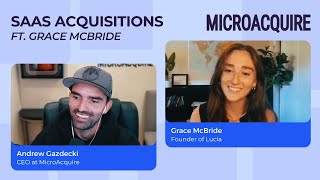
This is a YouTube video titled "SaaS Acquisitions Stories w/ Grace McBride, Founder of Lucia" containing an English conversational interview recorded in September 2022. The discussion features Andrew Gazdecki interviewing Grace McBride about her entrepreneurial journey, including her startup MicroCard, the sale of TripKit on MicroAcquire, lessons learned from due diligence, and her new company Lucia, a freelancer marketplace for travel planning. The conversation also touches on personal travel preferences and advice for student entrepreneurs.
Foreign.
I am here with Grace McBride, who recently had a startup, MicroCard. Grace, how you doing today?
Doing great. Yeah, thanks for having me on.
Yeah, my pleasure. So for those that don't know you or your background, do you want to maybe give a quick intro of yourself and maybe add in triptychs as well?
Yeah, of course. Um, so just some quick background about me. I mean, I started out in college, kind of grabbing little jobs here and there, and I stumbled into a group of other college students selling luxury travel to high net worth individuals. Thought it was really interesting and I kind of worked at an entrepreneurial environment all through college. Uh, it was an awesome experience, but I really decided I wanted to do it on my own. So when I graduated I started TripKit, which was essentially an assistant service for travel advisors, which if you think about travel advisors today, everyone thinks of like Liberty Travel or you know, Expedia. And I would say those absolutely are true and absolutely fair assumptions to think about. But when it comes to luxury travel, there's actually a really niche industry out there of assistants and travel advisors out there. So we wanted to cater to that and kind of found a niche there.
Nice. I was looking at the trip kit website before the podcast and it, it looks slick. Did you. So, so, so you would help high net worth individuals kind of plan trips out? Is that kind of.
Yeah, we actually didn't end up being the ones to plan the trips. We were actually selling B2B to those travel advisors themselves. So we would help those travel advisors with any of the work that they needed, primarily focusing on the itineraries. So it was a service business. We hired VAS to basically help do that work. And they were, the travel advisors were selling trips to those high net worth individuals. Every crazy over the top trip you think you can imagine. We were then putting all the details into a beautiful itinerary to then send to them any sort of like back end admin thing.
So that's awesome. The reason I asked the high net worth, I'm just wondering if there's any like cool celebrities or like all day long. Really?
Oh yeah, yeah, of course. CEO celebrities. It was full plethora of them. And that's why we had to be really careful in the beginning to, you know, make sure that we kept privacy.
I won't ask you like names or anything, but was there any customers that you had or clients where you were like, oh my gosh, like I'm a fan or anything like that?
Way too many, way too many. I can't. Yeah, I can't say exactly who, but I'll say we had a ton of professional athletes. A ton of like, not like big bank CEOs or anything like that, but like notable company CEOs, actors, actresses, you name it. We saw a lot of them. Got to meet some in person even. That was more when I was actually planning travel. But yeah, it was pretty epic, man.
I've only. I've only met like three celebrities in my lifetime. Um, so I, I envy you. That's. That's a nice perk of, of a startup, I guess.
Yeah. Benefit. I mean, I would say for all of them. Very, very normal people, which is kind of a nice surprise. You're just planning someone's trip. They want to go on a trip with their family and it just happens to be a really, really, really cool trip.
That's awesome. I'm envious of the trips they probably took. Tell me about your experience on Microquire. You list trip kit on Microacquire. Walk me through just kind of how that went.
Yeah, I think in the beginning we kind of flirted with the idea of selling TripKit. We were working on another project at the time because we were just excited about a bunch of different things at once and knew that we'd built a really strong project. So we had actually been introduced by someone else who'd been micro acquired and they had sold their SaaS kind of service business had done really well and they were really excited about it. It was another student, another student at Notre Dame while I was getting my mba and he kind of told me about it and I was like, oh, I haven't heard about this. Let me, let me take a look. And got introduced to the website and pretty shortly after got signed up. It started poking around pretty shortly after. We then found that you could work with brokers and things like that. So we actually collaborated with a broker on the site to kind of get our profile to look really good and make sure we had all the right numbers and things like that, because I really didn't know what a buyer would be looking for. Now I think you've released some tools actually that helps a lot of that. So I, I think I missed out on some of those newer tools like your LOI tool and everything like that. But yeah, we got pretty much posted and sold within a couple months, pretty quickly after.
That's so awesome to hear. And yeah, the we. We got some more fun tools coming soon.
I know, I just missed the window. We'll have to get the next one up there.
Hey you. You got you got acquired, so that's all that matters.
Exactly.
So tell me about. So how many buyers reach out?
Oh, my gosh. So we had hundreds reach out. We had to sift through. Yeah, we had a lot. I think maybe because luxury travel got people really excited. We had been contacted by well over a hundred. We didn't get to meet with everyone by any means. We kind of sifted through.
That would take, like, weeks.
Oh, my gosh. No, we couldn't do it. Um, so we had had the broker actually help us sift through some of the inquiries, but we ended up meeting with probably well over 30 or 40 people.
Nice. How did you. Okay, so you have. That's a good, good amount of buyers. How did you land on the buyer that ended up acquiring the company? What did they do that maybe appealed to you? Maybe the purchase price? Maybe they were. What. What about them stood out? Um, kind of made you feel like that would be the person to. To sell to.
Yeah, I think we had kind of one really clear goal and that we wanted to sell to someone that had the same values as us and same ethos and had the same kind of goal to grow this company. And we found a lot of really great buyers that were looking to maybe acquire into their current company or scale in a different way. And those are all very valid reasons to buy our company. But we just felt like we were servicing a very, very niche industry that really relied on our company. So we wanted to make sure that we could still service them with whoever took it over. So we met.
Yeah, that's awesome. So you sold essentially to someone, and that's a great way for buyers to stand out as well as sometimes it's not just the price. You know, I could tell you got some passion for travel and, you know, you don't want to just sell to someone who's going to, you know, just destroy or ruin the reputation of the business. So that's. That's something buyers, I think, can really leverage if they have experience that industry or just kind of outlining that they're going to keep your vision intact. And so it's awesome, I guess, you know, moving into maybe, arguably maybe the not so fun parts. How did, how did, how did due diligence go for you? How did you handle that?
Yeah, definitely less fun to have to go into that for sure. But it wasn't, it wasn't too bad. And I'll only say that because, again, I feel like we were prepared. By the time we had put everything onto micro required, it kind of forced us to get everything, like get all of our ducks in a row, if that makes sense, you know.
Yeah, sorry. Sorry to interrupt. I was just gonna say that's literally the smartest thing you can do when selling a business is just be prepared. Because when you get to due diligence, if the buyer has everything to already go through like a deal or, excuse me, a data room, it just makes the whole process so much faster. So that was kudos. Kudos to you on that.
It also made us. This may sound like an obvious thing, but for a small business owner, it's not so obvious until you're really in it. We really were still doing things here and there that are not sellable. So we were saying yes to projects here and there that maybe weren't something that the next buyer would be willing to do. And we finally, when we got serious about selling, we had to really hone in on exactly what we were selling to the buyer and make sure that we weren't saying yes to ancillary projects, make sure everyone was paying our subscription price and not getting any crazy discounts anymore. And we really had to like shed some of the kind of nonsense that was going on that we were letting happen over the last three years. And it really, really, really made the business take a step up. We actually ended up dramatically increasing our revenue just by getting ready to sell. So that's my biggest lesson from the whole process. Kind of sitting in those systems and making sure everything's up to snuff actually really benefited us from a revenue standpoint as well.
That's awesome. They can kind of due diligence in a way can kind of make you look at your business from like a third party perspective. Like, yeah, we shouldn't be doing like 90% discounts or like, yeah, that service isn't profitable. Like there's a number of different things that you just as a founder, you just kind of will take on just to keep momentum in the business. And you know, it's always hard to say no to a customer, so that's awesome. So basically preparing to sell your business helped you grow your business. Did I get that right?
Helped me grow my business, helped us sell it, but also in the next company is helping us set it up the right way. I definitely wish we set the business up from the beginning as if we were preparing to sell it even if we weren't. It's a mentality that I wish we had had the whole way through because it really does benefit you when you're kind of, like you said, looking at it through a third party.
Yeah, that's. That's the beauty of starting a second company is you kind of learn.
Yeah.
Now, hey, you know, that we should have done that maybe, you know, at the beginning and stuff like that helps you avoid other mistakes. Okay. And then I guess my. My next question would be, is in terms of, you know, a lot of, you know, founders might be listening to this with companies and thinking, this sounds awesome. Like, maybe I should start doing due diligence on my own business and preparing it for sale. What are maybe some tips you would give to a founder that. Looking to sell their business on microwire?
Yeah, I mean, I would say the biggest thing is to really focus in on how profitable you actually are, make sure that you're really, really paying attention to those metrics and really paying attention to your finances the way that you think you are before you're selling. But really, when you go through diligence, it forces you to get really serious about it. And we're all. We, you know, my entire team are very, like, financially focused, making sure we kept track of the numbers and everything. But when we had to really lay out, this is what our profitability margin is, this is. This is how much our labor costs, this is what all our ancillary costs are. This is our, you know, monthly kind of excess costs, those things and kind of getting prepared to look at those, that was something that we really had to swallow in the beginning because we were kind of just thinking, oh, this is about where our profit margin is. But until you really set aside those numbers, that was something that we should have done sooner. It would have benefited us when we were selling, so we could have sold for a higher price probably if we had paid attention to that earlier. And that makes me sound like we weren't paying attention to our finances, because that's just not true. But it just means you have to be stricter with yourself. So that's something that we had to take for account then. But also, obviously, staying organized. It's a lot of work to pull out paperwork from three years ago, five years ago. Financial documents from every credit card, every bank statement's a lot of work. So if you don't have some accountant, like, keeping track of this diligently, I mean, the amount of coding, every expense, making sure that it falls under the right category. It's just a tremendous workload if you don't do it from the beginning.
Yeah, we. We write a lot about due diligence. So if anyone listening is just curious about what is due diligence what questions are commonly asked? I don't know if you ever checked out the resources that we provide. But for anyone listening, check that out because there's. It can be overwhelming but once you kind of grasp gets a lot easier and it sounds like you did a fantastic job. I'll tell you a funny story about when I sold my, my first company I had to go through. So it was an eight year company so they. I needed to hand over every NDA I had ever signed. Every, basically everything. And the, the funniest part during due diligence was I had an NDA signed with the buyer as a private equity group from maybe six years ago and I had to give it to them like, hey, we've met before, maybe we can make something happen this time around. I don't know. But yeah, things that I'm everywhere. Yeah, yeah. Just keeping a folder available with everything and just keeping, you know, good house cleaning for your company is something I always recommend. But I got a hunch you're working on something new and I want to, I want to hear it. What is it?
I can't help myself. Yeah, we, and again, hindsight's 2020 and that's kind of what I love about, you know, being able to sell the first business and work on another one because you kind of get to take the learnings with you. But yeah, working on a new company in the same industry. If I can stay in this industry forever, I will. But we're working on a freelancer marketplace that allows you to not just outsource, you know, itineraries, but actually outsource any sort of concierge details when you're travel planning. So now we're not doing itineraries but all of the travel planning process instead. So being able to provide freelancers in the marketplace is kind of where we're leading into now.
Nice. I, I love MarketPL.
They're joking. Yeah, no, I, I will say didn't really know we were building a marketplace when we started, but we kind of ended up growing one. And you definitely learn a lot even in that type of business. You know, our first one was more service based but because this one's tech, it's just a whole other animal.
Nice. So how would it work? Let's say I wanted to go to Croatia, but I'd be able, yeah, you'd.
Be able to go on to our platform, hire someone with either that expertise or something that you might like about their experience, their ratings, etc. And you can basically use them to do anything from dinner Reservations, searching hotels, getting advice on transportation. Literally anything you want.
Oh, man, I'll. I'm gonna. Sorry, what's the name of the company again?
It's called Lucia.
Lucia. Okay. I'll put it in the show notes because I'm the type of person, when I plan, I just book the flight and figure it out from there.
Ye. Which is totally fine. But you might want a little bit of help sometimes.
I do, I do. I'm just. I. Number one. I don't know how. I don't know. I don't know anyone in Croatia at the moment.
We do. We'll help you out.
Yeah, See that I. I really like that, that concept. I, I think I grasp it. And then I guess for final questions, I'm gonna throw some, some random ones at you. Is that, is that okay?
Hit me with it. Yeah, go for it.
All right, so these ones are just off the top of my head. But if you could take any trip and let's say it's a two stop destination, so you go to one place and then you immediately go to the next place, what would it be? And if you could bring one person, who would it be? On the layover in particular.
That's a very. I thought you're going a very different angle with that question. Who would I bring? Oh, it would have to be. It'd have to be my co founder. Is that cheesy to say she's super entertaining and we spend every day together already, so we just kind of. We keep each other entertained on flights all the time. So I definitely have to say her.
Nice. Okay. And then the, the two locations, where would you go? Like, would it be like a Vegas to New York trip or would it be like Italy to Greece trip or.
Yeah, I just got back from a week long conference in Vegas, so I want to say no Vegas for me. I'm good with Vegas for a while.
Yeah, I'm in the no Vegas too.
I'm good. And it was for work too. I'd say right now I'm going to choose two places I haven't been to because I always try to get a new places. I definitely want to try Dubai. That's always somewhere I really wanted to go. And New Zealand. Those are not near each other, but I think I could pull off the long flight.
Nice. Yeah, I've actually always wanted to go. I talked to someone recently that told me a story about basically how there's all these really, really high end luxury cars just stuck in Dubai. And I always, I always assumed it was because People were wealthy and they would just leave them. But it was actually because I guess during the 8 financial crash, they couldn't pay off the cars. So they would just leave the country and then they wouldn't have to, they wouldn't have a car or have to pay for it, I guess, or something like that.
So ironically, we need, yeah, ironically, now we need like a ton of rental cars in like Hawaii. So if we can get them over to Hawaii somehow I can't find a tour company anywhere. Yeah, yeah.
Second question. If you were stuck on an island and you can only bring one book and one item, what would those two things be?
Oh, man. I mean, my favorite book is how to Win Friends and Influence people. But if I'm alone on an island, I don't know if that's really going to help me. So I'd have to say, oh man, I really love Ariana Huffington Thrive. So that one would probably be top book for me. And then item to bring with me again, I'm a reader, so I'll just bring the Kindle. I'll bring the rest of the book.
Nice. Good answer. And then in terms of, you know, I, I started my career in entrepreneurship in college, so I, I, I admire your, you getting into entrepreneurship early because that's in my opinion, the best time to do it. Do you have any advice you give for, you know, student entrepreneurs? Just go for it.
Yeah, I would say yes. Go for it with an asterisk. I definitely agree with you. Yeah, right.
That's like the best part. Just start.
I agree with you that it's the best time to start a business, without a doubt because you have no responsibilities for the most part. If you're lucky enough to not have to worry about, you know, working yet full time, or maybe that is your way to work full time. For me, I did need to, so that was kind of my way to do it. But also, and it'll force you to be profitable from day one, that kind of stuff. But the asterisks I would say is it's really easy in the beginning to think in college, like you're right by this amazing idea you came up with. Like, you must be right. And I just didn't have like the world knowledge yet to know if I was right or wrong. So I'd say just do your due diligence. Of course, when you're starting a new company, you know, you want to do the research and make sure it's something people need and you have product market fit, but you're going to Invest your own capital and a ton of your own time. I would definitely say just make sure, you know, you know that you can find a profitable business in there somewhere.
I love that. The tip I would give, which I don't recommend, but what I did was I took a fifth year in college so I can get financial aid to pay for my rent and food. And then I minored in entrepreneurship, didn't go to any classes, and started a business then.
Can I tell you, I might have done something very similar recently when I went back and got my mba. Yeah, I literally went back to get my MBA because I thought, I'm starting a new company. I loved starting a company in college. It provides so much, so many resources and so much protection from, like, the real world. No one really expects anything of you yet, but you also have like, these brilliant professors around you that can give you feedback and a ton of, like, free help, et cetera. I mean, I could go on about the resources that I got there. You just have to take advantage of them. So I lowkey did that over the last year and grew the company while getting my MBA for that reason.
That's so smart.
I was the worst student, but I was too.
My entrepreneurship teacher, I would kind of joke with him. I. I came into class candidly like, hey, I'm starting this company and that's the only reason why I'm. And he's, I'm gonna stop in. And sometimes I'd show up for five minutes. I'd be like, you know, I'm still alive. I'm gonna go work on something. And he was really supportive and we had a really good entrepreneurship program. I could candidly say I don't think I'd be where I am today without the sport. I went to Chico State. It wasn't. We call it the Harvard of the west, but sorry for another time.
I mean, it's true, though. Like, no matter what you kind of get out of it, you kind of seems like you leaned into it and got what you needed, you know, so whatever works for you, I guess. I mean, I did the same thing. I went up to all my entrepreneurship professors day one, and my finance and my accounting and all my other professors. And I was like, I gotta be honest with you. I'm running a business full time right now. I'll be here every once in a while. And I'm sorry for all my professors who might, like, find this and hear this. Really sorry. But, you know, I would show up and say, I'm. I'm really busy. I'm gonna have to stay, step out for calls I'm gonna have to miss some days. Please don't fail me. But, like, I know I'm not getting an A. If there's any way I can help, you let me know. But that's just kind of my reality right now. And they were great about it. They probably shouldn't have been, but, like, they're awesome.
That's awesome. Well, congrats to you and congrats on everything. Thanks so much for. For joining me on this podcast. If people want to just learn more about your new company or all you online working, they find.
Yeah, of course you can find me, of course in my email and, you know, happy to share it, but my website is let sl.com you can find me there or email me as well. Just gracelets.com sounds good.
I'll put that in the show notes. All right, Grace, this has been a pleasure and congrats on all your success, and I'm looking forward to seeing how far your next company goes.
Thank you. And thanks for helping make it happen.
Yeah, my pleasure. No, it's all you. All right, see you.
Thank you. Bye.
More from Andrew



The Buyers Who Made the Move: What They Bought, How They Did It, and What Happened Next






