SaaS Acquisitions w/ Brian Parks founder of Bigfoot Capital
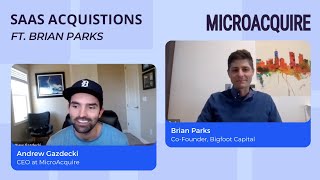
This is a YouTube video titled "SaaS Acquisitions w/ Brian Parks founder of Bigfoot Capital" containing an interview-style conversation from March 30, 2021. The discussion features Brian Parks, founder of Bigfoot Capital, along with multiple interviewers and a host, focusing on topics such as debt financing for SaaS companies, Brian's entrepreneurial journey, and insights into funding growth through debt rather than venture capital. The content is a multi-speaker interview but does not include Andrew Gazdecki as a participant.
Foreign.
Thanks so much for, for joining me today. I'm excited to have a conversation with you.
Yeah, likewise.
Thanks for having me.
So to kick things off, we've chatted.
A few times and there's a lot of conversations around debt financing. Bigfoot is definitely a major player in their space, I guess to kick things off. How did you start Bigfoot? What is it focus on?
Just a general overview of your company.
Yeah.
So started Bigfoot a little over four years ago, January 2017. And so that was kind of on the heels. The previous 13 years I had spent kind of split across investment banking, helping really sell interesting microacquire, helping sell primarily lower middle market businesses. So companies doing kind of 5 to 20 million in revenue, maybe 5 to 10 million in EBITDA, something like that, selling for 50 to a couple hundred million bucks. So spent about five years doing that primarily outside of tech. And then in 2010 decided I wanted to be an operator and joined my first startup as employee one. So did that. Then I started a company, an enterprise software company.
We gotta go back. How did the startup work out? Were you employee number one?
It's no longer around, but it worked out all right. I mean, I think there was a lot of learnings there. And I think with that company, for me specifically, it was the two founders.
And I joined and wore all the hats, right.
But I think that company, the guys brought some domain expertise and I think execution was just kind of a problem.
Along the way in terms of, okay, we built a product and we built the.
It was a marketplace model. We built the supply side, which is arguably quite easier. Building the demand side was a different story and kind of building that machine. And I think there was, it was.
A relatively lightweight technical product that was way overly engineered and invested into.
So I kind of. And we raised some venture capital for.
That company and ultimately it didn't work out, but that's okay.
So I left that company and thought, hey, I may want to do this my own at some point and kind of become buddies with, you know, the primary engineer and the devs. And I went to a coding boot camp, actually one of the first ones.
Out in San Francisco.
Not really with the thought of being an engineer myself.
Thought of, hmm. I just saw a lot of money.
Dumped into something that probably didn't require a lot of money to be dumped into it.
And engineers are happy to be paid.
And build stuff, but not always the best thing to do. So I did that and then came back and worked as a Rails engineer for like two months. And then Was presented with an opportunity to lead a company, not my idea company, called Brand Folder, which fast forward to about six months ago, had a really successful exit to a company called Smartsheet. It was great, right? But I spent kind of thank you. And I was I guess 30 at the time and was, okay, cool, I'll be a CEO. But didn't know what the hell I was doing.
No one does.
No one does.
And so ton of learning's there and doing a lot of things wrong and sitting in the office at midnight reading the Struggle by Ben Horowitz and just being like, yep, that's me, that's me, that's me, that's me.
That's one of my top 10 favorite books.
Yeah, the book's amazing. So anyways, did that and that was really cutting my teeth in a different seat, operationally speaking.
So now you're in debt. How did, like now I'm in debt. Like, I love your journey because you have so much breadth of experience. You were in investment banking. You've been through, you know, a startup like the ups and the downs, then you had, you know, a win and now you're maybe I just kind of like cut you off. And like I want to hear about how did you get to Bigfoot?
Like and it's, and it's kind of like, why debt?
Right?
And so I think, you know, I raised equity capital for the first company I mentioned and then we raised them for Brand Folder early on, pre product, like free anything really. And had a bunch of peers and folks I know that had kind of done the same. But growing up cutting my teeth in investment banking, doing M and A transactions, there was always a capital structure, a capital stack, right? And it was very, not just, hey, let's go raise a bunch of venture capital and blow up. Good or bad blow up.
It was just a different way to kind of construct the capital of a.
Company, which would include some equity, would include some debt, would include various components of debt and types of debt.
So I was very familiar with that construct and that didn't really exist in early stage software.
Right.
Where I ended up spending my next.
Kind of seven years, right? It was all angel venture or nothing else, right.
When did you start bigfoot? What year?
2017. So I just kind of thought like, well, why, if you, why can't you lend to these companies?
There's gotta be another path, right?
And I'm not the only person who thought that.
And obviously now there are other players.
And at that time there was really.
The only one I could find was lighter capital who had been doing revenue based financing for a while, so spent.
Some time kind of, you know, digging into what they do and then basically said alright, I think I'm gonna try to do something somewhat similar and focus on these early stage software companies where.
I've been an operator, simple as that.
Right.
And then was just kind of off to the races and had to convince.
Some other people that that wasn't asinine.
To lend money to companies that are oftentimes losing money and have no kind of traditional assets. So was able to do that and.
Then we just started kind of doing our thing.
And so fast forward to today and you know we've put out about $18 million in loan commitments to about to 22 companies. So that's what we've done recently. We kind of institutionalized our own capital.
So now we've got more capital to kind of keep doing the same thing.
Nice.
What would you say like a perfect.
Fit for Bigfoot Capital is? Cause I know every financing based company kind of has their sweet spot, whether that's by vertical revenue. Is there like a certain sort of.
Criteria that you look for with Bigfoot?
Yeah, I mean there's a whole host of them.
Right.
But you know, I'd say we will.
Operate with companies as early as kind of 75k in MRR.
So about million dollar top line businesses.
All the way up to kind of the furthest that we're involved with currently.
Is like a 15 million dollar run rate.
Right.
I'd say our sweet spot generally speaking is kind of the 2 to 7.
Million dollar top line companies growing nicely.
May or may not have raised some outside venture capital or other equity. But they're in growth mode. But they're looking to understand how to fund that growth in a multitude of ways. And so for us we're trying to understand how we align and with that growth plan. And if we do then it's fairly straightforward. So we approach it quantitatively of course.
And then we more qualitatively look to.
Understand the business and what it's doing.
Right.
And so that's what it boils down to, man. I mean you can, you can run a lot of stuff through models and algorithms, so to speak. But for us putting out you know.
Half a million to two and a.
Half million bucks, we're not that group.
Looking to fully run everything, you know, in some automated fashion and give money in 2020.
So you're, you're like a little bit.
More selective, like you will issue, it sounds like larger loans, you know, Companies that have clearly identified a predictable growth model and that's what you finance rather than, you know, the really, really early.
You know, microquire size type business for the most part.
Right.
I mean, we're toying with the concept of, look, if we can get into.
Companies a little bit earlier in a kind of reasonable format.
Right.
Not put too much debt on them and grow with them, that's great.
Right.
Like at the end of the day, we're growing this company that's only four.
Years old oftentimes alongside the companies funding.
So I very much view us as a peer. And what we're not trying to do, while we're certainly trying to grow, we're not trying to just be transactional. Relationships matter to us and we run a fairly concentrated portfolio that we can pay attention to and support.
Nice.
What would you say your favorite portfolio company is? You don't have to say their name, but can you say the situation how you met them and because there's always this like, you know, I think a lot of entrepreneurs, maybe not so much as say, when you first started Bigfoot, Venture Capital was kind of the only way to fuel, you know, growth of your startup and debt is starting to become more, I guess, normal as a way to fuel companies growth. But do you have like a story.
Of like an entrepreneur? Maybe they were thinking of venture and.
They ended up, you know, raising you and now they're just something that you enjoy sharing.
Yeah, I mean, I think there's the.
Company and then there's the people.
Right.
So for us and for me maybe specifically, it's pretty personal.
Right.
So I kind of mentioned as a peer.
Right.
And so it's folks like you that have grown businesses and are growing businesses and you know, have some experience and not necessarily their first rodeo. And there's always like more of a personal story to it. Right. People have families, people have objectives personally and their business is a vehicle for that. That's what I like. I can think of the certain founders that bubble to the top of my head where it's just like, Donnie's an awesome guy. I'm going to go to bat for.
Donnie any day because I know he's.
Hustling and I know he's just a great guy who's working to grow a business. And Donnie's raised a little bit of.
Strategic equity capital and is probably on that easy path. But if we can play that, play our role kind of in the interim and help them get to that, that's great.
Right.
I can think of Mike down in Arizona, who, you know, had also raised some venture. And I'd met Mike like three years ago. And then ultimately we ended up working together and put a million bucks into.
His company and he sold it to strategic.
Right.
And increased his valuation by like 60% and boom.
Awesome, right?
Not bad, not bad.
The money with us.
Right.
And so he's playing supporting folks like.
Himself, not necessarily directly, but through us.
So that's awesome.
Right.
So we have those types of stories.
That for me are just great.
I mean, yeah, what you're doing is.
You'Re helping them retain equity.
So when they go to exit, they get to capitalize a lot more on that liquidity then. So that's awesome. I guess my next question in terms of like debt based acquisitions, I've asked you about it, I get asked all the time, what's your thoughts on that model? Is it something that you see in the future for Bigfoot? Is it something that you've explored or thought about? What are your thoughts on if someone came to with a $2 million company or whatever criteria fit, how would you think about that?
Yeah, so the first financing I did in this space was actually predated. Bigfoot was an acquisition financing. We called it a sasquisition, which then led to Sasquatch, which then ultimately led to Bigfoot. So that's how we even named the company.
I was going to ask you that. I was like, I wanted to know. So that's how you thought of the.
Name Bigfoot circulated into Bigfoot, which, whatever.
So it was SAC position and then Sasquatch and then Bigfoot.
We've done it.
Right.
But I'd say we haven't deployed it in any strategic manner yet. In terms of say an acquisition financing product, it's something that comes across our radar and companies ask about it. And sometimes the companies we fund maybe, you know, tuck in an acquisition.
So yeah, we're definitely thinking about it.
And of course you and I have talked about it. So it's. How do we go about kind of productizing it? Let's just say.
Nice.
So if someone had a deal and they wanted to see if they were a fit with you, what would be like the three bullet points if you had like revenue threshold, churn number even? Do you have any sort of like numbers that you could share just of this maybe makes sense and obviously they can reach out to you to see if it does.
Yeah, I mean, for us, kind of the very high level filter is, are you US based? You have some software product you're selling to businesses Right. In whatever format. Doesn't have to be pure place to ask, can be a marketplace, can be metered, pricing, usage based, whatever in terms of how you run the revenue model or even tech enabled services. But there has to be some core software component to it. And then kind of that 75k MRR I mentioned, those are like US based B2B software. 75k in MRR.
And then we really like to understand.
What are you using the capital for? What is the plan here and can.
We give you enough to make it make sense? For instance, if it's okay, we can give you a half a million bucks.
And you're going to burn through it in a month. That's not us.
Right.
Maybe some, you know, and then a.
Lot of derivative things lying there under.
We'll chat with anyone that kind of ticks those first three boxes. You know, have a quick conversation, see if it makes maybe sense to evaluate.
And if it doesn't, try to lead them somewhere productive.
Nice.
That's helpful, I guess to kind of wrap things up.
You talk to a lot of entrepreneurs, I'm sure. What are, you know, for people listening that may be building a business. What's like your favorite business tip that you give?
Oh man, I think it's take the long view. Honestly. So it's, you know, these things take a while.
If I go back to brand folder, that was a, you know, whatever nine.
Year journey to an exit.
I don't remember with.
With your previous business, how long you spent, you know, building that up.
It was like a decade.
Right.
So take the long view.
Right.
I think it's.
Which may sound obvious, but. And then have that manifest in the.
Way you build your company.
Right.
And so that's not, you know, you.
Gotta move fast, of course, but not.
Over optimizing certain things, not being too transactional in certain areas. You know, looking forward while executing in the now.
Nice.
Okay, I got two more questions for you because I'm just curious. What's your favorite business book?
You had one like you were gonna be stranded on an island and you had to just bring one.
What would it be, man?
So the hard thing about Hard Things, which we touched on was a really good one. I can't claim to have read like a ton of business books, but really like that one, Jim Collins. Oh man. What's the Bus One by Jim Collins.
Could Google it right now.
But the Good to Great.
Good to Great. Yep.
Who you have on your bus.
Good to Great. Yeah.
That's one of my favorite books.
More from Andrew



The Buyers Who Made the Move: What They Bought, How They Did It, and What Happened Next






