SaaS Acquisitions w/ Elise DeCamp VP Acquisitions at WeCommerce
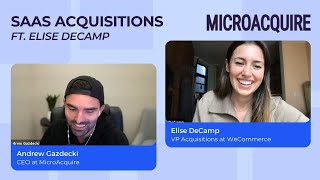
This is a YouTube video titled "SaaS Acquisitions w/ Elise DeCamp VP Acquisitions at WeCommerce" containing an English podcast-style conversation recorded in July 2021. The discussion features Andrew Gazdecki interviewing Elise DeCamp about WeCommerce's acquisition strategy, founder engagement, and the e-commerce SaaS landscape. The conversation also touches on personal interests and book recommendations, providing insights into acquisition processes and founder relationships in the SaaS industry.
Usually just roll with it and then. So we're live now. So I'm with Elise de Camp from WeCommerce Acquisitions. Thanks so much for joining me on this podcast.
Thank you so much for having me. I'm so excited. We're just doing it.
Yeah, we're just. We literally just kind of at like, what do we want to talk about? And then we just hit record. Um, my. So, so my first question, and I. I'm sure others are. Are wondering this too, is give me a little bit of background about We Commerce. What do you guys do? You know, what is your background? Any details on founding story? Let's start there and see where it goes.
Awesome. And I should apologize for, like, I don't know if you can hear this, but the expressive soccer watching outside. I'm in New York City and there's like this very excited bar across the street. Anyways, I don't know if you hear.
That, but is it. What kind of bar is it? Is it like.
I think it's a European bar. And they're watching the soccer matches. Football.
I'm not a. I'm not a football fan, so. Or I'm an American football, but all my friends are huge soccer football fans. So I get made fun of often for that. But I can't hear it if it makes you feel good.
Okay, good, good. Well, I get FOMO every day. I'm like, should I go outside and be watching? But anyways, here we are. Anyways, so, okay. We Commerce. WE Commerce launched out of Tiny Capital. So Andrew Wilkinson and Chris Barling started Tiny Capital many years ago. They've been building and buying companies in the software ecosystem for a long time. And I think around like 2019, they realized that there's a thesis to be had in the E commerce landscape. And they'd done enough work in it to realize they wanted to really focus on it. And so at that time, they really transitioned Tiny to being a bit more of a family office, more focused on a general sort of thesis. And they launched E Commerce as a public entity to focus on commerce software. And we have sort of stuck in the general Shopify ecosystem to date. It's growing at such a healthy clip. We feel like there's a ton of opportunity there. And so that's sort of. That's been the focus ever since. And as a result, we've done a couple acquisitions since. We have about like seven companies in our portfolio. Some notable ones of recent are stamped IO, which is a reviews platform we acquired last year, closed this year. And then 460, which is a shoppable Instagram influencer.
Eight to eight, however much you work, or eight to 12, whatever that is. What does your day to day look like and what's like a good day?
Oh, what's a good day? Today's been a great day.
Is it because of the. The soccer game across the street or is it someone else?
I think it's because I went to like a workout class this morning that I'm like, you know, on fire. If you go to like a 7am workout class and then start your week, I just highly recommend it. I feel really good.
Nice.
I think that it's really very much like a startup and that we're a small acquisition team and we are fairly new to, in our sort of life cycle. And so a lot of my job is changing like every month or so, just like it is if you're a founder. I was a founder prior to this, and feel like there's just different chapters and things you're learning. And so that's a high level, sort of nebulous answer. But I think, like, more tangibly, my time is really split between really like outreach, like being founder focused, and like connecting with new founders that we want to get to know. And those can be like first, second conversations. Another. Probably quarter of my time is spent on diligent, diligencing, sort of open opportunities. Quarter of my time, I guess that might be a little bit slight. It can sometimes be like 100% of my time that can really take over from like time management perspective. And then I think another part of my time is really thinking about how we are externally facing as a brand. So that's something that's fairly new and we haven't spent a lot of time on, but something that I've done a lot in my background. And so there's a lot of open room for us to sort of be more external facing. So hosting dinners and having a podcast and things like that. So spending some time sort of developing those. Those things that we want to do.
Nice. So you're essentially, you know, viewing this like a startup even though you have a large. You're a public company. Right on the Canadian stock exchange.
Yeah, yeah.
But you're thinking of ways to essentially maybe re. Energize, rebrand, really bring, you know, E commerce, you know, further into, you know, the eye of founders. Is that, is that accurate to say?
Yeah, definitely. I mean, it's funny we haven't talked about this internally about like our external messaging. This is purely in Elise's head I see us as a startup, I guess, and I think everyone would agree, but I mean, we're working with these sort of nascent companies. Right. Like, our portfolio is still like new companies that have been around for maybe five years. But, like, I still consider them startups. They're still small teams. And so I feel like we're right there with them. We're small, we're were early and. Yeah. And it allows us to like, just make decisions quickly. Move quickly. Yeah. And sort of work as a team, be like really integrated with each other.
Nice. I like that people still call Facebook a startup. So the definition of a startup, I don't know where it starts and ends.
Got to be a cap somewhere. Right?
Here's a curveball. Question. Can you walk me through a perfect acquisition step by step? Like initial reach out? You can go all the way down to the color of the logo. What is like? Elise sees a company, buyer reaches out. How could they optimize their chances of E commerce being interested and potentially being acquired by you guys?
Oh, yeah. Okay, let's think about this. So I reach out. I cold DM you on Twitter. We talk that week.
So they respond back. Yeah, okay.
You got to respond back.
Yeah, got it. That's key.
Yeah.
And I bring that up because it's so like that. For me, at least in my experience, just responsiveness of founders, it can be huge. I'm not sure if you agree on that, but. Sorry to interrupt. You go on.
No, I think that. I think that's right. I think one of the things that I try to push people to do, some people will respond and be like, yeah, I don't know, I'm just not thinking about it right now. Maybe down the road. Or they'll sort of see it as like, kind of insulting. They'll be like, no, like, I have tons more room to grow. Like, why would I have an acquisition conversation? They see it as like, it's an out. It's like an end of the road. And so I try to like, convince founders, if the opportunity is there, that like, that's not how they should be looking at it. Unfortunately, acquisitions have been sort of, I think, branded inappropriately in our sort of society as this, like, really laborious, awful experience. Because it can be, it definitely can be. It can take a year, it could fall through. You could just, you know, be completely distracted from actually building the business in the process. It's. It can be really painful. And so we really try to make it as, like, pain free as possible. And so I try to have conversations with people that are just like, let's just get you evaluation as quickly as possible just so you can see if you want to like have this, if this is a real thing. You know, I don't want to, I don't want people to spend too much time on, on going through this process, but I want them to see it as an option. Right. Does that make sense?
It does. And I can actually verify that for what it's worth. I've had a lot of founders that have worked with you and the tiny team. I don't know if you guys overlap, but I've heard nothing but great things across the board by just making it easy because I went through an acquisition process that took years and probably years off my life as well. So I, I think a lot of founders will, will definitely appreciate that approach in terms of like, you know, sort of like the size of businesses that you're looking to acquire. Can you give any details on that, like profitability, revenue size, or maybe even something that like you're looking for actively today?
Yeah, we typically say that a million dollars in annual revenue is sort of our starting point though. We'll sort of flex on that a little bit. And then max, we're saying sort of 50 million in annual recurring revenue, which is a lot. That's like a huge, it's massive, right? Yeah, I would say that probably 90% of the companies that I talk to are annual in that 2 to 7 million dollar range, let's say majority. And for us, you know, there's not a better or worse in regards to size. Profitability is great. We definitely look for profitability as a publicly traded entity. It supports our stock price. And so we do want to be able to at least see that there's a path to profitability if there, if there isn't one. So I think like a dream target is like having 40% EBITDA margins. But we see, I've seen everything under the sun. I've seen, you know, businesses that are doing like, you know, 10 million in ARR that have like 80% margins. It's kind of crazy and I've seen the exact opposite.
So did you acquire that business 80% margins?
I don't know. Can't say too much.
Okay, okay.
But yeah, I definitely never go in with any expectations. Like I, you know, I kind of see myself at this point. It's like a walking, talking benchmarking system since I have talked to so many. But you just never know until you look under the hood.
So what can founders do to Better prepare for acquisitions in your experience. What's like a common theme that you see because you talk to so many founders, maybe it's a simple P now, maybe it's responsiveness to your questions, maybe it's being open about selling. Like, what are some things that founders can really do to, you know, as you really start going down that path with them? They're prepared.
And yeah, I think like definitely it's important to be really open and transparent about your historicals. Like, you know, if you have any, if you had any sort of founder fallout, if you've had any indebtedness, like if you've had any sort of, any things that we should know, we should know in advance. Just builds trust, like where we're easygoing people, but we sort of need to see those in advance. And I think from like a materials perspective it definitely helps to be fairly organized. You know, we don't expect someone to have like a full blown data room. Especially if I'm reaching out to them, like why would they if it's not something they're not going through a full process. But you know, it definitely helps to have a strong understanding of like the simple things which are like, do you have like organized P&Ls from the past few years and the most recent quarter churn metrics? Like you and I have talked about this a lot. Like just having an understanding of your customer cohorts and retention and like any changes on that end is just so important to us. It's a little scary when a founder doesn't have that together. What else from like a materials perspective? Perspective is really important.
What about from, what about from like, you know, relationship standpoint? I know you mentioned like transparency. I'm sure just being a stand up person is a no brainer. Is there any sort of things that you know when maybe margins are like a little bit lower but they kind of paint the story of, you know, we've been, you know, really maybe we've been growing the business or operating the business at break even and like that scenario. Is there anything a founder can do to you know, just stand out in terms of like a person that you'd want to work with?
Yeah, I think definitely like storyline matters. So if there is like, if they're a, if they have a secret sauce in general, like we're here for it. So we're also flexible in like our model. Right. We're not buying businesses to completely like tear down the team and the founder and start afresh. Like we work, we talk to the founder we work backwards and say, like, do you want to stay? What if you're going to stay, what would that look like? Like, do you want to keep a certain amount of equity? So the. There's definitely something exciting for us. If the founder has a secret sauce towards building their business, whether they're like just a masterful product person and they can see an opening in the arena, and then they can build a product in three months and they can just turn those out like every six months. I see that. That's like a really valuable human and, like, we just want to be around them. Right. Or they are like a growth marketing, like, expert. They like, really, like, good with products. They've hired the right people on product, but really they know how to get their app or their software out there. Like, we, we want to know their secret. So there's like a lot of intangible values there too, that, like, goes just so far beyond, like, finding a revenue multiple or something like that.
Nice. And then how often do the founders that you work with stay on board after you acquire their company? I know it's optional. You give them.
Yeah.
If they want to walk away quickly, they can. If they want to stay on, they can. How often do founders stay on and what does that typically look like?
Yeah, I don't know if I can. Like, there's been enough for there to be like, a lot of pattern recognition. There was stamp. The founder did not for various reasons. And then with 460 did. So it really totally depends. And I was telling someone the other day, it's oftentimes the founder, like, wants to start a family. Like, I don't know what the deal is in this industry, but, like, it's always. That's like, the reason that I hear 90% of the time that founders are like, whatever we do going forward, I just need more time to spend with my family. And so it's an interest. It's very interesting to sort of solve for that.
That's kind of awesome. You know, you're. You're starting families with acquisitions. That sounds kind of weird, as I say it, but.
Yeah, trying to solve for their needs, you know, like, I.
Mean, what an awesome part of your job is, you get to enable people to move on and, you know, start a family, move on to another business, whatever it may be. So that's how I view acquisitions at least is, you know, sometimes you get to a point where you're ready for a change, you want to start a new business, start a family, buy a home for a wedding, whatever that's what acquisitions pay for student loans. Yeah. So that's awesome. What's the hardest part about your job?
Oh, goodness. Speaking to venture capital. I don't know if I should say that.
Yeah, I mean, I think everybody has, you know, a hard time with that. There's like two, three, maybe that don't. But yeah, that's. That's a true one.
Yeah. It's like apples to oranges. Like, it happens so regularly that founders are evaluating selling versus taking on more capital from venture, which. And it's just their opposites. And it's just kind of funny that, you know, that's. That's a regular thing. That's stuff.
Yeah, a short story there. So, on my first business, that's exactly how my initial angel investor sold his business. He was in a position where he was going to either raise capital or sell a business, and he had term sheets on both sides. He ended up selling the business. It's now worth billions of dollars, Literally billions of dollars. And he's doing fine. He want. He sold the business for 50 million bucks. His name is Christian Friedland. He started a company called build.com and he sold it in 06, right before the 08, I believe, or before the crash. So, you know, it's kind of things like bird in the hand, two in the bush. You might have something of immense value. His life is great. He's in Puerto Rico now. He's a happy individual, but every once in a while, he'll kind of. I talk to him frequently still, and he's like, gosh, kept that company.
Why did he sell? What was the.
I don't want to speak for him too much personally, but it was a situation where this company was looking to acquire either his company or another company, and he ended up selling his company. And then the company that wasn't acquired, his company later acquired for at a much lower valuation. And so they had a way of reducing basically the cost of their supply chain or whatever. They literally sold toilets on the Internet. That's how they started. They have the coolest. I did a podcast with him when I first started doing this. So for anyone listening, check it out. Christian Friedland's like the closest to an Ari Gold I've ever met in my life. A genius, absolutely hilarious, and one of the best humans I've ever interacted with. But that story came to mind.
Well, I'm gonna listen to that later.
So I guess this, you know, final questions. What do you like to do for fun? Elise, Tell me a little about yourself on, like, A personal level.
Oh, that's so nice. Thanks for asking. That's right.
Of course. Of course. I try to be a nice guy.
Yeah, you are a nice guy.
Thanks.
Let's see. I have a dog, so I spent a lot of time with him, so I feel like he's a Berna doodle.
I love doodles.
Really?
Yeah, they're like, like pillows. I mean like, literally don't like. I don't mean like, I'll lay my head on it, but it's just like such a cuddly animal.
So cuddly. Yeah. He's usually like really involved in calls, so I'm surprised he is asleep right now at my feet. Girl said I would get him up here, but so, yeah, a lot of dog park time. Let's see. A lot of reading. The big reader.
What's. What's your favorite book? Oh, my gosh, that's a hard question. You can give me like one of your favorite books.
Okay. The Glass Bead Game. Do you know that I have.
Do you read fiction or nonfiction?
Both.
I have. I haven't heard of that one. No.
Really?
Oh, I'm an avid reader. I have it. I have a huge.
Oh, you're gonna really like this.
Three books.
You're gonna really like this. I'm gonna study. It's Hermann Hesse. Pat Hesse.
What's it about?
It's about life. Yeah. I don't quite know how to explain it, but it sort of puts into perspective like careers and life and choices and it's really good, I think. What do you like to read?
I pretty much only read business books. It's a habit I need to break. A friend recommended World War Z recently, the book, because that's one of my favorite movies also, I should say, like, I like Moneyball and like some other normal movies, but that movie I always liked. But the book I guess has like different chapters of like, how, you know, I don't know. Check it out. It's different than the movie.
Okay, cool. Which one do you think is better?
Well, I've only seen the movie. I haven't read the book.
Oh, yeah. Okay.
So that's on my to do list, is to start reading some non business books. But in terms of favorite business books play bigger, if you've heard of that one. So I like marketing and category creation and branding. I think you would really love that. Read Impossible to Inevitable by Jason Lemkin and Aaron Ross. What's another one? Strategic Entre. Ism is like the word. It's kind of a book about how to build an acquisition or how to, how to build a company with the purpose or the goal of it being acquired. The premise of the book is basically trying to, you know, build a puzzle piece for a larger entity to potentially acquire. What else? That's from my top three. And then probably tuned in. Tuned in is another good one about just really how to, you know, not just talk to customers but when you talk to customers, how to really pull out pattern recognition so you get, you know, you don't show someone a product and like, do you like this? They're almost never going to say no, I hate it. You know, you can really get that honest feedback.
I'm reading. Never split the difference. I don't know if you've read that before.
I haven't. That's on my list of like everyone's read it. I haven't read that one.
Yeah, it's, I mean really good. Like love the lens that it's coming from. He this, the author like worked in FBI for a long time and negotiated hostage situations and very interesting. A little bit hard to get through but like we're getting. I'm like 75%. I'm like looking at the percents every like few pages I'm like chugging through. So it's interesting. Hoping to employ some of these strategies. We'll see.
I'll check both of those books out, I promise. So I guess final question. You know, there's a lot of entrepreneurs out there looking to sell their business. You know, why should they potentially consider selling to E commerce? And how do you help founders achieve what they're looking to do?
Yeah, I mean I definitely think that choosing the right partner is really important and every business is so case by case that I can't sort of say like we are the right partner for everyone for the X reason. But I think, I think we are the perfect partner with certain companies for that reason. We're very specialized and what sort of value we think that we can provide and we think about the founder and what they're looking for and what their Next sort of 10 years should look like. And we want to build businesses for the long term. So we're making bets in sectors of E commerce that we feel really strongly about and feel like we can really add value to in the next 10 years. So yeah, I don't know if that gives a really. It's not a hard driven pitch, but that's the honest answer is highly specific. And we think that we have an exciting road ahead. Again, we're a startup, we think this is just the beginning. So it's going to be a fun future for E commerce.
I love it. Yeah, we got a Shopify SaaS application with revenue from 1 to $50 million. Definitely reach out to Elise. Elise, how can people get ahold of you?
Yeah, you can email me. Actually, I don't know Elise@wecommerce co. Totally fine. Or you can DM me on Twitter. And I think it's should work on this. It's decamp underscore. Elise.
All right, Elise, thank you so much for joining me on this podcast. It's been a pleasure.
Thank you. Appreciate it. Sorry. Really? Fine.
Cheers.
Really?
Yeah, they're like. Like pillows. I mean, like, literally don't like. I don't mean like, I'll lay my head on it, but it's just like such a cuddly animal.
So cuddly. Yeah. He's usually, like, really involved in calls, so I'm surprised he is asleep right now at my feet. Girl said I would get him up here, but. So, yeah, a lot of dog park time. Let's see. A lot of reading. I'm a big reader.
What's. What's your favorite book?
Oh, my gosh, that's.
That's a hard question. You can give me, like, one of your favorite books.
Okay. The Glass Bead Game. Do you know that I have.
Do you read fiction or nonfiction?
Both.
I haven't heard of that one. No.
Really?
I'm an avid reader.
More from Andrew



The Buyers Who Made the Move: What They Bought, How They Did It, and What Happened Next






