SaaS Acquisitions w/ Eyal Toledano founder of MicroAngel
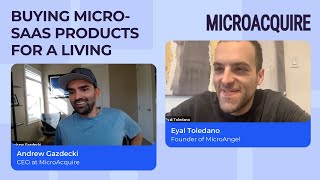
This is a YouTube video titled "SaaS Acquisitions w/ Eyal Toledano founder of MicroAngel" recorded in May 2021. It features a conversational interview between Andrew Gazdecki and Eyal Toledano discussing SaaS company acquisitions, due diligence, and Eyal's fund MicroAngel. They explore strategies for acquiring and operating micro SaaS products, mentorship, and scaling startup involvement. Andrew Gazdecki hosts and actively participates in the dialogue, providing insights and questions throughout the discussion.
All right, we're live, y'.
All. Sweet. So we.
We were talking before this about a number of other things, but we decided we would focus on the first acquisition that you made.
Yes. Thankfully, enabled by Microacquire, no less. Very important. Very, very important. It's. It's. It's like. I think it's like, without Microacquire, it would have taken at least another three, four months just to find, like, that kind of deal.
Wait, let me ask you, though. Like. Okay, so describe what was the first deal that you did?
So I bought a B2B SaaS Shopify app called Reconcile, which basically helps Shopify stores send all of their payout transactions and all that accounting data over to Xero automatically, which usually takes like, 20 to 25 hours to reconcile every single transaction that happened throughout the month. And I bought that end of February, and it's been ticking along ever since. Yeah, first acquisition of the fund.
Nice. And I remember that one. It had, like, 50 people. There was a lot of people interested in it. How do you think you stood out on that acquisition.
By far? I think when the acquisition was listed, I remember it, like, listing in the middle of the night. I saw it come out, and I knew that it would be, like, a hot one, but it was really expensive. So, like, they were reporting, you know, like, 73k in our ARR and asking for 350k, which was, I found, outrageous for, like, that kind of product. But I didn't mind. Like, I still got in touch, you know, I still basically did my thing and basically made an offer which is completely outside of the norm. Like, normally I would get in touch with them, I would meet them, because I knew that this was a really fast deal. I made an offer up front. I was like, hey, will you accept $180,000 in cash? Just straight up half of his ask. And I just sent that outright into the chat. And I actually said, will you accept 180k? And he replied within minutes. Would that be in cash? And I found that to be a really strong qualifier. Okay, for starters, you're actually looking to sell. Secondly, you answer really quickly. So there's a bunch of interest in my last response. And then you're asking if it's all cash, which is like a seller's question. You're really there. And I basically said, yep, all cash. Ready to move really quickly if you want to move really quickly. And that's basically, like, within a few days, an LOI was drafted. Thanks to that, I was just able to just cut through the Noise and go straight for the goal.
Yeah, I think definitely moving quickly and having cash offers is definitely a huge benefit and a way to stand out as a potential buyer. What did you do for due diligence? Like what's, what are like maybe your top three tips or things that you kind of like things that you look for when you do due diligence on something.
So the first thing is like, how true is the revenue? Because reporting revenue is one thing, but actually being able to look at the historical, like how much they actually build. It's one thing to report a run rate, it's another to report what you actually build. And once you do that, you tend to find patterns. For instance, I'm looking at a deal right now that on those fundamentals looks really good. But then when you chart the revenues, you can clearly see that the revenue capped out. Then that was a pattern I identified and it made me ask like, wait, what's the churn rate on this? And then when I looked at it, the churn rate was so extreme that the revenue could no longer go any further because of that. And so I withdrew because of that. But like, that's the thing. It's just like get a visual representation of the revenue so that you can pattern find is the first thing. The second thing is like, same thing but with costs. Like, you know, like everybody wants to report a high profit, but then everybody like reports on their costs differently. At the end of the day, like, you want to get an idea of what you need to spend to maintain what you have, like, and get clear picture on the profit. And then at the same time you want to base your offer on that profit number. Like I don't really make offers on ARR, I make offers on Ebitda. You know, like, that's the whole point is how much can I get out on my investment? And then the last one is like, invest in what you know for sure. Like the whole idea, the whole advantage is that you're buying something to operate it without having to start it from scratch. But you wouldn't start something from scratch that you don't understand. So like only buy things that you understand so that you can actually benefit from what you do know and apply it A thing. Like the only reason I was interested in reconciling, for instance, is like, my wife is a cpa. I've been through many attack seasons through with her, you know, and so I've been exposed to this kind of stuff. I use Xero all the time. I'm a Shopify app developer. And I get all, you know, all these stars were aligning and then the product was really simple. So like it made a lot of sense for me to acquire something I understand and can work on. Yeah, that's what I would say.
That's awesome. Tell me about your goal. I know what it is, but you have a fund. Tell me the name, tell me your goal. What are you looking to accomplish over the next like 2, 3, 30 years?
Sure. I don't know about 30 years for sure especially. But Micro angel is the name of the fund. Basically the idea is like literally a small angel. What would that look like? Somebody who doesn't have, hasn't had a huge win in the past, but might have like saved up some money and like challenging the notion that the only way you can get into startups full time, like almost like indie hackers if you will, is to start from scratch. And what would that look like? And so my goal basically is to invest like I'm investing a half a million dollars over the next few months, which I'm almost done. And the goal is to hold the products that I'm going to buy, really simple micro SaaS products, to hold these for a period of two years and over that period of two years to basically perceive all of the revenues that those micro SaaS products produce as personal income. And since they're high profit, I can basically leverage that as my take home pay. And because I do that, I no longer need to sell like half of my time as a freelancer or something like that, or work only nights and weekends or something like that to work on any projects that I want to work on that feel like play, knowing that the products, like over those two years those products will keep really steadily growing because they're simple products. But I only invest in products that grow over time really slowly. And because they are growing really slowly over a period of two years, they'll reach a certain point where the value of my portfolio will allow me to sell it. So I can perceive a 2x return on that half a million dollars two years later. And that's kind of the idea. So like for two years can somebody take a sum of money, invest it in micro SaaS products that throw out high margin MRRs, use that MRR as revenue for some period of time, use that new available time to materialize like whatever bootstrapped product or whatever, like be ambitious, right, and do things that you otherwise wouldn't be able to do. And then when the time comes to go all in on your project, you can basically sell off that portfolio, which will have grown over time, and then use that to go all in and focus on the one thing that by now is taken off. That's kind of the model that I'm trying to prove out. And the idea is that if this works, and I'll know in a couple of months just by like, the direction that it's going, I want to enable more people to basically do it. And I'm like, my initial reaction was to just raise a rolling fund and just invest in more products and do things like that. But I think instead what I'll probably do is like, enable more people to go full time. Like, that's the main thing. It's like for every person who manages to be an indie hacker, like, and what I mean by that is the person who signs up to the pain and like, do it all from scratch and like has the scales and all those things. For every one of Those, there's maybe 100 or 200 who kind of have the skills, but not like, can't actually get into it for whatever life circumstantial reason there might be. And it'd be really cool if there was like a fund that basically let you keep all the mrr. So like, imagine I would give you assess that the fund would buy, you would operate it for a certain period of time, keep everything that you make. But then when we sell, we're the ones that take for instance, the return. And in that time, this individual would have basically built up a bunch of experience, would have stripes, like they've earned their stripes, and then could potentially buy something bigger. And I think that's where I'm headed as a tiered incubator, accelerator or something like that approach where I can continue to invest as an investor. Because the idea is if this model works, I'll continue doing it as an individual with another half a million dollars, for example. But then how do I scale this? And the idea of scaling this is more like, I don't need that MRR as part of my fund. What I care about is the eventual returns that I can get from enabling dozens or hundreds of entrepreneurs to do this rather than just me on my own. That's what I'm exploring right now.
That's awesome. So to kind of simplify that, you would acquire a company asset and then you would place a young operator to help grow, manage that. Either company or applicant, is that kind of right?
Pretty much. Pretty much, you know, and like, let them benefit from the product in its entirety. But then when the time comes to sell it and I don't know yet if like, probably they would have to have some skin in the game. Maybe they best it, you know, for two years, whatever that is. But like to make it more easy to get into startups but then reduce that initial failure rate. And the way we do that is a we buy instead of build from scratch. From scratch. The second one is like mentorship. So like I've been through the ringer dozens of times and like somebody who does it for the first time, even though I give them a product that's sort of running on their own, they still have to have an idea of what to do. But the advantage now is like, you know, like when you start something from scratch, you have to know everything and you have to learn everything and you have to do everything well, you know.
Like as they're basically put out buyers, basically.
That's right. The advantage with something when you buy it is that it's more focused chaos, you know, like you're buying something where you know where the fire is and you know, exactly like you have a playbook for how to fix it. And the difference is that instead of you doing it on your own, we would be enabling other people, showing them the ropes in a really specific context and they would be learning things in the context of making a product get better. Which to me is more important than like, you know, like market. Product fit is super important, but it's a singular event in the life of a product. After you're done with that, then everything starts. That's so much more important in my view now is how you execute. So yeah, that's what I'm exploring.
I like that. I completely agree with you. I think you learn the most in startups when you actually are involved in one instead of just reading about it, talking about it. I like that. That's a way of getting young entrepreneurs who might go down the path of building something, it doesn't work out. They just wasted a bunch of their savings and you could kind of help them by putting them into a, you know, product of paying customers more to kind of, you know, move around, so to speak. I guess my next question would be, so you're doing all this really awesome and interesting stuff and you're sharing it with everybody. What, like, how did you learn to, you know, acquire companies? Or what advice would you give to someone? You know, square one. They're like, I'm interested in doing something similar. I'd like to buy maybe one SaaS company. What resources would you recommend checking out? Aside from yours? Because Yours is awesome. That should be a no brainer. Where did you start in terms of like, how did you learn how to put this together? What would you recommend to yourself if you're just starting?
You know, that's tough because like coming up with this idea wasn't like a weekend. Like I've been thinking about this stuff for years, you know, like for me it was a wall that I was trying to get through. And that wall was I didn't have any resources that I felt I could dedicate and that changed over the last few years and like it enabled me, so to speak, to start this fund.
Right.
Like not everybody has a half a million dollars lying around. Right.
Let me reward that, I guess. Not resources like financial. I met.
Oh, learning, sure. Yeah.
Like how did you learn? How did you get the confidence to say, hey, I can acquire a SaaS company and I don or Apple to do it?
Sure. I mean I've been, you know, in tech for like 15 years at this point. You know, I've worn the CEO hat a few times. So I've learned through failure more than anything. But a lot of like I've built a style over time. So like there are books, like the E Myth Revisited, you know, like one of those books that has just changed the way that I think about business. So like there are a few moments in my life that caused me to create like my style. And like over the past, I would say like five years, I did so much. Basically I helped startups grow really big, really fast. Like that was my personal value prop. I was basically a VP of growth for a bunch of startups. So I know how to do this on the field. And like I earned my reputation locally in Montreal because like I actually walk the walk. I do the stuff, I'm like a marketer that can code but then also do the stuff, not just write about it or sell, you know, education on it, so to speak. So like that's what I would say is just like walk the walk. Like start by figuring out what it is that you are looking for and like try to materialize that future. And what I mean by that is like if you have a certain set of skills that has or a certain kind of experience over your lifetime that has suddenly caused you to say, yep, I can do this on my own. Like I can. Or you're suddenly interested in buying something, the reason that's happening is because inside like there's some experience that is pushing you to say like, yeah, I could do that. Like I would just say like feed that and go from there, you know, like, every person will buy things differently. You know, like, I get a bunch of Twitter DMs from different angles. Like, someone will come in with, like, the minutia. Like, you know, how do you cut up the payments and, like, over what period of time? And, like, those things don't really matter. You know, like, what really matters is whether a deal happened, whether both sides are happy, whether you feel like you know what you're going to do. You know, like, at the end of the day, this is way less rocket science than it might appear. You know, like, you're trying to find people who are working on stuff that you like, that you identify with for a market that you understand. And, like, really, then you're trying to convince them to give up their product in exchange for, like, in a transaction. Like, everything is so different that you can approach it really humanly. Like, that's the first thing that I would say is just approach it like a human and talk to people and meet them and, like, understand their motivations and be really clear about what your motivations are. And what you'll find is that especially through places like Microacquire, because there's so much deal flow you'll have, like, in a volume that suddenly you'll identify some of those people that kind of think like you or work on products that are interested, you know, that you're interested in. So I just say that, like, expose yourself, but be really clear about what. What it is that you're looking for. And if you approach it, like, from a perspective of, I don't know, if I were to start something from scratch today, odds are I would work on something that I know and that I'm interested in, like, go from the same direction. But the difference is that you'll have to then produce. Like, there will be a transactional component at some point. That's really the difference between buying and starting something. Yeah, that's really it. And then you're just dealing with a different set of challenges, I think, than starting from scratch.
I like how you said that. Just be human. Because honestly, the most successful people I've seen on Microquire, you know, approach people in a way where they, you know, they value the relationship. Because, like you just said, with the first app that you acquired, the price was too high, but you still communicated with a potential seller. You built that relationship or you fostered it, and you never know where things can change and you start to, you know, maybe get on the same page with the seller. Yeah, I definitely like, that advice, I guess maybe just, you know, final questions are, you know, who do you look up to? Like, who do you look for inspiration or, you know, favorite authors, anything.
That's a tough one on the spot because, like, like, I'm a firm believer in, like, you are the five people that you hang out and read about the most, you know, and I, I change those five people all the time because otherwise, like, you're. You just become one kind of person. And for that reason, I just read a bunch of different kinds of things at different kinds of. Like, right now I'm getting interested in 3D printing. I had. I have no idea what seed there was that was planted in my brain somewhere along the lines, but suddenly I'm looking up 3D printing, like books. But, you know, over time I had a mentor back at Founder Field. So, like, he's not on Twitter or anything like that, but like an accelerator that I went through in Montreal back in, like 2011, 2012. And this guy, John Stokes basically taught me, like, how to communicate. Like, that's a very, like in italics, you know, like, how do you pitch? Really, like a typical startup? But, like, he broke it way down to, like, stop like, complicating things and be human about it. Like, you are trying to get someone to understand some insight that you have that is going to make them understand your product or your startup or whatever it is, and like, break it down into like these five or ten different buckets and like, walk them through. And like, he made me understand how to communicate, really. And that helped me throughout my life. Another thing is another person is probably Ryan Dice from Digital Marketer. So Ryan basically, like, back, I would say, like five plus years ago, when he was still like actively creating the content himself, was driving all of that content through his own experiences. So it wasn't like frameworks and things like that. It was like, I did this. It worked. Here's how you could do it too. And he made me really think about just like demand generation and customer acquisition very differently. Where in the past I was really like, leading from the gut. Like, how can I. What ideas can I come up with to attract people? You know, like, and it broke it down to just like economics of like, what are the different funnel pieces? And like, how do you. Like, I made me understand marketing and numbers, I guess, and then that actually translated to things, you know, like analytics and the product, like mix panel and like actually taking this, these learnings at the marketing layer and applying it to the product and growth marketing and things like that. Really interesting stuff. Like I mentioned, E Myth revisited. This idea of building systems so you work on the business instead of inside the business is just a huge thing.
That's a total mindset change. I meet a ton of entrepreneurs that are deeply working in the business, but when you start working on the business, that's when you get the significant changes. So that, that's a key learning right there for sure.
Knowing how to zoom in, knowing how to zoom out, like, recognizing whether you're zoomed in or zoomed out, you know, like, how the pieces fit together just made me a more strategic person, you know, and then all those things together just makes me more deliberate about, like, you know, like, if you're setting a goal, like, what are the things that happen for that goal to actually happen? And it's funny because, like, it's less scary today than it was before because I rec. Like it. And I don't mean like this in an arrogant way, but like, you know, there's idea, this idea of, like, how a master becomes a master. So, like, you start off by thinking you know everything. So, like, it goes like this. And then as you learn things, it goes way back down because you realize, like, oh, wait, I don't actually know anything. But still, like, as you learn more over time, like, you get a white beard and you're like, old and you're super wise, you still don't think you know everything. And that's when you're. You're a master, you know, like, and I feel like I'm starting to get to that point where I feel like I still don't know everything, but I'm much more comfortable with that because I know what my style is today and I know how I apply it. And, you know, I find comfort in that, basically.
Nice.
I like that.
I guess. Final question is. So I've been watching your journey and you're documenting every part of it. If people want to learn more about Micro angel yourself and the deals that you're closing, where can they find you? Where can they subscribe to your newsletter?
Cool. So I'm on Twitter at Eyal Toledeno. You can read the newsletter at Micro Angel. So it's free, mostly free. And I try basically to write as much as I can. And right now it's focused on things like how I'm buying stuff. But over the next few months, it's going to start transitioning to how I'm fixing the products that I've acquired and how I'm going to operate and grow them. And so it's going to be a journey over the next two years and MicroAngel so is where you can find it.
All right, well, thanks for joining me on this podcast. And definitely check out Micro angel because yalls documenting every single part of buying companies, growing them. And maybe one day this will be a billion dollar fund or something.
God willing.
All right, thanks. Thanks for joining me.
Cheers, man.
More from Andrew



The Buyers Who Made the Move: What They Bought, How They Did It, and What Happened Next






