SaaS Acquisitions w/ Landon Bennett Founder of Userfeed
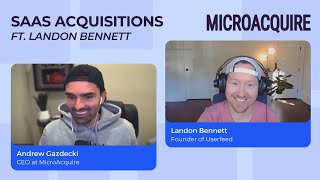
Landon Bennett, founder of Userfeed, talks about building and selling his SaaS startup through MicroAcquire. He breaks down the acquisition process, deal structuring, and why focus matters when you're trying to get acquired.
Foreign.
I'm here with Landon Bennett, founder of a company called User Feed that was acquired on Microguire for six figures. So glad to have you on here, man.
Thanks for having me.
So, to kick things off, tell me a little bit about you. I remember that startup coming in and I looked at it and I was like, this is sick. Do you want to maybe start off with explaining what it did, the problem solved, all that fun stuff?
Yeah. So User Feed, it started out being a feedback tool built solely on top of Intercom's platform. We ended up like, our strategy ended up being kind of trying to build multiple apps on top of Intercom and using that as sort of like a, its own flywheel within the Intercom ecosystem. So similar to like how people do do that sort of thing on the Shopify app ecosystem and they'll have like multiple Shopify apps and then, you know, they have some users over here, they see the other apps you have, they start using those. And since we weren't branching out, you know, with other support platforms, like integrating with them, we decided let's just build multiple apps inside the Intercom ecosystem. So we only got to like two apps before we ended up selling the business. But, but that's, that's essentially what we did. And so we had the one, the, the one app that was the, the feedback tool built on Intercom. And then we had another app that was sort of like think, sort of like sales loft, something like that where it's allowing you to set up like follow up messages, but you could do it directly within an Intercom conversation. So it was mostly geared towards support related issues. So like when you know that, you know there's not a, there's not a resolution to the issue, you can continue to follow up and then if that person follows up with you, it like reopens the conversation and you know, cancels the follow up and all that stuff. So they don't have any of those features. So we sort of built that out specifically for Intercom customers.
Nice. The design is badass too. I remember looking at it and I was like, I'd use this. So nicely done. I love, I love how, you know, a lot of entrepreneurs when they think of startup ideas, like one great place to start is like ecosystems, you know, like on top of the ecosystem or the Intercom app store or Slack or something like that. So that, that's badass. Tell me about the acquisition. You know, I want to know everything, but you're free to only tell me what I know. Nothing. I just know you Sold it. I hit you up on Twitter to hear the story. How did it go? How did you hear about Microacquire? How did the listing go? Tell me how you negotiated with Buy. Give me the five minute rundown.
Yeah, and that's a super blanket that.
That was a question that could have been broken up into like 10, but like maybe just give me like the quick highlights and then we'll, we'll narrow in.
Yeah, we'll, we'll do the whole story. So, so we actually, Kyle, Kyle and I, Kyle's my co founder. We, we actually had two software businesses. So we have another business that we're still running right now called Ad Reform and we've had that like, we've been doing that for about four years and then User Feed was about two years old at the time that we sold it. Um, but. And Userfield actually was like born out of like a problem we had at Ad Reform in terms of gathering feedback, using intercom and that sort of thing. So that's how it originally got built. But at some point, even though User Feed was growing and it was just, it was growing slower than our other business, which was already much larger, which is Ad form.
Right?
Ad Reform. Yeah, I think at the time.
I'll put in a plug.
Yeah.
What. What does Adform do?
So, yeah, so basically it's a, an ad ops automation tool. So all of these ad tech companies, agencies, all of these different companies within the ad tech ecosystem, typically they all have ad operations teams and these are the teams that are, think of them as like sales operations for SaaS companies. But it's like, because it's ad tech related companies, they're doing all this ad serving and trafficking and queuing ads and reporting and all these things. It's like all the little, tons of little tasks that they're doing all day, we basically build a number of different tools to automate, you know, not all of those tasks, but a number of those different tasks. So it's a, so it's a badass startup. We like to think so.
I mean, I'm very familiar with, you know, sales teams and building them and like the, the struggles and just like, you know, figuring out ways to like streamline stuff. So I like the sound of that. I'm going to check it out.
Yeah.
But back to the acquisition.
So yeah, we, so we decided to sell, this is in I guess December, like late November, December of 2020. So right before the beginning of the year, we basically just decided like we need to go full time on Adder Form. It's already like, it was like a, you know, mid six figure business. ARR. And we just, it was a lot larger and we just needed to focus our time on it.
So I want to pause there because that's, that's such a good lesson for entrepreneurs. Like, so you sold a business that, you know, I'm assuming that you weren't putting full focus on, but it was a good product and you have this like better business that has more upside. And so you decided to kind of like wind down a couple, sell a couple off to focus fully on outer form. Is that kind of correct?
Yeah, basically. I mean, basically, yeah. Take some money off the table, get some, regain some focus for Kyle and I.
So you got a little seed money out of acquisition?
Well, I'd say ad reform was, was seeding user feed for, for a long time. So, but, but yeah, I mean the cool thing was we basically, so we basically put it up for sale in December, beginning in December. And our goal was let's try to find like money is not the number one thing here. Right? Like we want to, you know, we want to make a little bit of money. But I think the bigger thing for us was we want something that's easy and quick or, and find somebody that's a good fit, basically. So, so yeah, so we put it, put it up. Uh, I was actually really surprised with the amount of like incoming requests that were kind of coming through. I mean we probably had probably 40 just like within the first like week or so. We had like 40 people reaching out, you know, requesting more information. I basically would, I spent a good amount of time kind of like weeding through those just to make sure that they were legit and not competitors and that sort of thing. And we probably dwindled it down to about, I don't know, let's say around 20, that we were like, went a little bit further with, or jumped on a call with. And then from that 20 we kind of like went kind of the next step of going through a little bit more due diligence with about 10 of those. And then we ended up getting about three offers and this was all within the timeframe of about two weeks, basically.
What? I didn't know this. Yeah, dude.
Yes, it was, it was super, super easy in terms of just getting like raw like traffic or leads, um, which I was surprised, I was honestly surprised with. And, and, and, but yeah, so we kind of went from there and then we started going, we looked at the different offers and we went back to kind of where we started with our goal of like, okay, we want something easy. We want to kind of just get as much cash up front and just be able to move on within a, you know, a month or two. Because, like, the whole goal of this was to regain focus on our other business. And I love that.
Like, like, when I sold business apps, one of the main things I focused on was I valued terms over price. Like, no, earn out all cash, quick transition. Those are important to me. And also focusing on like the relationship, doing due diligence on the buyer, Are they legit? It sounds like you kind of went down like a similar path. Is that, is that accurate?
Pretty much. And I think, I think I had reached out to you at some point. This is back when you were probably handling all the support load.
Yeah, yeah. Oh my gosh. Yeah.
But you were helpful. You were really helpful because I was basically like, I mean, you basically gave the advice to focus a lot more on terms than on whatever the value of the price that they give you. And you also mentioned, I think you also mentioned something about like maybe starting out with a little bit lower desired offer number so that you get more offers. Yeah, I think that maybe helped us get a little bit more action on that, you know, on the listing. Yeah.
If you get multiple, there's a saying, if you have one buyer, you have no buyer, so you want to draw in a bunch. And then if you're successful, you can, you know, negotiate and raise up the price or you have leverage on the terms and stuff like that.
Exactly. So we got those three offers. A couple of them were finance based, so it was like one of them was some sort of earn out type of thing or milestone based stuff and that we weren't interested in that. The other one was financed over, I think it was 12 months or something, which we were also not interested in. It's like the whole goal is let's get the money, let's help with the transition for one to two months, and then we're basically gone. And so the last offer was basically that I think they paid us like half or 75% upfront, and then after that initial month or two transition period, they paid us the rest of it. And there was no sort of like milestone other than like time. Right. Is like just work with us for two months to transition this from a, you know, technology perspective and all the tools you're using and, you know, information about customers, all that kind of stuff.
I love deal structures like that because, I mean, just from like we bought a Shopify SaaS application and we did 50%. It was with like a bunch of friends like Sean Puri from my first million. I don't know if I ever follow that story, but we did 50% up front and then 50% after. And it was just like for fun, just like, hey, let's buy something. And we had like a bunch of people pulling in. But the more you can de. Risk the acquisition for the buyer because it's not like a house where here's the keys and they walk in, they just like, oh, I know everything. So just like being. Yeah, yeah. Just even, just like the two months of just like is it running smoothly? And you know, so even just like that small transition period can be huge for buyers and it also, it attracts more buyers and it builds trust too. Showing like, yeah, this is a great company and I'm willing to, you know, hang around for a couple months if you need me.
Exactly right. I mean we still have a, like an open Slack channel or Slack Connect or whatever they call. Call it.
Yeah.
With them. So every, I mean I've seen a couple times over the past. I mean we're, you know, we're obviously pretty far past that now, but every once in a while they'll reach out with something. I still keep up with the buyer a little bit. Just like, hey, how are things going? How's your kids? We both had Kit. We both had kids like in the last like couple months, so going through the same stuff. I.
How old is, how old are your kids?
I've got a three year old daughter and one and a half month old boy.
Man, how you sleeping? You look great.
Yeah, I'm. He's actually sleeping pretty well at night. Not during the day though. So. Yeah, if you start hearing some cries, that's what that is.
Oh man.
My wife is on maternity leave so she's, she's definitely burying the brunt of it at the moment.
I, I got a two year old and maybe after this I'll, I'll send you some ebooks on my son. A colic. We're getting off top. Oh, it was, oh, it was, it was insane.
I mean honestly it's, it's kind of on topic because another factor, it was a smaller factor but you know, the, the prior 12 months, what were just. It was the pandemic. Right. We're all home. My wife and I work, my co founder's wife works. So it's, it was, it was just a difficult time like with kids and stuff and so like you're juggling kids at home, multiple kids at Home in my co founder's case. And on top of that, like the pan, you know, the pandemic and everything, and then you've got two SaaS businesses that you're trying to also manage and run. And it's just like, it's just too many things during that, you know, that the pandemic, like, and we were just like, we gotta, we gotta move on from this.
I'm a big believer that just focus is like so key. And I love how you were just going all in on one startup instead of, you know, ones at like multiple other businesses. And I assume you love your new startup, the one that you're focusing on more.
So, yeah, I mean, we, it's. It was, we've had it for like, we, it's been around longer. You know, I think in some way, like we're. I'm sort of split on that. Right. Like, obviously focus would help you to drive more growth in one particular thing, but it is kind of nice to, you know, have this, you know, the startup that pays the bills. Right. And then you can sort of experiment like we did with User Feed. And even though it wasn't a huge success, like, we still were able to like, we, we had cash flow from it for multiple years and then we just sold it for six figures. Like that's a pretty good outcome for. During that time frame, our other business like grew, you know, hundreds of percent. So it's like we, we, we're in a better position overall from doing it and maybe we could have been in a better, you know, even better position if we had just stayed focused on outer form. Possibly. Um, but I do think it, in some ways it, it helped us to, you know, not be quite as burnt out on like one thing.
Right.
It kind of, it reinvigorated us to work on the, the older thing.
It's like the hardest thing with entrepreneurs. It's like I'm.
Oh.
Cause I look at these startups all the time and I'm like, that's an awesome startup. And it's so hard for me to stay focused on microquiring. Like, okay, just, just, just don't. Like now I only approve startups after my team. But I'd wake up in the morning, I'd see the cool like, user feed. I remember the day user feed came in and I was like, this is awesome. Like, I, I like how it's integrated into the intercom ecosystem, like the problem that it's solving. So, so congrats on the acquisition. Six figures out of that now you have Another startup that you're focusing on. If you were going to give any tips to founders that are looking to get acquired on microcquire, what would be like the main, like two that you'd give.
First tip we kind of talked about, which is I think you need to have, you need to have sort of a strategy going into it of like, what am I trying, like what am I trying to do right now? Like what, and what am I, what terms am I not okay with? Basically like, where do I draw the line versus just going into it? Like, oh, I wonder what I'm going to get. Let's just see what happens. Like I think I know it's important to kind of like have that like already, you know, talk to your co founder or whatever it is and just be like, this is what we're okay with. These are what we're, you know, these are the terms we're not okay with. Let's go into it and just, and, and look for that sort of thing. And you could be upfront with people too and like not waste your time. Cause there's gonna be a lot of like people reaching out, requesting info. It's like, I don't wanna waste my time or their time, so just get those terms outta the way. It's like if you're not here with, with the terms, like we're not interested in doing anything at all.
I love that. Yeah, and buyers appreciate that too because that's their question is like, what are, what are you looking, what's an ideal outcome for you? And just being upfront from that. Even if you just have like a PDF or just like a doc or just like bullet points, we're looking for this, this, this, this and this. Here's my calendly, if you're interested or something like that.
Yeah, so I think that's, that's important. The only, the only thing that we sort of took some time and we struggled with a little bit just because of our, you know, we're not experts at selling a business or acquiring a business and never have done it before. So. And I think you guys are actually working on some of this stuff right now, which is like having more resources in terms of like legal templates and things like that. Because like just getting started with like a legal document to just start from was like, was sort of hard. Right. Because the buyer had never purchased a business before. We had never sold a business like no one. Where do we start here? What's legit sort of starting point or template from a legal standpoint? And then we can get our lawyers involved after that. I think that took some time.
I think you gave me that feedback. So now we have like templated resources. Do you want to hear a product roadmap just for fun?
Yeah.
So in the next month we're going to be releasing like a directory. So when you went to go sell user feedback, you could have hired an attorney within microguire. You could have hired a business broker at a small percentage or a fixed fee, like five grand. Can you just handle all the negotiations and then bring me back the three most interested buyers? So those. I think you gave me that feedback. So thank you. If that was you.
Yeah, yeah. I mean that, that, that would be super helpful. I think that's, that's where we got stuck the most or kind of like what took the most time. Cause we kind of basically just said we put the ball in the buyer's court and we were like, hey, you got to give us a legal tuck. And he's like, well, I don't know. I mean, I've never done this before. So he was kind of, kind of figured it out on his own. And then, then once we got that started, that's when we sort of like brought our lawyer lawyers in, which we just used, we used somebody sort of like pro bono. So maybe that's not the best advice. You probably want to get a real, you know, get, get a lawyer and pay the lawyer. But I mean, it worked. It worked. So. But yeah, I think, you know, for us down the, like, if we ever do anything that's bigger, right. Like if we're getting into the millions and you know, if, if we were to sell the business we have now, it probably would be somewhere in the, in the millions. Um, so we probably would maybe focus a little bit like get a lawyer from the start, you know, pay a lawyer, potentially even get somebody else to help us, like some sort of advisor or something like that. Just because it's such like, those are a little bit more, you know, there's a little bit more on the line and you don't want to screw it up.
If you have a life changing acquisition and this is kind of like by the time this is released, the directory might even be out. But I fully agree. If you have a life changing acquisition, especially in the millions, it really does go a long way. Hiring like a MA advisor investment bank just, it brings insurance not just to you, but also to the buyer. It's the biggest signal to a buyer that you're serious and you're actually going to Sell this business one way or another. So. Fully agree with you there. Final questions. Favorite color.
Black.
Really?
Is that a color? I don't know. Like, do they consider that one of the main.
I mean, it's technically all colors combined.
It's on the. It's got to be on. What do they call it, the wavelength or whatever? Yeah, my daughter asked me that, like, at least three times a day, so I got that one prepared.
I have this, like, I slammed my car door and like, there you go. Everyone thinks I'm like, like a death metal fan now. And I'm like, no. And I thought this would heal within, like. Like a week. Like, it just like.
No, it stays forever.
Yeah, thanks for letting me know. I had some people tell me that, and I was like, no. Okay, last two questions. Favorite entrepreneur. And you can't say Elon Musk. Um, I stopped Elon Musk saying. Cause people just kept. I love Elon.
Right. Yeah, that's hard. There's so many that I respect in different ways. Right.
You can say.
I'll give a couple shout outs to some. Some people in. In my town. One is Tope from Calendly, who's a good friend of mine.
Oh, my gosh. That. That. That company that's. That's up. That's up there with my top five.
Totally. And another one that I respect for completely different reasons is Kyle Porter, which I think you. I. I saw you had him on one of your podcasts.
Yeah, I know.
He's. Yeah, he's just a.
We were.
We were the machine man.
Yeah, we were one of their first customers back in the day. We did like a case study, but we. Dude, sales law back in the day. Oh, my gosh. You load that up with like 500 emails, the response rate would be like 80%.
Yeah, yeah, we. So funny. Funny story here. Little tangent, but. So I love my co founder, Kyle and I, we used to work together at a company called Rigor, which was owned by. So David Cummings is the guy that sort of like. Yeah, he's like the starter of like, he started like, Pardot Sales. Technically, Salesloft, Rigor. He's the first investor in Calendly. Like, you name the company in Terminus, he's a gangster. Yeah. So we all started in this one room. So it was like Rigor with like three employees. And then Salesloft had two employees. At the time, it was just Kyle and the. Well, he had three. So he had the two engineers. He would just come sit in our room. Like, I was a sales rep at Rigor. And he would sit in there and he would just be like, all right, show me all. All the things you do. And I just want to, like, find the gaps in this process. And I was like, man, I got to go look up every single email in these. You know, in Salesforce's like, lead tool or whatever. I got to look up their emails. Like, if you could just. If I could give you a bunch of LinkedIn accounts, you could just, like, spit out emails, like, life changing. And so that's.
I remember that. Product prospector. Yeah. And they shut it down. I was like, kyle. No, Kyle. Kyle is such a wonderful human being.
Yeah, I.
He's one of my favorite founders, for sure.
Yeah. So it was. Yeah, it was. We're all stuck in a room in those days. And they were built. We got to see it kind of firsthand, which is pretty cool.
You could have handed out 5, 5K checks and been a billionaire, man.
I know. What was I doing? I know Topa. I remember the day Topa's like, hey, you can invest in Calendly. It'll be the best investment you ever made. Yeah, it was. I don't know how, like, if he was half serious or whatever, but at the time, they only had, like. I want to say it was like two or three employees, so it was pretty early.
I'll make you feel better. So my initial so business apps, we only raised $100,000. And I talk about this guy all the time because he was like my mentor. He's like one of my good friends. His name's Christian Friedland. Started a company called build.com.
Yeah.
Basically home Depot online. If you buy a toilet, you probably buy it. There's.
They were one of our customers at Rigor back in the day.
Oh, really? Right on. So basically the third engineer at Instagram was from chico. That's where bill.com is based. And I've seen an email from Kevin Systrom saying like, hey, we're raising a seed round. Christian, do you have any interest in investing? And then he's shown it to me a few times, and I'm like, you need to delete that. Like, so, I mean, you know, if you're in tech long enough, you just come across stuff like that. So that's awesome. All right, final question. Favorite book or a book you're reading right now or a book you hate or. No, don't.
Not.
Not a book you hate.
I like. I mean, zero to one is great. I'm sure you get a lot of people that say that, but I think I'll go with that one for now.
That. That is kind of like a mandatory.
Yeah, you got to read it. I can't think anything off the top of my head that's new that nobody would suggest.
I would recommend Play Bigger. Tuned in is solid.
Oh, nice. Play.
Play Bigger is, like, cool for, like, brand building and, like, marketing, if you're into that. I don't know. I read a lot.
I need to get audiobooks because reading is a challenge at the moment with all these kids.
I feel bad for giving you book recommendations after you just had a kid.
It's been a while since I read a book. I could barely. I could ba. I can. I can get a little podcast in on, like, 2x speed, like, while I'm feeding the baby at 5 in the morning. Yeah. And get one in there. But that's. Or when I'm running or something.
I've lived that life, man. Like, but congrats, man.
Like, well, congrats to you guys. You guys are doing awesome things, and I know it gives. Like, Kyle and I talk about it all the time on our podcast, Made with Grit. Just throw it in there.
Grit. Tons of grit.
That's all you need with grit. Yeah, we talk about it all the time. It's just. It's super. Like, we bootstrapped our businesses and kind of plan to do the same in the future. It just makes it for us. It really de. Risks that whole process because we know even if we don't have a huge winner, we can still get something out of it, at least from a financial standpoint at the end, if we decide to sell it, and that changes the game.
$1 profit is better than 100 million in seed funding, in my opinion, so. You're kicking ass, Landon. All right, I'll let you run, bud. But thanks so much for joining me on this podcast. If you want to get a hold of you, learn more about your new company, where should they reach out?
Our company is adreform.com so just ad reform. And then my Twitter handle is LandonB32. And if you want to check out the podcast, we do, which is kind of similar like Bootstrapper podcast. It's madewithgrit fm, and we're gonna. We're gonna have you on soon. So I'll.
I'll join whenever, man. I. I think we'll all. We'll. We'll coordinate and I'll put all the things you mentioned down in the show notes. But, dude, thanks so much for coming on this. Great meeting you and shit.
Man.
Congrats on all your success.
Appreciate it. You, too. Thanks for having us on.
More from Andrew



The Buyers Who Made the Move: What They Bought, How They Did It, and What Happened Next






