SaaS Acquisitions w/ Roman Lytvynenko Founder of Pur Ninja
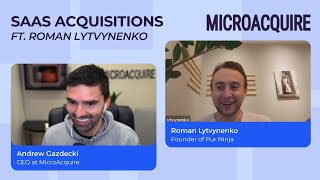
Roman Lytvynenko sold his SaaS business Pur Ninja through MicroAcquire and talks through the acquisition process. He shares what he learned and what's next for him as a founder.
Foreign.
I am with here with Roman, who recently got Micro acquired for five figures. I'm excited to learn more. I don't know the company, and I told Roman I'd attempt to pronounce his last name live on the podcast because it. I was telling you, Roman, something I always do. They're like, how do you pronounce that name? I'm like, nope, you're doing it live. So, Roman Livotentico.
Nope, not it.
Well, how do I pronounce it? Livinetico. What. What heritage is that?
What.
What heritage is that?
Is your.
Is your last name, like.
Not sure I understand the question, but it's like Ukrainian question. Ukrainian surname. Yeah. Yeah.
Do you want to try pronouncing my last name, like.
Totally. Okay. Kazdaki.
Oh, man. Yeah. Perfect. I am. I have lived the life of my last name being mispronounced more times than I can count. And I'm. I get very happy when people get it right. Everybody. Everybody calls me Gaz, though, But to kick things off, so. So, dude, you got. You got micro required for 5 figures. Congrats on that.
Thank you.
To start, do you want to maybe talk about what the business was, what it did? We can kind of just go from there.
Yeah, sure. So the business is basically SaaS, and the SaaS is about social media scheduling. This is basically like buffer and dozen of other applications around, and basically it's all about. It was all about subscriptions and this is it.
Nice. I like how even in, like a crowded market with so many other, you know, large competitors, you were still able to build a pretty successful business. So congrats on that. Thank you. In terms of your experience on microcore, how'd it go? So you list the business. What happened next?
Yeah, so basically I have very interesting, in my opinion, story about that. So somewhere around June, I was like five years in, and I kind of expected this application grew more. But I wasn't really interested in social media at some point of my life. And I was thinking basically in June that I will let it live its life and I will do something else. But I remember that there is a microacquire and I can actually try to sell it. And this is basically what I did. I listed it on microacquire and support is really helpful there, you and the team. And it was really nice. It's really nice to have ability to ask some questions, especially when without prior experience of selling the business. I had a lot of questions and it was super cool that you answered all of them. So I Listed and I started receiving a lot of like a lot of hellos I guess, and people were basically asking a lot of different details about finance and all this stuff. So I prepared profit and losses report and presentation and basically I waited for some, some time and then I met the guy who eventually acquired that nice huge congress.
And thanks for the comment on support. I used to do all of the support and so I probably wouldn't have time for this podcast if I didn't have such a great team helping now. So that's great to hear and congrats on. I like how you, you prepared, you know, materials that buyers need, you know, like a P now and a presentation. So good job on that. If so as you went into due diligence with the buyer, what were, you know, some of the key learnings? Maybe if you can go back and maybe be more prepared. Is there any like advice you would give to, let's say, let me reword that. Let's say I'm a founder. I'm listening on Microquire. What were some learnings or tips that you know, you would give to a founder looking to sell their business?
I definitely recommend tracking expenses. This is for example, this is something I didn't do and at the very last moment I see it and I started creating the list of the services I use like AWS and so on and so on. And I started pulling the data from there, like how much money I spent and it took quite a lot of time and but this is very useful data so I'd recommend spending some data on pulling that report. I believe it's very useful. And of course creating presentation, speaking about, speaking about your plans, the weaknesses, you know, the strengths, you know about the market. Like just being astros as transparent as possible.
Because I love that. Yeah. Because the more information you can deliver to a buyer, obviously you know, the higher chances are going to be interested. And also just the trust you build with the buyer because they need to wrap their heads around your business, you know better than anybody. And so when you, when you have that material up front, it can make all the difference. That's, that's great advice.
Yeah. Like even if you decide to keep something to yourself, it will appear on due diligence, like whether you want it or not. So it's better to be transparent from the start and everyone will be happy, I believe.
Nice. How long, how long did it take you from start to finish, from initially listing on microacquired to getting actually acquired and meeting the buyer?
Yeah. So for me it took, I listed Somewhere in the start of June. And we basically signed business sale agreement in August. In 18th of August. We could have done it earlier, but there were some problems with epic.com so basically we did it a bit later. So I would say two months.
Two months, Nice.
Yep.
What else I got? Okay, so you successfully acquired for five figures. You were well prepared with documentation when you were speaking with buyers. 60 days. That's not. That's not too bad. Um, I always tell some founders, you know, sometimes it takes a week, sometimes it takes three months, six months. But nice job on that, I guess. You know, final questions would be, so you sold a business, you got acquired, man. Congrats. What do you. What do you plan to work on now? Or do you plan to take some time off or.
Yeah, so my plans right now is to start another business, but in the like in the area I'm very interested in. And this is basically some development tooling because I really felt it that if you interested in area, if you really like, if you have a lot of empathy to the customers, it will be much easier to do something in that market because at least, at least you can do a lot of content marketing because you know that area and it will be much easier to grow the business. So right now, this is my next step. I'm going to start another business in some development tool in marketing.
I love that and I completely agree, because what you have is you probably have a unique insight into that market. And that unique insight usually comes from you really like that customer that you're serving and when. I've always been a huge believer that the founders that go the distance and build the biggest companies are the most successful companies, however you define that are the ones that have fun doing it. And it really, in my opinion, it starts with the customer. Like, that was one of the first things I did when I launched, before I even started anything with Microcar. First thing I did was I wrote down the types of customers I'd love to serve. And you're one of them entrepreneurs, startups. That's kind of like my sport. And so I was like, okay, I would. What kind of business can I build to serve startups? And it's made all the difference, in my opinion. I think that's something that entrepreneurs should think, really think about is do you want to be dealing with XYZ customers all day or, you know, someone you could really relate to and you can have, you know, a unique insight, kind of like what you're saying, question. So you got funds from the acquisition. Will you Be using some of those funds to kind of seed your next startup?
Probably not. Maybe partially. I believe it will be some mix of personal money and that money. But in general, I expect I will use personal money for fundings, and I don't really think I will need so much of them. I really do believe that you can start almost without any of them. You can Even test Google AdWords with very minimal investments. So.
Yeah, yeah, no, I agree with that. I love your attitude in terms of, you know, a lot of people are under the impression that, you know, you need a lot of capital to start a company, and more often than not, that's just not the case. Unless you're trying to build, like, the next Google or something like that.
Yeah. Maybe this is just the question of scale.
Yeah. Okay, final questions. Who is your favorite entrepreneur, if you had to pick one?
Oh, it's very tough question. Let me think a bit. I'm really. I'm really quiet on Twitter in terms of tweeting, but I'm really. I really love.
I found you. I read that's how this podcast happened. You said you, and I was like, hey, I'd love to hear that story, man.
Yeah, but I'm not usually that loud on Twitter. But I do read Twitter a lot. And let me just quickly grab Twitter, open my Twitter. So, yeah, so probably the first one who comes to my mind is Adam Bathan. Not sure if I pronounced the name correctly. If not, I'm sorry, but. But like the general. In general, I really love the idea that a developer can build successful company for, like, serving other developers. It really inspires me.
And that's awesome. And that's your people, you know, other engineers, other developers. So I'm really excited to see what you do next. And do you have, like, a company name yet for your new business or startup?
Not yet.
Okay.
Not yet.
Well, I'm excited for you, Roman, and I'm definitely rooting for you. And congrats on the acquisition, and thanks for making the time to just share this story. I think it's going to help a lot of entrepreneurs.
Thank you so much. It was nice talking to you.
All right, Roman, great meeting you. Cheers. And congrats.
More from Andrew



The Buyers Who Made the Move: What They Bought, How They Did It, and What Happened Next






