Startup Acquisition Stories w/ Ryan Kulp, Founder of Fork Equity
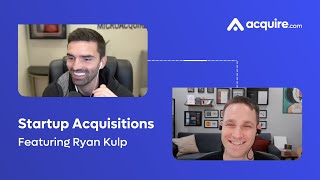
This is a YouTube video titled "Startup Acquisition Stories w/ Ryan Kulp, Founder of Fork Equity" containing an English interview conducted on January 31, 2023. The content features a conversation between Ryan Kulp, founder of Fork Equity, and an unnamed host discussing Ryan's journey into tech startups, his experience acquiring and growing small SaaS companies, his favorite acquisitions, and his educational course on micro acquisitions. The discussion covers topics such as acquisition strategies, deal flow, and the micro acquisitions community. The format is an interview-style talk with two speakers.
Foreign.
I am here with Ryan Culp, the founder of Fork Equity. The man, the myth, the legend. Ryan, how you doing today?
Hey, how are you?
I'm doing well, I'm doing good. So for those that may not know you or your background or about Fork, you want to just give a quick introduction? Brazil.
Sure. I've been in tech ever since I got out of school, around 10, 11 years and halfway through my journey, or the first half of my journey, I was a marketer at different venture backed startups. And then somewhere in the middle I had like a mid tech career crisis and decided that I can't just sell code, I need to know how to write it and explain it to other people. So I got into product development, programming, and then I sort of transitioned from being an employee to being a founder. So I started a few companies. One of them was called fomo and we sold that. And in the midst of all of that started, as you mentioned, Fork Equity, which is a micro PE fund. And we've been buying, growing and selling small ish SaaS apps for about four or five years now.
Nice. Yeah, I've been following your, your career, so to speak, for some time now. So congrats on the, the FOMO acquisition that was, that was awesome to see. But I guess I'm just wondering, how did you get into all this? How did you get into buying startups? Maybe what was the first acquisition?
Well, I definitely fell into it. I moved to San Francisco. I was in New York City again, working at other people's companies and learning a lot. And I moved to San Francisco for a new job at a venture capital fund. So that was my first time touching, quote unquote, the money, you know, where people use spreadsheets at work more often than, you know, Gmail. And at that fund I started getting acquainted with term sheets and raising money and valuations. And what can you do when you raise money? How do you deploy capital as a fund? How do those companies then deploy the capital to grow their company? And, and through that process I got to be in front of or adjacent to lots of different exciting, small, essentially startups, but they didn't always call themselves that. You know, just because you write code doesn't mean it has to be a startup. It doesn't mean it has to be stressful. It can just be a technology company. And one of the companies I discovered during that time working at the venture fund was a Shopify app. And I said something to my buddy Justin at the time, you know, there's the Shopify app And I'm trying to get them to. To take our money at the. At the venture fund, and he doesn't want to. And the Shopify app owner said, actually, I'd rather sell my app than raise money and grow it. And so this was just a typical day at work for me back in, I think, 2015, early 2016. But my buddy said at dinner that night, what if we just bought it? I was like, bought it? What do you mean, bought it? How do we do that? And 30 days later, we owned this Shopify app. And so that kicked it off. That got me into making small acquisitions. But at that time, with my first acquisition, I didn't really think of it like that. I didn't think, I'm now a buyer. I'm building a portfolio of assets. None of those thoughts occurred to us. The whole thing actually felt like a joke. So we needed to make a business entity because what we bought were the assets, right? We bought the customer contracts and the code. And so we made our business entity called Solstice Equity Partners as just a total troll to, like, what are we doing buying companies? But luckily, the company just kept growing and growing and afforded us a lot of other opportunities. And then we thought, you know what, maybe we've learned a thing or two about how to take a lifestyle product and make it a little bit bigger, or at least big enough to support a full team, to have a growth strategy, to not just wake up each day and, you know, what should I work on today? Add a little more structure. And we've been testing out that theory on, you know, 10, 20 other software companies since then. And again along the way, we thought, okay, we actually know kind of what we're doing. Maybe let's just put a bow on it. And we called that bow Fork Equity.
Nice. I love that. So in terms of. So that was your first acquisition. How many acquisitions have you done in total?
Maybe 10 or 12, I think, total deals. Like 20. We've started things that we've then sold. So that was like a deal but not an acquisition because we were the creator and the seller. And then we've done things where we bought it and resold it. We've bought things and held them forever. We've bought things that we're still working on Now. So between 10 to 20, depending on which type of deal we're talking about.
Nice. And then in terms of how you evaluate, you know, every firm has a different sort of, you know, acquisition mandate. How do you evaluate different acquisition opportunities? I'm sure you're Looking at a ton. What's like one that gets you like super excited or if it comes across your desk or email or whatever, it's like a bullseye for you. What do you, what do you look for the most when you're looking at acquisitions?
My wish list is something that is run currently by one person part time, built in Ruby on Rails.
And that is I, I remember like when I first launched Micro Require, we exchanged emails and you were like, can you just have one feature request, please?
Yes.
Tech Stack. Tech Stack.
Yes, yes. And now there is a way to look for that, right? So I have filters on my Micro Acquire account where I'm like constantly just searching for Ruby or Rails and you know, it's not a deal breaker. We've, we just bought an app a couple months ago that was in Node. We're always doing deals outside of that, but that's our dream, you know, Wish list. I would almost favor an app built in Rails run by one person than something that's like making more money and has a team because there's so many, I'd say in between the lines, pattern matching that you can do when certain parameters line up, at least in our, in our perspective. So for example, if something is run by one person, it means they probably have pretty good systems. If something's run by one person, it means that they figured out a way to make customer support manageable. Customer support can be the ultimate killer if you're trying to build or buy lifestyle applications. If they're running it with one person, it means that they are probably in tune with the customer because they are not outsourcing the features to one person and making customers happy to someone else. So they are sort of the source of expert knowledge and they can transition that to you more easily as one person than if you need to interview an entire team. So there's a lot of things we found to be advantageous working with solo founders. But otherwise, you know, in our thesis itself, you know, if you go to fork equity slash thesis, that's going to have different parameters than I just said. But ultimately we've had to try to fit what we're looking for with our personal. I don't just, I don't want to just say strengths, that's obvious. All of us should be seeking things that complement our strengths. But I would even say, I would go so far as to say things that match our personal temperament. So for example, I really don't like doing demos and sales calls. I'm good at sales, but I hate having that one Hour blocked off in the middle of your day where you can't really focus and do deep work. So for that reason, for my temperament, we avoid businesses that require high touch sales processes. We only are interested in businesses where people sign up and pretty much figure out how to use the product on their own. I know there's a ton of opportunity we're leaving on the table by avoiding those kinds of businesses. And even businesses we do buy, we may be leaving opportunities on the table by refusing to have, you know, a more enterprise component to onboarding. But that's just, you know, one of my, I don't want to say deal breaker, but kind of deal breaker is I don't want to build a business around phone calls and meetings. To me, I might as well just have a regular job if I'm going to have phone calls and meetings all day. But that's just me. So these are, you know, if we were to put all these on a list, I'd say only half of our parameters for deals are things that another fund manager or someone getting into this space could go, okay, let me copy paste, you know, solo founder, good points, but some of these attributes I will totally own as just my ego, my personal preferences. And it limits us from deals. But it also means that when we find the right deal, it's really right and I don't have to bend the shape of my lifestyle to accommodate, you know, a new deal.
Yeah, I love that sounds. You're just playing to your strengths. You know, you don't want to buy something and then end up hate hitting, running it. Like I got to do sales calls all the time, I got to do. I think that could apply to a number of different businesses in terms of how you grow them. If your strength is in inbound marketing, you know, makes sense to maybe focus on those types of businesses as opposed to like a enterprise, B2B sales play like you're kind of, kind of describing. So I got, I got a question I've wanted to ask you for a long time. What? What's your favorite acquisition like? What's been the one that you did? And maybe you can determine this based on the success of the acquisition or just the product or just working with the founder. Anything is fair game. But what's like. And maybe you don't have one. Maybe I'm asking you to choose your favorite child, so to speak. But what's been just your favorite acquisition that you've done?
I've thought about this a lot actually, and this is the first time they've been asked, so I'm happy to talk about it. My favorite is a Shopify app we bought called Cross Sell. It was not our biggest acquisition, but we did buy it, grow it and sell it to sureswift Capital, which a lot of your listeners might have heard of and they're still running strong with it today. Cross Sell was my favorite for a few reasons. First, I already knew the Shopify space really well at that point. So our first acquisition which became fomo, you know, I had to go to the Shopify website and say what is Shopify? I mean that's how little I knew. I had to make an account and sell stuff, you know, my on my own to learn what it is like to be a Shopify seller. By the time we got Cross Sell a few years later, I knew everything about Shopify. I had gone to the Shopify developer conference, I had memorized the API endpoints in my head. I, I didn't need the API docs to build features. It was all so comfortable that the entire experience of buying, growing, we rebranded, sort of relaunched and then ultimately selling Cross Sell was like a victory lap. And it's easy to say now, I'm not saying it felt that way during the, during that process. And I'm not trying to say this to pat myself in the back, I'm trying to say this to communicate that when you find a niche grouping of parameters. For me it was like Shopify apps and Rails Low Touch Sales, $20 a month Price point, handling up to thousands of customers full time customer support. Those kinds of parameters I became very comfortable with and it allowed us to do the Shopify deal like we were able to bang the register over and over again because we did probably five or six Shopify apps. FOMO was one of them. Cross Sell was one of them. We built a few that we sold. We have one now that we're still running that. We built that, we're I think selling right now on Microacquire and with Cross Sell. What I really liked about it is that I, and I'll admit this publicly for the first time right now, I never wrote a single line of code and I think I never replied to a single customer support ticket. Now someone could hear this and say it sounds like you didn't do anything and you're really lazy and that's fine. But what I did do is I managed the product, product manage the direction. So we had a Trello, we had developer, we had customer support, we had a hundred things we could be doing. As every CEO knows And you have to just choose one or two to do today or to do this week or to do this month. And as time goes by, first month of running your company, you can do 10 things a month and by the fifth year, you can do like half of one thing per every two months. Things just get slower, things get more political. You have, your team has a lot of opinions. Cross Sell, we were able to run from a very high leverage perspective the entire time. We had monthly cash dividends, we had monthly reports to sort of our co investors. We were able to show really consistent, slow but consistent growth. We were able to execute on things customers wanted. We were able to rebuild the app from scratch in Rails with zero downtime. And those, those achievements are thanks not to me, they're thanks to the, to the team that we hired. But either way, whether it's to the credit is to me or to them, I got to be on the, on the bus. I got to take a ride and watch a product I think very calmly grow and resell to a new owner, meanwhile, still serving thousands of happy customers. So that was my favorite for sure wasn't our biggest outcome in terms of roi, but it was positive and it's become a blueprint for us for future deals. Like, how can we learn from cross sell and apply that to this deal?
I love that. It sounds like, you know, when you acquire companies, it's almost like you're going on this like, new journey with the startup and you have all these opportunities for wins. And I'm glad to hear that one worked out. How. Let me ask you this. How much activity have you done on Microacquire in terms of like buying or like selling stuff? If you had a guess, I'm pretty sure you hold the record for the fastest acquisition for that one, 2K or something like that. I'm just personally curious.
Sure. I think we've done four or five deals, maybe sold two things, bought two things and almost sold or bought one or two other things or that are still in progress. Yeah, the, the fast deal was when we participated in the build cell 30. Yeah. Awesome hackathon. Yeah. So, you know, to those listening, maybe many of you saw this microacquire kind of helped produce something. Build cell 30.
We, we had, we had nothing to do with that. It just popped up. No, I was just like, this is super cool. And yeah, just to kind of like piggyback on what you're saying, it was a community of people that just said, hey, let's build something in 30 days with the goal of getting one customer to sell on Microguire.
We.
We didn't have any. We sponsored it, but we didn't start it or anything like that.
Okay. Neat. Yeah. Thanks for that color. So I saw it and I'm. I'm an idiot. So I was like, I saw your logo and I thought, this is Micro Acquire. They know what they're doing. So I'm going to participate. And so that brand association worked really well. Sponsorships can work. That's the marketing lesson here. And I was bored. It was around Christmas of last year, actually, and 2021 rather. And I thought, I can participate. Let me sketch out an idea. I want to follow all the rules exactly. I don't want to start building January 1st. I don't want to try to sell it until I get a customer. I want to make it clear that I didn't build outside of the parameters. So, you know, I built an app that was an NFT tracker that would let you publish sales to, like, a Discord channel, which at the time, NFTs were huge, and every NFT had a Discord, and every Discord wanted to have a channel that, like, shows a live stream of sales because it builds social proof. So I did a YouTube live stream to build this app. We built Zapier integrations, blah, blah, blah, launched it, got like 100 signups. Couple of them paid, they paid in crypto, they paid in cash. And then I listed in a micro choir. Within seconds, maybe just a couple minutes of listing, I got a few messages. And within a couple hours, the money was in the bank. And it was done at like 3am it was a very small deal, right? It was like $1750, maybe. That was my asking price. That was what I got. You know, you never know when you list something for an asking price. If somebody instantly says, you know, I'll pay you what you're asking, you feel a little bit of seller's remorse, right? And. But I didn't want to make it about optimizing the dollars. I just wanted to prove a point, which I think was the spirit of build sell 30. Just to demonstrate and help communicate to people that you can do this, this whole, like, process, making something that people want and making some money from it, you can do it a lot faster than you may otherwise believe. And I wanted to be a part of that, that mission. And so, yeah, that was a fun, fun time. And then, you know, this deal this year, we have also done one or two deals on the buy side and the sell side. So it's been, you know, it's been a gold mine for us. You always have to keep your deal flow sources, I would say agnostic. You have to be willing to look under every nook and cranny to find something. And sometimes the best deal is never going to be listed anywhere. It's going to be the right time, the right place, a little bit of luck, a little bit of serendipity, a nice cold email, the person's in a good mood and then you're going to get a deal done. But I think that when Mike requires doing to. To democratize and add liquidity to the other 99% of deals is super important. And you know, we've been getting a lot of benefit from it.
I appreciate that and I thoroughly enjoyed. I was up that night when you listed the app that you were just talking about and I rushed it into approval. I was like, yeah, let's go. And then two hours later, like, it's old. And I was like, wait, what? So that was a fun night. So moving on to, you know. Yeah, there's probably people listening to this thinking, you know, I want to get into acquisitions. You know, you obviously had a pathway and you built a course that I personally have taken. I refer to people all the time. Do you want to maybe just kind of speak to that? Microacquisitions.com. what is it? How does it help buyers?
Yeah, right on. Well, I kind of mentioned in my $0.02 about me earlier that I fell into this and it wasn't for.
Oh, one thing we should clear up too is I was not aware of micro acquisitions before I registered the domain. Microquire.com.
Ah, yeah, let's actually clear this up for everyone because I've been asked this privately and hopefully just by seeing us hanging out right now, everything's cool. I think we had one of these. There's a, there's a word in science for this. It's like the. Oh, I just was looking up the Wikipedia for it the other day. But it's a concept in science where there's sort of a shared consciousness among scientists. And a scientist in America and let's say another scientist in Germany will reach a similar conclusion or have a similar aha, breakthrough moment at literally the same time, like within days or weeks of one another. And this is a phenomenon that's happened in history many, many times. And then they're competing to get the first piece that's peer reviewed or to make their findings, you know, public so that they can say, I created this. And I think that perhaps you And I, and other people as that are all in this space with us, had this moment of like, wait, pe. That's a thing? It's been around for tens of years. Not. Not too long, but it's been around throughout, you know, the 20th century, now 21st century. What if we scaled that down? What if we made it more accessible? What if you didn't need to have an MBA in finance? What if you didn't need to raise millions of dollars from family offices and universities? What if there was a way to do it with your own disposable income and some friends and family and some financing? And that was the realization that I had. That you had. That several people have had in the last few years. And it only made sense to call it micro, micro pe, micro acquisitions, small acquisitions, you know, keyword plus modifier. And so we registered this course, microacquisitions.com in the summer of 2019. And it was sort of a shower thought, you know, I had been getting asked over and over again through email and Twitter, dm, you know, hey, Ryan, I saw that you bought this. I see you tweeting about that acquisition. How did you find it? And everybody's questions was a little different. You know, how did you find it? How did you raise money for it? How did you get a legal contract? How did you negotiate? How did you get them to reply to you after you bought it? How did you make it grow versus continuing the status quo of the previous owner? So all these questions I sort of put together in an outline. Like, okay, is this a blog post? Is this like a live stream? Uh, what is the best format to deliver my 2 cents on this? And having made a couple courses in the past about other subjects, coding, marketing, whatever. I thought, you know what? I'll go the course route. And so I put out a tweet in the summer of 2019. You know, if I built this, would people pay for it? That kind of thing. People said, yeah, yeah, yeah. Well, we all know how that goes. You say, I'm going to do this, Would you pay for it? And then the thing's ready and nobody shows up, right? So I want it to be very conscientious of that. It's just a flaw of human nature. I've probably done that too. I said, yeah, yeah, go for it. And then I ghost them. And so I made a landing page that, of course accepted money. And after I made that landing page, I DM'd every single person who hit like, on the first tweet. And I said, hey, you liked my tweet or you replied and said you would buy it. Here you go. And it worked. I think we did like 10 grand in like a day or something like that. And these are all people I did not know. So it's not like I had some big audience just vying for, you know, my content. No, I didn't think I knew any of these people. Maybe a couple. And so that was like, that's encouraging. So we put together the course, made it into six modules covering what we consider the six steps of, of acquisitions. You have to source something, you have to make fit your thesis, you have to negotiate, you have to buy it, transfer the assets, figuring out a go to market plan, automate the systems, and then package it up and sell it again. And we've been expanding on that project, the course@microacquisitions.com for a few years and we've continued adding lectures. We're getting students just about on a daily basis. And it's been really rewarding to watch students. Some of them are quitting their jobs, they're buying companies. I was traveling around the world for fears, and I met people in different countries who would see me on Twitter in their country, go to coffee and say, hey, I bought this company after I took your course and I doubled it or I tripled it. And that's been really, really rewarding to see. And yeah, it was just this funny coincidence that Micro Acquisitions microacquire share a similar name. But of course, now you're moving up in the world as all of us, I think knew you would to to the big boys to acquire dot com. But I think we both can just say to everyone now that this was a funny, happy accident. Even our branding, right? Like, I was wearing a purple shirt when I made the launch video. So I took the hex code of that shirt and made everything on our site purple. And then I noticed Micro Choir had like a better purple. So for anyone listening who's seen us both, this was just a really funny phenomenon.
But I. So I heard about the course the week after I launched microcquire. I launched it on Product Hunt and then someone sent me Micro Acquisitions and I was like, oh, shoot. Like, I like, I didn't mean to like, copy like this name. Like, oh, damn. But if you look back, I believe we exchanged emails because I just wanted to like, say, hey, like, I wasn't trying to like copy you, dude, but I believe I registered the domain like, August. And then you launched in like September or something like that. That's the proof point? I don't know, it doesn't matter. But I'll put, I'll put a link in the show notes of this. So if anyone's looking for. It's probably the best course I personally have come across. There's been, you know, I think with anything good, there's copycats, you know, duplications. So I highly recommend that course and it's got a fantastic name, but I'm obviously biased when I say that.
I appreciate it. Thank you. Yeah, it's been, it's been really rewarding to, to, to ride the journey with it and it's been a source of deal flow for us. So that's what's funny. It's like we treat the course like a portfolio project. You know, we have systems in place, we have a team. We are thinking of product in terms of features. Would be like a new lecture versus fixing a bug. And we have to think about if we want to ever have an exit strategy. And then of course, students take it and they say, hey, I found your course. I'm not going to take it, but I'm trying to sell my company. And so we've actually got, at any given moment, a few deals in our inbox that are just there. You know, they're direct to us. They're not on marketplaces, they're unlisted. They're private deals just because micro acquisitions exist. So you never know what's going to happen. The more content you create spurs up these new permutations of serendipity that we couldn't have anticipated when we got started.
Nice. Well, I hope, I hope you maybe do a V2 one day and it's on master class or something like that.
Give me a break. Yeah, they have amazing commercials, though.
All right, man, maybe we'll edit on that note. But Ryan, thanks so much for just making the time to, to come on the podcast and congrats on all the success. You know, I'm rooting for you, but for people that maybe want to learn more about your story or just get in contact with you, what's. What's the best place to find you?
My hub for all things my antics and trolling is just my personal website. So it's ryancculp.com as well as Ryan Culp on Twitter. Feel free to get in touch. And I kind of open source published my whole life, so whether you want to learn more about or collaborate on tech or marketing or, you know, getting into farming, my latest project, it's all.
Going to be there I gotta check that out. All right, Ryan. Appreciate you, man.
Yeah, thanks for having me. Cheers. Cheers.
More from Andrew



The Buyers Who Made the Move: What They Bought, How They Did It, and What Happened Next






