Startup Acquisition Stories with Anita Kirkovska, Co-founder of VoicePen
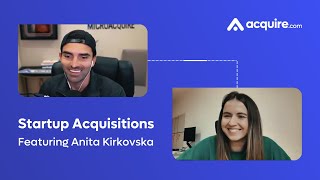
This is a YouTube video titled "Startup Acquisition Stories with Anita Kirkovska, Co-founder of VoicePen" recorded in June 2023. It features a conversational interview between Andrew Gazdecki and Anita Kirkovska, where Anita shares her journey as a startup founder, discussing the creation, marketing, and eventual acquisition of her startup Bio. They also talk about founder-market fit, building multiple products with no-code tools, and the acquisition process on acquire.com. The conversation includes practical advice for founders looking to sell their startups and insights into Anita's current project, VoicePen, an AI app that converts audio and video content into blog posts.
All right, I'm here with Anita, founder of voicepen, who recently had a startup acquired. Anita, how you doing?
Doing great. Thank you for the invitation.
Yeah, my pleasure. Thanks for coming on. So for those that may not know you or your background, do you want to give a brief introduction of yourself?
Yeah, sure. So before I started my startup, 2021, I basically hold a lot of different roles in marketing and growth and I always work with startups, so. So I hated just corporate jobs. I was like all for building things, testing things, validating things, and I felt like I was always going to be a founder. It was just a matter of time. My last job was I was a growth engineer at this company called Intersect Labs. We built a no code software for data analytics, which we actually sold to Zapier in 2021. It wasn't through Microacquire, sadly, but it was an interesting process. And at that point I was supposed to make a decision whether to join Zapier or to start something of my own. I was like, okay, this is the time, let's do it. And that's when we built Bio tool that we sold on Micro Acquire recently. And then after which Marina and I, Marina is my co founder, we decided to just build things, validate them, test them, do that in the path of just building things and validating. And that's like, like really easy for us because we also work with no code and nowadays with AI as well. So we kind of shipped a lot of products over the last year. Some of them worked, some of them didn't. And now we're working on voicepen, which is basically an AI app that converts video and audio into blog posts and, you know, the usual. I also have my AI newsletter. I get to learn from my AI newsletter as well as I get to share the news with other folks. Yeah, that's, that's what we're doing right now.
Well, you got a lot going on and you recently gotta win. Yeah, it's weird for even me to say, but, you know, we're. We're acquired dot com, not. Not microquarter. Even though.
Yeah, yeah, I know.
Migraine. It's. It's never coming down. It's. It's always a reminder. So what made you build bio? Let's, let's start there. What problem did you see in the market? What problem did it solve? Problems. Maybe a brief would be helpful.
It was interesting with bio because it kind of changed the concept. So we actually started to build that around 20. End of 2020, beginning of 2021 and around that point the NFT craze was happening, right? Like everyone was buying NFTs.
Oh my gosh, I remember that. I was like, you remember that? This isn't going to end good.
Exactly, yes. And we kind of like dabbled with some parts of it and we were like, okay, well we own all of these NFTs and we got to see on the market were owning these NFTs and that they were buying NFTs and there were a lot of scams from makers who shipped NFT collections and stuff like that. So bio at that point was supposed to be your like linking bio that lives on the blockchain, right. That validates your NFTs, what you possess. It's your link in bio of everything that you own in the metaverse, but then also like a snapshot of who you are, what you're building, are you credible? You know, can people buy from you? And stuff like that. So we started with that, but then soon after, I think it was like four months after, we didn't really find market fit and stuff like that. And we didn't really feel that we were to build a product like that. So we kind of looked at something that was closer to us and that was like makers, creators, digital makers and creators, stuff like that. But then you also have like all of these other linking BIO tools and the competition is really strong. And like building a product like this, you need to rely on building a user base that is huge and then getting money and stuff like that. It's really hard to monetize. And so what we switched into was this video first tool for creators to create their portfolios on. So basically what you're getting is you can create your bio page, you can record a video of yourself, and then you can create multiple versions of that LinkedIn bio so that if you're applying to a conference or a job or whatever it is, that you can basically have all of these versions in one place, but then also you can connect other tools that you use. I don't know if that's confusing, but.
No, not at all. I'm looking at.
It was a long time since I pitched this product.
Yeah, no, I'm looking at it now. I mean, show the NFTs you own, show the products you've launched on products.
Yeah, we still kept the NFTs part like it's still there. I'm not sure if the new owner is going to proceed towards that path.
It's mostly like, let's backtrack on the NFTs I had previously built crypto company in 2018. So I saw the big up and down. So I was 2017.
Crowley.
Yeah, exactly. I actually like NFT, just to clarify. But yeah, me too.
I'm still getting offers to some random NFTs that I own, which is really weird. I'm like, what's happening when you've seen.
Something go up, you know, part of you is like, you know, we'll see what happens. This is great though. So it's essentially, you know, portfolio for creators to put everything they've made. This is great. Okay, so you built a product. Okay, now what? How did you get your first initial customers?
Mainly through Twitter and protocol. So we had a launch. We basically, you know, built in public. That was the core thing. And with no code. Like there is a big active community as well. And at that point it was very nice or interesting for us that, you know, we were kind of praised by the community that we're actually building a nice looking product with a no code. Especially with bubble. Because like there was this story going out on that if you build with no code, then the app is going to be bad, the app is going to look bad. No good UI in any other no code app. So we honestly really focused on building the best app, not building the best app. That solves a problem at that point. And it's a lesson that you learn like, okay, stop making things perfect, just ship and see if they stick. If people use it. We were kind of on a roll, just shipping features and stuff like that. People were using it. They really loved the integration part because you would log in with your product hunt, we would take your products, list them automatically. If you're a designer, you can link to your dribble account, other accounts as well. And basically it's your one place out of every app that you. I think that we got around 10k users, most of whom didn't pay.
That's. I mean, that's a lot though. I mean, 10,000 users.
It is, it is. Honestly we didn't even do like any paid campaigns, anything specific. It was all through building public and that people loved it.
I really like that strategy. I always say if you don't know how to market your bit like you have no idea how to market at all. You're a technical founder, just vote in public, just tell people like, hey, I built this, hey, I added this new feature. And then by bringing people along for that journey, you create kind of an emotional connection with potential customers because they, they like see your startup, you know, grow up. Like, oh, it started Here. Now it's here. Um, so I love how, you know, you were. And then another thing I think that you did really well was, you know, there's a lot of creators on Twitter. There's a lot of creators on product. And so being able to market into a channel where your customers are. Like, if you were selling to a procurement department at Fortune 5, they're not on Twitter. They're not.
Right. Or if you're selling a B2B startup, go to LinkedIn or on Twitter, maybe, you know, like, maybe your users are there.
Exactly. So I love how you marketed this. This business exactly where your potential customers are. So that's great. Okay, so moving on to my next question. So things are going great. You have users. People are enjoying the product. What made you decide to sell Bio?
Yes. It wasn't a decision made at that point. So this was happening, like, last year, and we decided to sell it. Now, why? We drop it as a product last year, like, we started to work on it. We're like, okay, it's free forever for everyone. Like, just use it. We weren't able to monetize it, and we didn't want to raise money to basically, you know, extend the Runway for that product. Because essentially what we thought was, in order to build a product like this, we need to raise money, offer it for free until we find that monetization part where we can actually charge users to for specific features. So that was one. The other part was that we didn't feel like it was a really good founder market fit for Marina and me. We were like, okay, what do we want to do? What is our goal? What do we know? Like, really good. And it didn't really match with what we wanted to do. And so that product actually pivoted in something else more in the B2B space. I was in the previous company that I mentioned, Interstate Labs, that we sold to Zapier. I was more like doing marketing and growth into the B2B space. At that point, I was feeling like, okay, I understand the B2B market more than the B2C market. Right. So those kinds of things led to us deciding, okay, let's drop this product. Let's build something else. And, yeah, so now, until now, I think we have around 10 products that we built since last year, aka no code. It's easy to build and test them. And we have one profitable business, which is Voicepen.
That's impressive. And I really agree with you in terms of just the importance of founder market fit, because a lot of founders will build Companies, I always say, you know, you really need to love the problem that you're solving, then also the customer that you're serving.
Yeah, exactly.
If you build a really successful company and you hate the dentist, and it's a tool that helps dentists, you're still going to have to talk to dentists all the time, and you're going to build a job that you hate. And so one thing I recommend often is writing down, you know, customers that you'd love to serve and kind of writing down the things you don't want to do in advance of building the business. So you enjoy what you're building.
Exactly.
You're excited about working with. Like, you have. You also have unique insights into these types of customers. And all that does is it just helps you, you know, go. Go longer with the business. So.
Yeah. And also, if I may add something to that, also you need to kind of build a list of what do you want to do personally. Right. Like, when we were starting to build bio, it was on and off. Like, we had on and off conversations with Marina about whether we should raise money and then bring more money and that I think that it was really hard to raise money summer of last year, everything that happened with COVID with the economy and stuff like that. But then it's really important to answer those personal questions, like, what do you actually want to do? Like, do you want to build a big company and have, like 100, 200,000 people to manage, or do you just want to build products, be a sole entrepreneur, you know, just build things. I don't know, be flexible with your work. You don't need to be in the office all the time, work or lead teams, whatever. And so I felt like Marina and I, we lived in this big lie that we were projected, this dream of we need to build a big company and we need to have a lot of people and we need to raise a lot of money and stuff like that. And I think, like, this year in January, we kind of sit down and we're like, okay, let's put the pros and cons on the list. Like, what do we actually enjoy doing? And we realize a lot of things about us, but that are really hard to say sometimes. Right? Like, I just. I don't want to run a big company. I just want to be able to build things that are going to live on the Internet and that I'm going to enjoy every bit of it and I'm going to make money out of them. Right. And I'm going to have, like, my Flexible time. I can work from wherever I want. I don't need to have investors that I need to, to give reports to. And so like we build this list. Okay, let's see. And we also love to build with no code. So January of this year we kind of started to take like 40% of our work is going to be like no code work. We actually have like a studio, like no code studio. And then part of it is just building and testing these ideas and see what sticks. But we have the freedom to do that. Like, we're not constrained that. Okay, we're building this big company and.
We need to do X and Y. I love that. Yeah. Because, you know, a lot of entrepreneurs, you know, they kind of fall into the trap going back to previously of creating a job they hate. Because I'll give you an example. You, if you, if I totally agree with you, like a lot of startup founders build, you know, businesses without really understanding what do they want out of it. It could just be freedom. It could be the ability to, you know, express, you know, your creative abilities and build awesome products.
Yeah.
And then, you know, also financially too, you know, do you want to make a million dollars, you want to make $10 million, you want to make $100 million? As those numbers go up, your, your statistics go down, you know, it's much easier, you know, so. But that will shape your decisions. You know, let's, let's just use, you know, even a hundred thousand dollars as a goal that is very achievable and will determine like you're not going to raise venture capital if your goal is race is to make $100,000. So having, you know, anti goals and just writing down what you want to achieve with the startup. And I also love how you mentioned you're building multiple products because that allows you to rapidly test the market rapidly bring like find product, market fit really quickly. I actually wrote a blog post about.
This one time and really send it over.
I will. But basically it was the concept of thinking like an angel investor. So there's a saying in angel investing where you want to make investments in minimum of 12 to 15 companies because the rest probably won't work out and the one will pay for the ones that don't. And so as an entrepreneur sometimes thinking in that framework of, you know, rapidly build products and then one will take off and that's one that you shift your, your full focus to or you just focus on all of them if they're all, they're all working. So I like that sort of portfolio approach that you're taking. All right, let's get back. I got to hear the acquisition story.
Yeah, sure.
All right, so you list on acquired.com what happened during the first couple of weeks. How did that experience go?
It was really simple. I mean, from what I remember, I just hosted the startup there and then a bunch of these messages kept rolling in. And what I know that I kind of, I knew that I needed to just reply to all of them instantly. And it felt like that because I felt like, okay, obviously there are going to be like a lot of window shoppers, right. But in order to catch those with the highest intent, I need to reply. And it's been here to answer questions. And they had a lot of questions. We got a lot of requests actually. And then I know that like the questions kept repeating. And so I built this list with frequently asked questions. Then every time someone would ask, I would take the answer from that and paste it so I would answer even faster. But yeah, it was, I don't know, I think it lasted around a month or two until we found a buyer.
Nice. You just gave away one really big tip that I, that we, we try to tell as many founders as possible is having a centralized document for everyone's question. Because with that document, number one, you'll save time. And then you also educate other buyers on question that other buyers are asking. And that, that really does three things. Number one, it saves you time. It's a great way to follow up with buyers that maybe haven't said anything and they're not interested. And three, it shows that other buyers are interested. And there's a saying, if you have one buyer, you have no buyers. So you know, when you share that document, you know, a buyer will see their question and they'll see other buyers.
Yeah, yeah. And realize usually they're like follow ups as well. So those questions are there. So no need for follow ups, right?
Yeah, yeah. And then, and then, and then. Great. Sorry to interrupt you. Were you going to say something? No, I was just going to compliment you on responding to buyers is so important. There's a saying where businesses are bought, not sold. And that couldn't be further from the truth. You have to sell your business, you have to talk to buyers, you have to message them, you have to answer their questions. Because what you're really doing is, number one, you are selling your business so you're getting buyers excited. But your job, when you're selling a startup business, whatever, is really to de risk the acquisition for the buyer. And a big part of that is just helping them understand the business. And if you're on, if you're unresponsive, if your answers aren't, you know, they don't make sense, you're not willing to hop on a call. Those are all yellow flags for buyers. And buyers are always looking at so many different businesses that it reduces the chances of you. So you did, you did a fantastic job there. So nice.
Yeah. And one thing about the risking the purchase, for example, for our acquisition, the buyer wasn't a technical person. And since we have a no code agency, what we did to offer was that post sales support where we would answer any of your questions. We even basically supported them in fixing some bugs in the app. And then we also, right now we have one member from our agency that is working directly with them to build new features. So that span between buying this startup and finding a developer, if you're not technical to run it, like we minimize that. We de risk that for you. We're like, okay, it fits perfectly for us. Right? Like, we also get to give you one of our employees. Right. But then I de risk it for you because right away you can just work on it, you can add your marketing data, whatever. We know the platform, we're going to be the fastest way to build and iterate on top of it.
Yeah, bravo on that again. Just de risking the acquisition for a buyer is so big, especially on the technical component where if someone's able to stay on board or is able to help with the transition. A lot of times we see agreements made between buyers and sellers where they'll just say, hey, for an hourly rate. If we ever have any questions, can we reach out to you for help?
Yes.
And it could be a 30 second response from you or like a week hunt for them, like where they're just trying to guess what, how does this work? Who is this customer? So bravo on that again. Okay, so how did you select the final buyer? I assume you probably had multiple interested buyers. Buyers. What was it about the final buyer that made you comfortable moving forward with this individual?
Yeah. So with Bio, it was a pre, pre revenue startup and we were able to sell it thanks to you and thanks to my tweet on Twitter.
Yeah. And just to clarify, maybe we'll do a moment here because I remember that tweet. We, we love pre revenue startups but we're very, we're very selective in terms of the ones that we list because we get so many of them. We get literally hundreds per month and some of them are, you know, there's just not. If we don't have, if we don't think we can help it sell, we won't list it. That's just kind of how we think about it, right?
Yeah. And that's okay. Yeah. Maybe on your end, what it's going to be like really useful to creators like myself is to just surface that information. Like if I, if I have a pre revenue app, like what do I need to have other than money for you to list the number of users.
You really kind of, that's kind of traction. Yeah. Well just like a product on page.
Yeah.
Users, people using the product. So anything that's just not a built this, no one's using it. Because when we list those, we don't know if it has bugs. If it's a clone script, which is a very common item that we actually see is people will just buy a pre built piece of software and then put it on a server and then pre revenue and then it's really a scam. So we, we knock a lot of those down.
Yeah. And that makes sense.
So just any sort of traction, you know, people, any sort of traction, users, web traffic, anything that shows that this app is, is being used is thumbs up on our end.
Nice. Yeah. And to answer your question, like how did we choose our buyer? It was like pre revenue startup. You need to find a buyer that you know either believes in that idea or has a specific spot in the market for that idea. And with our buyer, like she's a creator herself and she lives in those communities where this product is going to be like the best fit. And for us, honestly it was mostly like finding that person that I know is going to take this to the next level. I personally know that there is an opportunity to grow this as a video first link in bio tool. But I know that I'm not the best person to do it. If you have networks, you have those, if you work with creators and stuff like that, then you know you have like a real opportunity to build and grow a product like this. And so Leila is that profile of a person. And instantly, instantly when she messaged us, I think like in just two days we did everything on acquire.com and then we moved on to escrow which was like escrow was the most painful process for us, which I know that you're doing something about it right now. I think when you have an in.
House it's all right. It's our biggest complaint. We gotta, we gotta upgrade coming first week of June so it might be out by the time this podcast comes out, but yes, we have an update coming.
Okay, great. Yeah, so that's that. That was the part on how we found our buyer.
So that's great. You found someone, you know, excited about the project, willing to take it farther than, you know, you were willing to. Those are the most ideal acquisitions where, you know, you were no longer, you know, as excited about the business. Then you found someone who's able to bring in, you know, new and has new ideas and wants to take it farther. That's. That's win, win.
Yeah.
So congrats on that. I guess from here, if you were to, you know, speak with another founder, found someone who's able to bring in, you know, new energy and has new ideas and wants to take it farther. That's. That's win, win. Yeah, so congrats on that. I guess from here, if you were to, you know, speak with another founder. Come. They come to you. Anita, how do I, like, what should I do? I want to sell my startup. What are, what are some of the main tips you would give them?
Yeah, just that, like, talk with other founders who sold one of their products and acquired because, like, we didn't ask for any advice. We just went there and we tried to read through the resources, go through it ourselves. And I feel like it slowed down the process. Not by much. Like, you know, if you put your time into it, then you're going to basically understand what you're doing. But just talk with someone who sold a startup and then they can give you, like, the caveat of things that you need to think about and be careful and how to prepare for, you know, like transfer of assets. What are you actually selling? Like, that was a big question for me because we, like this product was the first product of our startup that we opened up in the US and then I wasn't sure what I'm actually selling. Am I only selling the assets? Am I selling some IP rise? Like, what was the, the definition of the selling piece of it? I had a lot of questions around that, which I learned through one offer. And then I asked actually the buyer, let's agree, what are we selling right now? And that was really stupid to ask when you're selling because you need to be selling, you shouldn't be asking the buyer, okay, what are we selling here? So things like that, just talk with other founders. They can reach out to me. This is an open invitation. If you're trying to planning to sell your startup. Just reach out to me if you have any questions. You know, I have all the Answers. All these other people that sold their startups have all the questions. The answers to your, to your questions.
That's awesome. That's what, that's what I love about just the startup ecosystem in general is just the willingness to just help others, you know.
Yeah.
And one thing, I'm not sure if you knew this but you know, you can call our phone line or you can email us your questions. We review Lois all the time. We review asset purchase.
Really? I didn't know that.
Yeah.
But your support is really fast. Yeah.
Like hey, any sort of questions on you know, how does this legal doc look or how does, how should I proceed with this? Because we, you know, we want to see startups succeed and get acquired so we do.
One advice or to interrupt you. Yeah, finish your thought and I can give you that.
I was just going to say, you know, we, we have a team specifically in place for questions like these. But I do fully agree. Reach out to friends, call a friend, someone who sold a business, they've been through it and they'll have, you know, really good advice.
Yeah. What I wanted to tell you about micro acquire.
It'S hard for me. It's hard for me too.
I know, but it's harder for me because I'm reading it on your wall like you need to drop the part like it goes in instantly in my head. So what I was about to say is that you know, like maybe like there is an opportunity for you to kind of introduce. I don't know if this makes sense with your business model but from our process selling to non technical person has its own challenges and they need to bring in a developer or in our case like it worked well for us because we also have like a development agency and we can help but for non technical teams maybe you can recommend development agencies or just have a marketplace of technical people who can help you take your product, buy it, get a developer and then grow it or even marketing folks as well. I don't know, just. I thought about the development part because I felt it.
Yeah, no, that's great feedback and I, I completely agree with you. At times we have recommended development agencies for due diligence or maintaining an application. So we do make those recommendations from time to time. But. Okay, not enough to where the point where like we have a dedicated service because I, I completely agree. If you're buying a complex SaaS product and you, you don't have any, any engineers that are going to be staying, my advice is to get an agency involved and see if they can understand it. Do the technical due diligence with you, and then from there, if there's a fit, and then you have agency on hand, but not a full time employee that you constantly. Great, great feedback, and I completely agree with you on that. Anita. It's been. It's been a pleasure chatting with you and congrats again on the acquisition. And if people want to learn more and your story, where's. Where's the best place to find you?
Twitter, for sure. Find me on Twitter. I share a bunch of no code slash AI stuff. Yeah, best place.
All right. What's. What's the startup you're working on now? I want to make sure we get that in this. The show.
Yeah, yeah, for sure. So we're currently working on Voiceband, basically, this app that takes audio and video files. It can be like a TikTok YouTube video, educational video, whatever it is. It can be a podcast or a webinar for this podcast, for example, that we're currently doing. And. And if you put it into the app, it's going to create a blog post and then you can have multiple versions of the blog post. You can pick topics from the conversation and write separate blog posts from it. And so you're just repurposing all of your audio content into written content, and then you can target for better SEO stuff and stuff like that.
I like that. I'm going to send this to my head of marketing and see if he'll check it out.
Yeah, please do.
Well, Anita, I'm rooting for you. Thanks again for coming on and congrats on the acquisition. I hope maybe if this new business grows into a huge company, I get you back on the podcast.
Course. Of course. Let's hope for it. And thank you for the invitation again.
Yeah, my pleasure. All right. Nada. Cheers.
Thank you. Cheers.
More from Andrew



The Buyers Who Made the Move: What They Bought, How They Did It, and What Happened Next






