Startup Acquisition Stories with Guillaume Bardet, CMO of Testimonial.to
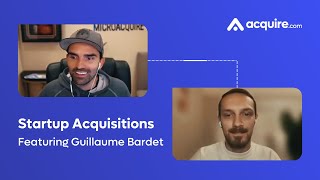
This is a YouTube video titled "Startup Acquisition Stories with Guillaume Bardet, CMO of Testimonial.to" recorded in May 2023. It features a conversational interview between Andrew Gazdecki and Guillaume Bardet discussing Guillaume's journey building and selling his startup Clearly, a bookmark manager Chrome extension. They cover topics such as the acquisition process on Acquire.com, challenges faced, lessons learned, and Guillaume's current focus on Testimonial. The discussion provides insights into startup acquisitions, founder experiences, and practical advice for sellers.
Foreign.
I'm here with Guillaume, founder of clearly, who recently got acquired on Acquire. Guillaume, how you doing today?
Very good in yourself. Thank you very much for having me on.
Yeah, my pleasure. So for those that don't know you, do you want to give a quick introduction of yourself?
Yeah, of course. So I. I started in the music industry about 10, 15 years ago at this point. I started when I moved to Miami when I was 13 years old. I started working with a lot musicians and so I was organizing events in Miami and we had the different artists like Avicii come. And so eventually I. It kind of turned into like a marketing agency. So at that point I was working on helping those musicians, pressing vinyls for them and different little projects. So it kind of became a little bit overwhelming. So I was trying to work on the solution for myself to organize all this mess and organize all those projects. So that's when I built clearly for myself. And then eventually that turned into pretty much working at Appsumo, but also having clearly listed on Appsumo. And then eventually I started working with Damon from testimonial to. In January, and I went full time with him then.
Nice. So I got. I got a couple of questions. I gotta, I gotta pull back out of that. Who is the coolest artist that you met? I'm. I'm an Avici fan. You know, recipes. Who is maybe your favorite artist that you met?
So Avicii was by far my favorite one. Also. I've known him since he was 16 years old, you know, so I, I was the first one that brought him to Miami. At the time. I paid like 400 for the booking. Yeah, it was a very. Behind the American Airlines Arena. So I rented out this club called Bongos and it was an ultra after party pretty much. And so we just brought out a bunch of different, you know, smaller, younger DJs. And then I worked with Steve, Duda, Gramatic and a bunch of different artists like that.
Nice. I remember when I Believe we're recording on 18th, I believe, yes, we may be today, because I got married on the 22nd and we played like a couple of each songs at my wedding. Yeah, just.
It was around this time. Yeah. Because it was close to like the festival season and stuff like that. So it was kind of on lineups and had to be removed from lineups. It was a little bit unfortunate.
Yeah. Sad. Anyway, so tell me about clearly, what is. What is clearly? What does it do? What problem does it solve?
Of course. So, you know, it's pretty much a bookmark manager So I had a lot of tabs open and I was trying to organize all of it so that I can come back the next day and pretty much have a clean slate of tabs. So it's a bookmark manager that you can organize with different boards. So if you have multiple projects or even you can organize, organize it with work and your personal stuff. And so it is just a very simple Chrome extension that you can use and have it within your browser and save bookmarks or access you. You could also do little notes and stuff like that.
It looks beautiful. It looks like maybe like Trello for bookmarks. Is that kind of.
Yeah, yeah. So you. Yeah, exactly, exactly. So we had the. You know, a lot of people are copying each other these days and kind of shipping the same exact thing. But what I did is our competitor was Toby at the time. So it's kind of like one tab also where you save bookmarks, but it goes into one very long and extended column. So it makes it really hard to find something like two years down the road. So I, I was using it myself, but it just became very crowded. So I tried. I was using Trello at the time, so I was like, okay, can I do something around organizing this in a Trello aspect? And you worked out that way.
Nice. So you saw. I like how you solved a personal problem. I mean I have like my bookmarks, they're all at the top of my Chrome, but I do it where they're little bookmarks, but it's only one letter. So I literally 30 of them. So I could probably use this product. How did you get, you know, the first customers for it?
Yeah, so it's. I think, you know, a lot of people probably say something like launching on product and. But that was slightly after what I first did is I went on like places like indie hackers and I'm not sure if they do that at the time today, but at the times they would give you the email of the user when you'll go over their profile. So I'll try to find relevant people that were kind and helping others. And so I, I pretty much cold emailed them, you know, and so that's how we got the first, you know, like 100 users that then helped us out with the launch. So it was not like just launching with nobody using the tool. So that was really helpful.
That's literally cold email works. That's literally how I launched. You know, micro choir now acquire just.
Called email People users called DMs too, you know, and like all those. But I kind of targeted cold dms, not, you know, somebody that I knew could benefit from the tool that's willing to help others, you know, may need that early on. Like that's what I was trying to find.
Sometimes you need that. You know, in the beginning of a startup, just hustling, just reaching out to people, asking if they try it out, get feedback.
Well, funny enough, during the acquisition, actually somebody messaged me telling me that he was one of those people that got the email many years ago. So I was like, that's amazing. You know, like some people are still around helping and we actually do have users from like three years ago, you know, so that, that's, that was probably a good sign for the acquisition tool. You know, to see people still using the tool and not everybody churning within two, three months or something.
That's awesome. Yeah, I, if the, the one of the buyers was a customer, that's always a good sign. Yeah. So let's, let's, let's, let's move into that. So you, you built, clearly it's doing well, it's, it's profitable, it's solving a clear problem and it's beautiful product. What made you decide to sell it in the first place?
Yeah. So, you know, I think with software it can be a little bit tricky sometimes. Where I started to see that my input of effort was not kind of bringing the output that I was hoping for, you know, because I don't find my be this great, amazing startup person or this and that. But every time I'll put in, you know, a month of hard work, the income was still very slim and so I was struggling to, you know, keep putting in a lot more effort and kind of not really taking it somewhere, you know, and not that I don't, I don't think it has value, but I don't think it was a project that I wanted to focus on for the next five years, for example, it was time to move on to another project and maybe the other team has either bigger goals for it or even smaller goals on their own, but at least I wouldn't be, you know, putting five hours of work on it. But then the output is kind of like a 1 hour ish worth of output.
It's a smart way to think about it. Yeah, because a lot of people get stuck building stuff for years when they, exactly, they lose passion and they just keep going and go. And sometimes the best thing to do is just sell it and move on. Move on. Like if you're not waking up, you know, stoked to work on what you're building.
Exactly. And that's, you know, it comes down to also the buyer that I found which we'll get into a little bit, you know, but I found the indie maker kind of buyer, you know, so it's like somebody and we'll talk about it but a retainer, like a 10% ownership in the product too. So it's a little bit like I'm still there to help them with what I've seen. You know, the things that I've seen work and the things I've seen not working and stuff like that. But I'm not there on the day to day hoping for the biggest outcome possible. I'm just there to help out.
Oh, so you retain 10% during the sale of the business. Oh, so you still have like a vested interest in the.
Yeah, exactly, exactly. Just really trying to help them make sure they get the most out of it, you know, kind of avoid. Because I've still been working on it for about five years. So it's this way of, you know, you'll help them avoid and waste time on a bunch of things that probably won't move the numbers or things that I've already tested myself, those kind of things.
You know, that can be a great way to just de risk an acquisition for buyers. Just saying, yeah, I'll stay around for any issues that might pop up because every startup has some bug and it's like how do you fix it? And for each year it's like oh just delete that line and or you know, two second fix and then without you it's like a two day like exactly.
And you know, I feel like they're already grateful for that because I've already helped them them with a couple like you know, tricky server switch this and changing the email for that. And I go all the way with oh, here's the exact template that I use. You can just copy paste it on your new account this and you know, instead of all starting everything from scratch, you know, so I think they're grateful for that.
That's so important, just goodwill with buyers when you're exactly selling the business and finding ways to. Because acquisitions are risky and so if it's. I always say it's not like handing over the keys to a car. There's parts of the business that you may not discover in due diligence and it may not be until six on something comes up and just being able to contact the founder just for simple questions. And the only way to achieve that is building, you know, goodwill. So let's Move over to. Okay, so you. You list on acquired what happens in the first week.
Yeah. Okay, so there's a little funny thing that happened, which I'm going to mention now because he is gonna probably come up a few times, but I actually listed clearly about two years ago, maybe, you know, like just around the Corona time when it all started. And what happened is I got a lot of messages, but I was not focusing on sell it, so all the conversations kind of died down. So then I came back to you guys about, you know, two months ago, three months ago, or something, and that's when I really went out at it and really tried to sell it. This time the goal was to sell it somewhat as quickly as possible. So I kind of had to rebuild the connections, you know, like a re. Because all those conversations, people had already bought something, you know. So I kindly reached out to your team and asked them to potentially be featured in the email again, because I noticed that that's what got me a lot of messages. So, you know, about two later or something like that, I was scheduled to be featured in the email. And overnight I pretty much got, you know, like 15, 10, 15 different messages. And that kind of kept on growing after that. And yeah, we just started a bunch of different conversations. And I was kind of aiming for people that, you know, like, the conversation seemed a little chill somewhat, you know, and not to trying to get into too specific because it was still on the smaller side of acquisitions. So I was kind of looking for somebody that understood that and I was not taking it extremely seriously too. So that's how we started.
Nice. So how did you. How did. Did you find the. The buyer? And also when you. When you listed three years ago, that might have been me, like, who did the list?
Oh, you did everything you did. I was talking to you by email. You created the whole thing. You edited the description a little bit. You lowered the price, which was actually a good move because I was like, I think like 5,000 above, 10,000 above or something like that. And so, you know, you helped out with all those things to really ever be something that look clean on your marketplace too, you know, like not just another listing that looks all messy. So that was really useful, I think.
Yeah, those. Those are fun and let's call them painful days, because I'm sure I was doing. I've said it a few times before. Listing cleanup, newsletters. But anyways, okay, so you got a buyer that a bunch of buyers have just reached out. Some of them aren't giving you the right. You Know, vibe or, you know, personality that you want to work with, which is important because, again, you're going to be working with this person through due diligence, transition, all that. Exactly. How did you land on the buyer who eventually acquired?
Clearly, yeah. So to just, since we talked about that, I retained the percentage. I, I, that wasn't the plan at first. Right. So I was not necessarily looking for that at that time. So I was just looking, you know, for somebody to have a good conversation with. And so I kind of opened all the LinkedIn profiles, kind of looked at what they were doing and all that stuff. And so I had pretty much three buyers in mind. So we're going back and forth and I was, you know, potentially trying to go through some of the, the upside and like, the major downside stuff, you know, like trying to just get all of those out of the way. And at that point, we pretty much retained still. Those three people were still very interested. So I kept having more conversation with them and then I kind of weighed it down to two people and then I negotiated with those two and one offered. Well, right before that, I really was filling it with one of the person. We got on a few calls and stuff like that. And you worked out great. So then I, that's when I tried to negotiate a little bit and that that person offered 10%. And also I had a good feeling from them as it was like an indie maker and stuff like that. So I had a very good feeling about it.
Nice. I mean, that can make all the difference too, just like, you know, kind of give and get. And that 10%, you know, is a sizable portion of the business. It's something you've spent years building. So I assume you have some sort of. Everything I've built I'm, you know, attached to in some way. Yeah, so just, I mean, that's a, that's a great way to incentivize both parties where you'll take the offer and then for the buyer, again, it de. Risks it where if any issues pop up, you're here to help.
Yeah, it worked out great that way. And I think, you know, finding the buyer was actually a very interesting process because you guys, you guys make it very easy with the funds verified with the LinkedIn profiles, all that, so we can, you know, do a little check at least and make sure that you, when you go with those three people, that you're going with the right three people at least, and then you can kind of go from there.
Nice. Yeah, I appreciate that. Yeah, we, yeah, of course we've added quite a bit since three years ago. Yeah, we didn't have any of that three years ago. Okay, so you. You and the buyer agree on. On terms. How did due diligence go? Quick, easy, hard.
Yeah. So what we did is we. We did it in a couple steps. You know, we. We first started, I did a zoom, Zoom call with like a screen sharing, you know, where I was pretty much sharing the, like the database, like how the backend works, the Google Analytics stuff, and kind of going over some numbers just to make sure all of it was. Because, like, in screenshots these days, you can change any information that you want, you know, so I was trying to, you know, have them see that it's all real and live numbers and stuff like that. And so we just went over that and then on their site because. Are you referring to the escrow process or not just yet?
Both. Well, due diligence and transfer and escrow. We can just talk through that whole process. Yeah.
All right. So then the. The escrow process was not. It was not as fun. So what happened is I registered on micro require.com with my clearly email, but then I was trying to my personal email with escrow, and so those two pretty much created an issue where the two were not syncing together. And so I had to contact escrow and then that took a little bit of time. Then he had to verify the information. So unfortunately, the escrow process actually slowed down things by quite a bit. But, you know, aside from that, it was very simple, like the actually going through the. In the required steps, you know, like verifying your information with them, then sending out the. The, you know, the. I think it was just a password sharing stuff. So just sharing that, all of that was a fairly easy process. Just the verifying email. Definitely recommend making sure you use the same email as your acquiring account.
Nice. That's. That's good feedback. And we actually are working on a escrow upgrade. We're calling it like escrow v2.
I saw this morning, upgraded escrow. Right?
Yeah. Because, you know, the interface on escrow can be like, situations like that come up. And so we're. We're giving it a huge upgrade. So by the time this podcast comes out, it might be out. I'm pretty excited about it.
Well, that's really nice. I think, I don't mean to cut you off, but I think, you know, I think for a smaller acquisition like me, buyers will really like buyers and sellers will appreciate it. You know, I think escrow will be extremely important for higher acquisition Obviously, but at our side, like the size that we were going with and I was already trusting the buyer is even in California, somewhere nearby. We could have almost done it in person if we wanted to. And I feel like just going through a require that come for myself and him would have been just as simple and worked out out just as well.
Nice, that's great to hear. Well, I'm glad the acquisition went well and you found a great buyer. It sounds like you're still in contact.
Yeah, thanks to you. You guys really made it easy. You know, the, the amount of buyers. Actually like at one point it was like 60 or something. You know, it was, it's very busy. It's, it's very good what you guys are doing.
Well, if you build a good company and you put it on there, I've, we've seen some wild stuff. Yeah.
And I'm sure like you had suggested the right price too, you know, like kind of combining all those together makes it that obviously you show up in people filters and stuff like that, I'm guessing.
Yep, that's absolutely correct. Lots of people are kind of just crawling acquire all day long. Especially since your business is, you know, great product, profitable, you know, that's something a lot of buyers are interested in. So congrats on building and congrats on.
Thank you very much.
The acquisition. I guess, you know, my last question would just be my asses on, you know, every podcast I do. But if you just had to give, you know, two or three like main tips to founders looking to sell or get acquired, what you would would they be as they go into the acquisition process or during the acquisition process, what were your biggest learnings?
Yeah, of course. So I did take a couple notes actually to try to make sure that we'll go over some good ones. So let me just go through them. Okay. So the, I think the screen sharing was a very nice thing to do and that worked out very well. It brought this sort of trust with the buyer and I think that was a good thing and that they appreciate it. I think the escrow process, making sure that you have the same email, I think is a very good one and it's very simple. You can just avoid that issue and then sharing growth ideas, you know, the sort of things that we had in mind for the things that we didn't implement, the things that we wanted to build, the things that I got pretty much estimates on, you know, like building an iPhone app, this sort of stuff and kind of you can put in a little bit of information about those Sort of stuff. And yeah, if you. I think that's. It has to be cool. Yeah, that's about it.
Yeah.
If you could negotiate, if you started like me and kind of listed slightly below to get some offers, you know, the time to negotiate. If you have your three good buyers that seem very interested, you know, nothing stop you from actually sending that one message about trying to get a tiny bit more before closing.
Yeah, no, I agree with all that, especially the growth opportunities too, because most people buy startups to grow them and.
Yeah, exactly.
No one has better growth ideas than, you know, the person who built the product. You know, you've been living in it, you've been building it, you've been talking to customers, just sharing that. Even the bad stuff, even the stuff that didn't work or stuff you haven't tried.
We discussed a bunch of features that I tried to ship and kind of remove from the tool, you know, although, so that they kind of scrape it aside in terms of, oh, we shouldn't grow that way, you know, and focus on those things. And I think that'll be useful for. Because technically they could buy, they bought it already, but they could technically focus on it for the next three to six months and already resell it for more money. I know that's not exactly their goal. Right. But it's, it was all set up in a way that's easy for them to take over it, grow it and make it more valuable. So I think if we have it set up that way, it's kind of a way win, win for everybody.
Yeah, it's like you're handing them a product roadmap that's already exactly, you know, you know, tested with customers, the feedback and all that good stuff. Well, that's, that's again, congrats on the, the acquisition, I guess. Final question.
Thank you.
Andrew, what do you, what are you working on now? Full time testimonial or anything on the side or.
Yeah, no, so I'm trying to do the opposite this time. I think I've listened to a lot of things about actually kind of freeing up your time being as valuable as working on things, you know, so I'm trying to free up my time but also just go full time on testim manual and kind of mentally full time, you know, like also like when I'm walking my dog, I'm still thinking about it, you know, so kind of just trying to focus on one thing and not be too diversified for the time being and eventually I'll work on something else. But for now just trying to focus on this one thing and grow it as much as we can.
Nice. Well, I'm, I'm. We were talking before we started recording. I'm a big fan of Testimonial and we're a customer, so I'll put a link down in the show notes.
Thank you very much. It's really nice to have you guys as users. You know, I see all the. Your very nice wall of love. So many nice saying good things about acquire.com and I'm really not surprised. So, yeah, we're glad to have you as a user.
Well, thank you for building it. And told Damon said hi.
But yeah, of course he was excited to get the microphone for this interview. So hopefully people can hear me.
Well, yeah. Do you care if I share the one story about Damon?
Go for it.
Go for it. Yeah. So Damon, the founder of Testimonial, he was on Twitter and maybe when Damon sees this, he'll comment. But I was just scrolling through Twitter and he had this, this like quit in public goal and he was like, I need a thousand more in monthly recurring revenue. And I just bought like five plans or something. This was like two years ago, I can't remember. And then I was like, all right, you gotta quit your job, go all in.
And it worked out very well for him.
Yeah, it seems like it. I'm really happy for him and you and so thank you very much, Andrew.
You know, it's. He's been doing that for a long time too. You know, he actually. But clearly on appsumo himself to support me back then, you know. So he himself has been supporting people for a long time and he's been really, really nice to work with and very supportive in the industry in general. So it's been really great and we're very excited for all the things we're shipping. You know, there's so much that we're doing that's a little bit outside of the indie maker stuff, like the wall of love from Twitter and G2 and product and now we're kind of going way beyond that and focusing on e commerce and bigger agency stuff. So there's so much to do and we're very excited about it.
It's a great product.
Thank you very much.
So if you want to learn story or maybe follow you online, where can they find you?
Yeah, of course. So it's Guillaume Bar. So it will be my full name on Twitter and then based on that, I guess that'll be the best place we can chat there. You can send me a message if you're listed on the choir and you have a little question or something, probably the team will be better to reach out to. But if you have a simple question about a chrome extension, I can help out.
Sounds good. I'll put all that in in the show notes. So congrats again, and thank you very much, Andrew.
I'm really grateful for the platform you've built, you know, because I'm kind of expecting maybe to use it again in the future or recommit it to friends that will. Then they'll be getting their first acquisition. So it's. It's a really nice thing to have in the market for everybody like us. And I know you guys are doing big acquisitions, but even for smaller people, you know, just trying to build something and sell it and benefit from that. So it's. It's really nice.
I appreciate that. Thank you.
Of course. Andrew, thanks for coming. Thank you for having me on the. Yeah, thank you very much for having me on. It was great talking to you.
My pleasure. All right. Cheers, my friend. Cheers.
More from Andrew



The Buyers Who Made the Move: What They Bought, How They Did It, and What Happened Next






