Startup Acquisition Stories With Jeel Patel, Founder of InvoiceOwl
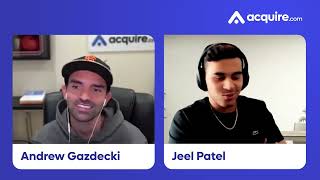
Jeel Patel sold her invoicing SaaS business, InvoiceOwl, for six figures using SEO-driven growth. She talks through the acquisition process via acquire.com and what she's building next with her logistics software startup, Upper Inc.
Foreign.
I'm here with Geo Patel who recently got acquired for six figures. Jill, how you doing today?
Doing good, Andrew, how are you?
Good. Thanks so much for coming on the podcast. I'm especially excited about this one because I have a soft spot for products like this that serve, you know, SMBs and again, very simple product, but you did really, really well with it. So um, before we get into that, do you want to maybe give listeners just a brief introduction of yourself that may not know you?
Yeah, for sure. So my name is Jill and I started Invoice hall back in university. I'm just currently 23 years old, still learning a lot of new things.
Congrats.
Yeah. So just 23 years old, learning quite a lot. And the journey with Invoice Owl has taught me some valuable life lessons as well. But going back to When I was 19, I started learning SEO through affiliate site called tomfw.com and started that site with $500 and within one year got a five figure acquisition offer. And that was a big deal back in those days because of course 19 year old me didn't know much. But learning the SEO process, like how to scale a website, how to like what host a website and then ultimately selling stuff to people like convincing people to trust you, your reviews and buying it, that was a whole learning process. But after one point it was just like I wanted to do something recurring because when it comes to affiliate, once people buy your product especially the niche viewer in was men's grooming products. And once you buy a beard trimmer, you're not going to buy another one for at least six months or one year. So, so the we wanted to once I was looking for something that was recurring and that is when we had this landscaping project going on in the house. And this is like, it sounds like a magical story, but it was not. This, this guy, landscape guy was sending me paper invoices and I was just curious like why is he not using anything digital? And he was not a tech savvy person. So I did some research for him, like what softwares are out there. And back then the software called Invoice to Go who was very similar to Invoice all got acquired by build.com for 600/million dollars and they had released their like acquisition deck in the public. And I went through the deck and I was just like these guys were doing some interesting stuff but one thing was their SEO really sucked. Like being the SEO guy, the first thing I checked was I went to Ahrefs and I checked how we're doing while people on one side were searching for things like invoicing software for Plumbers. Estimating software for Plumbers invoice to go was nowhere in that picture. So I saw it as opportunity and fast forward started it.
Gotcha. I love that. Yeah, because there's a lot of. So correct me if I'm wrong, but it's just, it looks like a basic invoicing app for small business owners, landscapers, plumbers, essentially any sort of service professional. Is that correct?
Yeah, yeah, that's it.
Yeah. What I love about your business is there's a lot of competition in the space. You know, there's a lot of different invoice builders. And I noticed on your website you have like free tools. You had, I could see in the footer you had a lot of different pages that pointed towards, I'm guessing really targeted SEO keywords for the types of customers that you were targeting. So it felt like, you know, it was a great product mixed with, you know, a really good marketing and distribution strategy. Is that correct, Assam?
Yeah, that's exactly a good way to say it. Because we didn't have the product. We started the SEO six months before we had even the mvp. Like before even we started working on the mvp. We had started the SEO six months before that.
No, that is smart. So it was kind of like, so you saw this as, you know, this is a product that clearly has demand. There's people clearly searching for a product like this. And so you thought, if I could just get the product to rank for these specific key terms, maybe it's, I don't know, Plumber invoicing app or something like that. And if you could rank for those terms and then you successfully get there, you'll build the product and you have immediate demand before even building the product.
Yeah, because like I still remember we had this on homepage, we had the sign up button, but when one user clicked on it was just like, hey, we are on our way to build a great product for you. Just bear with us. And you would connect it, collect that email address. But yeah, that was pretty much it. Like we're just writing some simple blogs on WordPress.
That is super smart. I really love that strategy. So you built demand up all organic, so essentially free search traffic before you even built the product. Tell me about when you launched it. So you said you spent six months writing SEO articles. It it's six months that goes by, you're starting to rank for some pretty valuable key terms. What happened when you actually had a product? So it didn't take them to, you know, hey, you got to wait. Or you probably had a bunch of people waiting for the product, I assume.
Yeah, so we had a bunch of people waiting for the product. But the far greater number which we saw was for example in SEO you try to rank for this low search volume, low competition, keywords and we are ranking for this. For example, a small example is just best invoicing software for small business owners. Like this is such a big term and low competition. So we are ranking on that and we just added a cta. When the product was ready, we just added CTA on these blogs and then we like promoted Invoice sound like as a number one software for small business owners. And we started seeing signups like right, right next day.
Nice, that's impressive.
So that, that was number one thing. And then we also had the email list. So we started to launch like through customer IO. We started to release like email campaigns and everything to these people like who showed interest in the product earlier. But honestly speaking didn't see great response over there because as you know like these people who is buying like if you're buying a small 1020 software per month, then you're not going to wait like six months until someone comes up with a product. You will just go like there's hundreds of competitors out there who are doing exact same thing. So they would just go ahead and buy the different thing. But we saw we had like switching customers, like people switching out from invoice to go coming into invoice out and those kinds of people that's reaching out of the softwares to come into our. Oh really?
Did you have like comparison pages to other companies, like Invoice to go versus Invoice Owl. Did you have like all those types of SEO pages?
Yeah, so we had like comparison types of pages. I think for any SaaS business. Like this is the lesson I learned is like comparison pages, alternative pages, review pages. Like if you have these three pages nailed out and then I think you are getting your major like inbound channel is like right there.
Nice. So this is really, this is awesome man. Good for you. At age 23, I started a company in college too and I have massive respect for anyone that starts this early. But so essentially this really sounds like a commoditized product meaning you know, you're not really trying to innovate too much but the innovation is happening on the go to market or the distribution side. So it really sounds like a SEO play with a product attached to it. Is that kind of accurate? Like that's kind of the strategy that you implement.
Yeah, basically to get started, that was the only strategy, like how can we win this game through SEO? But then after one point because I know like I'm big fan of like reading books. So I know like people when they say in their books that you know what major businesses fail when it comes to like marketing and sales. So I think that's my approach with any business. If I go, if I'm going to start is how to build an inbound engine and then you can think of something creative. Like I think innovation just doesn't come from like doing something disrupting the industry but like doing something better in the industry by finding the gaps that can also be done. But I think that I can do it once I have the revenue stream and the inbound channel coming in.
Yeah, no, I can. I love, I love what you just said. I completely agree. I think you can innovate on the product, on the go to market strategy, on the distribution strategy. How are you acquiring customers pricing? There's so many different ways to innovate. Um, all right, let's move on to the, the acquisition. I'm. I'm curious, you know you're the business is doing well. How many customers did you grow invoice out to? I can ask.
So, so we had the free tier on the like platform as well. So if you count the number of users it was like 13,000 plus users. But like the customers, customers would be in like thousand or something range.
Nice. So that's a good amount. So what made you want to sell the business?
Honestly like we have this different business. It's like it's called Upper Route Planner and my, it's like my family is into SaaS space so my dad started this software but I think it's in logistics space and I just see like I'm more excited to like do something logistics space and that is why I wanted to move away from it. Nothing more the more to it. And it's just that also invoice out. It's as you said the competition is like extreme. So it's really hard to differentiate yourself when you're competing on one side against software like Pickbooks because they have the invoicing model and on one side you are competing against also get job or in service titan on like when you have all this kind of like the landscape is very diverse and that is why I wanted to do something logistics based and it's similar kind of audiences but like which invoice almost targeting the software we are currently working on.
That makes sense. Yeah. I mean you built it up to a, a great number in terms of the traction and it's a great time to sell. I mean there's nothing wrong with cashing your chips. That's what I always say is, you know, if you're not passionate about the business, nothing wrong with selling it. Let's talk about that. Okay. It's closing day. So this is the day when you're going to receive the six figure wire. What did it feel like when it hit your bank account?
Honestly it was just first of all it was a relief because the transition process is a bit itself learning like what to do, how to do, supporting the other side of the person who is going to take care of the software. So first it was a relief that okay, finally it's done. Now how to just provide support. Other than that, I don't think, I still don't know what to do with the money. I'm just going to invest back into another business. But, but yeah, nothing fancy or not doing any like buying an expensive car or anything smart.
I love it. Well, let's, let's rewind the tape a little bit. So how did you, how did you find acquire.com and what was your expectations going into all this? Did you actually think you, you could sell this for the amount you did on the marketplace?
No, I don't think like my, I don't think it would have been so for answering, sorry, answering the first question. How did I find acquire.com I think big fan of you on Twitter. I follow your tweets and everything. Like advice are also like bit interactive there. So I knew you but other than that I think yeah, aqua.com I just knew about it that there's this thing which exists which makes it easy and yeah, I just signed up for it. And you guys have a great team who can help with onboarding and everything. Like if I, I had like thousands of questions but I think the person who I was in contact with, she was able to help me like transition.
Who'd you work with on my team? Was it Emily, I believe?
Yeah, it was Emily.
Nice. How was it working with her?
It was pretty good actually because every week like even if, because if I forget, she would just look back with a short like email like hey, just wondering if you had any questions. And I would just reply that yeah, I had discussion. Then instantly I would get a response. So pretty nice working with her. And yeah, from day one, like I remember the first call I took with Emily, lot of questions Lot of like things like how to do this, how to do that, and she sent me all the resources and yeah, pretty easy when you have like those kind of people who can guide you through the process.
That is awesome. And then how did you prepare for the acquisition? I'm sure Emily gave you some tips or some best practices. Um, did you put together any certain materials for buyers or anything like that?
Oh, yeah. So basically the first thing we did was started to like, got. Got like the first call we had with the buyers that was just the intro called due diligence etc, but apart from it, we just asked for their expectations on like, what do they want apart from the like code and everything, what do they want from support which will make the transition easy. And, and I think Emily also supplied me with some of the things like checklist or anything, so that was also handy. And then we just prepared this Excel or Google sheet which had like every single thing that we wanted to give them. Then also the documentation, because our documentation wasn't that great. But we listed down everything that we need in documentation we needed to transfer. And then it was just like checklist, do this, do this, do this. And we had the date, like when, when we, when did we complete it or when did we transfer, transfer that asset. So once both, like both parties agreed that for example, customer subscription, so we needed to transfer that. So once both parties, okay, I have transferred it and other guys, like, okay, I received it, then we just marked it on the sheet that, hey, this is done nice.
I mean that's super important because what you're essentially doing is I always say you're closing the gap with the buyer. So when they look all these materials, you make it a lot easier for them to take a call with you or be comfortable acquiring, you know, your business because you have a transition plan, you've outlined all the assets that they're going to be buying and these are questions they're going to ask you anyway. So having these materials available in advances is huge. And you know, I think a lot of startup founders really don't understand how much it impacts your valuation, the amount of buyers interested. So you did a great job on that. How did you decide to go with the, the buyer that ended up acquiring this? What stood out about him? Was there anything? Was it just the highest bid? Was it. You guys got along. What about him stood out?
So basically as like speaking honestly, this is multiple like, like interested parties on the foreign voice or I think we are doing. And during the same week we are doing calls with the Multiple buyers. And this one buyer, they had the experience in the space and they were like. Because we had another different buyers who are not technical themselves. So they wanted support from our end and everything to help them set up. But these guys were like, killing it in the space. They have killed it in the space and they just wanted to get started with it, so. And it was like they wanted to keep it smooth. And that's, that's what I wanted, like ASAP and smooth. So, yeah, that's why I chose them. And offer was. I think we had all like similar offers in the same lines. So I don't think that was the part of it was just like how move is the most like, smooth and like fastest for us.
Yeah, that's also, that's also big for maybe other people listening in terms of, you know, which buyer to pick. Sometimes it's the one that you just get along with the best. You know, the one that kind of understands the application. Maybe they're technical. That's always a plus. Maybe they're willing to, you know, move quickly on due diligence because they have experience in the space. It can be a number of different things, but whatever makes you most comfortable with that individual. Because there's. There's a quote I always say on this podcast is, you know, you can't do a good deal with a bad person. And there's just so much goodwill and acquisitions. I've never seen an acquisition close when the two people are yelling at each other, just not seeing eye to eye. So that's awesome, I guess, you know, in terms of due diligence and transferring the assets and going through escrow, how did that process work? And any hiccups or, you know, things that maybe took a little bit longer than they should have.
Yeah, but of course, in these things, it takes, like delays are always there. And it was, it's none of the, like, party's fault. Like, both are trying to achieve the same thing, but it's just like the third party systems from which we are trying to migrate, like Stripe or anything. Those things take time. And I think we had a long weekend like in the middle of this transition. And that disturbed, like that delayed everything by one week. So. But other than that, it was smooth. But just going back to your last point, as you said, like, how, how important it is to like have goodwill in the, in the, like any negotiation, anything. I just like wanted to add that there's this book called like, Negotiating the Impossible and that is what the author says in it too. Like, people usually when it comes to acquisitions, mergers, anything they try to focus on substance which is like amount or like dollars or like how, how can I get the highest bid from buyer. But I think the process is more important. So the author is saying like negotiate on the process rather than negotiate on the so which is just like how you can make things smoother, how you can have this documentation, how you can transfer it fastest, how you can speed up the escrow, how there are no delays. I think these are more important parts rather than just like the substance which is the amount.
I, I agree. I think what you're referring to, which I typically say is you can negotiate on terms, you know, someone wants to do 90 days of due diligence and another buyer wants to do 30 days, 30 days is going to be, you know, more attractive. Or if you can, you know, negotiate all the things that you just mentioned, just having a smooth transaction, you know, not having a big headache as you're selling your business has value to it. So I, I completely understand that. I guess you know, my last question on the acquisition would be now that you've you know, successfully sold a business for you know, six figures, if you had to you know, give three piece of advice to another startup founder looking to you know, reach the same level of success as you, what would it be? Or no, let me rephrase that, sorry. Specifically in terms of selling your business, you know, three tips. Now that you've been through an acquisition process, what are three tips you would give another founder looking to sell their business?
Ah, that's a tough one. I think first would be the key, no brainer, have like proper documentation from like even if you're not planning to sell, just have like a documentation which is just like in smallest things like how you set up mix how you set up like your database and etc, and not just the bigger pieces because people usually have documentation for the bigger pieces but the questions that comes are usually in the smaller ones. So I think the documentation is the key. That's the first step and having videos like with documentation like you explaining product, you explaining the database architecture, everything that is an advantage for not only the party was trying to buy but also like if you're new team members or anything it's easier for them to understand like all this architecture. Second tip is yeah patience would be the key because as I said the long weekend we can disturb everything. And I think patience and the trust goes hand in hand that it's not in other parties fault like usually in this thing like something gets delayed, it's natural for humans to just question like hey, you know, what is this guy going to do something wrong or is this guy going to do it like take my things away? But I think patience and trust would be the key during this like selling businesses. And third would be, yeah, yeah, grass is always greener on other side. So you need to decide like what you are willing to give up and what you're not willing to give up. And as I said, substance versus the process, like that's when it comes up. So I think that those would be the, they are basic tips. But I think they are the three basic tips.
Yeah, those are good. I like the last one the most. You know, substance and, and process, you know, really understanding what's important to you in the acquisition. So that, that's, that's great advice and I guess, you know, my last question is what are you building next? You touched on it a little bit. But every entrepreneur I talk to, they sell a business, they have another one they're they're already working on. Tell me a little bit more about your new business that you have.
So it's in the logistics, but it's called Upper Inc. And Upper is basically route planning and route management software. So let's say it's your 50 stops to deliver today. You have three drivers and who will go where and all these three drivers, one is driving in car, one is delivering in truck and one has a medium sized truck. So capacity optimization. So how do you take care of those like route management and secondly, how do you notify customers like, hey, your order is out for delivery, then proof of delivery, live tracking of driver, fleet management. So it's those kind of software. Already doing great on it. We are at like half a million dollars in er so already. Yeah.
Whoa, man, look, Here you go. What's. How do you, how do you go to the website? I'll put it in the show notes for people to check out.
It's upperinc.com U-P-P p E-R-Inc.com okay, I'll.
Put that in the show notes. Well, Jill, thanks so much for coming on the podcast. This was awesome. Congrats again on the acquisition. It sounds like your new business is rocking. Maybe I'll see you back here again for I don't know, like an eight figure acquisition next time.
Yeah, for sure, for sure. Looking forward. Fingers crossed.
All right man. Congrats on all the success. Cheers.
Thank you. Thank you. Cheers.
More from Andrew



The Buyers Who Made the Move: What They Bought, How They Did It, and What Happened Next






