Startup Acquisition Stories with Marco Fazio, CEO of Hypeal
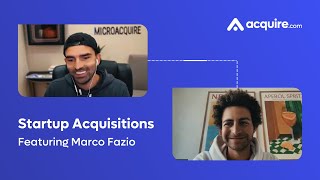
This is a YouTube video titled "Startup Acquisition Stories with Marco Fazio, CEO of Hypeal" containing an English conversational interview recorded in May 2023. The discussion features Andrew Gazdecki interviewing Marco Fazio, founder of Lito Travel, about his experience building and successfully selling his e-commerce business on acquire.com. They cover topics such as the acquisition process, working with M&A advisors, due diligence, and Marco's new startup venture in crowdfunding platforms. The conversation provides insights into startup acquisitions and entrepreneurship.
All right. I'm here with Marco Fazio, who is the founder of Lito Travel. Marco, how you, how you doing today?
Hi, Andrew. Thank you for having me. I'm doing great.
Yeah, my pleasure. So for those that may not know you or your background, you want to give a brief introduction of yourself?
Yeah, sounds good. So. Well, actually I kind of work most of my life in E commerce for big brands like Adidas and Reebok and the sports side. Solo brands, one of the first brands aggregator that did an IPO in the ecommerce space last year. And yeah, on the side, actually, while I was working full time, I built my own company, my own E Commerce LiteTravel, which started first as a Kickstarter and then turned into a Shopify store and a real E commerce business.
Nice. Well, congrats on the acquisition with Lido Travel. Let's, let's, let's start there. So what, what made you start Lido Travel? Was the idea behind it? Did you have like a light bulb moment?
I think like, when it comes to E commerce, there's two types of founders, right? Those that have an idea and don't know much about E commerce and those that know a lot about E commerce but, you know, not necessarily have a product itself or they're not, you know, designers, but they have the ability to build. Right. The infrastructure behind it. I was one of the second type of people because I was working in Adidas. I really could understand a lot from this big brand and how marketing and branding really works at scale, let's say. But I didn't necessarily have, let's say, only one idea. I had multiple ideas. What I did was really to go over a framework. I think it's very important to go over a framework to really go at speed and make sure you don't get stuck in the decision making process. But literally listed a few ideas that I had looked at the market, looked at Amazon, looked at Kickstarter, other crowdfunding platform, see what was there. And the best idea at the end of the day was the fact that, yeah, I was living in a small apartment, had a lot of suitcases, they occupied a lot of space. I didn't like it. So, yeah, I thought that maybe creating a suitcase, that is space saving could make sense, there could be a market for that. And later on I found out that that was the case.
Nice, I love that. So you had, you know, a personal problem firsthand and then you also had market experience with E commerce. So when you combine those two, it usually results in a Successful business. So that's awesome to hear. So walk me through. So Lido Travel, it's, it's doing great, you know, it's got customers, you know, life's good. What made you decide to list it on acquire.com?
Right. So actually I started the company more as a side project. Right. So I was working full time and for me it was about, the experience was about, you know, learning everything about E commerce, launching a business for the first time. I believe that I will continue launching businesses for, for the foreseen future. But it was my first experience. So at the end of the day I found myself in a position where I had a profitable business. I was doing a lot of work, of course, because it was, you know, running operations, running a full time job. So yeah, having the possibility to, let's say call it a success story and exit early has been really fantastic for, for, for my life. And I tried a few, you know, different routes to do that. But at the end of the day, the successful route was to list on acquired. Com.
Nice. So let's, let's. I'd love to dive into that as I'm sure you probably guess. All right, so you, you list on acquire.com what happens like within like the first week.
Okay. Based on acquire.com I got initial interest, let's say from the mention because it got mentioned for newsletter. So let's say a lot of initial interest there. But unfortunately everything died out afterwards because we were going into Q4, so slow down in general in M and A activity, a little bit of, I think fear of market acquisitions in E commerce at the time. So basically at the point I was finding myself at the point where I just couldn't move forward. So at that point I looked at what were the options and I saw in the platform that you could hire an advisor. So I literally talked to all of them, see what made most sense, and then hired an advisor to help me out selling the business.
Nice. Who is the advisor, if I can ask?
Yeah, it was Marty from Westbound Road, which has done an amazing job. So yeah, thank you, Marty.
Yeah, yeah, Marty's great.
That's good to hear.
So walk me through. So you're working with an M and a advisor and now so what happens at that point? What was kind of the process that led to a successful acquisition?
Right. So I mean when you get listed, you get an initial inflow of leads and then what you do get is a long tail of people that are specifically searching for, you know, E Commerce, specifically searching for your type of business, which Is of course a much smaller amount. Right. So maybe I would say, yeah, Q3 per week in my case. And overall, it took us around five months to sell the company after listing on the platform. But what the Advisor Martin team did was to kind of do an outreach, a weekly outreach to leads. Right. So to potential buyers, engage them on a weekly basis. So yeah, more or less like a sales funnel, if you want to call it like that, so that people will be engaged over time, the same people, the same audience, to actually move forward, reward and create an ally and express the interest. So I think what made the difference in this case was really a continuous follow up on the potential pool of buyers and just be consistent following up in the platform with every single person that reached out initially with the interest.
Nice. Yeah, that is kind of crucial. And I talked to a lot of founders that don't necessarily understand that in terms of, like when you're selling a business, you got to really sell it. You know, you got to follow up with every single lead you have. I always recommend, you know, treating each buyer like they are the buyer and build or not. So following up with, you know, weekly updates or product demos or any additional information you can share just to continue that interest with the buyers is absolutely crucial to sometimes finally getting a deal done. So I'm glad, I'm glad you did that. Can you walk me through? Okay, so how did you, how did you find the, the final buyer? What about them stood out? Was it the offer? Was it you two just got along really well? How did you land on the final buyer that acquired your company?
Right. So yeah, of course we had quite, quite a few people we talked to. I think overall, maybe we talked with messages maybe around, yeah, something like 80 people in total that kind of were at least interested to see the pitch deck and so on. But overall we got two. Lois. The first one didn't. Didn't go well. It was actually a little bit tough at the beginning because once you receive an LOI automatically, if it's your first LOI ever, you think your business is getting sold. But there's a few steps from there. And the second time when we got the LOI with the actual buyer, it just felt very good from personal perspective. The relationship with the buyer, very professional. It was a buyer acquiring a few small businesses, small e commerce brands that we're looking into sustainability and veganism as a, you know, to add in the portfolio. The suitcase we produce is made of recycled pet plastic. So yeah, it was a fit in that sense in the strategy. They would keep the founder story within the growth of the company, which is something that they really liked. And yeah, it just felt right. So at the end of the day I went for it.
Nice. Yeah, I think, you know, getting along with whoever's buying your business is just absolutely critical in terms of. Because when you sell your business it's, I always say it's not like handing over keys to a car. You're going to have, you know, probably a three month transition period or a six month transition period where you're going to have to work with that person. So being able to get along with them and then if they have, you know, items like they're going to keep your story intact or have a vision for the business, I think that makes the best acquisition. So it's great to hear. Tell me about, tell me about due diligence. So you are, you are correct when you say sign an loi. It is not done by. I, I always say that's. Excuse me, that's like the first inning where you know, a lot of entrepreneurs think you get an ly. They celebrate and it is something to celebrate, but it's really the start of, you know, someone potentially buying your business otherwise fall through all the time. Tell me about like due diligence just from like a high level. How did that go? Any bumps in it? Any headaches caused? Any tips for other entrepreneurs going through due diligence?
Yeah, I think like what is, what is important in the due diligence is that or well in the entire acquisition process is that the buyer knows what is buying in a way because we got a lot of questions from other potential buyers that they just, you know, didn't really fit the how to say how you would do due diligence in the E commerce space, for example. Right. So very specifically into KPIs in the accounts and so on. This buyer for us, yeah, it was pretty smooth because at the end of the day, if you know about E Commerce, it's really about Google Analytics, Shopify account, the Facebook ad account. And then it's very easy to see how well the business is running. Right. So we can all write some things in the financials, have certain type of expenses and so on. So having that kind of financial due diligence, which is very important, but it's not the same across the world. There's different jurisdictions, different rules, different tax ruling and so on. But the good thing about being built on E commerce is that everybody's using the same platform. So once you hand over, let's say the reading rights of the accounts. It's pretty easy to verify that you have traffic, that you have sales, that you have good average order value, customer lifetime value and make your own assumption as a buyer on the actual value of the business. So I would say due diligence has been pretty smooth for us because we went first of all handing over all the reading access to the, to the buyer for the ecommerce platforms. And then once we, yeah, made the transaction, we just switched the accesses from reading access to admin access and that's it.
Oh man. That's as easy as it gets. Due diligence for a lot of other people is a lot more difficult, especially if you're moving software or you have a stripe account with 10 different products in it and you gotta figure out, you know, which customers to move over. So that, that sounds like actually handing over keys to a car. Actually, the more that I think about it in terms of, you know, the experience of the buyer, how do you think that, you know, played a role in due diligence? Because on one hand, you know, I've seen a lot of, you know, first time buyers and first time sellers, you know, we'll kind of help guide them through due diligence in terms of, you know, these are the things that you both should be working on and you know, looking at. And then on the other hand you have experienced buyers who typically, you know, can close a transaction in, you know, two weeks to a month. You know, they just seem to, they've been through the process before and it sounds like your buyer had. Do you think that made due diligence a little bit easier?
Yeah, exactly. So it wasn't the first acquisition I believe in the E commerce space was I think maybe the fourth or the fifth acquisition in a relatively short amount of time. So I think that was speeding things up. Right. So we closed from LOI to asset purchase agreement in around two weeks, which is relatively fast I would say. And yeah, the buy already had like the template place they use for the previous transaction. So we did made some adjustments in the, you know, the escrow transaction in, in the rights of the assets and so on. But I think if you, yeah, if you've already done it right, it's, it's always easier to, to do it a second time whether you're a buyer or you're a founder.
Yeah, I actually, you know, typically will advise founders to work with experienced buyers even if the price is lower because the chance of the LOI closing is higher and it'll just make your life a Lot terms of, you know, if you're selling a really technical product to a non technical buyer and they've never gone through an acquisition. So I think another tip for maybe some entrepreneurs listening, if you haven't acquired anything, just buy something for 5k, go through an LOI, go through the asset purchase, go through due diligence and that alone will help you when you get to, you know, larger acquisitions. So everything goes a lot more smoothly. All right, so it sounds like due diligence was a breeze, transition was a breeze. You know, I'm assuming deals closed. Anything else you want to add to it? That was kind of a, it sounded like a perfect acquisition from start to finish.
Yeah, I mean I would say it wasn't also like easy. Right. It still took five months. So on a weekly basis we were reaching out to buyers a little bit. Sometimes, you know, we felt that we were getting closer to it, but then, but then not really. I think like it was, yeah, quite a marathon. But the last part of the marathon went very smoothly. So that's something that I really enjoyed. And to be frank, I wasn't really prepared because I expected to have more bumps along the way. I think as you say, working with buyers that already bought a business, it's preferable also because there's expectation alignments. A new buyer might think that he buys a business and then this business is running by its own. What I wanted to make sure of is that the buyer had the capability is to run an E commerce business. So to run the operations, to run ads, to run merchandising. Because yeah, if it's just the first time that you buy a business, you have never heard about E commerce. I have experience from working in E commerce, incorporate as a founder. It's very hard to do that. Right. Running a business that is already operating if you've never had experience in the field. So working with experienced buyers definitely was the. Was a good call in this case.
Yeah, I would completely agree and I think that's, you know, good advice across all types of businesses. So I guess, you know, that would move into maybe. Another good question, you know, for other entrepreneurs looking to sell their business. What's maybe, you know, the top two, three learnings that you gain through selling your business.
All right, so I think at the end of the day it's very hard to make valuations on early stage startups. VCs struggle with that, we struggle with that. Especially when it's bootstrapped. It's just not very easy. So there are ways to do it and I think looking at the multiples of previous transactions on acquire.com was actually a really good way to do that for us. So, yeah, I would say once you're selling your business, two things. First of all, be profitable, especially if you are in the E commerce space. Because it's going to be really hard to convince someone to buy an E commerce business that is not profitable just because it's really a margin optimization game at the end of the day. And then, yeah, just make sure that you have a clear understanding of your monthly profit and loss account. Right. Because first thing buyers want to see and that's also how your business is valued, is to see how much profit you make on a monthly basis, how much revenue, how much cost you have and ideally that is consistent. Right. So if you have a lot of volatility in the cash flow, that is a little bit less attractive for a buyer. Right. Because you don't know what's going to happen the next month. But if you do have that kind of stable cash flow month by month, then it becomes, it becomes more interesting. So definitely getting the financials right and try to get stability month by month over the cash flow, of course, ideally towards a growing trend until, until you get sold.
Yeah, no, that's, that's great advice. You know, I, I think, you know, in terms of, you really hit the nail on the head in terms of just having, you know, clean financials because that's how a lot of buyers are going to value your business, you know, right off your p now. So regardless if you're selling a SaaS business or an E commerce business for a lot, for a lot of buyers, it's almost required, like they can't really understand the health of your business or make an offer until they have, you know, clean financials. And without them, it does show kind of a lack of preparation in my opinion, in terms of, you know, you should get these things prepared before you bring your business to market because it'll just make everyone's lives so much easier. So that's great advice. I guess my final question is, you know, what do you, what are you working on? Now? You mentioned you are probably going to be starting multiple businesses. Have you already started one or.
Yeah, actually today's the day where I just announced, you know, my, my new business and we are kicking off fundraising for it. So basically I, you know, I've launched my company on crowdfunding. My mentor from, you know, from Little Travel on Kickstarter has been launching more than 20 products on the market through crowdfunding and we just sit down and notice that there's a lot more that we can do in the crowdfunding space and adoption of the crowdfunding methodology to raise money for startups around the world. So, yeah, what we're doing is basically launching a new crowdfunding platform that will allow to have its own secondary market where the funds of the startups will be tradable. So more or less like in the, in the stock market, but more for early stage startups.
That's awesome, man. Congrats. What's, what's it called?
Ipo.
Ipo. Nice. I like that name. It seems that, yeah, it makes sense. I mean, you're, you're doing secondary trades on private companies and helping them get financing.
Exactly. So, yeah, I think it's going to be pretty exciting. There's a lot of, you know, challenges that we have to overcome from our technology and legal perspective. But at the end of the day, now it's the time to build something like that because the technology is already there. There's a lot of ways we can build this in a decentralized way. Right. So if you think about how big exchanges have been built, decentralized exchanges like Binance and crypto.com and so on, why are we using those exchanges only for Web3 companies? Right. Not for all startups, for example, and launching securities in that way. So yeah, a lot to come in this space and I'm sure we stay connected on that as well.
That's awesome, man. Well, congrats on the launch. And I'm ruined for you and maybe a few years or a decade down the line and you IPO or sell ipo. I'd love to have you back on the podcast.
Exactly. Sounds good. And Andrew, thank you so much for what you do for entrepreneurs around the world because I've seen your name many times while I was thinking about selling my business and again, I think you're allowing people to do something pretty, pretty awesome, which is making relatively small transaction if you talk about the acquisition space. But to me, this acquisition has allowed me to start focusing on what I really love, which is entrepreneurship. And not maybe just get stuck with the day to day operations of just one company, but being able to move forward and move to something bigger as well. So thank you.
Right on, man. I appreciate that I'm written for you. So if you want to learn more about your story or your new company, where's the best place to find you?
Yeah, you can just contact me on LinkedIn. I'm pretty active, to be honest. There, and we can always have a call anytime.
Cool. I'll put that in the show notes and. Yeah, yeah. Marco, congrats again on the acquisition and the new company. And again, I'm rooting for you, man.
Thank you, Andrew. Cheers.
More from Andrew



The Buyers Who Made the Move: What They Bought, How They Did It, and What Happened Next






