Startup Acquisition Stories with Ruslan Leteyski, Founder & CEO of Checkout X
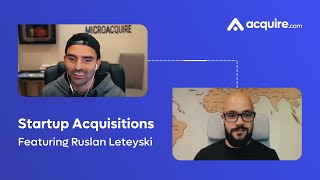
This is a YouTube video titled "Startup Acquisition Stories with Ruslan Leteyski, Founder & CEO of Checkout X" recorded in June 2023. It features a conversational interview between Andrew Gazdecki and Ruslan Leteyski discussing Ruslan's experience building and selling Shopify apps, including the acquisition process, challenges faced, and advice for other founders. The discussion covers topics such as product development, customer acquisition, due diligence, and the liquidity of Shopify app businesses.
Foreign.
I'm here with Russell, the founder of Venga AI who recently got acquired. How you doing, Russell?
Hey man, I'm doing great. And for me it's as I said, it's an honor to be on this podcast and I'm a huge fan of acquire.com or micro acquire. But I, I gotta say I like the previous name better. I cut more character to it.
Yeah, you know, I still the logo up here in the background, but we had to drop the micro to allow us to help start us of all sizes. But congrats on the acquisition with Vang AI. I'm looking at this now just for people that maybe don't know what VENGAI is. What is it and what did it do? What problem does it solve?
Yeah, so Vanguard AI is a Shopify app that helps you upsell automatically. So, so we basically wanted to do an app that you click a button and you increase your revenue by 10%. This was like our initial thinking. So basically what Manga AI does is it scans your order history, it looks through past orders and like maybe some other source that are similar to yours and it starts adding these upsell items through the customer journey that based on some rules they gonna start suggest suggesting cross sells and upsells and this kind of stuff. That's pretty much what it's doing.
Nice. So what's your background for people that may not know you?
Well, my background is a little bit weird because I've been part of every part of software. I've been building websites since I was 10 years old. I worked in a couple of startups as a product designers here in Bulgaria and also in France. And then for the past six years I've been building Shopify apps. I built a Shopify, became probably the biggest custom checkout on Shopify called Checkout X which scaled to something around $600,000 mrr, something like that. Bootstrapped. Then we got banned by Shopify for stealing the revenue. And then we build my AI as a spin off project this company.
Nice. I love it. Not the banning part, but just, you know, you got a setback but you got to keep going. And this is, this is interesting. So it's a, an app that helps with upsells and utilizes AI and it's a Shopify app. So how did you get your first customers for this?
Well, the plus side was, as I said, we worked with Checkout X for a long time. So we had already a very strong brand and we started approaching our previous customers as bang. AI was doing some of the things that Check Out X was doing in a more sophisticated manner. So this was our first approach. And, and we also started doing all kind of different strategies. We tested a lot of things. We tried going to events, to conferences. But what really worked for us very well and we started from the beginning is influencer marketing. So we partnered up with different gurus in the Shopify space and we asked them to start promoting the app. And they did, which turned out to be a pretty good strategy for us.
Nice. Yeah. I watched your introduction video for Bing AI and I liked how everyone in the beginning was talking about how much they like it. And you know, whether those users or influencers, it like really made me feel like, okay, this is a good, you know, Shopify app, so well done. Okay, so you, you, you, you build a product, you get customers, and then what made you decide to sell the business?
Well, as I said, Bang Ahead was a speed up project of another company. And we, what we did ultimately was we tried to build with Check Out X. That didn't work with us. So we said, okay, let's make a new project, let's give it a half a year, see what happens. That was, I guess, two years ago now. So we started my AI, we launched in two months and we started getting some traction. We didn't even have like paid version at this point. And we said, okay, let's give it another year to see what happens. And we made it for another year. We started growing, but ultimately even the team that we had and the setup we had, we were pretty far off from covering our expenses. And ultimately we saw that we're fighting in the most competitive space in the Shopify app store, which is upsetting. We had over 500 competitors and we didn't really see that we can do this kind of explosive growth. So we figured, okay, let's move on and do something else. So it was more like try deciding to do something else rather than just deciding that's the right time to sell. And when that opportunity arrived, like, I was looking at Picro Acquire and I figured, okay, we can actually sell this thing. Which is a force, because when I was starting Shopify, apps were not liquid at all. Right now, they're crazy liquid. I was so, so impressed with the amount of interest we got through acquire.com. so, yeah, we just decided it's time to move on. The team started doing different things. I also started doing different things or started looking into starting different things. And this is how it was. The, the way we decided to sell.
Nice. That's good self awareness. In terms of just that you built it, you built it to a good amount of revenue, it looks like, and then realize, you know, this is as far as you're, you know, excited to take it. And then you got it successfully acquired. So that's great. Um, okay, so you, you start your listing on Acquired a. Com. Can you walk me through just kind of like the preparation you did in advance just to attract the most buyers. Was there anything that you did in terms of documents that you created or anything like that?
Yeah. So even before we listed, what I really wanted to make sure is that I know how I actually gonna sell the company because we're a Bulgarian entity. So I was not gonna sell the the company, but I needed to figure out how I'm gon transfer the asset. So even before I started listing, I had to figure out how we're going to transfer the infrastructure. As I mentioned, we had other projects. So this is the thing. Like we had different tooling that we needed to figure out with the team how we're going to separate. So the preparation actually started one or two months before that. And then I made a plan. If I have a buyer, I need to do these like 50 steps in order to actually transfer the company. And then I went out of Bar.com, it was really easy. Um, it was very straight to the point. I filled it out. What you guys did bad for me was really great that you didn't reject my application, but you edited, edited from my point of view, which was great. And also what really helped was you had these formats for a wire deck. That also helped me figure out what information I need to provide. And I followed all the guides you guys have. Like the whole guide structure really helped me understand what's the process of actually selling the business.
Yeah, you did a great job in terms of, you know, preparation when you're selling your business is, is so key because you can't get those first impressions back with buyers. And I love how you had, you know, your expenses, your revenue pitch deck, just a buyer overview deck that we made with you. So well done on, on the preparation. That is, it's so key because without that, buyers are just going to ask anyway. So when you give it to them up front, your chances of, you know, maximizing buyer interest or, you know, getting acquired goes up a ton. So that's okay. So gray, you did, you did a great job with preparation. You go live on acquired a com. What what happens at that point? You mentioned a bunch of buyers reached out. What was like the first you know, two or three weeks, like on acquire.com?
Well, I had. It took a couple of weeks at first, like, so the first thing that's kind of made it weird is you get a lot of people that kind of want to see more information, so they send the NDA. And most of these people don't really. They don't follow up. What I was doing with these guys was I was actually following the wing up to see if some of them had interest. Some of them actually had. When we started going back and forth, I got a couple of people that were interested. And it was interesting because you have some people that, for example, they had a public company, they wanted to give me like shares of their public company. There were some people that were not really experienced in buying. So for them it was very exploratory. As with me, while I really knew that I want to get someone that already acquired another app because I wanted to have someone that's actually experienced rather than having two newbies figuring out how to transfer this.
So, yeah, yeah, that's, that's smart. And I rec. I actually recommend that often for, especially for larger size businesses to work with, work with an experienced buyer, even if it's at a lower price because your chances of it closing is so much higher because you can have an inexperienced buyer give you maybe a better offer with better terms. But if you have a way more experienced buyer with a reputation of closing and has experience with acquisitions, I would take that offer just because, you know, you're not going to go through due diligence and things are going to fall through and it's going to be a complete headache for you transferring everything. Okay, so that, so you, you found what, what about the buyer, you know, really stood out to you? Was it there you mentioned experience? Was it just how you two got along? Was it the plans they had for the business moving forward, you, you know, really, or was it just the price and the terms?
Yeah, so my thing was I wanted to really get this off my chest as soon as possible because I wanted to have free time to look into other stuff. So even when pricing the app, I kind of took the lower end of the spectrum, what I believe to be a fair valuation, which worked well for me because I got good interest. I think I got like at least three or four offers, serious offers at the end. The reason I chose this buyer was a combination of they gave me what I wanted, what I wanted as a price, but also they seem like they know what they're doing. They already had a Couple of other apps that they bought and I could really understand where they're standing from, like what's their business model, why they want to acquire this. And it kind of seemed that again, they know what they're doing. That was very important to me. It wasn't the best offer in terms of terms that I got, but actually I put myself in the shoes of the buyer and I thought to myself, if I knew what I was doing, I would be doing this. They were asking hard questions, they wanted to meet me a couple of times, they wanted to do proper due diligence. All this stuff that I knew that if someone is serious about buying and they know what they're doing, they're going to be doing right. So this was the main reason I felt these guys will be a good partner. Because the acquisition project is like a project on its own. You have to transfer the assets. There's a lot of things that can go wrong. You can have disputes and stuff. So you need a partner that you, at least you think you can work with for a while.
Yeah, I, I completely agree with that. I, I love how you did. I call this just pre due diligence where you, you have some calls up front, like you are asked and you respond to some hard questions. And that gives you an indication of what it's going to be like working with the buyer before you sign, say a letter of intent. And that's about you working with, getting all that out as, as much as you can before signing. That really dramatically increases, you know, again, the odds of your acquisition closing. Because it sounds like you got to know the buyer. They did some pre due diligence to make sure it was something that, you know they're going to be respectful over your time because no one wants to send out an loi. And then you sign it and then some simple questions they could have asked in the beginning, the deal falls apart. So just doing all that upfront before signing L is huge. So nice job there. So just continuing with the journey here. How was like due diligence and transferring the assets? It sounds like you prepared in advance. How much did that help you maybe go through due diligence? Did it make it easier? Did it make it go faster?
So due diligence was hard for me for a couple of reasons. The first reason that I think it's quite hard is that you kind of have to give your code base, like give access, right? So like this is a tough mental moment because they cannot really audit your code base unless they have access to it. They try to run the app, they try to figure out how this thing works. Right. But at the same time, in most kind of projects, sure, the buyer wants to buy revenue, but the code base is a huge part of the deal, so you kind of give it upfront. That was tough for me, but in the end I thought to myself, okay, if I really want to sell this thing, there needs to be a proper due diligence, right? And if the buyer knows what they're doing, they're not going to buy it unless they actually see the code base. The other thing that was stuck for me is the like the accounting and stuff because as I mentioned, we have other projects in the company. So our accounting was not split by projects. And some of the tools were like they're co used by different projects and stuff. So that was kind of. That I had to go back through like a lot of expenses, figure out what part of the expenses were part of this project, the other project, etc. But apart from that, the buyer was pretty much okay. They revealed everything. I answered a couple of questions to their dev team and it was okay.
Nice. So everything worked out in the end, but it sounds like it was a.
Little bit of work. Yeah, the fun thing, actually the transfers of the assets was stoked for a couple of reasons. Like we had to wait like three weeks first because escrow.com for some reason they stole the payment for one week. So one week we were just staying there, nothing happening. And then they approved it. Then we, we had to transfer the app to their Shopify account. That took a couple of weeks for Shopify, just standing there doing nothing. And there were a couple of things that were funny about the asset transfer. First things is that you realize your assets are just a couple of passwords and a couple of transfer button clicks. So you realize actually the cap table doesn't matter of the companies. Like whoever holds the password is the owner of the company. Right. And the other funny thing, it was not that funny at the time, but when we transferred the infrastructure, somehow the settings of the infrastructure changed. So the whole app crashed like a couple of hours after transfer. So I had to go back like it was like 12am in the evening. Like I had to feed the servers and stuff. So I was just like, oh my God, I sold it. And then two hours later I see all these errors in our slack and I'm like, fuck. But it all worked out.
And that again, I think that goes back to just the buyer that you chose, the one that was, you know, understand that these things happen. I Assume they were mad. Were they mad that happened as your dreams during that word?
Well, I think they. I think they fucked it up. My personal opinion, because probably they changed something, but they say, you know, so maybe just change by itself. But they weren't mad. They were understanding. They were. They just wanted to make sure, like, this doesn't happen again. I explained the issue, had to figure out what the issue is, and we had to work with their left team on their side because it was on their. Their infrastructure at this point.
Nice. Did you agree to any sort of transition period with the new buyer? Like for two months, three months, six months?
So what we did is majority of the money, we did cash and then we have like several parts over six to 12 months, depending on the performance of the app, in which I'm available for, like, ad hoc, for support inquiries, for, like, basically any of my knowledge that I stuff, since we don't transfer anything. But it's not really taking too much of my time because the guys know what they're doing and the app, I believe it's built well, so it's not breaking all the time.
It's good to hear. All right, well, I guess my final question would just be through the whole experience, what was your favorite part about acquire.com, which part really made you go, wow, this is awesome?
Definitely the part of getting offers. Again, from my point of view, especially for someone that's used to building their own products, I didn't believe somebody was going to give you like, six figures for like, some random project somewhere. Because even if it makes revenue, like, you don't really like, it's not like you're buying a house. It's very fragile type of asset. So I was really surprised. There is so much liquidity and so much interest in this marketplace. And it's not just for me, like, there's so many people getting acquired. And that's really interesting because in traditional startup world, you either sell for like 50 million plus or you don't sell. So it's a whole new category of acquisitions. It's really interesting and especially for Shopify apps, where it's like my brand or it's so liquid right now, it's really a good business model to just make Shopify apps and sell them after one year. I think you can make a lot of money doing that.
We've seen. I appreciate hearing that. Again, congrats on the acquisition. But we actually have, as you know, just a singular category for Shopify apps because they're such good applications to buy in. My opinion, because everything's built into analytics, the payments, even the distribution to some extent. So again, congrats. So final question. If you had to give just a few pieces of advice for someone looking to sell a Shopify app or even a SaaS app, what's maybe like three things that come to mind that you wish you knew before UN got acquired?
Well, I think. All right, a couple. First, make your P and L in advance. Like, we didn't do proper P and L reports per project basis, so that was a kind of tough one. But I think one of the biggest things that you can change in order to get a better acquisition is to shift your revenue business model because not all revenue is made equal. So in Vanguard we did recurring loss usage base. And what I realized is like people take these two types of revenue differently. If you have recurring revenue, that's the golden standard. But if you have usage based revenue or one off revenue, that's gonna really be tougher to boost in your valuation. So one of the things you can do is to start shifting your revenue to more recurring base, type and document everything. Like that's again, no brainer. But like, make sure you have good documentation, especially on the tech part, because these, these things very often require some folklore that if you haven't documented it well, it's gonna be very hard to transfer to another. And one last thing. Shameless plug. I wrote a blog post about like a guide on how to get acquired. If Andrew links it in the, like in the YouTube notes, you can find it there.
I'll, I'll definitely do that. I believe I've read it. Is it already out?
Yeah, yeah. You reshared it. I mean, I guess your team reshared it.
Yeah, yeah, I remember reading that. Thank you for writing that. So, Russell, thanks so much for coming on the podcast. It's been great to just, just hear about your acquisition story and I have a feeling I, I might see you again on acquire.com but in the meantime, if you want to, you know, get a hold of you or learn more about your story, where, where can they find you?
You can find me on Twitter at Letesky, which is like my last name. I share these stuff there. I share stuff about my blog there. I'm now unemployed and writing blog posts. So yeah, if you want to learn more about my take on the startup journey and how I think about startups and business, I think that's a good place to follow me.
Right on. I'll put all that in the show notes. Russell, thanks so much for coming on the podcast. And congrats again on getting acquired, man.
Thank you. Cheers.
More from Andrew



The Buyers Who Made the Move: What They Bought, How They Did It, and What Happened Next






