Stop Building for Months: The 2-Week SaaS Exit Strategy
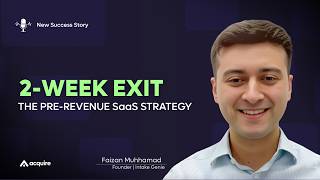
Faison has built and sold four niche SaaS products in weeks using AI tools, pricing them $1,000 to $12,000 and closing deals in one to two weeks through the Acquire marketplace. He maps fragmented small-business workflows, uses Cursor and Vercel to ship fast, and handles due diligence with functional demos and AI-generated docs. His next projects include an enterprise AI governance platform and a restaurant voice ordering agent.
Chapters
All right, I'm here with Faison, the founder of Intake Genie. Faison, how you doing today?
Good. Andrew, how are you doing?
Good. Well, congrats on the recent acquisition. I'm excited to hear the story. But before we dive into that, do you want to give just a brief introduction of yourself for those that may not know you?
Sure, sure. So I'll give you a very good background going back. So I come from more of a non technical background. So I graduated college about three years ago. I wanted to go into finance. I wrote for Seeking Alpha, which is like a investment research site. Interned at an investment bank, and then worked in the cryptocurrency space for a while. And then GPT3 happened. I was kind of like in the middle of reading a 10k filing for like a chemical manufacturer. And I was reading about this lawsuit that involved like PFAs in the middle. I like stop. And I think to myself, I'm like, what am I doing right? What am I doing? There's all these technologies out there now where I can learn anything about any niche industry and build something. And instead of charging a percentage, being a middleman, I can actually build something for an industry. So I kind of pivoted from there and learned all the new AI native coding platforms and started building. So yeah, my first platform was Echo Sync, which was kind of like a reputation management platform for SMBs. And then I. That was my first sale on Acquire. And then I kind of like, it was interesting to see that something so native so pre revenue could be sold. There's a market for it. So I went into other niche industries, niche verticals, kind of like map the workflows, saw existing products and tried to build something similar, but like with one or two better features. And so that's how I sold List Lens, which was a real estate staging tool for real estate agents, and ClipNotes, which is a podcast researching tool. And then most recently Intake Genie, which is a voice agent for law firms. And so the key really here is, I guess, taking advantage of this new asset class that is emerging. It is pre revenue software for small business owners. And you know, Mark Andreessen talked about software eating the world. I think it's not there yet. The real, like in terms of consumers like consuming, yes, software is eating the world, but in terms of ownership of software, it's not there yet. And I think there's this huge change to come in the future where every small business owner has a software side to their business. I think this is a going to be a whole new tradable asset which acquire is going to be a beneficiary of. And people like me who kind of build in niche verticals and then the buyer has a distribution so they buy from us. And then the ROI is very clear to them because they already have the network and the distribution in this space. Nice. Yeah, nice.
This is, this is awesome. So how many sales on acquire have you gone through?
How many acquisitions Intake? Genie was the fourth one. And I really plan on upping this in the next few months.
Right on. Walk me through like your thought process of finding these ideas and how do you get started? Like if I came to you and said, hey, I want to, you know, replicate the success you're having on fire, where would I start? Like, sure. Do I look at SMB industries or.
Sure. So I think I would, I would definitely aim for SMBs. And because you have to look somewhere where the market is kind of like fragmented, the customer base is fragmented and a lot of the product growth relies on word of mouth. A lot of these SMB products, birdeye and you know, podium and these folks, they, you know, sure they have like very good in house marketing, but ultimately they're like the well known players in the industry. It's a lot of like word of mouth stuff. So in this new asset class that's emerging, SMB owners are going to already have that word of mouth kind of like distribution already. So you have to look somewhere where someone can buy the product and leverage their existing network and kind of have that distribution already. They can, they can easily see where their next 10 customers are going to come from. So the key is to go into niche verticals. Could be real estate, could be law firms, could be anything. Home services. You have to look at the workflows, look at existing products. And there's a lot of similarities in different industries, a lot of very similar stuff. Operations, marketing, sales, it's the same thing everywhere. It's just that the products are different and like the nuts and bolts are different, but the key frameworks are the same in all industries. So you kind of map those out for each industry. Look at existing products out there, look at what they're deficient in and try to build a better product out there. Something that the potential buyer, let's say it's for home services, someone with, let's say four plumbing companies around different zip codes will look at it and will immediately realize the value and will immediately see where the next 10 customers will come from. So kind of like putting yourself into buyer's shoes and really knowing the industry deep down the vertical and it's really not hard to learn. Like 80, 90%. You can be 80, 90% there, like as an expert in any industry in weeks now, like the tools are there. All you have ask the right questions again and again and again and you're not going to be right every time. You're going to run into a lot of obstacles. But, you know, trial and error is how humans have progressed so far. So the idea is to just bombard AI and the Internet with questions about a niche industry until you kind of like get there and understand all flows and understand all products and try to build something that's like one, one deviation better than the existing thing in the market.
Nice. Then how are you building these platforms? Are you native?
You know all the AI native tools? I use cursor mainly and I know a lot of people like think these are unstable tools to use, but I would highly recommend that they kind of use the newer models because the performance is really incredible. Like Gemini 3 Cloudy 4.5. I know you might be seeing all those in like on your xp. So the quality has surpassed all expectations. And really, if you're not using AI native developer tools today, it's more like using shovels instead of excavators. So, yeah, very AI native. I try to kind of like plan everything beforehand, like a very detailed PRD before I start working, figure out what APIs to use, kind of like see what other players are doing, and then find the most efficient way to build the product. And it's really a matter of weeks these days. You don't really have to, you know, building a product, the velocity is very good now. Like you can build something very sophisticated very fast. And then if you have the right controls in place, the right security prompts, the right ways to scaffold everything, you really can build a safe, sophisticated software product much, much faster today.
Nice. And then how are you pricing these? So you're building these with AI, you're spending about, let's call it a couple weeks to a month to build a new product platform. How are you pricing them? Like, how do you come to evaluation?
So it really, this is a new market. So it's, it's a lot, a lot of it is just discovery just to see what the market, kind of like test the market. Uh, so it's. My products have sold anywhere from like 1,000 to like 12,000. So it really depends on what the market wants. So I try to price these at like the now, I guess because the market is kind of saturated. A Lot of new software products coming out around like the 6 to 7,000 range and see if there's demand from the market. If there's interest, I keep it there. If there's not much interest, I kind of like, reduce the price. But I would recommend kind of like holding kind of like a high watermark, and for a month at least maintain that and see what the interest is like.
Nice. So walk me through how the acquisitions usually go.
Sure. So usually I get like around 10 to 15 NDAs per listing, and usually there's one or two buyers who are very interested and. And they really want to make it fast. And I guess that's the beauty of acquirers. Like, really connects like, the right buyer to the right product. And then so usually the one or two interested buyers want to move very fast, and so you just work with them. And you know, the good thing about the AI native apps that I build is that transferability is a matter of like, you know, I can do that in an hour, basically changing hands. So very fast process. I guess the only bottleneck would be the workflow with escrow. Escrow.com, i think escrow is a bit overkill for microtransactions, but I get it that you have to have safety measures in place and make sure everything is like, whatever is agreed upon is transferred and then the price is right and the broker gets paid and everything. So, yeah, it's a matter of weeks, basically, from the interest to the acquisition process.
Nice. And do you do anything in preparation of the acquisition? Do you put together a document that outlines all the assets and services?
Absolutely.
So you'll think through, like. Second question is, do you think through like a transition plan where you'll build out new features or anything like that? Sure.
So what I do after I finish up with the code base is I have. I had the AI kind of like build me a handover document that kind of like goes through everything from, like, the APIs that need to be exchanged, the keys that need to be exchanged, the accounts that need to be transferred. Uh, so everything is kind of like set in paper. And during the first one or two calls, I, I kind of like, conversate with the buyer about how to kind of like, what, what new features can be added and how to distribute the product potentially and stuff like that. So, yeah, preparation really is. Usually the buyer knows what to do with it. You know, the, the, the interested buyers know, like, they have a game plan in their head, like, what they're going to do after, so they just want things Transferred right away is, is how it is.
Nice. What does due diligence look like for these small pre revenue app? Have to assume it's probably quicker than say if there's a lot of stripe invoices and stuff like that. Are you just kind of making sure the product works and transferring it over?
Exactly. So it's like a very sophisticated demo to them to make sure that every button works, every single feature works. Go through the whole platform with them and then they get to use it with a free account, you know, kind of test out everything. And once they're kind of like satisfied with every feature, that's, that's all they want. You know, there's no, there's no, you know, verification for customers. There's no there, then there's nothing else. You know, they, they basically, they're more concerned about functionality. Buyers are more concerned about what the infrastructure costs are to run these things, which are pretty low even for AI native apps. You know, with the services like Vercel and Supabase, it costs like 20, 30 bucks a month to run these things. So that's pretty much all the buyer is looking for. There's not much because there are no customers, there is no deep due diligence. Yeah. Nice.
And then on the calls where buyers are interested, are you just walking through the product and showing clients. Awesome. How it works, stuff like that.
Exactly. So just walking them through the platform and when they ask me why, you know, the biggest question is why are you selling? Right. If this is such a good product, why are you selling? So my answer usually is, and usually the buyer is like in the industry and they have all their distribution figured out. So I'm like, hey, you know, like I don't, I'm not in home services. I do not have like 25 people that I can probably like convert 50% of them into users. You have that, I have my building capabilities, you have distribution. So we're like connecting that way. So yeah, that's usually the talk.
Nice. Any tips when going through negotiations or getting buyers generally interested or is it predominantly driven by the quality of the product?
I think primarily the quality of the product. But in terms of negotiation, I would say don't be afraid to put in a counter offer, uh, especially if the product is good and if there isn't anything available on the market that's similar because usually the buyer like wants exact. The interested buyer usually wants exactly what you have. So you have somewhat of an upper hand there. So I would say do not be shy from, you know, doing counteroffers Nice.
That's great advice. If a founder came to you and they were looking to sell a similar business. What's like, you've given a ton of advice, but what's like the top two things you recommend to them?
Sure. I think number one would be putting yourself in the buyer's shoes and kind of like trying to kind of like a game of poker, right? You know, you, you try to figure out what their hand is, what their move is and feed in their confirmation and you know, give them the confirmation that they need in terms of like how they're going to distribute the product and you know, any, any kind of like questions about bugs and stuff like that. Be willing to kind of like make that clear that you know, the product is turnkey if you're, if you're building something pre revving and turnkey. Uh, and yeah, just that would be my advice is like put yourself in the buyer's shoes.
Nice. And then I guess my last question on the acquisition is what does the timeline usually look like?
Yeah, so the fastest one was Intake Genie. It took two weeks. Literally like from, from listing to like the, the escrow in my, the funds transferring in my account, it took two weeks. Uh, but I would say expect two weeks for everything, you know, because sometimes you would get your interested buyer in a week or two, sometimes it would take maybe two months. So it really depends. But usually the pattern that I see is 15 NDAs and then 2, 1, 2, 3 very, very interested buyers who would want to move very fast.
Nice. Well, congrats on all the acquisitions, man. This is super. This is super. Just awesome to hear and impressive. I gotta ask, what are you building next? What's next for you?
So I'm working on one big project that I don't want to put on Inquire right away. This is kind of like a long term play. It's an AI governance platform for enterprises. So a lot of these enterprises, enterprises are deploying agents and like third party AI vendors and like a lot of compliance violations are happening every day and these can cause them in the future. Right now the government is very lenient on AI, right. You have David Sachs in the White House, so things are easy. But down the line compliance violations could be a huge issue with agentaqs and enterprises. So I'm kind of trying to build a AI firewall around enterprises that kind of controls everything that goes into an LLM and out of an LLM and kind of prevent data leakages and compliance violations. So that's a bigger project at play. I have a co founder for that. But in terms of acquired, the next product is actually a voice agent for restaurants that takes in orders and does reservations and hopefully connects to OpenTable and some of the bigger platforms out there. Nice.
Right on. Well, excited to see the next acquisitions from you and hopefully we can get a 7 figure 1 in the near future.
Absolutely. That's the goal. That's the goal.
And then for those that want to keep following your journey online, where can they find you?
Sure you can find me on X. My username is a little tough but I can I guess send it over to you and you can maybe put it down down.
You'll put it in the show notes.
And then I'm active on LinkedIn and X primarily.
Right on. Well, Faison, congrats again on the acquisitions. Thanks for coming on the podcast and excited to see you keep building.
Thank you Andrew. Really appreciate it. Looking forward to many more acquisitions, hopefully in the future.
Sounds good. Cheers.
Thank you. Take care. Bye. Bye.
More from Andrew



The Buyers Who Made the Move: What They Bought, How They Did It, and What Happened Next






