The Clear Use Case Behind This Early-Stage Startup Sale
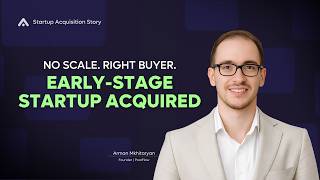
Arman Mkhitaryan built Postflow, a social media scheduling tool, as an MVP with no paying users, then sold it in two to three months through Acquire.com to a buyer who wanted it for internal use. He fielded interest from over ten parties and closed the deal after a single demo call.
Chapters
All right.
I'm here with Arman, the founder of Postflow. Arman, how you doing today?
Hey, hi, Andrew. Good, good. How are you?
Doing good. You recently got acquired. I'm super excited to hear the whole story. But before we dive into that, do you want to give a brief introduction of yourself for people that may not know you?
Yeah, sure. So thank you very much for the opportunity. My name is Arman. I am based in Czech Republic, in Prague. I am a data scientist. So I have almost more than 7 years of experience in the field. So my main focus is data analytics, machine learning, and these days, of course, AI. Yeah. And then I, the Postflow started as a side project. So that grew into something that I was able to sell, but we can dive in depth into that later.
So nice. Tell me about Postflow. What problem did it solve? What did it do? Yeah.
So the Postflow, the idea came from. Other social media management tools. The main one that I looked at and was kind of a motivation for me was buffer.com. So it allows you to schedule posts to different social media accounts and that those will be posted automatically on your behalf, on your accounts, whenever you set the date and time. So that was the main idea behind the Post Flow. So to allow to automate that process. So you can create a post now, but then post it later on whenever you want. Because usually when you deal with the social media, there are usually some optimal times when you should post and when you get most engagement. So that's the problem that it was solving for social media managers and content creators.
Nice. What was the hardest part about building something like this? Was it like the social media APIs or—
Yeah, I would say social media APIs were the biggest bottleneck, but the other side is also it was my first time building something. So I created a couple of websites, but this was the first big app that I was creating. So there were a lot of integrations that I was dealing with, but of course, again, as I said, the main one was social media accounts to integrate those and with the APIs, etc. That was a hard task, but I managed to do it. And yeah, and overall After that, it was a little bit marketing and stuff, but my story is a little different because I didn't— so I created the app, but I didn't market it much to get users. So when I sold the company, I didn't have any users or user base or paid paying users. So the idea was it's like an MVP that I also put into description what areas it— in which areas it could be improved so that the person who acquires it knows what to work on. And yeah, it was, I sold it like an MVP. So that was the idea. And my idea was to try to create something fast and also try to sell it and see if that works. And it worked. So yeah, it's a good start for me.
Right on. What were some of the questions you saw from buyers? Because the majority of the time, you know, buyers are looking for traction and we're gonna have questions on revenue, but you didn't have that. What kind of questions did they have? Was it focused around like where the product could go or what was it built on?
Yeah, so they, there were some technical questions about how I built it, what's the technology behind, etc. But the main thing is for them was to show them how it works, what it does, main functionality, etc. And as I understood, they purchased it for their internal use, not for marketing for external use. So they probably didn't care much about the user base, so, and it was easier for them to manage because there was not many users there. And yeah, it went smooth. So we had one call where I just showed them everything, answered their questions, and then everything went very smooth. Of course, it was my first time doing this, so I didn't know what to expect. There were a lot of questions from my side also about the platform, like how to what are the steps, you know, to progress during this acquisition process. But it went very smooth. So yeah, probably I was lucky. I don't know how others experience— what's the experience for others.
So that's awesome. We're a customer, Buffer, and it's like $300 a month. It's expensive. So I can see that being like a strategy. Maybe you build a product, sell the whole thing to a larger company to use internally.
Yeah, that was a good use case for them. They said that they like something like that so the internal team, marketing team can use it to do some social media marketing for them or maybe for other clients. I'm not sure, but that was for sure an internal tool that they wanted to have. And yeah, it's great. One thing I wanted to kind of differentiate myself was to put, to make it accessible for single content creators, not just to target the big companies or agencies, but for someone with a small budget so they can also start to have something, some such a tool in their arsenal, I would say. So that was my—
Nice. How would you describe your experience on Acquire?
It went very smooth. Of course, again, as I said, I had many questions. I didn't know like what to put and like how the description will look like, what actually the clients will see on the page, because there are a lot of stuff that you put there, but until you give an approval, they don't see it. And there were a lot of questions, but I just digged in YouTube and some comments in other platforms, and I got all the answers. And their overall experience was very smooth. So yeah, didn't have any kind of difficulties or bottlenecks that prevented something to progress. So yeah, maybe also it was a smaller business, that's why, but overall experience was very smooth.
We love to hear. How many buyers did you have reach out interested in acquiring you?
Yeah, more than 10, I think, but the ones that got quite serious and wanted to get it, probably 3, 4. And the guys that acquired were first. I was negotiating with others, but they had some other requirements. They said, okay, we want also this feature, that feature. If you could do that, then we can agree on price, etc. But yeah, I preferred not to do more work and to try to sell it as it is.
So nice. Nice. Um, did you do anything to celebrate the acquisition? Did you go out to a nice dinner or buy something to celebrate?
Yeah, we went with my wife, uh, for dinner. But, uh, yeah, I'm My goal is to— so it was like a first step to understand how it works and whether that type of thing to build fast and try to sell can work, and it works. So now my goal is to create more of such apps and try to sell those. Of course, I will try to get more traction and get more users so I can sell it for more amounts, bigger money. But yeah, so first experience, I'm happy. So I think it's incredible.
It's a huge accomplishment because you built something and then another person was willing to acquire from you. That's massive. Yeah.
Yeah. And it took around 2 or 3 months to finalize everything. So for the first 2 months, it was like kind of, yeah, some people were interested, but then they either required something or they were like, okay, then we, we chatted a little bit, but then they disappeared. So it was kind of, I thought, okay, maybe this doesn't work. Maybe I need to decrease the price, etc. But yeah, some guys like the price and the product, so apparently it worked. I just needed to be a little more patient, you know.
Amazing. If you were talking to another founder and they wanted to sell a little software app or business, what's a piece of advice you'd give them?
I would say try, don't be afraid. And of course, with acquire.com, it's very smooth. You may have a lot of questions in the beginning, how it works, what to do, what are the steps of the acquisition, like when the APA comes, then what's next, etc. With the escrow, I had a lot of questions, how it works, what are the steps, but it's very smooth. So don't worry if you have any questions, just Google, YouTube, and you can find all the answers. And for building something, just don't be afraid, especially these days with AI, you can build something even faster. Yeah, so just go with it and don't try to reinvent the wheel and try something that already works. And yeah, as a first project, that would be fine. Even some people I know, especially in the social media, you can see that people create some big companies by copying others, other bigger ones. So, and they become bigger over time. So Yeah, you don't need to reinvent the wheel or do something crazy. Just get an idea and work on it, and I think you will be successful.
Amazing.
Just go for it.
So, Arman, what's next for you? What are you working on next? You don't have to share if you don't want to at this time, but what are you working on next?
I have some other ideas in mind, so I will try to work. I'm currently working on a few of them and will try to go through the similar process, or maybe if it works well, maybe I will keep it, you know, and will be like a business for me. But for now, I'm building a few other apps and hopefully I can exit those with a better amount. So we'll see. Right on.
Well, maybe I'll see you back on this podcast with an even bigger exit next time.
Yeah, I hope so. I hope so. Yeah, looking forward to that.
Right on. Well, for people that want to hear more about your journey and follow you online, where can they find you?
Yeah, I'm more active in LinkedIn, so they can follow me on LinkedIn. I can provide the link later on, but yeah, my name is Arman Mkhitaryan, M-K-H-I-T-A-R-Y-A-N.
So, all right, well, Arman, thanks so much for coming on the podcast. Congrats again on the acquisition.
Yeah, thank you very much, Andrew, and thank you for this opportunity. It was very nice to talk to you and be part of this podcast. Thank you very much, and thank you for the platform you created. It's amazing.
So appreciate that.
Cheers. Thank you.
More from Andrew



The Buyers Who Made the Move: What They Bought, How They Did It, and What Happened Next






