The State of the Deal 2026
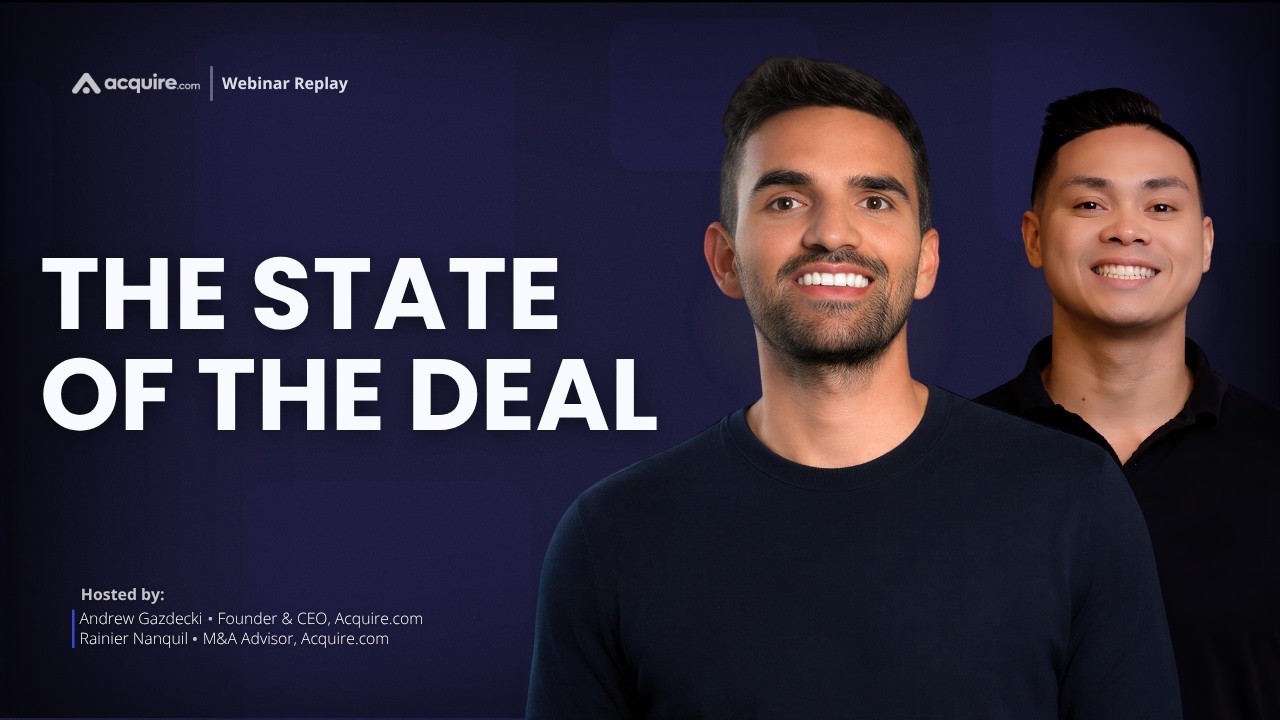
In this hour‑long webinar Andrew Gazdecki (CEO & founder of Acquire.com) and M&A advisor Ranir Nankhwell walk founders and buyers through the current M&A landscape for online businesses. They begin with a market overview, highlighting that Acquire.com has facilitated over $1 billion in transactions, hosts >500 k registered buyers, and sees average deal cycles of 60‑90 days. They compare profit versus revenue multiples across SaaS, e‑commerce, agencies, marketplaces, newsletters and mobile apps, emphasizing that profitability is the primary driver of buyer interest. The presenters debunk common seller myths, explain how pricing too high or too low affects buyer engagement, and outline the importance of clean financials, founder‑independence, and documented SOPs. They detail the most common deal structures (full cash, seller financing, earn‑outs, equity roll‑overs) and introduce SBA financing support, including eligibility criteria. Buyer personas (operator, portfolio acquirer, strategic buyer) and seller personas (ready‑to‑exit, portfolio trimmer, strategic exit) are mapped to preferred deal terms. The impact of AI on valuation, operational efficiency, and due‑diligence speed is discussed, with data showing a 336 % rise in AI‑related listings. The webinar then showcases four live deal examples across SaaS and agency verticals, illustrating how to evaluate price, multiples, growth, and seller motivation. Finally, they walk through Acquire.com’s end‑to‑end workflow (profile creation, NDA, data‑room, LOI builder, due‑diligence, escrow) and a typical 10‑week timeline, stressing the platform’s advisory support for both buyers and sellers.
Chapters
All right, we are live. What's up, everybody? Super excited to get started. Thanks for taking time out of your day to come watch this. We got some really great content. I got Ranir with me. He's on our M&A advisory team. Ranir, how you doing?
Doing pretty good. How's everyone feeling today?
We got a great webinar. It's going to be incredible. As always, if you guys have any questions, feel free to put them in the chat. We'll do our best to get to those at the end. We'll go ahead and get started. We got some good content. I'm excited about this one. Sweet.
All right.
Well, this is the State of the Deal. We're going to have some, some good discussions today for both buyers and sellers, whether you're looking to potentially acquire a business or you're a founder and you're looking to get acquired yourself. We're going to go over a lot of what we're seeing in the market today to really help both sides be prepared. We're going to be focusing on not just SaaS businesses, but also agencies and AI businesses. and mobile apps and everything else in between. Because as a marketplace, we've really grown beyond SaaS. And so we'll be talking about each of those categories and what you can do for them. A little introduction on myself. My name is Andrew Gazdecki. I am the CEO and founder of acquire.com. Before Acquire, I had built and sold 2 different startups. One of them I bootstrapped to about $10 million annual recurring revenue and sold it to a private equity firm. And going through that whole process, being confused and spending a long time finding a buyer, not understanding what certain deal terms were that really led to the idea to start what is now acquire.com. And I always like to say I got the coolest job in the world. I get to help thousands of founders get acquired and help them celebrate every single day. And with my time at Acquire, we've helped over $1 billion in acquisitions. So it's been a good run. And Ranir, I'll pass it over to you for a quick second.
Perfect. Hey everyone, this is Ranir Nankhwell. I'm an M&A advisor here at acquire.com. I've been in the dealmaking space for over 12 years now. Acquisitions, capital markets, investment sales. Previous to my time at Acquire, I was at Empire Flippers, Fishman Wakefield, and Marcus Milchapp. So dealmaking is in my blood and I'm here to help all of you.
Andrew's one of the best. I've seen him make it happen many, many times. And for the agenda, what we'll cover today, we're going to go over the state of the market with AI. A lot of things are changing, so we'll touch on that. How to prepare to sell. So if you're thinking about getting acquired, some actionable tips that you can think about now, things to work on next week or today that will really matter when you go out to market. We'll talk about how Acquire works if you're not familiar, how to register, how the listings work, how it works from a seller perspective and a buyer's perspective. And then on the buy side, we'll talk about what buyers want, the things that they're looking for this year and how they can better their acquisition search. And then we'll talk about the different businesses that we help get acquired from SaaS businesses, agencies, mobile apps to other marketplaces, newsletter, e-commerce businesses. And then at the end, we have some actual deals on acquire.com right now that we're going to be going over to give you an idea of just the size and how me and Rainier would evaluate the businesses. So those are of interest. You can check them out. But by the numbers, so acquire.com, we have over half a million registered buyers on the platform today. We facilitated over $1 billion in closed transactions. which amounts to over 2,000 successful acquisitions. So a lot of activity on both the buy side and the sell side. We see a number of acquisitions every single week all across the globe. And typically with the deals that we help get acquired, we see the average time from listing to close to be about 60 to 90 days. We also do things like identity verify every single seller to ensure that listings are of the highest quality on Acquire. We connect financials. All private sensitive information is NDA gated, between buyers and sellers, so you have full control over who sees your information. And I'd say the most important thing to point out on the slide right here is the acquire.com team does provide advisory, and we hold your hand every step of the way to make sure that you are successfully acquired because so many things can go wrong during acquisition, whether you're getting a fair valuation or there's certain things that come up in due diligence. Is it appropriate? Whatever you need help with, we're there to assist you and really make sure the deal actually closes. I'll pass it over to you, Rene.
Perfect. So profitability is king in our market. So you probably heard about profit multiples, revenue multiples. These are important indicators, whether you're on the buy side or the sell side, to help buyers really compare different deals on the market compared to yours, for example. These are all indicators that everyone in the industry uses, but at the end of the day, profit is king. So profit multiples weigh a lot more than revenue multiples and some of these other indicators. And so if we look at the valuation range by category, for example, in our SaaS vertical, 3 to 5x profit is what we're seeing in the market trade at, or 1 to 3x of revenue. On the e-commerce vertical, we're seeing 2 to 4x of profit or 1 to 2x of revenue multiple. On marketplaces, we're seeing 2 to 3x of profit or 1 to 2x of revenue. And on the agency side, we're seeing 1 to 3x profit multiples. Or 1 to 2x of revenue. Anything to add there, Andrew?
I would just point out something that I think surprises a lot of founders where if their business is not profitable, it can be so much harder to find a buyer for that specific business compared to a profitable business. For example, if there's a SaaS business doing $2 million in revenue, but it's breakeven compared to a SaaS business that is doing $1 million in revenue, but $600,000 of that is profit, The profitable business will see enormous amount of interest compared to the nonprofit business. So I think the main takeaway on this slide is if you're a founder looking at this and you're thinking about selling your business at some point, start thinking about how you can make the business more profitable today. Are there certain expenses that you don't need? Could you increase your pricing? Can you grow revenue beyond where you are today while keeping your expenses in mind? Because again, this is what every single buyer is going to look at, and this is really going to dictate How many buyers are interested, the final valuation, and really just if you can exit at all in this market based on what we've been seeing.
Awesome. So then in terms of finding the pricing sweet spot, you've seen the range. It could be 3 to 5x, 2 to 3x. You're probably thinking, okay, well what's the difference of pricing at the low end versus the high end? Well, there's a huge difference. At the end of the day, what we've seen is if you overprice your listing by over 20%, the serious buyer interest drops significantly. So what that means is if you overprice your listing by 20%, only 2% of the active buyer pool will actually take your listing seriously. Because what that shows to a buyer is that you may not understand where the market is at, where other comparable deals are trading at. And on the flip side, if you price it 20% below fair market, That buyer pool number jumps to 92% of the active buyer pool looking at your deal, signing an NDA, reaching out to you, and that leads to more offers or meetings, conversations, and oftentimes a better price, better deal structure, and just a better outcome. So we'll walk through this a little bit more here on this webinar, but really finding the pricing sweet spot is important, and we're there every step of the way to help you through this process. Anything to add there, Andrew?
I know you love this slide in here. I think it was you that, that showed this to me originally years ago. But yeah, I think a good way to think about this is it's kind of counterintuitive than what most founders think. Like a lot of founders we work with, they'll come to us and they'll say, you know, well, if you say 3 to 5x, obviously I'm a 5x and let's price it 6x to get the highest price. But if the goal is to get the highest price, you generally want to price below where your business is typically going to be valued because then buyers get interested, they get excited. They go through the materials, they sign your NDA, they go through your data room. And when you have more buyers that do that, you typically will see more offers. When you see more offers, you're able to negotiate better terms and higher valuation. So again, it's counterintuitive, but when you price below your valuation, you typically see an outcome higher in the end because of the increased interest. There's another saying, if you have one buyer, you have no buyers. And this is a great way to ensure that you have as many buyers as possible. Interested in your business. And then on the complete flip side too, we work with so many founders and we just have so much data around this topic. I would go as far as saying when we see founders wanting to list above a recommended valuation range that we give them or something like that, I would say around 94, 95% of the businesses generally don't have a great experience or just don't see the buyer interest you really need to have a successful acquisition. So it's that important. Pricing is probably one of the first things that we like to go over when we work with founders because it's so crucial to a successful transaction. And obviously, if you're looking to sell your business, you want a deal to actually get done. And when you price it correctly, that's really one of the best things you can do to ensure that happens.
Perfect. So we'll move on here to the top 10 seller myths versus reality. So starting with the first one, growth alone sets my valuation, when the reality is profitability and retention matter just as much, often more in this market when it comes to valuation and buyers taking your listing very serious and moving to the next steps of conversations, meetings, and offers. You want to make sure that a lot of the fundamentals are hit so that you can get to that best exit possible. And when we start moving on to The second one, price high and let the buyers negotiate down. Just like what Andrew was saying, you want to have a competitive buyer pool. The more offers that you get, the better terms you'll get, and the more backup buyers just in case that first buyer can't perform and close. And again, as we said earlier, if you overprice your listing, buyers are going to move on to the next deal. So I was just looking today, we have over 1,100 listings live on the market as of today. And if you put yourself in the buyer's shoes and you see an overpriced listing or a listing that's on the high end, they're just going to move on to the next deal without signing an NDA, looking at the financials. They're going to move on to any other competitive comparable deal that's priced closer to market. Keep moving on here. The highest bid always wins. I really like this point because we've seen many times, Andrew and I have worked on many deals where a lot of buyers have actually won by not having the overall highest purchase price, but by having a better rapport with the seller, having a better deal structure that the seller wants, because every seller is different in that they have different goals for price, timing, transition, legacy of their business. There's so many other factors that take play when it comes to a winning bidder and winning buyer that you really want to get a firm understanding of the seller and what's most important to them. On an ideal exit. The next point here, I can organize my financials later. That's another very important one. If you don't have your financials, your books and records ready to go by the time you list, the buyer just won't take you seriously because you haven't done your homework yet. You're perceived as not having commitment to the sales process than actually selling your business. So have your ducks in a row, do your homework, organize your financials, your SOPs, Have your books and records ready so that buyers can immediately start underwriting and analyzing your business. Moving on to the next one, AI makes my SaaS less valuable. So everyone sees the headlines, everyone sees the news of what's happening with AI and SaaS businesses. That may be true in that SaaS and being able to spin up new businesses is a lot easier with AI, but it's actually strengthened a lot of businesses making processes A lot smoother, less overhead, smaller teams. So it cuts both ways. And if we keep going to the right side here, my business is too small for real buyers, when in reality a ton of our business that sells fairly quickly is under the $150K pricing tier. And some of our deepest buyer pool is looking for those, let's say, starter-sized businesses under that $150K mark. So We're selling a lot of those deals in that size. A revenue multiple is always the right lens. Again, as we said earlier, profit is king. They want to look at the profit multiple. That's a real key indicator, especially in today's market. And again, making sure that when buyers are able to compare apples to apples versus comparable businesses, profit is going to be king. Revenue multiple is important, of course, But at the end of the day, especially in this market, it's going to be profit. The higher the profit margin, the more buyers that you're going to attract. Next point here, I need a broker to get a good outcome. And so the cool thing about acquire.com is we've streamlined this process so that you don't have to pay that typical 10 to 15% brokerage fee plus retention month to month, plus brokers, you know, keeping that information and Rolodex. When you have access to hundreds of thousands of buyers on our platform, we have all of these processes and templates ready for you to use on our platform. Today is an amazing time to be a seller because you have a lot of these processes where we can help you throughout the process. But if you're an experienced seller, you can do it on your own with our tools. Next one here, selling takes a year or more. Again, with the typical brokerage process, I've worked at several different firms. It typically takes a long time, 12 months plus, because a lot of the inefficiencies through that typical brokerage process, when we've made it so much easier on our platform here at acquire.com, where you have access to buyers instantly, you have those conversations ready to go, you have all of these tools that we have on our platform to just streamline that process. We've sold tons of deals within 60 to 90 days, some a lot sooner. Some a little bit longer, but typically what we've seen is 60 to 90-day closes, which is amazing in the industry. And then last point, buyers will understand I'm founder dependent. So a founder dependent business is going to be a little bit harder to sell because a buyer wants to make sure that it's not totally dependent on you. What a buyer likes to see is that the business can run. Let's say if you're gone for a week or two, that the business runs as usual. So the less hours that you spend on the business, the more that you have your team in place, your SOPs in place, and make it less founder dependent, the more buyers are going to be attracted to your listing. That was a lot there, Andrew. Any questions or anything to add there?
That was, that was a beauty slide. I would, you know, what came to mind was like you were saying, we have seen a lot of scenarios where the highest bid doesn't always win, and that's because Like when me and René are working with founders on deals, what we're typically looking for is highest probability of close rather than just the highest price. For example, if you get an offer for $2 million from a very credible buyer that you get along with great, they have financing in order, they've acquired businesses in the past compared to another offer that's at $2.3 million and it's an inexperienced buyer, it's not clear how they're going to finance the transaction. We will always recommend the lower offer with a much higher probability of close, because again, that should be your main goal is actually closing a transaction. And sometimes that top line number doesn't tell the full story in terms of what the best route to take is. But I think the great thing about Acquirers, our goal is always to get multiple different offers so you can make the decision whether that's going with the highest price or the one that has the highest probability of close. But those are some things to weigh as you're thinking about it.
Awesome. So then the next slide here is the real trend on multiples. So in the previous years prior to now, we saw mayhem in terms of deals closing, high multiples, big private equity shops taking down deals, really high multiples. And then when the market corrected, talking about macro, interest rates got higher, cost of capital got higher. The good thing that we've seen throughout the years is that even though the multiples have compressed lower is that the disciplined buyers have kept cash on the sidelines. So what we mean is that deals are still happening. So they're still happening this year, last year, every year deals are happening. Sellers have a different reason to sell. Disciplined buyers have always been around. And so we're still seeing deals in the 3 to 5x range on average. And the correction is largely over in terms of what we've seen really at the 3 to 5x mark. It's really stabilized and the market really bottomed out in 2024 in terms of the compression of multiple. And again, we've got tons of buyers still looking for deals. The best listings with the best fundamentals and price to market, they're still selling. So that's the great news. And we think that it's bottomed out and deals are still going on and multiples are starting to trend. So Andrew, anything else to add there on the trend of multiples on what we're seeing?
Yeah, I mean, one way to look at it is the COVID boom that we saw with multiples just skyrocketing. You know, I like to tell founders, just think of that as a time that just never existed. You know, it's kind of like buying Cisco stock in the dot-com bubble, and I think it just recently got back to break even from its peak in the dot-com bubble. So it's not to say that, you know, multiples are, you know, just trending downward. Another way to look at it is during 2021 and COVID, there was just a huge increase in risk assets to a point where, you know, we could probably call it a bubble. And we've since declined from that and reached back to a market normalization. So we're back to a level where this is the true value of the businesses. Obviously, every founder wishes they sold during 2021 when multiples were really, really high and, you know, we were in a bubble phase, but it's just hard to time the market. And now we're getting to a stable period where Again, we're seeing great transactions. We're seeing a lot of buyers step up, a lot of cash buyers, financial buyers, private equity buyers. So absolutely a good time to sell for sure.
Excellent. So then a common question that we get is how to justify a higher multiple. You know, the 3 to 5x is such a broad range. What do buyers really look for and what do these multiples mean? So the higher the multiple generally means that it's a lower risk asset. And so when we think about financial and growth drivers, The higher multiple often is commanded by higher and better fundamentals, which is high profit margin, high year-over-year growth, low churn, large total addressable market. And on the operational side, it's high product use, multiple years in the business, strategic partnerships, a dominant brand. So you really need to understand from a buyer's perspective of how they're valuing businesses and pricing. And that way you can list at a range that's reasonable. And so buyers actually click, sign an NDA, get the conversation started, because if you don't have any of these fundamentals and you're trying to command a higher multiple, they're going to move on to the next deal. Yes, we're selling deals at the higher multiple, but you really need to make sure that you hit these fundamentals to command that multiple. And if you don't, that's totally fine. You just need to understand that You need to really compress that multiple down to justify where your business is at.
Yeah, well said. And when you go to market too, depending, let's say you don't check all these boxes, you know, we like to work with founders and position your business to really highlight what's great about your business, whether it's really profitable, maybe it's not growing very fast, maybe it has amazingly low churn, but it's in a smaller market. So we highlight obviously the profitability and the low churn. So don't be discouraged if you don't have all of these pieces in place at your business. Most businesses don't. That's just a reality. And what we like to do is really focus in on the parts of your business that make it great and that buyers are really going to be interested in. All right. Now we're going to switch over to some discussion around buying. So if you're a buyer on this webinar, why is it a great time to buy? I think the overarching theme here is the market valuations that we've seen have come to what I like to describe as a fair market value where you're no longer paying paying multiples that are sky high, you know, I'd be wondering if those are going to continue to decline. We're really seeing a stable market with a lot of sellers coming to market that are pricing to reality. And when you have really excited sellers looking to price realistically and really excited buyers that are looking to acquire realistically, we get a lot of transactions done. So entry points are more accessible. The market has been rewarding discipline. Sellers are pricing to reality. And I think the main point of why acquisition for starting businesses is you're essentially buying product market fit. So think of what it takes to start a business where you have the initial idea, you put together the website, you put together the product, you go talk to customers, you realize the product isn't what customers want. You go back to iterating on the product, you go back to customers, you go through this process of finding product market fit that could sometimes take years. Sometimes you never find it at all. And that's the reality for a lot of businesses. And so when you acquire a business, you're acquiring a proven process with a proven product with happy customers. And if you're the type of individual that excels taking something from say 1 to 10 rather than 0 to 1, entrepreneurship through acquisition is one of the best routes that you can explore, bar none. And then at the bottom, the best time to buy is when the market has reset and the sellers are ready. That time is now. And that's absolutely probably the whole theme of what we've seen all year where We've really seen market multiples stabilize. We're seeing sellers really understand that, price into reality. And on the other end of that was thousands of buyers that are ready to acquire at those valuations. And for sellers, why is this a great time to sell? So I have conversations with founders all the time about selling their business, and I'd say the number one reason that I hear is looking to start a new business, especially in the age of AI. Maybe they built a SaaS business in 2022 or 2023. It's a good profitable business. It has thousands of happy customers, but they have a new idea in AI where they can completely rebuild in a different way than they were able to when they started this company. Like as a real-world example that we had, we weren't involved in this transaction, but when Airtable sold to Bending Spoons, they sold for about a billion bucks. A lot of people were saying that it was a low valuation. They were selling to a private equity firm, but there was a part of that transaction that I think a lot of people missed where they actually carved out the new AI product into a whole new company for the founders of Airtable to focus on exclusively. So this is the founder of a multi-billion dollar company, and even this individual said, you know, the time to really go all in on an AI-focused product with a new idea is now. So I'm going to sell the legacy business and focus on this newer cutting-edge business. And I thought that was really, really interesting. We're also seeing that all day long on, I would say, a smaller scale. But going over the side, you get to build what's next. A smaller multiple is still a one. This is a big one. You know, when I talk to founders, sometimes they might be, you know, hesitant to sell at a certain price point. But a lot of the times, the reality is just never selling the business at all, ever. I've seen that many, many times where we'll be working with a founder, they'll receive an offer, the valuation just comes out too low for them at the time. And then fast forward 6 or 12 months later, you know, that valuation's starting to look pretty good because something changed in the business. Maybe they lost additional motivation, maybe it got disrupted by a new piece of technology coming out. A lot of things can happen in a year, and then they go back to market and find out their business is worth even less at that point. So if you're able to sell your business really at any sort of price that I would describe as fair market value, I think that's a huge win. And there's a lot of buyers right now. There are tons of interested buyers that we've been seeing come onto the platform actively looking for new businesses, and it's an exciting time on both sides when you finally get a point where both are Setting expectations realistically, because that's what gets a lot of transactions done. And then if you do sell your business, your proceeds fund the next build. So you wouldn't have to raise money from investors. You wouldn't have to think about how you're going to fund the business. You wouldn't necessarily need to eat Top Ramen for the next 5 years or something like that. You'd have a big win under your belt. You have experience, you have likely funds to focus and invest into a new business. And I did a podcast recently with a founder that actually sold a business with us. He did really well. And he actually went on to start a venture studio, which I thought was really interesting. He wasn't exactly sure about the exact business he wanted to start next. So he set up a studio with some people that he had worked with where they're ideating multiple smaller businesses at the same time. And when one really takes off, they're going to focus on that one. But he would never have the opportunity to do something like that had he not sold his previous company. So at the bottom, the market did not take your options away. It just gave you a good reason to use them. I think that absolutely could not be more true. Ranier, anything you want to add on these 2 slides I went over?
Yeah, all good points there, Andrew. And again, founders have different reasons to sell, whether it's to work on the next build, take some profits, buy a house. The reality is everyone has their life going on, and it's okay to take some chips off the table and buy that house for your growing family or move on to the next project or take It's off the table. It's— you've worked really hard to get to this point. Realize some of that with, you know, 3 to 5x of those cash flows and go on to the next thing.
Sometimes just taking a break, you know, it's a hard gig.
All right.
So how deals are actually structured. So we see a lot of different types of deal structures at Acquire. These are going to be the main ones. Top left, full cash at close. This is obviously going to be the most attractive option for you. This is where you sell the business and you get all cash at closing, which is absolutely amazing. This is going to be Likely the most rare option as well because it's the most risky for buyers. So to receive full cash at close, you generally need to have a competitive process, multiple different buyers submitting offers. One buyer comes in with 90% cash, 10% earnout, something like that. And then you're able to negotiate full cash at close for them to win the transaction. That's typically how I see it go down. And then we also have seller financing. This is where a seller carries a note, which is paid over time. Useful if you want to preserve cash and seller has high conviction. Watch creates ongoing relationship. Essentially, you'll sell the business and the buyer will pay you monthly payments or quarterly payments, or sometimes yearly payments, typically from the cash flow of the business. So you can have a transaction where it's 80% cash at close, 20% is going to be seller financed, and the buyer would then pay that portion of 20% as a monthly payment, a quarterly payment, or yearly payment for an agreed set of time. This could be over 5 years, it can be over 12 months, All these items are completely negotiable, and this is something that we actively help with as well. We can give our opinion and help make sure that the structure makes sense for both sides. Earnout. I'm sure everyone knows what an earnout is. That's basically a portion that's going to be paid out based on future performance of the business. You can have super crazy high targets. You can have very, very reasonable targets that's simply in place to align the buyer and the seller where the seller has some incentive to continue working in the business, answer questions, transfer knowledge over, that sort of thing. So these can be really great, not so great when the metrics and the performance targets are simply unreasonable. So another thing to look out for and something that we help with consistently, equity rollover is where a seller retains a small stake in the company. There can be situations where a larger company buys a founder's company and they get a small amount of shares in the acquiring company. There can be a whole new entity that's rolling up businesses and they would have some equity in that business. There's a number of different ways this can be done, but generally it means a seller can have what we call a second bite at the apple, where they'll maintain some equity in their business and another entity acquiring their business. And if there's an outcome later down the line, they would get some cash compensation for that equity. But at the bottom, most deals blend structures. Define your preferred structure before entering negotiations. That couldn't be more true. What would you add to this?
Right. At the end of the day, we could get as creative as needed to get a deal done. As much as every founder and seller would like to get full cash at close, a lot of buyers are going to want the exact opposite of that because they want to minimize their downside risk. As Andrew mentioned, if they pay all cash and then all of a sudden the business trends downward, that's a huge amount of money that they're putting at risk. So they want to make sure that you have some skin in the game to make sure that the business transitions properly, that the business continues to grow. So we can get creative as needed. We've seen all different types of deal structures win and get to the finish line. And that's the cool thing about acquire.com is we're here to help. And for some founders that haven't, maybe not as familiar with these different earnouts or equity rollovers or seller financing, we can work with you and the buyer to make sure that we make it a win-win for both parties.
Murney, I've always loved the advice you give where you tell founders, you know, if they're aiming for just the highest top line valuation on their offers, to let buyers know they're open to creative deal structuring where maybe it's not all cash flows, but they still receive the total sum over a designated period of time. Basically bridging the gap between a buyer that thinks it's worth this and a seller that thinks it's worth this. Creative deal structuring can get you there. Touching on this SBA financing support, this is something we recently added at Acquire. We've done a ton of different SBA transactions. But we've gotten formal support from a group called Franchisable. For sellers, essentially means this, you can have your business financing pre-approved. So we do SBA eligibility screening. This is lender-grade financials. The things that we'll need is lender-grade financial projections, review of historic P&Ls and tax returns, lender packaging and prequalification, financing guidance through closing. Essentially, this can really expand the buyer pool for founders that we work with where There's buyers that are looking to acquire certain businesses, but maybe they don't have the funds on hand and they're looking to finance the transaction. We're now bridging that gap and connecting sellers with bank support to get SBA financing and also buyers who are looking for financing as well. For buyers, we help you know whether you are financed before you get far down the road. This includes buyer financial qualification, lender matching, SBA loan preparation, underwriting support, term sheet through closing. And the goal here is to get as many transactions closed and bridging the financing gap Internally here at Acquire. Some things to know about SBA requirements to screen early, because Muneer also knows about this. We've seen a number of transactions where they'll receive an offer, they'll say that they're going to be using SBA financing, and 2 months into due diligence, they find out either the deal doesn't qualify or the bank isn't going to be able to honor the terms that both the buyer and seller already agreed to. There's a lot of things that can happen. So really making sure that you screen early. Can just really be the difference between a deal closing or not closing at all. So buyers citizenship, 100% of owners, direct and indirect, must be US citizens. For capital, 10% minimum equity injection plus post-close liquidity. Financial package, 3 years personal returns, 3-month bank statements, resume. These are all things that we'll work with both buyers and sellers on to make sure the process is smooth. But just from a high level, these are some things to be aware of. If you're looking at SBA financing for sellers, the big one is going to be US-based, must be SBA eligibility requirements. You also need 3 years of business tax returns and P&Ls. So it can't be a business that's 2 years old. It can't be a business that's based in Europe or anything like that. It has to be United States-based. It has to be in business with over 3 years of business tax returns. And then there is a cash flow requirement as well. It needs a minimum of 1.25 coverage on proposed debt. Which essentially means the profitability of the business can help pay down the payments to the bank that does the financing so the loan can be repaid. Kind of like when you really buy anything, you have a credit score. The lender looks at your credit score. It wants to know how much money you make. It calculates how much you generate per month and how much in terms of a monthly loan payment you can support to make sure the loan is paid off. So the business needs to be profitable. This isn't for unprofitable businesses. Valuation, price supported by independent valuation, transition, seller exits at close, and consulting. There's a number of different terms that can seem confusing, but SBA lending can be one of the best ways to get transactions to close for sure. Ranier, anything you want to add on these slides?
All good points there, Andrew. And just for anyone that's not familiar with SBA, so that stands for the Small Business Administration. The great thing about the US is they want to promote and continue to grow small businesses throughout the US. So if you're providing jobs, providing employment, helping the US with its GDP with in-house businesses, they're going to provide this SBA financing option. The great thing of what that means for a seller is you can get an all-cash payout because a buyer ends up using SBA financing. And for a buyer, you're putting at least 10% down and then getting the rest financed with SBA. So you're using that leverage, you're minimizing your downside risk, And it's just a very good option for both buyer and seller to make a win-win situation with this incentive that the SBA provides.
100%. Do you know what the interest rate is right now? I don't know off the top of my head, Rene.
It's usually 5, 6%, something around there. And so again, if you meet these requirements on the buy side and sell side, and then as long as the cash flow from the business covers a 1.25 debt coverage ratio and your business qualifies, you can use this SBA financing.
Those are great terms. All right, pass it over to you, Rene.
Awesome. So here's the playbook here for what buyers want and where to focus. So which profile are you on the buyer side? Let's say you're an operator who wants to run the business day to day, looking for something around $50K to $500K ARR. The next buyer profile is the portfolio acquirer. You want to acquire several different businesses. You've got a machine that has a sales team in place, a marketing team in place, You're looking for $10K to $100K ARR. And then the other buyer profile is the strategic buyer. You're acquiring for a specific thesis, you're willing to pay a premium, and there's a strong customer overlap where you can cross-sell your existing customer needs. And on the sell side, the ready-to-exit founder, you want a clean handoff, certainty of close, you've got your documented operations. Or let's say you're the other profile where you're a portfolio trimmer. You've got several businesses in your portfolio. You're selling one business to focus on the rest, just like the examples that Andrew gave earlier. Let's say sub $200K ARR, simple deal structure. And then lastly, you've got the strategic exit seller positioned to negotiate a premium price. You've got proprietary data or relationships, and you can sell for a very specific buyer. So we work with all of these different profiles on both the buy side and the sell side. Every different profile has a different exit strategy. So we've seen all different types of deals. The great thing about acquire.com is we help you strategize before you go to market so that you know the exact buyer profile that you're looking for so that we can get the right eyes on the deal, qualified buyers, make sure we focus on the exact points that these specific buyers are looking for, and ultimately get you the best price. Best terms and best experience for an exit. Next, we've got what buyers want and how to prepare. So what buyers want—they're looking for predictable MRR ARR, founder-independent operations, clean financials, an AI narrative that fits their business and their listing, and a growth signal that there's more opportunity out there. So when you are listing, you need to make sure that you. Put yourself in the buyer's shoes to understand what are the risks, what's the upside, what's the value add. Again, we're here to help you craft that narrative before you go on market, but these are typically the standard fundamentals that buyers are looking for, for any business that they're looking to acquire. And on the sell side, on the right side, how to prepare. Make sure that you document your retention story, write down every process, all of your SOPs are in place, Get 24 months audit-ready financials. That way you can defend any dips in the past of why revenue went down or up, spiked. You want to make sure that you have your narrative ready to go so that there's no questions on what happened in the past. And then decide your AI story now of how AI is helping grow the business and how it's defensible and there's a moat to other, let's say, Competitors that are spinning up with AI. And lastly, track your growth trend. Even modest, consistent growth is stronger than, let's say, a huge dip that you haven't been able to recover from. So just making sure that you have your ducks in a row, books and records ready, whether you're on the buy side or the sell side, you're ready to go. It shows the other side of the table that you're a serious buyer or seller. You know exactly what you're looking for. And again, We're here to help every step of the way. We have tons of resources and we've helped tons of founders and buyers. And so we're here to help. Anything to add there, Andrew?
Yeah, one thing I'd add is for the AI narrative, I think the first immediate thought is, you know, how does AI improve the product? How does it help us dominate a market or how will we not get disrupted by AI? That's the most common way to think about this question and the story. But a lot of times what we see founders focused on, and we'll encourage this, is how do they use AI internally to improve the business? Meaning, did this business used to take 30 people to run and now it takes 5 people? Did you used to need to do all these things manually? Now you have AI that's automated all these aspects of the business. That's also created some really interesting opportunities for everyone in this ecosystem, from buyers to sellers, where businesses are becoming more profitable. They can be operated more efficiently and that drives margins up. So that could be the story as well, which is just how are you internally using AI to improve your business?
Next, we've got SaaS, our strongest category on the platform, looking for 71% average profit margin. So on the buy side, proprietary data and workflow lock in one of the moats that large language models cannot replicate overnight. As mentioned with AI, it's easier to spin up different SaaS, but again, on the other side of the coin, as Andrew mentioned, if you're using AI to make it more efficient, then that's a huge upside that buyers like to see. The AI quoting tools let a new owner ship the backlog and clear debt fast and often solo. Again, as much as let's say different SaaS companies are getting spun up by AI, you're also moving your product improvements and roadmap a lot faster. And then lastly, the deepest inventory and steadiest multiples of any category with the fastest path to close. SaaS is our bread and butter. Yes, we have different verticals and a ton of our buyers on our platform are looking for SaaS. And on the sell side, your proprietary data and workflow lock-in are exactly what buyers pay a premium for. AI lets buyers pick up your codebase with confidence, meaning fewer stalled deals for you, and the deepest buyer pool of any category means more offers and a faster path to close. So at the end of the day, SaaS is our bread and butter. We have different verticals as well, but if you hit any of these points on either the buy side or sell side, we've got the largest qualified buyer pool for these SaaS deals on our marketplace.
I think one interesting thing I'd add that I've seen in the past, about the past year before AI, we'd see a lot of buyers be really nervous about working with certain codebases where if they didn't have full knowledge of how everything worked, it was a complete deal breaker. But now with AI, that never happens anymore. You're able to analyze codebases, improve products that are acquired, roll out new features faster. So it's been really interesting to see. And another strategy, maybe a talk for another time, but an interesting strategy I've seen is where buyers are acquiring these really great assets with great distribution already built in and then really building out the feature set. I think that's been interesting to watch, but definitely AI has been helping both sides on the transaction.
And then moving on to the next vertical, agencies. We're seeing a ton of agencies go on the market, transact on our platform, and the ones that are built on recurring revenue are the ones that are most sought after. And these deals typically take anywhere from 60 to 90 days to sell on our platform. Some have closed sooner, some have closed a little bit later, But on the buy side, what we are looking for is client contracts, renewal history, give you immediate proven cash flow from day one, niche expertise and trust that takes years to build, and a new entrant can't buy the relationships that you've already established. AI absorbs the reporting and research grind so you can focus on the relationships that drive growth. And on the sell side, your client relationships and your renewal history are the single biggest driver of buyer interest on your listing. The deep niche expertise that you have is very trust heavy in this vertical, and it's hard for a buyer to walk away from that. And lastly, the documented AI that you use in your operations reads as a margin lever for you to expand immediately. And so SaaS has been king on our platform, but we've seen a ton of agencies sell on our platform more recently. And it's kind of like I've seen on YouTube, all these like AI automation agencies, all of these agencies that were already a business model previously. They've just become way more efficient with AI. So we're seeing a lot of that. If you're a buyer or a seller for this type of agency business, reach out to us, let us know how we can help. And we're seeing a ton of momentum for this category.
100%. It's all because of the operational efficiencies with AI, meaning, you know, it used to take, you know, 10 people to run an agency, or let's say 20, but that same agency can now be run with like 6 or 7 people, sometimes less. And that makes the businesses way more profitable. Margins increase. It makes really, really interesting acquisition opportunities.
And then to go back on how AI is reshaping every deal, it's the biggest swing factor in buyer interest today. For the buy side, AI has enabled layered and real core workflow selling at strong multiples. AI coding assistants set a lean or non-technical buyer to maintain and extend the software. Once that you needed a full team, like Andrew was saying, 20, 30 people can run on a lot less now. AI absorbs the operational grind, freeing you from— to focus on your growth and relationships from day one. And on the sell side, businesses with AI already built into the workflow and drawing strong multiples, documenting where AI has improved your margin gives the buyers the credible growth story that they can act on. And then lastly, AI lets buyers move through the diligence faster, which shortens your time on the market. So again, we see these headlines of AI and how it's disrupting all these different businesses. Really what we're seeing is a lot of these businesses strengthen from cutting a lot of overhead, making it more efficient. So AI is, at the end of the day, it's here. It's actually making a lot of businesses more efficient, and we're seeing a lot of deals incorporate AI and still get done on our marketplace. Anything to add there, Andrew?
Yeah, I mean, From our company's point of view too, last year was our best year ever, and this year is looking like it's going to surpass even last year. So just to kind of give some sense to how much AI is also just improving the businesses that we see on Acquire and also the opportunity for buyers to improve those existing businesses, it's been pretty awesome to see. And I think it's a trend that's going to continue as AI continues to improve and more capabilities become available. Yeah, it's a great opportunity to both buyers and sellers for sure.
And then AI is one of our fastest-growing categories. So the last 12 months versus prior 12 months, we've seen 336% more AI-incorporated listings get submitted, 115% more getting listed, and over 225% getting sold. So supply is leading the story, and AI represents 10.5% of submissions and 8% of new listings on our marketplace. So it's growing. A lot of businesses are getting spun up, showing the proof of concept, showing their revenue. And so if you have an AI business out there, we're happy to help, happy to give you a complimentary evaluation and just prepare for that exit if you're thinking about that.
100%.
And then we move on to the marketplace. AI marketplace shares more than doubled. So in terms of submitted and Listed from previous 12 months to current 12 months. Again, at the end of the day, 10.5% of all submissions are now AI related and up previously from the 4.6% seen in the prior year. We're seeing a ton of AI businesses get submitted, listed, and sold. So very active vertical on our marketplace.
100%. I mean, just to touch on these 2 slides again, we've had our best months, best quarters, best year thanks to AI. I think just the interest on both sides has been truly unprecedented. If you're a buyer and you're interested in potentially acquiring a business, there are so many different options on the marketplace today, whether you're looking for multimillion-dollar profitable SaaS companies or AI-specific businesses or something on the smaller side to get you started. I have to encourage you to get after it. And then for sellers, the interest from buyers is just through the roof right now. I think the numbers here just speak for themselves in terms of just what we're seeing overall in the marketplace. And AI truly has brought this opportunity for founders where if you have an existing business today, but there is another business that you'd love to focus on where you see an opportunity in the market with this groundbreaking technology, I highly recommend you at least explore that. Like Raneer said, we'd be happy to talk to you, go over what your business could potentially sell for, help you through the process. So some of the things about—
And then the AI submission momentum accelerated over the last year. So You see on this graph how much AI submissions have trended up. I really love hearing about these solopreneurs or very small teams that are 6, 7, and even more figure type of businesses getting spun up, created, and eventually sold. And I just love being part of that story and seeing that story because it's like, what a time to be alive. It's like AI, you see it on the headlines as well. All of these businesses that are like one-person business and maybe some virtual assistants, 6, 7, sometimes 8-figure deals. It's really an amazing time.
I think what you brought up is amazing, René, 100%. Just seeing like what founders are capable today is just mind-blowing compared to say even a year ago where, you know, all the time we bump into founders that have these amazing businesses where most of the company is automated, tons of happy customers from support to marketing to product delivery. And it's generating not just hundreds of thousands, but millions of dollars in revenue. And they're just seeing the most explosive growth I have ever seen ever in my life across startups. And a lot of the times these founders have bootstrapped the businesses as well. So there's no investors involved. They're operating extremely profitable business that doesn't have a large team attached to it, which just is the opposite of everything that I think we've seen in the past. So what a great time to just be in tech and be involved with something like this. And I'd say, you know, another favorite thing I love to see is just, you know, when these founders are able to exit, to see them celebrate that moment, it truly is just an awesome feeling. But again, the types of businesses that we get to see in the front lines, it's truly incredible. And I think it's just going to get even more impressive too, as time goes on.
Awesome. So then the next slide here, we also help with these other verticals, e-commerce. Let's say you've got an Amazon FBA or Shopify. We help with that. We've got a deep buyer pool of qualified buyers looking for e-commerce deals. Marketplaces and platforms. We have a deep buyer pool for that vertical as well. Newsletters as well as mobile apps. All of these different categories we have different buyers for. So if you have any business in any of these different verticals, we're happy to help. We've seen deals close. We've closed tons of deals in e-commerce, marketplace, newsletter, mobile apps, SaaS, agencies, AI. We're here to help. with any of these different types of startups. And so if you have any questions, we're happy to help. And if you want to even talk about exit planning, that may not be in the coming months, but maybe thinking about 6 months or 12 months later, loop us in early because it's not just overnight that you have a listing ready to go. You need to plan for those exits. And the cool thing about acquire.com is we have all those tools there to support. We have a team to help support you through that process. And any of these verticals, we're happy to help with. Andrew, anything to add here?
Oh, I just would agree with what you said around just having the conversation early, whether you just have questions or like there's a question in the chat from Alec that I think would just be perfect if you reach out to us directly. He's asking about, can you share for SaaS companies sold on Acquire in 2025, A, year over year revenue growth, B, year over year profit growth, last month profit multiple. Some of your public-facing reports mentioned the 3.9 TTM profit multiple, but would it be helpful to adjust for growing versus not? It absolutely could be, and yes. But what we'd love to do is sit down with you, go over your company on a one-to-one basis to really understand your business a bit better, and then we could share where we think the range would fall. But again, just having the conversation early, just understanding what you potentially could sell for and what you need to do to potentially sell for more. Have those conversations early because that can absolutely make the difference when you do finally successfully get acquired.
And so at a glance, again, here's the verticals that we specialize in: SaaS, agency, e-commerce, marketplaces and platforms, newsletter, mobile apps. We've done deals in all of these different verticals. We have a deep buyer pool of qualified buyers looking for these deals right now. And again, even in this market, there's so much activity, so much buyers looking for these types of deals. So reach out to us if you have any questions, loop us in early, And we're happy to talk about comparables where the market is trending. And just like Alec, his question was, well, what if my year-over-year growth isn't a rocket ship of growth? There's still buyers looking for either stable growth or maybe not a rocket ship of growth, but just any type of growth. As long as you hit the other fundamentals of profitability, several years in business, huge TAM, all of these different things we're happy to discuss. Because every business is different and the multiple is just a very simplified indicator of what businesses comparable are selling for. But at the end of the day, we need to have a deep understanding of your business to have an accurate valuation for it.
Okay, now I'll touch on how Acquire works. So if you're not familiar with the acquire.com platform, everything that we've done at Acquire, we took the acquisition process that we've gone through personally. I've sold 2 companies before this, And we just tried to think of ways to make it easier, more streamlined, better for founders. And so starting with buyers, it's really easy. You create a profile, you can start browsing immediately. When you find a business that you're interested in, you'd sign an NDA. The seller would approve that NDA based on information from your buyer profile. And then from there, you can review their mini data room. You can answer questions directly with a founder. And if you are interested in submitting an LOI, we have a letter of intent builder on the platform that perfectly describes all the terms of the letter of intent to help you craft the best offer. Then you would go into due diligence where you would typically have a 2 to 4 week process depending on the business, and then you would close. We have escrow integrated into the platform, transition support with seller asset transfers. On the sell side, You get verified and you list, you can connect your financials, highlight your moat, immediately go live. You can upload important documents. You can record a Loom overview of how the business works for buyers to really understand the opportunity. And then from there, buyers will begin signing NDAs almost immediately, showing you interest in the business. And then from there, it's your job to talk with each of these buyers and see who's interested, set up calls, Figure out who's submitting offers and really just decide on a final price. So once you go through that, you would manage due diligence and then you would close and transition over to the new owner. And I think the key highlight of the whole way acquire.com works is just how much we support, especially sellers from start to finish, because we know the acquisition process can be confusing or daunting or just flat out nerve-wracking where a lot can go wrong. You want to make sure everything is being done correctly and no mistakes are being made. And that's our job. Our job is to support founders, help them through the process, answer any questions, whether that's late at night or during the day. We are typically available to really make sure that the deal gets done because that is always our main goal is making sure that transactions go through successfully. Nothing falls through the cracks. A lot of times it can make all the difference. I know I've seen Rainier countless times giving CPR on deals and helping both sides stay cool because tensions can get high on acquisitions. So again, the acquire.com team is here to help. It's what we do best. We have tons of experience. We've seen every type of transaction and issue and seller freak out, buyer freak out, you name it, we've seen it, we've dealt with it. And that collective experience is really what I think is a huge advantage for us and really making deals happen. Anything you want to add, Ranulph?
No, that was great.
All right. So just a typical timeline. Week 1 to 2, you're going to be browsing, listing. Week 2, connecting, fielding interest. Week 3 to 4, LOI and terms. Week 4 to 8, due diligence/asset purchase agreement. Week 8 to 10, escrow and transfer. Week 10 plus, close. That's a very simplified timeline. Internally, we break this down a bit more detailed to give you a good expectation of what to expect week by week. Who's in charge of what, what your responsibility is to, again, really make sure a transaction is successful. Some things to think about for buyers: have financing arranged before you submit an LOI, whether that's through SBA financing or you're going to be using a private party of investors or your personal funds. Just have that proof of funds available because it builds seller confidence. Request a 30-day exclusivity window post-LOI to protect your diligence investment. This is something standard to expect across all acquisitions. For sellers, have financials organized before you list. It speeds up offers. Typically, a clean P&L with expenses and revenue broken out by month can almost be an expectation by buyers. So have a clean P&L ready. Offer a 30-day exclusivity window, just like I just mentioned. It's something that all buyers are going to expect. When buyers submit offers, they're going to be looking to typically invest both time and a lot of times capital through due diligence, they want to make sure that you're not chopping the offer to other buyers. But again, these are things that we help with on a daily basis. So if you have any questions, we're always here to help. Okay. That's pretty much all the content. Now I have just 4 deals that me and Ranier will just quickly go through, and then we'll wrap it up here.
Let's do it.
All right. I can't remember, am I kicking this first one off or are you?
I can kick this one off. So this first deal is a SaaS startup based in California. It's a B2B data platform with over $440K ARR. And so just walking you through the process, let's say we put ourselves in the buyer's shoes. We really look for, again, the fundamentals. So let's say this deal here, bear with me one second. Let me pull it up on my end. Oh yeah, sorry. So yeah, while we're waiting for Andrew to pull it up, As a buyer, your eyes are going to gravitate towards the price, the multiple, years in business, description of the business, the opportunity, what the potential upside can look like. And from there, what I like to do is actually scroll to the bottom where it says the seller reason for sale. As Andrew and I were mentioning earlier on the slides, it's, you know, every seller has a different reason why they're selling. A lot of the times it's for a new opportunity, Sometimes it's to take money off the table and buy a home or some significant purchase and really get an understanding of why a seller is selling. Because it's important to know that they're not running away from a problem and it's more of, okay, there's something else that's either making me more money, opportunity to make more money, or let's say it's for taxes or partnership dissolution. Something like that shows the motivation of a buyer. So now that we've got this deal pulled up here, this is a SaaS startup in Florida. It's the only AIO SEO plugin for one of the largest CMS platforms worldwide. So I look at the asking price, then I look at the multiple, 5x profit, 3.8x revenue. So that's right within the multiple range that we're seeing trade in the market. And if you scroll down a little bit, Andrew, so I like to see the TTM revenue versus TTM profit. So huge profit margin on this business. That's a great sign. Last month's revenue, last month's profit, all looking good. And if you keep scrolling down, Andrew, so then that's a high growth rate as well. So December 2023. So this business has been around almost 3 years. That's great. A lot of buyers want to see a long track record, been in business for a while. And if you scroll down just a little bit more to the seller reasoning, financial gain, and it's bootstrapped. So again, I'd like to, if you're a buyer, ask a little bit more on the seller reasoning for why they're taking chips off the table. Get an understanding if it's for Another opportunity to make a significant purchase. Whatever the reason is, you want to get a clear understanding, and that will help you eventually craft an offer that meets the seller's ideal exit of what that looks like. If they're more concerned with overall price, timing, deal structure, that helps with all of that. Andrew, anything else to add for this particular listing?
Yeah, well, first, great job with that. My computer just went crazy right there. You know, I think the main thing to highlight is, you know, obviously you want to start with the asking price. Is it within budget? Multiples, is it within what we were discussing previously, fair market value? And does the business interest you? Like, for me, right off the bat, I love this business because it has some scale to it. It's in an interesting marketing SaaS space. I'm a marketer by trade, so I'm I really like that. But again, our platform allows you to quickly go over, you know, growth rate, asking price reasoning. The TTM profit stands out to me as well. This business is likely SBA financing eligible given the size and it's USA-based. So if you're someone who's going to be interested in acquiring a business with financing, these are the things to really look at: location, profitability, asking price. But overall, I'd say this is a really strong business and something that should check a lot of the boxes. boxes for a lot of different buyers. You want to move to the next one?
Sure thing. All right.
Am I kicking off this one or are you?
Oh, you can kick this one off.
All right. Well, if you're looking for an agency business, this is another solid size business. This is a done-for-you Instagram DM funnels that turns e-commerce social traffic into sales. So briefly, just glancing at the listing, I can see top line revenue is over $6 million, 40% profit margin in the last 3 months. So highly profitable agency. No single client accounts for more than 2% of revenue, so no single customer concentration risk. I think this is a great business, priced attractively, 2.4x profit multiple. Just seeing the revenue here, profit here, last month's revenue, last month's profit. Another thing to point out too is once the NDA is signed, this is where you would be able to access the data room and chat directly with the seller. But for now, this is just all the information we have available since we haven't signed the NDA. Average contract value, $24,000. So this agency's signing good-sized deals. Retention rate, 75%. That's great. Looking at the growth, I see -31%. So I want to know from the seller what caused growth to go down. Was it just an amazing year last year? They haven't caught up to that just yet. Been in business about 7 years. To me, this looks like a great business. Ranier, what do you think?
Yes, I agree with you there. It's got a lot of the fundamentals in terms of It's profitable, it has 6, 7 years in the business. And then the thing that stands out the most is the customer concentration of no single client accounts for more than 2% of the revenue. A lot of businesses that we see, it's, you know, there's one client that makes up a large part of the revenue, and if that client leaves, that's a huge sticking point in negotiations where a buyer doesn't want to take over the business, and then all of a sudden that big client leaves. So this one is great in that it's diversified, well diversified in terms of several different clients that don't make up a huge part of the revenue. And then if we scroll down to the very bottom, Andrew, my favorite part is reason for sale, starting a new venture. So it just brings up a lot of questions. Okay, you're starting a new venture. I saw that the annual growth had dipped down. As Andrew mentioned, get a clear idea and story of why the revenue went down. And why they're focused on starting a new venture. Maybe that venture started last year and that's why it took up a lot of their time and energy, and that's why the business dipped down from last year. And so that's a good opportunity for a buyer because if they had fully focused 100% of their time and energy, maybe it wouldn't have dipped down. So there's just a lot of questions there, but overall this business hits a lot of fundamentals. Great size, profitable, many years in business. And in terms of a buyer, you know what questions to ask.
Yeah, this business is also likely financeable with SBA as well. Oh no, would it be? Because they're in Australia. But going down back to the selling reason, starting a new venture, number one reason for selling on Acquire the past year for sure, hands down, which, you know, great opportunity for both sides. The founder of this business likely has a new business that they want to start or typically has already started working on, and that might be the reason why growth has declined. And that provides a big opportunity for buyers where maybe they can buy the business at a lower price than if it was growing 300% Year over year. And that growth is stalled because the founders aren't truly focused on the business with 100% of their energy. So it really, really is a win-win transaction. Okay. Just real quick, I'll go over this last one and we'll call it. I wanted to include this one. This is another agency business. It's subscription website design and management service doing about $130,000 TTM profit, $110,000 annual recurring revenue, 76% SDE margin. So highly profitable business. But just wanted to highlight the size of this business next to these other ones. So obviously these are multimillion-dollar businesses generating million-plus in profit. But if you're a buyer that's on the lookout for a smaller size business, we have a number of these on Acquired. They're typically great businesses. They're just at a lower scale than the other 2 listings that we've shown you. So something where the business is off the ground, the founder has put in the work, In this business, I can see that they've been around since 2021, so over 5 years in business, a great starting point to really scale this business further. Just looking at this quickly, it's profitable. It's been in business a good amount of time, good Google reviews. This would be a great business to really build off of and really scale further with 100% focus. And if I had to guess, I know Ernie is starting a new venture. So this is another founder that likely is barely focusing on the business. Maybe they've already started a new company, and I'm guessing this business just needs some full-time attention to really make it thrive. Anything you want to quickly add, Ranir, and then we'll wrap it up?
I think that was all great there.
All right, well, that's all we got, everyone. Thanks so much for your time today. I know we're over the hour mark. Again, if you have a business that you're looking to potentially get acquired, we'd love to speak with you. I have this one last slide that I'll quickly just show to everyone. So if you're a buyer, you know, our value proposition is we have thousands of verified SaaS and agency listings. You can sign deals, make offers immediately. Check out the platform if you haven't already. For sellers, you know, we have the largest buyer pool of verified buyers in the world. If you're looking to potentially get acquired, reach out to us. We'd love to give you a free valuation, learn more about your business, really explain what we're seeing in the market and how we could potentially help you get acquired. But again, thank you all for taking the time to join today. We really appreciate it. And maybe we'll catch you on the next one. And Ranulph, thanks for joining, man.
Thank you all for your time.
Thanks, everybody. Bye.
Bye.
More from Andrew



The Buyers Who Made the Move: What They Bought, How They Did It, and What Happened Next






