Why Buy vs. Build: The Acquisition Framework for the New AI Era
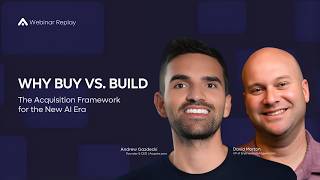
Andrew Gazdecki and David Morton explain when to buy SaaS businesses instead of building them. AI market shifts and lower valuations make now a buyer's window. They walk through Acquire.com's deal framework: evaluating targets by MRR growth and churn, structuring offers with earn-outs and seller financing, and why sellers often pick lower offers with better terms and faster closings.
Chapters
All right, what's up everybody?
Going on?
We'll go ahead and get started here in a little bit. We'll let more people join the webinar, but we got a great topic. There's obviously a lot going on today with tech and AI, and we see a lot of that at Acquire.com and excited to go over what we're seeing. All right, so today's webinar, we're going to be talking about why build versus buy. An Acquisition Framework for the New AI Era. As I was saying at the beginning of the webinar, AI is really transforming tech in every single possible way, and we're seeing a lot of that in acquisitions where we get asked a lot from buyers, how should we be thinking about things with this new era? So we're going to be going over a lot of that today. Without further ado, for those of you that may not know me, my name is Andrew Gazdecki. I'm the founder and CEO of Acquire.com. Prior to Acquire.com, I had bootstrapped a SaaS business to about $10 million in annual recurring revenue, and that was acquired by a private equity firm. And just going through that process showed me how difficult acquisitions can be. Everything from finding the buyer to figuring out legal documents to going through due diligence. I thought it'd be really interesting if we built a better way for founders to get acquired and also a way for buyers like you to potentially find SaaS acquisitions and help facilitate those. So we've done over $1 billion in acquisitions since we started the company about 5 years ago. And I've seen pretty much everything you could possibly think of when it comes to acquisition, every mistake, every deal structure, tons of different founders getting acquired all across the globe and truly love what I do. Love serving founders, love helping entrepreneurs win. And I'll, I'll pass it over to you, Dave.
All right. My name's David Morton. I'm the VP of engineering here at acquire.com, and I have 25 years of experience building and scaling startups from the early stages where I was the first employee through hiring and scaling and all the way through acquisition. And this is my second company with Andrew. I was around for the business apps days through that acquisition, and I'm just thrilled to be here at acquire.com to help buyers find the right business for them and sellers exit and find the right deal for them. And so it's just great to be here and great to be with all of you to talk through this new era of business.
And Dave, how long have we been working together? Over 10 years? Is it 12 years yet?
Yeah, it's somewhere between 10 and 12, Andrew. It's been a minute. We've had a lot of fun.
We've had a lot of fun. I know, that's a long time. All right, let's keep moving here. So just a quick agenda. So what are we covering today? We're going to be going over the window of opportunity, why this moment is different for buyers. Every single day we're seeing entrepreneurs be successful acquiring different businesses, and it truly is a great moment to be a buyer in this market. We're going to go over why. We're also going to talk about what to buy. There's a lot of different businesses on Acquire. There's SaaS businesses, e-commerce, mobile app businesses, newsletters. We have multiple different categories, but we're going to talk about an acquisition framework for the AI era and how to think about what to buy if you're not too sure, and then how to buy the mechanics of acquisitions from search to closing on acquire.com. How do we make that easy? Ways that we help. And then the numbers, because the numbers are really, really important. If you're looking to acquire a business, you want to have a path to seeing a ROI on your investment. So we're going to talk about multiples. ROI, what your budget buys, how to essentially put together your buy box. What are you buying? How are you buying? What is the size of the business? To give you some actionable takeaways. And we'll talk about some buyer stories. Again, we see a lot of entrepreneurs roll up different SaaS companies. We see institutional private equity firms acquiring SaaS businesses, implementing AI, streamlining operations, seeing great returns. And then we see some of those buyers return back to acquire.com. We get to work with them a second time and they're able to sell the business at a much higher price than they originally acquired the business for. So again, there's a lot of opportunity today. I think a lot of people think of acquisitions with AI today as mainly a risk where it's really hindering software acquisitions. And I'd say that's definitely true. But there's also a lot of opportunity where AI is being used to really improve businesses and drive up the multiples and the valuations, because AI can just usher in so much more efficiency, which can lead to more profitability and just overall healthier businesses. So we're going to talk a lot about that. And then at the end, we'll have Q&A. So if you have any questions, again, feel free to put those in the chat and we'll get to those at the end of the webinar. And if you're not familiar with acquire.com, we have over half a million registered buyers on the platform today. We've done over $1 billion in facilitated acquisitions, over 2,000 successful acquisitions, which is really humbling to say. So it's 2,000 entrepreneurs that we've helped exit their business, reach a life-changing outcome, 2,000 buyers that we've helped step into a new business to operate in. So again, my favorite part of the job is helping entrepreneurs win, and we get to see that pretty much every single day at Acquire. Um, and on average we see deals closing between 60 and 90 days. We do see faster, we do see longer, but that's about, um, the average that we see on the marketplace. Okay, passing over to you, Dave.
Kick it off. Yeah, let's talk about why, why, um, right now is different. So we're at this rare alignment of motivated sellers and really great businesses reaching maturity that really makes for a unique opportunity to buyers. And so, um, with AI disruption and maybe a little bit of uncertainty and market uncertainty, sellers are ready to move, um, on from their business. Maybe they don't know how to integrate AI into their business. Maybe they're not ready to, um, update their business for this next, uh, generation of AI, and, and they're looking to exit. And there's some really great deals to be had. And what's great is that inventory has never been deeper. We had this huge SaaS boom in 2018 that produced thousands of profitable niche cash-flowing businesses, and they're reaching maturity now. And as I said before, sellers are looking to exit, and that just makes for a really great opportunity because prices are coming down and multiples are rational again. We had, you know, a couple years ago at Acquire, sellers were commanding huge amounts of money for these startups, but prices are coming down now, and that creates opportunity on the buy side where Prices are at a great level. Some of these founders, they don't want to put their business through adding AI features or updating it with AI. And so that creates this great spot for buyers to come in, apply AI, and really take the business to the next level and grow it. And as we talked about before a little bit, you don't need to build from scratch. Of course you can, but buying a business allows you to kind of like skip ahead in the line, right? It allows you to jump into a market with customers, uh, start talking to your customers, figuring out their needs, and actually growing the business. Um, even with AI, there's still that last mile of software engineering where it always takes longer than you think. There's always edge cases and exceptions, things like partial refunds and refunds. When you're sort of scoping the, the, the story on— it's going to take longer than you think. And so to be able to skip all that and, and have a customer base is really huge and just really hit the ground running.
100%. I think the biggest takeaway for me on, on this slide is the multiples are rational again, um, because you remember, Dave, we saw some crazy multiples in 2021, uh, a little bit in 2020, and to see those, you know, come down, uh, essentially to reset with what I believe is, you know, fair market value. It's been nice to see. And then you combine that with a lot of the inventory on Acquire. There's a lot of opportunities and I get to see every opportunity too. So a lot of the times I sometimes joke where I say if I wasn't running Acquire, I'd be acquiring startups on Acquire. It's completely true because a lot of the times, you know, we see a lot of great products, true product market fit. And for one reason or another, the founder wants to move on from the business. Maybe they have another idea. Maybe they no longer enjoy operating the business. Maybe they just don't have the skill set for the next level of growth to be unlocked. And that's where a buyer can step in and really breathe new life into these businesses and really find that, that next leg of growth. So again, a lot of opportunities on the marketplace.
Yeah. And when the price comes down, that completely changes the risk profile and completely changes the opportunity. And so some startups that were priced like they were 3 years ago all of a sudden became, become really viable and, and, and really good opportunities. And so some of those businesses are worth taking a look at again, just because now with a price reduction, the math just kind of pencils out differently and you can come over the top with AI, increase margins and efficiency. I mean, it's a whole different ballgame once those factors come into play. 100%. All right, so what are we seeing on the market right now? So we, we see a couple of different types of businesses. The first is vertical SaaS. These are your industry-specific tools with captive sticky customers in, I would say, niche industries. Like think of legal, construction, healthcare, and hospitality. The brand means something in this industry and the relationship they've built means something. And AI can't easily replicate that, right? Like you could build the software, but building the relationship, the brand, and everything that goes into a business you, you can't just type into a prompt and get. And so that's what you're getting with these vertical SaaS companies, a really interesting play. You have AI-enabled SaaS. These are products where the founder already has added AI features on top of a real core workflow, but maybe they haven't done it all the way, or maybe you see an opportunity. And I think the key thing about these businesses is if you take AI out of the equation, it's still a viable business, right? Um, the business is more than just the feature. And I think the interesting play here is to see what they've done, um, recognize that the capabilities of AI are continuing to grow. And so is there more you can do there? Did the founder completely leverage all the tools at their disposal, or is there still sort of like fruit on the vine there? We have DevTools and API. These are like B2B, you know, high net promoter score, low churn, uh, technical moats. And I think the thing that are interesting about these businesses is developers are a real passionate community, right? Like, I'm one, I know. And so you get this customer base that's going to be happy to talk about the features they want, what they love to see on the roadmap. And so I think the interesting play here is buying these tools, engaging directly with the customers, hearing what they need, and continuing to roll out a feature roadmap that sort of plays to their vision of the product. We also have profitability— productivity tools. These are lean, profitable, one-person operations, low churn recurring revenue, and minimal support overhead. I think of these as like, you know, construction bidding software, like dental scheduling, like very simple business model, one-person operations. And I think the thing that makes these interesting in the AI era is they're really easy to operate. And so you can take all your specs, you can take all your documentation, hand that to AI and really have you help it run the business, which is really incredible. We have content and SEO plays. These are businesses with owned audience, newsletter subscribers, or organic traffic modes. If you have distribution, you can make money off of it, right? You can always sell ads, you can cross-promote other applications, you can upsell. And so these are businesses with distribution, and you can either continue to build on that, monetize that, or leverage that audience from perhaps another product. And finally, we have marketplaces and networks. Uh, these are, these are hard to build, right? A two-sided marketplace is difficult. You sort of need buyers and sellers, or riders and drivers. And so by being able to buy a marketplace or a network that's already populated, you can really just focus on growth and scaling. You don't have to get caught up in like, how do I get one side of the marketplace on this platform? You really get to hit the ground running and just think about how can I grow this, uh, this product.
One of the interesting trends I've seen on the, the marketplace probably in the last 12 months or so is people acquiring both the distribution and the products. I thought that was a really clever strategy. For example, there's a newsletter that targets marketers. They would also acquire a product that sells specifically to marketers, and they combine those two businesses and they both grow alongside each other. So again, like there's, there's interesting strategies like that to think about. I also like vertical SaaS just because of the industries that you can play in where I can't remember the, the specific business I saw recently, but it was in a very niche dental industry, which I thought was super clever and it was a great product. It had close to 0% churn because these business owners rely on the product so much. So these opportunities, they do exist and there's just a number of different categories to look through.
All right. We see a couple of different buyer types on Acquire.com, but by far the most common is the operator, right? Yeah. You're sort of buying a job when you acquire this business. You want to have domain expertise in the business you're buying, right? That could be knowledge of the industry because you work there or you're, uh, you've acquired a lot of knowledge about it. Or maybe you're a marketer and you feel like the marketing message isn't quite right, or there's possibly underutilized channels. Maybe you're in product and engineering and you feel like the roadmap is missing features. Um, but what I think the key thing here is you want to have a secret sauce that you're going to apply to this business to grow it, right? On the buy side, you're taking risk buying the business, so you need to see opportunity there. And that should really come from the tools and skills that you have. And so the idea here is to buy with cash or seller financing and then hold this business, essentially buying yourself a job, grow it, see if you can increase the metrics. And then at some point you can even put that marketplace back or that business back on acquire.com and sell it. We see this all the time with serial entrepreneurs who buy businesses, grow them, and then put them back on the marketplace.
You know, one thing to add there, Dave, is I did a podcast with a serial buyer, uh, a few months ago, and his strategy was looking for a SaaS business with just one marketing channel stood up where he could then add an additional marketing channel. So one marketing channel has already been capitalized on. For one reason or another, the original founder didn't understand that channel. Let's say they did paid and this buyer was good at social media marketing. He would focus on that channel marketing and look for businesses that were not excelling in that channel. And because of that, he was able to 3, 4x businesses and he'd come back on, acquire and resell them. We see that type of stuff all the time, which I think is great.
Absolutely. All right. Our fastest growing segment is definitely the portfolio acquirer, right? And so you're buying multiple small SaaS businesses and you sort of run them as a portfolio. It's kind of like building your own mini Berkshire Hathaway, right? Where you're like gathering all these pieces together. Maybe they play off each other, maybe they don't, but each of them makes a little amount of money. And as an aggregate, they make a significant amount of money. And the reason I like this play is because you have a lot of eggs in the basket. One of my friends has a content site portfolio company, and one of his— one of the sites in his portfolio just caught fire due to social media. And so he sort of recalibrated and doubled down on that business. And so I really like this play because you don't need any one of them to hit a home run. You're sort of like building them together and getting the aggregate revenue. But then if one of them is just sort of in the right place at the right time in this ever-changing economy, you can shift gears and just double down on that business and just go full bore. And then you also just have these residual businesses running. And I think the other thing too is in the world of AI, having these very small, simple SaaS, they're really easy to run when you can take a lot of the documentation, you can shove that to an agent and you can have it help you run these really simple, small SaaS businesses. All right, the third type that we see a lot is the strategic buyer, right? And so the strategic buyer is looking to add a feature, capture a market segment, or eliminate a competition. And so this is a situation where you're really like buying something for a purpose, right? You're buying the feature 'cause you need it or you're capturing a customer segment 'cause you lack that. At a previous company I was working for Epic for Kids and we were acquired by Baidu. And it was purely a strategic acquisition. They wanted a foothold in the US market. They bought the company and then they were able to sort of run their playbook. And so strategic acquirers, they usually move fast. They know what they want and they're usually willing to pay for it. And so if you have a business and you see a piece that you really think could add value to your business, could augment that business or really increase the ROI of your company, reach out and make that purchase and go ahead and increase the value of your current business.
Love it. I think the big takeaway for me here is you want to have a playbook as a buyer, whether that's, you know, you're really good at marketing, you come in and improve marketing, you're really good at operations, you come in and streamline things, or you reduce expenses, or you move the business to a different market, whatever it may be. You really want to think of that in advance and look for businesses where you think your playbook could add a ton of value. Absolutely.
All right, the best deals don't wait for you. On Acquire.com, a strong listing with clean metrics gets multiple LOIs within the first week. And so the buyers who are— as a buyer, you really have to watch the marketplace, right? And by watching it, I mean we have email notifications that notify you when startups are listed. We have a Slack room, you know, we've got a lot of features in search to find exactly what you want, like in terms of financials or if you're a strategic buyer. And so the good businesses that hit the marketplace, buyers are ready and they move quick. And so keep an eye on the marketplace. If you see something you like, definitely reach out to the seller, get a conversation started, right? You know, it doesn't hurt to get your questions early, evaluate the business quickly, and start building a relationship just in case other buyers come in.
100%. I'm going to give the Slack app a shout out right here. That's my favorite. That was an idea I had. Everyone was against it., but I'm always in Slack and we have this little app where you download it, you can set your criteria, and anytime a new listing that comes on that matches that criteria, I have all listings enabled, so I see literally everything. And I'm just in Slack working with my team all day long and just having a notification come up. I go over to Acquire, check it out. It's amazing. So check that out. Just go to acquire.com, go to the footer. It's free. It's a cool way for you to constantly get notifications if you're like me and you're always working, you're always in Slack. But also we have the email notifications, we have the daily newsletters. But the more you can stay close to the pulse of Acquire and the deal flow, the better.
Also to shout out the Slack app, it gives you like a quick summary too. So it's not just telling you there's something new, it gives you a little card and gives you some of the financials, a little summary. And so yeah, we love the Slack app.
It's such an underrated feature at Acquire. I love it.
All right. Not every deal is a good deal. Oh, and back forward. All right. So at Acquire.com, we vet all the listings, but you need to do your due diligence as well. And so as you're evaluating the business, right, like, look, are the docs clean? Is the business ready to exit? Do they have sort of their Ducks in a line. Is the business founder independent, right? Like, is their likeness part of the marketing? Have they documented everything? Is it easy for you to come in and take over the business? These are the things that you want to look for as a buyer, right? You're going to take over this business and you're going to instantly jump into how to grow it. How can I increase users, things like that. And so having it set up in a way that it just allows you to just hit the ground running, I think is key. And then operator fit. Andrew touched on this before, but like, what is your secret sauce? Like, do you have domain expertise to grow this? Are you a marketer? Are you an engineer? Like, what's your angle? Like, what can you do different than the founder has done to maybe grow it? And maybe, maybe there's not a whole lot to do. Maybe the founder is just ready to move on to something else. But I think it's important to sort of have that secret sauce and the, The acquisition for you may not be the most impressive one. It might be the one that fits your skill set the best. And also, I guess I would say too, don't underrate excitement for the business. Like, pick an industry that you're like, you're excited about, right? Like, this is your business, you're going to be pouring your soul into it. So, so pick something that excites you. All right, moving over to revenue quality. Uh, we want MRR over one-time payments. We want high NPS. Low churn. We want a product, you know, as buyers that our customers love. It makes it so much easier. And I think subscription businesses, they are the way to go. I worked for a company and we did microtransactions and it just felt like at the beginning of the month we were, you know, battling uphill to get from zero back to our target revenue. And I think the exciting thing about recurring revenue is that you just have to focus on churn. The money tends to come in and it really narrows your focus. So Love MRR companies, you know, love high NPS, low churn businesses. These are the things that you want to look for when evaluating a business. And finally, defensibility, right? The best businesses are hard to replicate. They have something unique about them. Workflow lock-in, proprietary data distribution, customer relationships, or just a unique take on the industry. And so think about, right, what, what makes this business good and what makes it especially defensible in the AI era?
Love it. I would double down on operator fit, uh, just to, to really beat this drum, because again, you want to find businesses where you, you think you can add value, and that's going to come down to what is your skill set, what does your playbook look like. Um, that's how I've seen some of the best returns at Acquire. So something to think about, um, again, is it marketing, is it operations, uh, are you very technical and you're able to add new functionality to the product and And I think the exciting time or the exciting part about the times we're in is with AI, it, it supercharges everything. You become a 10x marketer, a 10x engineer, uh, 10x operations. You can reduce costs all at the same time. Uh, so it's, it's very interesting. So the stronger the playbook, the higher the returns generally are.
Yeah. And if you're on the product and engineering side, maybe that founder hasn't yet used AI to increase their margins or efficient and improve efficiency, right? Maybe there's automation you could put in place and maybe you can just do more with less. And so definitely something to think about, especially if you're on the product and engineering side or heck, even if you're non-technical. I mean, these days you can have AI help you build a lot of the AI features, but there's, there are a significant amount of founders who just have decided they've taken the business as far as they want to go. They're, they don't want to take it through the AI era. And so there's opportunity there just buying that business and bringing on, you know, some low-hanging fruit on the AI side to help out with revenue. All right, what you're actually buying in 2026. So, you know, we touched on this before in the last slide, but you, you want something unique in the business, right? You want something like proprietary data, right? Years of domain-specific labeled structured data. Heck, even if it's not structured, you can get AI to help you structure it. And data is valuable, right? You can train LLMs on your unique data. You can train machine learning on your unique data. Maybe somebody else wants to buy your data. And so proprietary data in the age of AI is extremely powerful. Vertical relationships. We touched on this earlier too. Like maybe your business has built trust over the years in a unique vertical. Maybe the brand stands for something. I think this is a really interesting play because if that brand is strong and those relationships are strong, someone new into the market isn't instantly going to break them, right? Like, you know them, they know your product, they trust you, you deliver. And that's not worth other people risking their business on. They're going to stay with the software that works and that they have trust with. Workflow lock-in. This is a business, right, that you bring in. I always think of HubSpot when I see this one. You bring it in to do one thing and it sort of has tentacles and gets tied in. And so with HubSpot, maybe you brought that in as your CRM and now it's in your sales, your customer service, you're tied into your product, right? And so it's sort of locked into the processes. And if you're buying a business that has that, like you're going to have extremely low churn. You know, the businesses want to focus on what they're good at and they just want their tools to work. And if there's a product in there that's doing the job and doing it well, they're going to kind of leave it alone so they can go focus on the areas where they want to be competitive. Finally, distribution and audience, right? You know, own email list, SEO authority, community. Distribution is valuable. It always has been valuable in the startup era and it continues to be with users. You can always make money in a variety of ways. And so buying distribution and buying audience is a great business to buy. There's so many places to go. And it's hard to build distribution these days and audience. There's so much competition from apps and social media and marketing that an app that has good distribution or audience is extremely valuable. The things you want to avoid, right, are just general productivity. I mean, obviously tools that do what ChatGPT does now for free. You don't want that. They're just going to continue to get better. And then, you know, sort of buying a feature, not a product. If the entire value prop can be replicated by a single API call, you don't want that. That's too simple. That's not a business. That's not a revenue-generating product. It's just a feature. And so, you know, look for businesses that are complex and hard to build. I think those are the best. A couple of years ago at Acquire, we used to see businesses that were kind of a ChatGPT wrapper sell, but those days are long gone. You don't want that. You want a real business that's revenue generating.
Completely agree. And I think one thing to also add, that's just kind of an interesting, uh, personal footnote, I haven't really seen a completely vibe-coded business yet. Yeah, I haven't seen someone completely vibe-code something and get beyond maybe a couple thousand in revenue. So I think To me, what that really points out is just how much of the value is really in the product market fit, the distribution, the brand, the customer relationships. Those things are hard to build. And that's why people are interested in acquiring businesses over just building one from scratch, even with how much easier it's gotten, because those parts unfortunately haven't gotten much easier yet. You know, reaching out to customers, somehow figuring out a way for them to care about what you're building. Pulling out their credit card, you know, signing up for the product. That's still— it's always been the hardest part. But, uh, I don't know, have you, Dave?
No, I haven't. I haven't yet either. I mean, I, I still think it takes, you know, it takes a lot of hard things like you were talking about, like talking to customers, still building audience. Like, you know, it's, it's hard to build, um, to build customers. It is, and it continues to be, and especially in an ever-crowded, like, media scape. And so I, I still think that's the sort of the crux of it and why distribution company companies that have distribution are so valuable.
100%. And that's another way to think about what you're potentially acquiring as well is, you know, product market fit and 2 years of time back where all that time figuring out how the product should look or function or what the brand should be or what the marketing message should be to customers. Because that's a very iterative process. It's a large process of trying something. It doesn't work. Having the endurance to keep going, but being able to just acquire a business that already has those things figured out where you can come in and kind of dial the knob on what's really working, do more of that, do less of the things that aren't working. Yeah, again, tons of opportunity.
Yeah. All right. What to look for and what to walk away from. So what do you want to look for is just MRR trending up or flat. If it's flat, we can work with that, right? That hopefully you can bring your special sauce or your unique angle to the business to grow it. But we'd love to see growth. You want churn under 5%, right? You want users that love your product, or rather a product that fits with your users, that they don't cancel. You want no single customer over 20% of revenue. You know, I think this is a guideline. I think you can work within that. You can price in that risk, but like, Generally speaking, you like to see the revenue distributed evenly. Documented SOPs. This one is huge. Not only does the seller need to be able to explain every process, but it should be documented. Like I said, in this world of AI, just take all that documentation, send it to an AI agent, and they can be your sort of like advisor that knows everything documented about the business. You can spitball stuff off on it. And as you're coming up to speed on how the business runs, you're going to have this collaborative asset that you could talk to about the business. So documented SOPs, a must. Like you need everything documented so you can focus on growing the business when you acquire it, not figuring out how to run it. And then seller willing to do 60-90 day transition support. That's huge, right? That's de-risking the business for you. That's showing you that the seller is confident in the business. They're confident in the transition. And so you love to see that. The red flags you want to look for, right? Revenue spike in the 3 months before listing, like your classic, like, pump and dump. We don't want that. Uh, sellers can't explain why they're selling. I think this is a great question to ask sellers, like, understand why they're selling the business. We have this on the listings themselves, but I think hearing it in their own words and understanding why they're moving on from the business is important. It'll also give you hints as to where the opportunities are and maybe some of the things they've tried that didn't work out. You don't want all revenue dependent on one channel. You know, obviously you'd expect that a business has tested all channels. I think that, you know, this one is also sort of a yellow flag, right? Maybe some products work better in certain channels. You know, maybe, I don't know, you have an e-commerce company and it really works great on Instagram. And so all their revenue is coming from that single channel, but you Generally, you'd like to see other channels and definitely something worth talking to the seller about. No documentation, that's 100% a no-go. You can't have it all in the seller's head. And then, you know, customer contracts that don't survive ownership transfer. This coupled with the no single customer over 20% is key. You don't want to buy a business that maybe has one or two customers and then maybe the contracts either don't transfer over or get renegotiated in the event of a transfer. So just keep your eye on that.
I know, love it.
All right. You're not buying a product, you're buying a revenue system. And before you write an LOI, ask yourself, you know, can this business operate for 90 days without the current owner? You know, what are you going to need? And as you go through due diligence, if you find holes in documentation, just make that part of the negotiation. Hey, I need this documented. I need that documented. But, you know, everything could be built into the price. Everything's negotiable. And so just keep an eye out on the pieces that are there and the pieces that you need the seller to augment.
I think a big, big part here is just, you know, communication where there's certain things that maybe you're not comfortable with. You know, you want to talk with the seller about those things upfront, ideally before you submit an LOI. But a lot of the problems that we've seen during acquisitions are usually just from a lack of Communication. So anytime, uh, you're in a position where you have a question or, you know, you think there's too much risk coming into the deal, make sure to just communicate, and you can generally put yourself in a good spot. Because like Dave said, everything is negotiable. Uh, the transition, uh, the level of detail put into the SOPs that are going to be transferred over. Sometimes we even see founders, uh, building features for buyers before exiting the business. Maybe As a buyer, you see the perfect product that should be angled a little bit differently or maybe to a different customer type. So rather than acquiring the business, finding someone else to work on it, understanding the codebase, you just negotiate with the seller to help make that process happen. So you can do things like that as, as just an example.
All right. What every buyer wants in 2026, right? You want revenue verification, right? You want to be able to connect Stripe and verify where the revenue is coming from. You want to verify their MRR. You know, there's a lot of different ways to calculate MRR. So maybe you guys come up with different numbers, but understanding each other and where you're coming from. And so you want to understand all the metrics and you want to verify the revenue yourself. Uh, same thing goes for traffic and acquisition source. You know, figure out where the customers come from. This is especially important because it could affect your roadmap for the company. Where is there opportunity? What has been tried? What hasn't? The tech stack health, you know, can you maintain this code base? You're going to have to release updates to the code, right? Whether that's features, bug fixes, or just security updates or framework updates. So make sure you feel comfortable to push code to production and maintain it. AI can help a lot with that. I still think it's important for eyes to be on code before they go to production, but AI could do a lot of the heavy lifting for you. Uh, customer concentration, um, you know, request a customer list and make sure that it's pretty evenly distributed. And if they have these clumpings of revenue with a, a small number of users, you know, talk through that and price accordingly and make sure you de-risk it as much as you can. And then finally, uh, talk about the AI exposure, you know, ask the seller like You know, you know, how does this product fare in an AI world? What are the risks? What are the opportunities? Because I think that's key for any business you buy in 2026. Yep.
Agreed. I think, you know, one thing to keep in mind too is sellers always know where the most opportunity can generally be in a business, or at least you can learn about things that have been tried. Did they work? Why did they fail? As it relates to AI, You know, how do they view their product within the marketplace? How are their competitors stronger than them or weaker than them? You can learn a lot from the founders. And again, communicating through that to find where the opportunities are, I think, is, is a must, must-do for every buyer. Okay, we're gonna transition over to from search to close, essentially how to buy. So I'm going to briefly go over how acquire.com works if you've never used the platform. We try to make it extremely simple and easy. Step 1 is going to be creating a profile. You can set your criteria from business size to location to category and only see businesses that are matching your criteria and you'd be interested in. Uh, from there you browse and filter. We have live metrics, verified revenue from, uh, Stripe or ChartMogul. We also connect with Google Analytics. So you can really see the, the health of the business before signing an NDA or learning more. Let's say you find a business that you're interested in. From there, you can message the seller directly. You would sign an NDA, and once the NDA has been signed, a seller would countersign the NDA. Then you'd be granted access to the listing, and that's going to contain generally the P&L of the business, going to contain confidential information from Random at times depending on the size of the business, just generally more information about the acquisition that most buyers are going to want to see. So we try to do a good job in really giving buyers the, the necessary information that you're going to need to assess the opportunity upfront. But again, you can go through this process from creating a profile to browsing listings, reaching out to sellers,, in 10 minutes, probably 5 minutes. Uh, and we have— Dave, how many listings do we have in the marketplace today? Over 1,000, correct?
Oh, way over 1,000. I'd say approaching 1,700.
So tons, tons of inventory of businesses of different sizes, different locations, different verticals. Um, so, so definitely go through and set your filters. It'll make life a lot easier. And then from then, when you find a business where You've spoken to the founder, uh, you've slightly agreed on price and you want to move towards an offer. You would submit what we call a letter of intent. This is a high-level agreement where you're outlining the price, the structure, and the timeline to closing the acquisition. This is generally a pretty simple document. We have a letter of intent builder on the platform to make that process easy. Um, if the letter of intent is accepted by the seller, then you'd move into what we call due diligence. This is going to be where you're granted data room access. This is typically going to be a 30-day process, sometimes longer, depending on the complexity of the business. And one thing I'd add here is in the age of AI, a lot of these processes have become so much easier for both sides, meaning due diligence used to essentially be a black box. What do you do? What parts of business should you look at? Where is the risk? Have I I done every part of due diligence that I possibly should? Now that's just a few prompts, um, in ChatGPT or Claude or whichever AI system you use. And that works for sellers as well, such as a buyer asked for this document, is that appropriate during due diligence? For example, like the buyer asked for full access to my Stripe account, is that appropriate? The answer to that is, is no. But we would answer these common questions very often, and now AI almost works as an M&A advisor and assistant for both sellers and buyers. So something to to keep in mind. You can draft LOIs, you can draft purchase agreements. I don't recommend that, but I've seen it done. So when you get through due diligence, this is going to be where you're heading into close. Highly recommend using escrow. We have escrow providers integrated into the platform. Every deal that we facilitate on Acquire utilizes escrow, whether that's escrow.com or one of our larger escrow partners. Once you've agreed on escrow, you've transferred funds, then you begin the asset transfer. That's when the seller or the founder is going to be transferring over the domain, the customer list, the Stripe accounts, everything related to operating the business. And then from there, escrow releases funds to the seller and you've successfully acquired a business. And this was a very brief, high-level overview. We help with this entire process from start to close. But just to give you some, some context of how the process works and how we look to help on, on each piece of that, whether that's finding the businesses, which before Acquire would, would take quite a bit of time. You can find businesses anywhere, obviously, but really finding businesses with motivated sellers is a different story. Having the correct information immediately available We spend a lot of time getting this information from sellers before taking them live, drafting LOIs, drafting purchase agreements, flowing in escrow. Again, we try to make the entire acquisition process easy and secure for both sides.
I think one small thing you can do on the buy side is take a little time and really think through your buyer profile, right? We don't ask for a lot on the buyer onboarding, but Sellers are— when you make an NDA request, sellers are looking at your profile to decide if they're going to give you access to the private information of the business, right? The website, the name, the P&L, and those are what you want. And so in some cases, if you sort of breeze through the profile, you know, sellers may think twice about that. And so, you know, you don't have to spend a lot of time on it, but, you know, put in your LinkedIn profile and also write a little blurb about yourself and highlight why you're, you know, a good entrepreneur. I think that that's important and something that's overlooked by buyers sometimes. And also, you know, get your funds verified. We have fund verification on the buy side here at Acquire.com, and that sends a strong signal to sellers that you're a strong buyer.
100%. And this is advice that we give sellers as well, like things to look at— verified funds, complete profile. So if you're serious about potentially acquiring a business, take 5 minutes and definitely do those things because it does make you stand out. It gives you a good first impression, um, gets everything started on the right foot. Okay, what a realistic timeline looks like for closing. So 60 to 90 days from first message to close. Uh, this isn't a full comprehensive list, but again, this is a good high-level overview. So the first, uh, week or two is going to be browsing, putting together your buy box, really shortlisting businesses that you're really excited about. Signing NDAs and having the initial conversations with sellers. This is where you're asking, why are you selling? What are you looking to achieve from an acquisition? What kind of deal structures are you open to? We'll talk more about deal structures in this webinar. Then after that, you're going to be spending week 2 and 3 deep diving with the, the founder, really looking to understand as much of the business as you possibly can during the stage to make sure that all the key metrics are as stated, really looking to verify these things. And then based on that, based on all the information you've gathered, you would submit a letter of intent and negotiate terms and the structure of the acquisition. I always recommend trying to really be as upfront as possible about your expectations of the acquisition with the seller before submitting a letter of intent. This can include the transition. This can include needing to document certain SOPs. This could be needing to Uh, you know, build functionality. It could be whatever is important to you as a buyer, and then write that into the LOI, and then both of you are on the same page, which is critical to a successful acquisition. Uh, LOI is sent and both parties sign, move into due diligence. Once you move through due diligence, which is going to take the bulk of the time, as you can see here, uh, week 8 to 10 is going to be purchase agreement, escrow, asset transfer, And then week 10 plus, you've successfully acquired the business and you're moving into transition period with the seller support. Some of the tips here at the bottom have financing arranged before you submit an LOI. This is a big one. I would expect to be asked, how do you plan to finance the acquisition? It is deeply frowned upon when you submit a letter of intent, you take a signed LOI, and then try to go source funds based on that. If That is the case. Communicating that upfront with the seller is recommended. For example, you're going to be using bank financing or you're going to be looking to pool investor funds after the LOI is signed. That's entirely fine as long as it's communicated. Also, I would recommend a 30-day exclusivity window post-LOI to protect due diligence investment. This is completely standard. We see it on the vast majority of acquisitions at acquire.com. And a good acquisition attorney pays for itself 3 times over. Don't skip legal. For a lot of the buyers that we work with at Acquire, we completely understand that this is, you know, one of the largest investments of your career potentially. And we recommend both sides just invest in making sure that every aspect of the acquisition is legally sound. It's a small investment generally. We have referrals that we're able to get both buyers and sellers. So definitely recommend crossing your T's and dotting your I's there. Dave, anything you want to add to this slide?
No, the only thing that I would add to this is, you know, on both sides, but since we're speaking to buyers, you know, really work diligently to move quickly through these phases. Everybody wants the deal to get through. You've agreed on a price, you're working through the details, and at Acquire we always say time kills deals. And so you know, you want to do your part to keep the acquisition moving along, to show that you're interested, that you're acting in good faith. And so as you work through these different stages, you know, move quickly through them, you know, work with diligence so that you show the seller that you're ready to move and you're working strongly towards a close. 100%.
So how deals are actually structured. So not all acquisitions are all cash. It's going to be a seller's preferred deal structure, obviously you receive 100% of the cash. There's no deferred portion of the acquisition, meaning there's no earnout, there's no seller financing, there's no equity rollover. All cash at close, generally we only see that when it's a competitive process and it's a tool to potentially win an acquisition over other offers that are being submitted. So as a buyer, you have multiple different tools to essentially de-risk the acquisition or align the incentives of the acquisition with the founder. What I mean by that is if you believe, if you both believe that the business is going to continue to grow, you can put a portion of the acquisition proceeds into, say, an earnout, meaning you want the business to grow, the founder wants the business to grow, and you're both aligned in the incentives to make that happen. As an example, you could do an acquisition for $1 million where 60% is cash at close, and then 40% is based on an earnout of agreed numbers that both you and the seller believe are reasonable to reach. And if that happens, you as the new owner of the business, the buyer, you succeed, and then the founder, they succeed as well. Seller financing can be another option to essentially bridge the gap between valuation The seller believes the business is worth $1.1 million. You believe it's worth closer to $900K or any, any number of those ranges. And then you could structure something where maybe the acquisition is $700K cash at close and then $400,000 seller financed over 36 months, generally from cash flow from the business. So these are ways to essentially move forward with acquisitions without having to put all of the risk capital upfront at closing. Equity rollover would be maintaining a small equity stake in the business that the seller sells. For example, you as a buyer acquire the business, you give a seller 10% of the new entity that has acquired the business. So if it's really successful, the seller has some ownership in that business. So these are all tools at your disposal. And again, this is another area where I think AI really shines, meaning Hey AI, what are some creative deal structures that would help bridge the gap of the valuation disagreement that me and the founder have? Or how do I structure a deal that highly motivates the founder that I'm working with to achieve these growth targets? So things to keep in mind as you look at acquisitions is not all acquisitions are all cash, and there are deal structures available that can essentially reduce the risk on both sides. Dave, anything you want to add?
No, I mean, I think this is where communication is key. You know, what, what is the seller looking for in terms of a deal? And then how can you come to a compromise or a deal that de-risks it for you and allows the seller to get what you want? Sort of a win-win. That's what you're trying to work towards, right? Yeah. And so of course I think most people just think that all acquisitions are cash at close, but they're not. And so These are levers you could use to de-risk the business, you know, find ways to keep the seller on so that they're vested a little bit and they'll help you out. And so as Andrew said, I think using AI to get creative and then again, keeping that communication channel open and understanding what the seller wants and then him understanding or they understanding that you want to de-risk the business.
Well said. Okay, moving into how to negotiate without overpaying or burning the deal. Just some quick tips. We recommend anchoring on cash flow, not top line. Obviously, as you work with sellers, it's going to be amazing if you're able to offer them 10 times revenue or something like that, but that's, that's not the reality and that's not what we're seeing in the market. We see a lot of the buyers that we work with only caring about profit or owner SE. Uh, so the profits from the business. So if you're able to work with the founder, uh, placing valuation on cash flow, not top line, um, the better off you're going to be. And we educate sellers a lot on this. A lot of the valuations that you're going to see on acquire.com are based on, uh, net profit. So this is another example of just the valuation expectations that have really come down to, to fair market value in, in the last year or so. Use due diligence findings, not ego. Essentially what, what we're saying here is when you find something concerning in due diligence, you want to communicate that to a seller, and that is potentially an opportunity to renegotiate terms or the structure of the acquisition. But it's not essentially to call them out or to say this part of the business is really bad or whatever it may be. This is an opportunity to again communicate what you're seeing or what your expectations were. How is that different from what was found in due diligence, um, because in order to keep an acquisition moving forward when something concerning comes up in due diligence, communication is 100% required. So just a tip there. It's also always important to ask for reps and warranties. Sellers should warrant revenue. This can be disclosed in the asset purchase agreement You also want to make sure there are no undisclosed liabilities and IP is clean. This is completely standard. Any seller that pushes back on this is generally going to be a red flag. And this is another part that we educate founders at acquire.com. And another one at the bottom, set a deadline and hold it. We, like Dave mentioned earlier, time truly does kill acquisitions when they drag on or they're really slow. This is when both parties tend to get nervous or antsy and communication starts to fall through the cracks and the deal falls apart. So when you submit a letter of intent, put an expiry date on it saying this LOI is only good for 2 weeks, meaning they need to make a decision within that time frame. Otherwise, the letter of intent is no longer valid. Urgency really creates focus. It can help deals successfully close. So highly recommend that. And then know your walkaway number before you start, meaning set a price, the top price that you're willing to potentially acquire a business and do not go over that price point for any reason and have that in mind as you start negotiations as well. It's always better to walk away from a deal if you're not feeling great about it or if you are going off course with your plan than it is to move forward if it's completely beyond the ceiling of your number. Dave, anything you want to add to this slide?
No, I think I just want to highlight the communication, especially during the due diligence phase, right? This is a lengthy process where you're vetting the business as a buyer. You have numbers you need to know. Either the seller gets sort of hit with pulling up numbers maybe they have and they don't have, and there's a little bit of tension as everyone's trying to get this deal done. So advice is just to take a breath, communicate, you know, hopefully the seller understands where you're coming from, that like, hey, I'm vetting this business. And, and I think communication is key, especially in this stage, just because you have documents flying around and asks and responses and stuff like that. So just be patient but thorough, right? I think that's key.
Yeah, I agree. Okay. Now going over the numbers, what does your budget buy? So we have a number of different businesses on Acquire from different sizes to different verticals. So here's some ways to think about that. So around the $10K MRR, we see these businesses generally selling for 2 to 3 times net profit, not revenue. So that's where I'd look at if that's, that's your budget. You're going to see typically micro SaaS businesses, a lot of high risk, a lot of high upside. A lot of these businesses' expectation here is it's going to be generally one person that has built an interesting tool. There's a handful of customers, a mini brand that's coming together. Usually one marketing channel that's been stood up, if any. And this is going to be generally the one of the highest upside areas for, I would say, marketers. If you're really good at marketing and you're just looking for a product with some signs of product-market fit that could really be repositioned, or other channels can be opened up, this is a great category. Uh, $10K to $50K monthly recurring revenue— this is generally one of the most active tiers that we see at Acquire. Um, this is where we're going to see strong inventory, competitive bids. The valuations here are going to be between 3 to 4 times net profit. This is going to be a lot more competitive for buyers, but these are going to be, uh, more structurally sound businesses where there's going to be more customers, there's going to be a stronger brand. Uh, the businesses, businesses have generally been around longer. There's going to be more data to assess and put through due diligence, more customers to potentially reference, and just as much upside as well. It's still generally pretty early in the journey of the business, business's lifetime, but a great area to look at if you're looking for something that has more structure to it and maybe can withstand a little more issues within the market. Next, we're going to see $50,000 to $150,000 monthly recurring revenue. Now we're moving into the premium tiers of acquire.com. This is where we're going to see, um, much larger buyers that are experienced in acquisitions. Uh, this is where we're going to see between 4 to 6 times net profit. Again, the businesses are getting larger, and so you're going to just see more data. You're going to see typically better, better built products, likely better processes in place. Sometimes a mini team is coming together at this point. And then at the bottom here, we have $150,000 monthly recurring revenue. This is going to be our institutional buyers. This is where our Guided by Acquire team is generally going to be advising the transactions. We're going to be assisting every single step of the way, and these are going to command a 5 to 8 times multiple. And I think, you know, one interesting strategy that we see all the time at Acquire is acquiring in one of these buckets. Let's say it's the $10,000 in monthly recurring revenue. You acquire a business for 3 times net profit and then growing the business and then moving into the next tier, $10,000 to $50,000 monthly recurring revenue where the business is bigger and it's also commanding a higher net profit multiple. Dave, anything you want to add to this?
No, I mean, I just want to highlight too, there's opportunity in all of these segments. And like you said, Andrew, you know, they're all a little bit different in where they are in their business lifecycle because obviously they have different revenue numbers. But there's opportunity here, you know, at the $10K and less band here. And so there's a lot of interesting startups there. I do think you need to keep in mind some of the topics we've discussed today, which is like look for customers, look for revenue, things like that. Like, those give you a leg up, and I think that's really where buy instead of build really plays into it.
100%. Okay, what your budget actually gets you— scenario planning. So looking at the top, we have $50K to $150K. That's going to generally be looking at a business that's generating between $1,000 to $4,000 monthly recurring revenue. And there's a large amount of inventory in this category. And this is probably the area where I would say I've seen 5-coded businesses where one person built an interesting idea. They got a handful of customers. It's just getting— it's coming together. But these businesses are going to need quite a bit of love. But again, if you're able to figure out marketing, figure out distribution, or maybe it's a great product where there's absolutely no customers and you're able to attach that to your existing business, or you understand distribution in that market segment, or you acquire a different business that has distribution, you combine them together. There's a lot of opportunity here, but also a lot of risk. If your budget is between $150,000 to $400K, this is where you're going to be looking at more established businesses and the revenue is going to be between $4K to $12K a month recurring revenue. And the biggest difference between the first category and the second category is this is where product-market fit is really going to start emerging with more clear signals. There's going to be a much larger customer base, there's going to be processes generally in place. Um, again, it's going to be a more established business, and your job is going to be operations and growth, not really validating does the market want this product. Moving on to the next category here, which is if your budget is between $400,000 to $1 million, you're going to be looking at businesses between $10,000 to $30,000 in monthly recurring revenue. And this is going to be one of my favorite categories within acquire.com. This is going to be our profitable vertical SaaS. This is where you're going to be seeing real revenue, real team, real processes, likely has a manager layer, possible to run semi-passively. There's a lot of really, really good businesses in this category. Um, and the opportunities in this category are going to be vastly different than the opportunities in, say, the micro SaaS category. So something to keep in mind. And then as budgets continue to grow and it's over a million, this is where you're going to see opportunities with more than $30,000 monthly recurring revenue, category leaders in a niche, multiple growth levers, acquisition targets of their own. Guided by Acquire team support is available on these acquisitions. And I think again, going back to what I was saying earlier, the biggest, the biggest thing to do depending on your budget is to really figure out what is your playbook going to be like. And I think that can really determine your initial acquisition as well. For example, if it's growth, you know, you could look at the first two buckets. If it's really improving operations and streamlining expenses, it could be the third bucket. If it's putting together capital and raising from investors, maybe it's the fourth bucket. So really understanding, you know, where you're going to be playing which bucket first, I think is critical. Dave, anything you'd add to this slide?
Yeah. And I guess the other part of it too is how do you want to run the business, right? When you're down in here at the smaller tier, that could be something you operate on the side. As you march up the tiers, like that's going to require something that's going to take a significant amount of your focus and maybe even require employees, right? And to manage employees. So kind of like, what are you looking for in running a business and where do you want to play? You know, I do think that if you're a first-time buyer starting on, you know, the operator side where you're going to run the business yourself, especially when AI is there to help you, is kind of where you want to play. And then you can slowly move your way up the tiers. But I think that's an important question to ask yourself is, How much time and energy do I want to put into the business? And then how does that fit into running the team? And then that might help you decide where to get started on these tiers.
Yep. Agreed. Okay. Now moving to the last part of this webinar, I hope, you know, a lot of this was helpful information. Again, we see a lot of opportunity at Acquire. We've seen a lot of successful outcomes. So I'm going to be going over just 2 different stories that really come to mind when we think of buyers that have been really successful with us. So in this example, this was a, a buyer that worked with us on a number of different deals. And really where they started was on the smaller tiers that I just went over, where they started on Acquire.com acquiring smaller software businesses under the $200K range to build operational experience and confidence as an owner-operator., and he had a thesis where after integrating several acquisitions, identified a 7-figure SaaS opportunity and was transparent about the risk, customer concentration, and stalled growth. And what he did from here was rather than forcing valuation or walking away, he approached the process collaboratively, focused on, focusing on post-acquisition value creation through operational improvements and strategic synergies. And the final outcome was a structured deal with an earnout tied to post-acquisition growth milestones. Both parties aligned incentives, opening a path to a 7-figure outcome not possible through all cash alone. So essentially they identified a great business on Acquire. There was a gap on valuation and you structured an earnout with the founder to align incentives so they had a win-win acquisition. And we see this all the time where, you know, maybe you see a business that's out of your budget, but you are the perfect operator for this business. You know how to grow the business, You know what is missing in the brand. You know, the existing customers, whatever it may be, that is a great pitch to the founder. And if the founder can truly believe that you can help grow this business, maybe there is a way to structure a deal where you both are aligned towards reaching that goal. Could be through an earnout. It could be seller financing, whatever it may be. If you have a vision to growing the business that I think a founder could really wrap their head around, That is an opportunity for you as a buyer. Dave, anything you want to add to this one?
Yeah. The reason I love this story too is just about the, you know, they highlight, they focused on being transparent about the risks, right? Like both the buyer and the seller, they're human. And I love that the buyer went to the seller and was like, hey, here's the risks of the business. Like, I love this business, but help me de-risk it so we can get to a spot where like I can come in and continue to take over this awesome business you've built. And so, I think it also just highlights to work with the seller when you're pricing things, get creative with the financing, you know, try to get to a spot where like you feel like you're both win-win and on the buy side you're de-risking, uh, the acquisition as much as you can.
Well said. Okay, another buyer story. This was a private investment firm focused on scaling SaaS and AI businesses. We see this quite a bit at AcquireWord., a different firm or private equity, private equity investment firm. Uh, they acquire SaaS businesses and they're able to grow them significantly in just months. So this was 3x growth in 17 months. And the find was they identified a high-quality software business on acquire.com early, moved quickly through diligence, and submitted a strong all-cash offer at a premium multiple. The thesis Conviction wasn't just about price, it was about what the business could become. Entered with a clear value creation plan from day one. Improved execution, strengthened retention, increased revenue quality. Uh, they moved with urgency, professionalism, and clarity. The ability to execute quickly helped close the deal. They had post-close— post-close, they executed aggressively against their operational plan. And the big thing that stood out to me about this firm was just their playbook. They acquired a business, they had a tried and true playbook that had been tested and used and successful with multiple different acquisitions, and this made them comfortable to pay a strategic multiple because they knew if they were to acquire, acquire this business, run their playbook, they were going to grow the business and see a return on their investment. And that is just the, the power of having a plan in place before you acquire a business. And this specific firm, they had that plan. They found a business that really aligned with that plan, and within 17 months, they tripled the business. The company is now significantly larger, more efficient, and positioned for a future strategic exit at a material— materially different valuation profile. Dave, anything you want to add to this one?
Yeah, I mean, I touched on this before, but I love the moving with urgency, professionalism, and clarity. You know, you don't need a complex playbook to do that. Work with the seller, you know, move, move quickly and be professional with them, right? Like work with them to close. I think that's the key thing about this story that I love.
Yeah, me too. Well, that wraps it up. If you're interested in acquiring a business or just want to look at the businesses that we have available at acquire.com, you can start your search literally right now. Uh, we have thousands of verified SaaS businesses. You just need to sign an NDA, begin speaking with the, the founder, and your next opportunity may be there. And if we can help in any way at Acquire, we are here. Uh, feel free to shoot us an email, reach out. We'd be happy to assist. And with that, we're going to go over a few questions if anybody has them. Um, but Dave, how do you think that went? That was fun.
Oh, super fun. I love doing these, um, especially talking to the buy side. It's, it's so fun to to, to present to buyers and, and to go through and, and see their journeys and talk through the experiences they've had.
Okay, first question. I'm going to have you take this one, Dave. It seems right up, right up your alley. What's the biggest technical red flag you see during due diligence?
I mean, honestly, it's probably lack of documentation. You know, I'm a developer. I suffer from this too. I, I start building features and then you get caught up in them, but You know, I think it's important that the documentation is there for buyers. Like, it's not unreasonable for buyers to ask for that processes are documented. Like I said, in the world of AI now, take all those SOPs, take all that documentation, hand that to, you know, Codex or Claude, and it can be your advisor in your startup. I really do think this is like the new way to run companies efficiently. And so Lack of documentation is probably the biggest thing I see, or even if it's not straight up documentation, I've seen things in the past where maybe there's a process that maybe like fails every once every 3 months and it's not documented and not fixed. Usually those come out during due diligence, and I think on the buy side, it's okay to ask the seller to fix those things. We talked about this before, doing due diligence, During due diligence, you have the ability to ask the seller to change certain things. And so make sure that you feel that that business is humming and ready to go so you can step in and focus on growth. That's going to be your full-time job. You don't want to spend time and energy learning how to run the business. You want that all documented so you can focus on making the business better.
Love that. Okay, I'll take the next question. What's the fastest way to kill momentum in a SaaS acquisition? I would say not communicating. We've said this quite a bit on the webinar just because it's, it's so true. Not communicating kills so many deals or just not having urgency, meaning, you know, something that could take a day ends up taking a week and then, you know, both sides start to get a little nervous and then communication lacks and the deal falls apart. So I would say just communicating a lot, moving quickly. One tip I have here is if you enter into due diligence as a buyer or seller, Put a recurring meeting on the calendar, whether that's on a Tuesday or a Sunday, whenever you guys are available. And I don't care if you talk about the weather. If you have nothing to talk about, still meet and talk about the weather, golf, if that's what you enjoy doing, or whatever. It's just a great way to ensure that if there's any issue, big or small, it gives you a designated time each week to talk about the issue. Additional new questions you have as you're going through due diligence. It can be the best thing ever for the DD process.
That's great advice.
I love that. All right, Dave, you got this next one. What would make you choose buying over building?
Well, I think it probably has to do with what you talked about earlier, Andrew, which is saving time, right? You know, I think in this world of AI, we think that we're just going to hand AI a prompt and it's going to build us just a turnkey business, but that last mile of software, it takes time still to do the QA and get the brand right and get all the bugs out. And so you're saving so much time, uh, buy versus build. And so instead of having to play catch up and, and maybe iterate for a couple of years finding product market fit, you basically get to skip to the head of the line and start competing in that industry right away and end up taking your secret sauce of what you do best. And growing the business. And so I think the time-saving aspect is huge. I fully recognize that AI is incredible with what it could do now. It could QA, it can write code, but that last mile of software engineering, it still takes a while to really build a product that's ready for customers and ready for production.
Well said, Dave. You're crushing these questions.
Thank you.
All right. We got 2 more questions. What is NPS? That'd be Net Promoter Score. Okay, last question here. Why do some buyers lose deals even after making the highest offer? That's a good question. It's really going to come down to the seller, meaning maybe they were speaking with a buyer that had different terms. Maybe it was all cash at closing. Maybe they had a quicker due diligence process. Essentially, did it appear like a higher offer to potentially close? That's a big thing that a lot of founders are thinking about when they go into due diligence is What can go wrong here? How am I exposed? What's at risk? So comparing two offers, if they're exactly the same, or let's say one offer is 10% higher and one is 10% lower, but the lower offer is from an experienced firm, they've communicated their process. How long will due diligence take? I can see a founder going with that, or it could just be vibes where they got along really well with another buyer. They had the exact shared vision for where the business could go and it just made more sense. But one way to win deals without being the highest offer is deal structures, being all cash, moving through due diligence quicker. Those generally help.
Yeah, I was going to say too that sometimes it's also the buyer's vision for the business. You know, don't forget the sellers have poured their soul into building these companies. It's like their baby, right? And so they would, they would much rather see it go to a buyer that's going to grow it continue to serve the community that they built. Right. And so as a buyer, you know, go over your plans with the seller, talk to them about what you plan to do with the business, because we've seen this in the past where, you know, maybe the highest offer isn't taken just because the seller's excited for what the buyer is going to bring to the table and how their customers are going to be serviced by this new buyer.
All right, everybody, that about wraps things up. Thank you again so much for just taking the time to join us for this webinar. I had a lot of fun with this topic. Uh, we'd love to hear your feedback if you have any. Feel free to shoot us a note. And again, if you're looking to potentially acquire a business, we have thousands of listings on Acquire. We're always adding new listings every single day. Uh, so we hope we can help you in some way. And, uh, again, thanks for joining.
Thanks everyone. Cheers.
More from Andrew



The Buyers Who Made the Move: What They Bought, How They Did It, and What Happened Next






