Why Buyers Wanted THIS Design Business
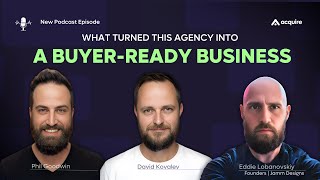
A recorded interview (YouTube) hosted by Andrew Gazdecki with JAM founders Eddie, David, and Phil Goodwin. JAM is a subscription design service (branded as J A M M Co) that positioned itself between traditional agencies and single freelancers by offering asynchronous, subscription-based access to senior designers (brand, web, product, illustrators) through a Trello-driven workflow, Figma deliverables, and Loom update videos. Key operational facts: one active task per subscription, target visual updates within two business days, and example client pricing mentioned (~$6,000/month in support scenarios). The founders sold JAM after concluding they had taken it as far as they could and found a buyer (Napkin) with scaling experience; they stayed on in design/transition roles post-acquisition. The transcript also covers onboarding, people management challenges, the due-diligence/data-room process, and founders' next plans (AI experiments, one-off design work).
Questions this video answers
Two business days (target for a visual update).
One task at a time per subscription (clients keep a 'current request' column in Trello).
About $6,000 per month (example given for supporting an in-house designer).
They referenced the close as November 20th (founders had not met in person since that date).
J A M M Co (two M's).
Chapters
Foreign.
I'm here with the founders of GM Designs. How you guys doing?
Doing good.
Great.
So for people that may not know you, do you want to just go around and give a brief introduction of yourselves? Maybe we'll start with you, Eddie.
Sure thing. Yeah, My name is Eddie and I'm obviously part of the three founders of jam. I'm brand designer mainly, but I do dabble into web a little bit and yeah, it's been fun. JAM with these two. I'll pass it on to maybe David.
Oh yeah. Excited to be here. Basically my intro is I am a designer and we kind of jack of all trades, kind of dabble in everything to be honest. And we found it unfold about eight years ago and about three years ago we founded. The three of us founded jam and we were pushing JAM for a while. Uh, but yeah, overall just designer, designer at heart. And yeah, excited to hop on this interview. So Phil.
Yeah, yeah, so my name is Phil Goodwin. Yeah, I've been in design, doing my thing in design since about 2005 and really in like 2015 kind of went from a, hey, I design everything to I only design products, digital products. And so kind of became a product designer at that point. Um, and then I actually ended up working for Eddie and David for about two and a half years. I was employed by them through Unfold, the agency that David just referenced. And after a BIG restructuring in 2023, approached them about starting this new initiative called JAM. So that's kind of how we got into it.
Nice. Tell me about jam. What problem did it solve? How did the business operate? Give me a high level overview of the business.
Maybe I'll start. Yeah. So the problem JAM solved for while we, what we quickly identified was that because after running like your traditional agency for so long, about five years, we realized, you know, agencies have a lot of flu, a lot of processes, a lot of. I guess there's just a lot going on there for by the time the client gets, you know, actual results or, or any of the visuals. And there's good in that, of course, but it's not for everyone. So there, you know, with the high, with the high budgets and, and pricing models of agencies, we, we quickly realized something like a subscription model which started getting a little bit trendy was something we want to dabble in. And Phil actually kind of learned about that early on and then pitched the US and we thought it was a great idea to try to explore. And it's really just offering service, service as a product. Right. And so clients know what the Expectations are. There's a whole process, it's Async and just generally it's a, it's a better fit for, for a lot of companies, a lot of clients because it's just a little bit more budget friendly and. Yeah, so, so it, you know, there's pros and cons to both, of course, but that was the main kind of need that we saw. Um, and maybe Phil and Eddie can add. Add to that a bit more.
Yeah, I think, I think what we saw on what I noticed in traditional agency worlds, we'd see people engage for, you know, a quarter or something of the year. Right. And you're paying like agency prices. It's really expensive to work with us at the time. And so you'd see someone spend, you know, 120, 160K right on brand and web and product, all this stuff. And then you see, you kind of watch from afar and you see the quality like after we stopped working with them, right, because it was expensive, right. To, to like maintain supporting those products, those brands. So you just see the quality of those decline over time, kind of looking on the outside. And so one of the things that JAM kind of solved was this ability to provide a support system of design that didn't have like the agency price tag but gave you still the agency quality and talent that you were getting, you know, at an agency. But you were able to get it in a, you were able to repackage what people were like. The, the price and the service was like way more kind of strict and we kind of did it inside of a specific standard operating kind of procedure, like set of procedures that kind of kept it affordable both, both cost efficient on our side and on the client side.
So.
And designers also enjoyed being able to operate in a very like strict way of working a strict process Async, you know, they weren't stuck in meetings all the time. There was like, there was. Everybody knew the expectation of what was coming next. So I'm sure we may get into like how JAM works. Exactly. But, but that was, yeah, a few pain points. I feel like we solve for people so you could kind of get the access to a whole team of people that you would normally get at an agency. But you're getting it at like basically the price of like a mid tier designer that you can really kind of like fire anytime with no consequence. Right. Like you can have a subscription and cancel anytime you want and that's fine. No, no harm, no foul. And, and you know, the designers are available for like anybody who's got a subscription. We've got brand designers, web designers, product designers, illustrators. And so different people are plugging into different projects at different times depending on the need. And the other kind of issue with the agency model was that if you wanted to, if you wanted to brand design but then you wanted to move on to web design, you kind of had to wait till the web design department had availability, right? So you might have to like have a few weeks delay of okay, well I just finished my brand and I'm ready to start on my site. Well you know, nobody in the web department's available right now. Will be available in two to four weeks. It's like okay, well then you have to wait like that time till you start your website. So JAM really allows you to be more flexible. So like maybe you work on a brand for just a couple of weeks. Like I'm gonna spend two weeks, I'm going to develop a really bare bones brand and then I'm going to jump right into web design, you know. So a lot of these like SaaS, startup pre seed, you know, just seeded kind of companies find a lot of value in being able to move more quickly like that without kind of being locked into you know, a more traditional agency. Here's a, you know an sow, a master services agreement. There's contracts for you to sign. We're going to start, you know, we're going to start in three or four weeks from now. You know, it's just like no JAM is like you go there, you hit the subscribe button, you get an invite to your board within a day and you're like starting on your task when you get your board, you know, so it's like the ramp up time is super fast. You can, you know some we, we literally had people who signed up for jam cause they were kind of like I'm not really sure about this whole subscription thing. So like I'm just going to sign up, I'm going to cancel it right away. So I basically just have one month, I'm just going to try this out. Um, we, one of our very first clients did that and cause he had tried another subscription service and wasn't like super happy with it and so he signed up for ours and then within two weeks he, he un. Canceled it and then booked a second one and so he had like two subscriptions running in tandem and we had him as a client for like eight months. So and it's really meant to like scale with the business, right. So you have like your kind of startups and then we also have like your, you know, really established, you know, companies who've been around a while and they, but they don't really have a budget to hire a design team. They might have like one designer in house who's overwhelmed, who, you know, they got like a plethora of tasks to get done and they're really only good at like two, you know, areas of design. So maybe they're like a web designer and they're like, do a little bit of branding. But the needs the company has are like really vast and they need to be able to illustration, they need to be able to work on a product. They need to be able to like do some, you know, intense, you know, more brand work. And so that guy tends to be overwhelmed, that guy or girl. And so JAM really acts as like a nice augmenter to them and a supercharger for them. So but you know, a client with steady cash flows may come in and be like, oh yeah, I'll hire JAM at, you know, $6,000 a month to like, basically support my designer who I already have. And, you know, they would plug in for. We've, we've literally had some clients at JAM who started with us the day we started and they're still with us to this two and a half years later. And they've, they've kind of scaled and used JAM at different capacities. They may have scaled up to three subscriptions at one time for like busy seasons and scaled back down to one subscription, you know, in like a kind of a support, you know, a support. Keeping JAM in a support role for their design person on staff.
So I think one way, a quick way to say it is like JAM subscription is like an employee that can do everything pretty well, right. Really well in a senior level. And it's very modular. So I think that was the appeal for a lot of companies for a lot of clients.
Nice.
I love it. Tell me a little bit more about the process. I'm curious. I submitted design request. Do I get designs back and say 24 hours or 48 hours?
Does it depend?
Yeah.
So the standard, the standard process, the way we go is two business day turnaround on a task update. So everything's in Trello, right. So you have like a backlog you can kind of build out. And clients, clients manage all their own boards. So we don't move cards around for people and we tell them all this in sales calls and things. But they'll create their tasks. They can have one task at a time per subscription. They have in like A current request column in Trello. And then our goal on our side is to get them some kind of visual update within about two business days. Now, we're not, like, we don't at all advertise that. Like, yeah, if you put in, you know, website design as your task, like your whole website is going to be done in two days, like, that's not real, right? It's unrealistic. So what we typically tell people is like, hey, you're going to have like a nice, juicy visual update. So if your first art is landing page design, your first update's probably going to be some exploration around a hero, right? So you might have like three, four, five explorations of, like, different orientations of a HERO image and how we might display text and images or illustrations and kind of like cast vision for that, you know, basically the billboard of your website, right? So that first update comes back to you about two business days later, which is like a loom video, where the design manager, who's kind of our. Your main point of contact at jam, who really facilitates kind of like all the work getting done and making sure the quality is up to snuff. Um, they'll have an update to the client, right? They'll shoot a loom video, a link to Figma where we do all the work, walk them through that, and then they say, okay, you know, give me some feedback. Because we need, you know, to. To keep going. We need some feedback. So the way that JAM works and we're like, super transparent about this on our calls before someone signs up is like, as long as if you're not giving us feedback in a timely way, like, you're not going to get the most value out of the subscription when we drop you an update if you don't give us any feedback for four days, like, nothing's getting done in that file unless you give us feedback. So most people get back to us within the day. Um, and once they have a round of feedback, the next kind of visual push that they'll get an update on is two business days after that. And so that's like rinse and repeat on every task until a client kind of deems like, a task done, like, I've got everything I need, then they'll move that to an approved column, they'll move the next one to the current request, and that cycle starts over. And that's task over task and month over month until they decide, like, I got everything I need, I can cancel now.
Nice.
Yeah.
Right on. All right, this question's for each of You. I'd love to know what is the funnest part of running a business like this? And what would you say the hardest part is?
You want to start.
I mean, coming from the agency world, it's been a big difference, obviously, big shift. Because we, as a design, as designers, because we try to. The way we set it up, it's mostly like, automated. All the. All the tickets and things, like, things that move around a lot, like messages and that come in, it's sort of automated. But as a designer, what I enjoyed the most, especially the early days when we.
We were.
When we were primary managers and designers, we got to design a lot as we eliminated all the. All the fluffs, like David was saying. So it was just purely design and work. You know, you just work on digital, and that's what designers want to do. Like, designers want to design. And that's been, you know, very. I mean, it was a lot of work, but it was very enjoyable because. Yeah, we just want to design and. Yeah. And at the end of the day, like, client just pays for design. He doesn't pay for us to sit around and, you know, to. To the meetings that sometimes are necessary. Yeah, I think. I think that's what I enjoyed.
Yeah. I would say for me, kind of what Eddie's saying, where it's just a lot more streamlined and automated, where you. Because we ran a business before an agency, and there's just so much, like, with proposals, estimates, invoicing, like, there's just so much to handle on that front on the operation side. And so here, you know, they literally subscribe. It's automated, and everything is, for the most part, automated when it comes to the operation side, which makes it fun because now we can focus on what we want to do. Right. It's like, hey, we're designers. We want to design. So. And I think kind of hopping around on small. At a smaller scale, like from different projects and clients, you know, that does make it fun. But on the other side of that, where it could be overwhelming if you have too many. Right. So.
But.
But if you're kind of handling three to five projects and you're just hopping around doing. Doing like, increments like that, you know, it's. It's definitely enjoyable. Cause you're not stuck on one project for weeks and weeks and. Or months and months. Um, so that. That's what I would say to that.
Nice.
Yeah, I. For me, the. I think the whole process was, you know, I've. I've kind of been freelancing since, you know, Like, I established a business, you know, in 2009.
Right.
But it was basically just me, so it was like a. I, you know, you kind of feel like you, hey, I own a business. I started an llc. Uh, and then I came to learn that I didn't actually own a business. I owned a job that I worked that had a business front on it. And. And then kind of going into like, working for a couple agencies and then, you know, going into jam. It's like, okay, we're actually trying to start a business now which was both like, fun and. And brought like a lot of challenge. So, like, I think the fun part and the cool part about JAM was kind of like learning how to, like how to build a business in a way that some like that I would want to like, buy it from some, you know, like, all the stuff is like, in place. The operating procedures are written up. Like, there's not a whole lot of questions about how this thing works and, you know, how everything flows. Like, it's pretty straightforward. I like, that was like a really enjoyable part and a really fun learning experience and kind of building this business. Also the hardest part is probably like the people management, right? Like, just kind of like figuring out like, all right, we got to get. There has to be designers in here, like, do design work. So figuring out like that process and any of the, like, you know, vetting, hiring, you know, everyone's an independent contractor at Jam, so there's no like W2 employees. So it's. That's its own kind of like, beast in itself of figuring out you want responsible designers in there, like people who are self motivated. And so like, that was probably the most challenging part is like just the people management side. That was not what it was when I just worked by myself all the time, right. Responsible for me, not for really anybody else. And so that was probably the. Probably has been the biggest challenge is like learning how to manage people well and better.
Yeah, I think every founder can relate to that last part, the people management aspect. So it sounds like business was booming. You guys were doing exceptionally well. What made you decide to ultimately sell the business?
I think kind of what Phil started or mentioned earlier, you know, we. When we started jam, some of the thinking was that we would, we would eventually sell. So it wasn't like, hey, let's sell for a specific reason.
Like, I don't think there's like a.
Specific reason we sold, but I think it was more. More of like, hey, we built this thing to scale it, to make it great. We pushed it as far as we could. And let's. Like, when we listed it, we didn't even know we would really sell it at the time. We thought maybe we might need another year or two. Like, we weren't sure on the timeline, but to our surprise, there were like a lot of good interest and, and one really stood out and we eventually landed the deal. So I think that, I think it was kind of organic. You know, it wasn't like we had like this reason to sell, but maybe like Eddie or Phil want to add that a bit?
Yeah, yeah, we, we. What Data said. And also we're really good designers. All three of us have different specialties, but we're not super good marketers. We're not super good at marketing. You know, like, and we do a lot of marketing material. But I think we pushed GEM to, to this point where, where it's established, it's built and it's working. But we, we want this, we don't want this company to grow bigger, you know, and plug it into something like the company that acquires n. It gives GEM on this opportunity to be something much, much better and bigger and you know, you can support more designers. And we're still, we're still part of it. We're still design designing for gem but yeah, I think it's, it's has a lot better future.
Yeah, yeah, I, I agree with all that. I think the main thing was we like hit the ceiling on how far we could push it and the growth, you know, trajectory, like we tried of different avenues and we're like, man, we just like don't. This like, isn't our specialty. Right? We can design, we can build this business, but we can't. We only get it to a certain level and there really needs to be like somebody who really knows how to, how to like grow past this like ceiling we keep hitting. And so, so that was, yeah, that was the thing. We, we met with Napkin the first couple times and they, they had actually been through a, they actually purchased a subscription business years ago, design business, but at a different, a little bit different scale of price point. I think the price point of the business they had purchased before was about, you know, 100 to $1,000 a month subscription. So not, not at like the same kind of like boutique sort of level quality we were going for with like senior level designers. But they, they had experience in scaling the same kind of business. And so when we like had. That was like in meeting number one, they like talked about that and I was like, dude, if you guys can do that with jam, like that is. That's what JAM needs. Like, our designers need more work. Like, I would love to see this thing explode so that everybody has more to do, because, like I said, everybody's a contractor, so everybody wants to have more subscriptions. They're managing. It's more. It's more money in their pocket. Right? So, yeah, so I think that was the biggest. The biggest thing of, like, we. We prepped it to sell, and then someone came along who looked like they could take it to the next level that we couldn't. So, yeah, yeah, I think those scenarios.
Are some of the best I see at Acquire, where the founders, you guys, you recognize that the business has hit a ceiling or you've taken it as far as you feel you can take it, then you sell it to a buyer that could take the business farther and allows you guys to focus on what you really like to do, which is design. So I think that's a win. Win for everybod, your clients too.
So that's awesome.
Coming with the acquisition process, though, what was maybe something you learned and maybe something that was a little challenging during that process?
Yeah, I think. I think we all learned a lot since this was our first acquisition. So, you know, definitely we had no idea what we were getting into. And I actually knew Acquire from years ago, so I already had. I was signed up and I actually saw your newsletters come in, Andrew, so it was, like, familiar. Right. So I was familiar with, like, prospecting and potentially buying. Right. And looking at listings, but never on the other side of it. So, yeah, so we kind of went in blind and yeah, I think we learned a lot. Acquire. We had a great. What is it, like a rep. Representative for Acquire, like the actual advisor. Yep. So that was really helpful. Like, I think without that, we would be in the dark. We. We'd have no idea what we're doing. And. And overall, yeah, I think the. The experience was just really good, really pleasant. The, the, you know, Acquire really kind of brought us from. From start to finish all the way through, really advised us throughout everything. And yeah, yeah, I'll let the guys speak a little more to that. But yeah, it was. It was very, very good.
So, yeah, the whole. So I have a. A friend of mine, my, like, business mentor is actually a business broker.
And.
And so I kind of had a little bit of, like, you know, a little bit of knowledge from him, but it's a. It's a different. Different type of brokerage. I mean, you guys specialize in the kind of business we had and so it was like. And David already had this relationship, and so we kind of got. Got going on. So I'm like, bouncing stuff off him the whole time, like, how does this work? You know? But I got to say, like, Kai was our advisor. Dude was a champion, okay? He, like, he really, like, he really championed our business, right? And, and really, like, guided us through the whole process because it definitely was, like, completely foreign. Like, I felt like I was in uncharted waters, like, constantly throughout the process. And I'm, like, constantly, like, hitting up Kai on the, in the messaging platform, emailing him all the time to ask him questions about stuff, because there's so many, like, aspects to this that you don't, you don't know when you're, like, going into it. And we got hit with the. In due diligence, getting hit with, like, a data room, right? I'm, you know, where I'm uploading, you know, there's like, I don't know what it was. It was like 16 sections, and every section had a bunch of subfolders of, like, all this stuff. I was like, oh, my good. Like, there's, there's a lot to this process, you know, and so. But I would say, like, Acquire overall, like, made it, like, as easy as it can be. Right? And so we, I, I thought the experience was amazing. You guys did a phenomenal job. The whole, I mean, you guys brought, ultimately the guy who, you know, initially reached out, came through acquire and kind of connected us with, with Napkin, and it was like, off to the races from meeting one. And so, yeah, experience with the choir has been amazing. And the acquisition process in general is really fun. It just kind of gives us, you know, if we ever decide to, like, try to build something to sell it again, like, I'll feel way more equipped this time. Yeah, yeah. It's addicting, you know, going through that and. But once you kind of do it and you, like, know what it's like. And then probably the scariest parts were, like, getting to the legal, you know, and you're like, in purchase agreements and you're like, going back to your redlining and there's like, transaction attorneys involved and then there's the attorney of the buyer involved. And you're like, you know, I'm pinging Kai. I'm like, hey, you know, there's like, taxes. You have to, like, think there's like, all these parts. And I'm like, man, I. I'm going to know so much more if I try to do this again. So anyway, it was Amazing. That was a long winded way of saying it was great.
Awesome.
Eddie, you want to add anything?
Oh, no.
And I think Dylan, David pretty well.
All right, What'd you guys do to celebrate when it closed? Do you guys do anything cool or buy anything interesting or fun or just do some designs? What'd you guys do?
What did we do?
We're going to Costco.
Yeah, that's the place to go. David signed the purchase agreement with his whole family. They were all standing around his phone. They had a video of him.
Yeah, it was fun.
I was awesome. I was sitting alone at a. I've got, you know, I got three kids that are like eight and under, and so my wife and kids were all at home. I was out at, like, a coffee shop. And so I'm like, David sending pictures of me and his family. Sign a purchase agreement. I'm like, I'm sitting alone at a table at a coffee shop signing this thing. All right.
They didn't rub it in. Didn't mean the rub it info?
Oh, no, not at all. Not at all. I mean, it was like, you know, special family's reaction.
Oh, they're excited. I mean, it was a long process as. As you kind of aware. You know, it's like months, a month or two long or at least the whole closing process with. With the. With the buyer. But yeah, once. Once it. Once it was official, you know, everyone. You know, everyone was excited because. Because. Because again, it was unknown. Right. Like the whole. Even. Even like towards the end, it's like, well, there's always that thought of, well, maybe something might not work out or something might fall through. But once it was official, yeah, everyone was like, all right, this is awesome. This is exciting. So, yeah, that's awesome.
I'm happy for all you guys. Eddie, you want to add anything? Are you good on that question?
Yeah, I want to add that we still need to get together and celebrate.
Yes. Yes. Eddie and David are brother in law, so they live, like, I don't know, a couple miles from each other down in Florida. And I'm in Georgia, so I'm like an hour outside of Atlanta. And so we haven't actually gotten to see each other in person since all this stuff closed on November 20th. So the celebration is probably yet to happen, to be honest.
Right on.
Something I look forward to. I hope you guys make it to Costco. I like that idea.
Well, final question.
What are you guys working on next? I think I have an idea, but any plans for the future that are new or just kind of Stay input.
Yeah, I think first and foremost we're still somewhat will be involved with jam with like the transition of JAM and also like just being on as like support and designers of jam. So, so part of our time kind of different between the three of us will go there. We're also working on just like some other products we're dabbling in. I think a lot of it is just early stage stuff more around like AI and stuff like that. And then also, you know, we're designers are at heart. So, so we, we still design and we will still offer that as a service, not subscription service, but it would just be like agency kind of level, kind of one off projects as they come in. So, so I think that's kind of the, the, the overview or at least for me and partly for, for these guys too.
So yeah, yeah, we're, It's a cool, it's an interesting transition to go from like you built a business and all these processes to like, okay, I sold the business, I'm no longer responsible for all the ownership related duties. Right. And I'm transitioning now into like, I'm going to work in the system that I, you know, I built. So that's like an interesting transition where you're like, okay, well I'm going to like now sit in the seat of all the people who have been doing JAM work for a couple years. You know, when we kind of started in that position when you're like mom and pop in it, it was like just the three of us and we're like starting this and we're doing everything right, all the business side, all the work. But we haven't had a time yet where we're like, we don't have any of the business stuff that we're like responsible for. We're just doing the work. And so, so yeah, we're all staying plugged in as design managers at jam, managing clients just like our other design managers do. But yeah, we've all got, we've got some initiatives together building little minute mini apps and little pieces of software that we're playing with. Who knows, maybe we'll be back to acquire at some point to list some of those. And yeah, you know, got fishing poles all over the place just to see what, what bites. So.
Right on.
Yeah.
Cool.
Well guys, huge congrats again on the acquisition. You did what every entrepreneur truly dreams of, building a successful business and getting acquired. Couldn't be happier. If people want to reach out to you guys and ask questions or follow along your journey, where can they Find you online.
Go ahead, David, you first.
Yeah, sure. So. So if there is any design needs, Jam is obviously a good place to start. So go to Jam Co. You know, you can sign up for, like a subscription, go through all the stuff, book a call with us. You know, we'll. We'll. We'll. We'll be happy to hop on a call and talk about your design needs and see if the jam will be a fit. Otherwise, on X, I am Dave Kova. Dave O V A or Unfold. Sorry, the other one is at Unfold Co, so you can find me there.
Boom. Yeah. Oh, and it's Jam with two M's too. If anyone's listening to this, it's like J A M M Co. Yeah, I'll.
Put it all in the show notes.
Oh, you got a link to the stuff. Yeah, online, I'm on X. I'm really anywhere that I pop up on socials. I'm at FHL Creative, like Faith, Hope, Love. So at F H, L Creative is me. So, yeah, if you want to reach out, I'm. I'm on mostly on X. So hit me in the dms. They're open.
Yeah, same here. I'm on X as well. And I'm at Wabanowski. Good luck trying that. If there's a link, you have a chance to find me, but if there's.
No link, I'll email you guys from the links. But again, congrats again on the acquisition. Thanks for coming on the podcast and I hope you guys keep crushing it.
Thanks, Andrew.
Thank you, Andrew. And thank you for your choir and everything else. We appreciate it.
More from Andrew



The Buyers Who Made the Move: What They Bought, How They Did It, and What Happened Next






