Why Clear Execution Made This Acquisition a Sure Thing
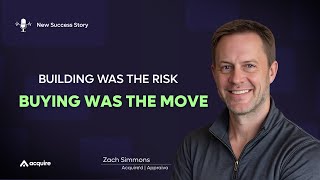
Zach Simmons acquired Aprava, an AI-vision dataset covering nearly 100 million U.S. properties, after four to five months of searching and one month of diligence. He found the founders on Acquire marketplace, kept them on with incentives, and focused on what he knew: sales and operations. The dataset serves real-estate investors now but could expand to insurers and trades.
Questions this video answers
Close to 100 million properties in the United States.
About a month.
About four to five months.
January 27, 2026.
Chapters
Foreign.
I'm live with Zach Simmons. Zach, how you doing?
Doing great. How are you, Andrew?
Doing good. Thanks so much for coming on the podcast. Congrats again on the recent acquisition. So this podcast is going to be a little different because you acquired the company apra. Before we dive into that though, do you want to give just a brief introduction of yourself?
Yeah, I'm happy to. I'm a serial founder builder. I've worn a lot of hats over my career, both at Big Cos, working at product management, but most recently over the last few years, really just focused on entrepreneurial efforts, new ventures, team building, trying to go through and build things in underserved markets. All of those kinds of activities really just formed around value creation business in early business formation.
Nice. Well, tell me about apreva too. What problem does it solve? What does the platform do?
Yeah. So aprava is a property condition data set. And what they have built is they have built an ability to go through and use AI vision models to go through and evaluate the property condition of close to 100 million properties in the United States. And this is an incredibly valuable asset. In fact, probably one of the very few property condition assets anywhere. And what they have done is they've built a pretty strong initial traction, specifically within real estate investors, flippers, wholesalers, for example. But there are so many different ways that you can go through and take this very valuable asset and commercialize it in. In different ways beyond the icp. So one of the things of many that I like about this is, is the optionality around not just a asset that makes transactions within the world's largest asset class more efficient, but also with other ways than which you can point and direct and commercialize and ultimately monetize this capability that they've, they've built.
Nice. Now walk me through the acquisition process a little bit. You met the founders on Acquire. How long did it take to close? How did negotiations go?
Let's start there. Sure. So we met on Acquire and, and you know, I've. I've looked at many businesses on Acquire. And you. My model and framework is really like almost a triple T. It is tech team and tam. And that's what I think this particular acquisition really checked all of those boxes when it came to what they were able to deliver in a large market with a differentiated capability, but also with a team that has proven itself to be both scrappy and innovative and how they've been able to build up a their traction from nothing in a fairly short amount of time. Nice.
And then when you initially met with the founders. Did you know this was an acquisition you were going to pursue right away? Did something persuade you over time? What did that look like?
Well, what I would say is I was initially interested immediately for all the reasons I just mentioned. But what I. What I would say is, is I was. I started digging in and I wasn't dissuaded. You know, often you'll go through and you'll get excited about a particular opportunity. You know, you'll start digging in the diligence, you'll find out that the target acquisition has this problem or that problem or something like that. And over the course of that diligence period, which was about a month or so, I probed, looked, looked, looked, and I didn't find anything that gave me pause. In fact, it was really just doubling down on what I felt was commitment, on what they had built, what they were, their vision as to where they were going to go and whether or not that I could be able to provide value for that. And then once those things kind of come together, then it becomes almost academic exercise in trying to put together a package that I thought would be something that would provide both myself as well as the sellers, a path forward. And, you know, rather than just a simple, you know, handoff, execute, or I should say handoff, execute a deal, and they walk away. You know, I was very much. And continue to be in the. In the view that the preva is strong because of its team. And keeping that team in place is something that I prioritized. And that was one of the. The real strengths about this deal is, is we were able to go and retain all the talent that that had that have built and lived this problem for the last two years. And that I think is going to be very beneficial for us in the coming year.
Nice. So the team is staying on board, is that. I assume it's on. Definite. Was there an agreed period of time that you guys landed on?
Well, we've agreed on incentive structure to keep them all on the team for a defined period of time, and I hope that I can retain them beyond that. You know what? This is ultimately a growth story. So what we are looking to build is. Is upon that team and continue going forward if I can retain them through both success and delivery upon what they've already done.
Nice. And then where do you think a pray book can go from here? Do you have plans to continue growing it on the pace it's been growing? Do you have plans to bring it into new markets?
We're going to start by focusing on Doubling down on what they've already found success in in their original icp. There are certainly different paths that we could, we could go down. But you know, you look at what I just said, the property condition data set that they have is so unique that you can spin that into different areas. Think, you know, the roofers or other trades, insurance, you know, you could go on and on. But like there are a number of different ways in which we can go through and create value by taking property condition data, applying some other data set to it to create derivative data that can be marketed as a product. And that is something that I certainly feel that we have a path towards, you know, in the future.
Nice. So I'm sure a lot of people listening to this podcast, they may be hearing, you know, you bought a business instead of building it from scratch.
What like, what's the high level like.
Reasoning to do that as opposed to just building from scratch wide wire?
Well, I've built things from scratch and it's really hard and it is, it is hard and importantly it is risky. And so what I think acquiring an asset in entrepreneurship via acquisition is, is that it really de risks the, the most risky time of being an entrepreneur. And so by coming in with and acquiring an asset that has, has good traction, it's, it's found product market fit well then it really becomes you're betting on yourself being able to go through and, and scale that up to business that's already been proven. And so your risk is really is your own ability to go through and execute on something that, that you believe in, is there and has been proven out in the marketplace. And that for me is, is one of the biggest draws to the acquisition marketplace is simply being able to come in to find a business that solves a problem that you care about and you're willing to commit yourself to for the next year to become a champion for those customers and a champion for that vision and, and then matching that against your own abilities as an entrepreneur that go through and take that business to the level in which it's at and then, I'm sorry, the level where it's at to where it could be based upon what you're able to throw at it. And that I think is entrepreneurialism in a, in a, in a non traditional way, but one that is immensely powerful, far less risky than going through and being a solo entrepreneur building something on your own and, and, and does so in a way that you know, now that there are market like the acquire marketplace I think is fantastic because it provides Entrepreneurs the ability to almost have an on ramp or off ramp to their own entrepreneurial journeys. And, and that allows individuals like myself or targets like Aprava to be able to go through, meet each other, find a way to go through and, and blaze a path that does not have to necessarily be financed by large venture capital checks with completely out like different size ambitions around outcomes and what defines success. Because when the entrepreneur is driving the ultimate outcome, that is just a different way to be able to go through and, and build value versus the traditional VC funded path that everyone talks about.
I think that's extremely well said, especially the part on you're essentially acquiring a business with product market fit which most startups never find product market fit. So you can either buy a business or you can spend years potentially trying to find it fail, wasting the capital or you can just buy a business that already has it. How long did it take you to find this acquisition? How long were you looking for a business to acquire?
So I've been looking for a little while, but I was fortunate enough to have the resources to be able to make this acquisition actually fairly quickly once the right one had been identified. So I would say when I was really, really in the game around that properly bounded buy box, probably only about four or five months, maybe less. So given the size and the scale of the acquisition, I felt pretty good about that. Relative to other stories you might hear out there. Nice.
What are some things in businesses that might scare you away? I assume you looked at a ton of different deals before this one. What are some common characteristics that would be instant no from you or maybe a yellow flag and you, you turn away.
Yeah. So lack of traction of course is a, is a big one. Limited customers, only a handful of accounts. For example, if the team was, was looking the, the runaway right away, that was something that I was hesitant about you know, rather than, you know, I certainly want to be able to build from a poor team. Um, but then all the normal characteristics that you would look at when evaluating is the, is the asset growing? Do they have a churn problem? You know, you can go on and on but like those are a few, I would say key attributes that would disqualify something from a deal within the deal flow.
Nice. So if another buyer was saying this and they're thinking I want to do this, I want to acquire a business where how could they get started? Like what's maybe a tip or two you'd give them to get going?
I think it starts with the first stat, so you gotta get out there you gotta find, you gotta find a deal, your deal flow and building your deal flow. And that could come from many sources, but the marketplaces are fantastic ones because there's lots of options out there. And importantly, just start talking to founders that fit within your buy box. Because it comes down to do you love the problem they're trying to solve? Do, do you love the people that you could be working with as a result of putting together this particular deal? And obviously it's gotta make financial sense for what you're looking to do. But again, it comes down to the de risking, I'll say it again, it is going through and finding a business that has reduced it down to just execution risk. And if it's only execution risk, then you're ultimately betting on yourself as an operator. And that is what's so great about, about entrepreneurialism through acquisition. Because that is what it really comes down to if you're, if you're picking that sweet spot, you know, at that, at that stage.
Nice. And what's like a common timeline you could expect for other people looking to acquire businesses, like 60 days, 90 days, four or five months, it depends on how.
I mean, it honestly comes down to how much time you're going to put into it. How big of a transaction are you looking to do? Because you can obviously, you're obviously going to put far more diligence and effort into a deal that's a million dollars versus one that's 50,000. So, you know, I think it comes down in part if you're a new entrepreneur or looking to acquire your first business. You know, how big is that check that you're going to need to buy? And therefore how much do you really, really need to scrutinize every single deal? And that sometimes is just going to drive a timeline.
How important is operating history to you? For example, let's say a business looks really good, it's growing, it's profitable, it appears they have product market fit, but they've only been around, say 10 months. Would that be interesting to you? Or do you recommend looking at businesses with say two, three years minimum operating experience?
I would like to see more than a year. But in the air, in the AI era, it's hard to go through and simply define that things are happening so fast and, and there are businesses and business models that are, that are coming up and developing, that they might be, they might be rocket ships and, and those are interesting businesses for other reasons because normally they're, they're much smaller check sizes, they're smaller teams. So you're going through and you're, you're, you're buying early, like really early. And so I, I, I don't mind the early ones. I, I didn't choose to go that route myself, but the early ones don't bother me so long as, as you know, I, as an entrepreneur felt that I had the skills either personally or through pulling other people in to, to ramp that up. Because normally those operations are solo entrepreneurs or you know, a very small team which might not necessarily have all of the skills or resources to be able to go and really scale that asset.
What if as a buyer you don't have a technical background?
Do you think that matters only so much if you can retain the technical people that created it or be able to, if, if they, as the seller is looking to exit, being able to replace that talent, you know, it again, it comes down to what stage is it at? Is it, are you still doing a ton of customer development? You know, that's the right skillset. Are you hiring, you know, the team's first, you know, handful of sales reps or trying to build an initial sales motion? That's a different skill set. And so it's what does the existing asset and team have? Do you complement that? And if not, do you have the resources to go through and hire those necessary people post acquisition?
I completely agree. I think sales and marketing is more important as experience than having a technical background based on everything I've seen because there's just so many opportunities I come across because obviously I see everything where it's a good product, good business built by a technical founder and a, if it's acquired by a operator with sales and marketing expertise that can scale whatever's working or scale up channels that haven't even tried. I've seen that win over and over.
And over a hundred percent. And you see that all the time. You see, you see a solo entrepreneur or two person team that they built a really cool thing, but they do not have the skill set, knowledge or experience or even desire sometimes to go through and grind out that sales mountain every single month and quarter. And again that's a different mentality. So if you as a buyer have that skill and you can keep the existing tech talent on so they can keep the lights on at the very least, then that's a, that's an excellent spot to be in because that's normally at that stage in which, you know, the business is, you know, they might have built an interesting product but haven't figured out how to sell it. Therefore the business isn't worth a whole lot, even though it could be. And so being able to add a ton of value, being able to take that into their new markets or increasing, you know, contract value or overall your ability to move the needle on value I think is tremendous as a even a non technical founder.
Completely agree. Well Zach, this has been awesome hearing about your view on acquisition and just giving tips for other buyers. Is there any other last tips you maybe share with someone who might be listening to this and thinking entrepreneurship through acquisition could be for them?
You know, certainly. And, but why I'd just immediately say is like, you know, go for it, trust yourself, vote on yourself and or should say bet on yourself and and ultimately I think you're going to be successful in, in how you approach it as as long as you're able to take that same passion drive and put it into this new venture. And then I would separately say if anyone has any additional like questions or wants to DM me or anything like find me on one of the social networks, I'm happy to go through and and talk to anyone one on one about their own journey, desires and objectives around eta.
Right on. Well Zach, congrats again on the acquisition. Thanks for coming on the podcast and I'll put areas to find you in the show notes, but thanks again for coming on.
This has been great. Cool. Thank you so much. Pleasure guys.
More from Andrew



The Buyers Who Made the Move: What They Bought, How They Did It, and What Happened Next






