Zero to $1m/ARR - David Cancel - CEO and Founder of Drift
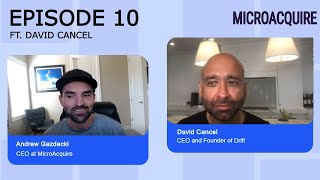
David Cancel, CEO of Drift, talks about growing the company from zero to $1 million annual recurring revenue. He covers early customer acquisition, product decisions, timing, and fundraising in this 2020 interview.
All right, with me in the house, we got DC CEO and co founder of Drift. Thanks for having. Thanks for being on the show, man.
Thanks for joining. Thanks for having me, man. I'm excited.
Hey, so I've been a drip user since 2013. Do you have any other users that have been customers for that long?
No. You'll be the only one then.
I'm Talking about the drip.com, like car drifting.
Car. Car. Yeah. Because we didn't exist. We existed in 2015.
Yeah.
You've been drifting cars that long?
Yeah. What did you pay for the domain? If I can ask drift.com?
Hundred thousand dollars, man.
Nice.
Believe it. We originally were called. Sorry to interrupt. Drift with two T's for the first year. Drift.com. two T's because I was too cheap to pay the 100 grand for the domain. And then I had to keep buying domains. Drift with three T's. Drifted, two F's. Three F's. Because no one could spell it right because the F's and the T's look the same when they type. So I had every misspelling ever. Then I finally gave up and I was like, I got to pony up.
Yeah. Was the Drift community upset that you took that away from them?
Not that we heard of it. It was interesting. The guy, I bought it through a third party. Then it turned out the guy lived like one state away and he was a Drift car enthusiast. We're in Massachusetts, in Boston. He's in New Hampshire. He was close. He's an engineer that was retiring and from Oracle, and we bought it from him. It's crazy.
That's awesome. So, David, you're a serial entrepreneur. You started multiple companies. And for. I guess what I'd love to kind of COVID in this podcast is, you know, you started Drift is what, your fifth company?
This company I started. I was part of three other startups before this.
So when you start companies, do you have some sort of thesis or framework that you start off with? And the reason I asked that is live chat was not new. I used snap engage in 2010. I used Olark, if you remember. Then support tools and requests would come into my sales team and they would be like, hey, we don't want to deal with this. We had a support line, and then you essentially took that tool and applied it to sales teams. And I guess the question I'm trying to ask is it seems like you spotted a trend in buyer behavior before everybody else and you built a product around that. Yeah, I consider that an entrepreneurial superpower. Was that kind of the thesis of the business? Like, hey, this is where I think live chat is going and communications is going?
Yeah. So I will say, I will back up and say throughout my entire career that the first half of it I did a traditional way entrepreneurs do, which is like to think, come up with some idea and then try to bring it to market, then try to convince the world that they should care about it. But that way is the wrong way to do it because that is about personally, personal manifestation. That's about your idea, that's about your ego. That's all that. When I started Drift, I had gone all the way in the other end and said, I don't care about my ideas. Ideas are worthless. I don't care about that. It's not about me. It's more about like, do we spot something happening in the world outside? So I call them external trends happening. Do we spot one, two of those things happening and those things causing massive behavior change? Because behavior change is the thing that's impossible, right? Us entrepreneurs always want to convince people to change their behavior, which is fundamentally impossible. And I said, okay, there are some happening, then the trick is can we use those behavior changes outside of our market to re segment a market that we know? And in the case of us, we came from marketing sales world. I had used Snap Engage In 2009, I had used Olark, I'd use all these things. Many people had tried to use live chat for sales use case, but it never worked for two reasons I believe. One, the world wasn't ready for it because it was still in 2009, not everybody that you know was texting and you know, using WhatsApp and using Slack and using all this stuff. So messaging wasn't normal. It was, it was normal to some of us geeks, right. And so that's why it was relegated to support. And then the other reason was that live chat was never built with a sales use case, so couldn't deal with the hard problems of qualification routing, making sure that that sales rep never gets a support lead because as you know, support person gets a salesperson gets a support lead, that's the last time they're going to use the tool. Right? As soon as they get that it's noise, they're going to put it to the side, they're not going to use it anymore. And so we had to solve that problem technically, the routing and qualification problem. And we had to wait for the world to be ready. And in 2015 when we started the company, I had been looking at Those changes and saying, okay, now everyone from your grandparents to your kids to everyone in between is using messaging over email, over phone calls, over everything else. So now it's going to become possible, we thought to use it in a sales use case, and no one had ever commercially used it that way.
That's awesome. And one of my favorite quotes in business, and I think you touched on it, is one of the hardest things to do is change consumer habits.
Oh, yeah.
Like, you can spend hundreds of millions of dollars on marketing, educating it. And then another thing that you said I really like, which is, I think a lot of wisdom right there. And I'd love your opinion on this is just market timing. You know, there's been a lot of products that have come out too early, too late. How did you, like, know this is like, the right time for drift to enter the market as, you know, live communication tool for sales rep?
Sure, sure. And I'd say on the first point, like, totally right. That you. I believe 100%, you're not going to change anyone's behavior. People will change their behavior because of an external change. Like in the case of right now, this pandemic we've all been forced to change or because of a selfish reason. Those are the two reasons, right. Otherwise you're not going to force anyone to make a change in a free world. And then, so, like, so for us, you know, for me, I look at a time like now, and I talk to entrepreneurs and business people and they say, like, what do you think in this pandemic Covid business? This. I'm like, this is the best time to be an entrepreneur ever. Right? Because the people who are not really committed to it get washed out. And more importantly, the massive behavior change that has happened globally creates opportunities for all of us. We can't even dream of what they are, but there's a whole slew of new tools, new services, new looks that we have to take because everyone around the world has fundamentally changed their behavior overnight. Boom. No one could do that. Right. And so super important. But to answer your second question on Drift specifically, I had really been looking at the trends in messaging for a long time and looking at the growth of Skype and then WhatsApp and then all these inflection points, largely, largely driven because of this, because of the iPhone and the Android phone really drove messaging adoption. And I started to feel that there was a tipping point, but we didn't know if it was true, like, when it was going to happen. When we started the company, we said, we think this is true. It will probably take the next five years to really prove if it is and if it isn't. And here's some evidence for us, we had in the first deck that we ever created internally, we said if these companies you can name the big companies start to move into messaging, that's how you know we'll have validated that the market is ready. Because they will move only when the market is ready. And so, and we have seen all that come the past. We've seen us create a conversational marketing category. And being one of one to now, hundreds of companies call themselves conversational marketing, conversational intelligence, conversational whatever. But that wasn't a term in 2017 when we coined that.
Yeah, your guys marketing is legendary in terms of creating the category. You bring in an enemy, which I believe was no forms.
No forms. Yeah.
Walk me through like the process of that because and correct me if I'm wrong here, but at times it seems like Drift is more of a marketing sales positioning company rather than a product company. The product's amazing, don't get me wrong. But I'm just saying like you, you made people look at a tool that was so common before and say, hey, it should be used for this use case for these reasons based on these changes in the market.
Yeah.
How much is in the DNA of Drift in terms of.
You nailed it. You have a good way of looking at it. I'd say it's totally true on exactly how we built the company because of another trend that we had been looking at. And that trend being that I thought we were entering this third wave of SaaS or this third part of the market where we went from first parts about invention, which is the beginning in SaaS specifically for us. The second was about like, was we had just come out of it. It's about like how do you build the most efficient model? And that was like you learned all about go to LTV to CAC and all these ratios and vertical SaaS, horizontal SaaS and blah blah blah, all this kind of stuff. And then we were entering when we started Drift, the third wave, which I call the Procter and Gamble wave, which is like technology is no longer a barrier. You know, models go to market, models are no longer a barrier. Everyone knows how to do those. And so the last thing that you have is your brand. And so like Procter and Gamble, who can sell tide soap for 20 cents more than that soap, how do you build this customer loyalty, this affinity for your brand? And so we started from day one, I didn't know anything about building brands? You know, I was an engineer and an entrepreneur and so I really studied on like and really executed at drift of like, how do we create? I don't want to be a software brand. I don't want to be a Boston brand or a San Francisco brand. I don't want to be tech. I don't want to be any of those things. I want to build a global brand and then in that serves a certain type of customer. And we would deliver different products and services and offerings to that customer base over time with this live chat being the first one of those. And so that was deliberate from day one. We didn't know if we could execute on or not. But like we started building that brand and you're right, like, you know, the software that we deliver and the offerings are amazing, but it's really the proximity to the customer and the brand and that promise that we make is the most important thing that we're trying to do. And I would say that's the most important anything any entrepreneur can do. Because we believe that all the powers move to the buyer. Because like there's mass commoditization in every single market. And you see that in all your direct to consumer kind of products and services. You see that in SaaS certainly. And you see that in almost every market today. And that trend is going to continue.
Yeah, I completely agree with that. Just the more you reduce friction in the buying process.
Exactly.
People don't want to fill out a form, get ebook like a minute later. They want to talk to sales reps.
Like immediately, I guess storytelling heavily. Sorry to interrupt you but like, because you made me just think of it there of just like we use storytelling a lot and we kept pulling ourselves, even though we were insiders in this market, kept pulling ourselves outside the market and reducing things down to the most simplistic terms to try to like test like did they make sense anymore? And when we did that, even though we had built all the software in the past, we said, what? You go to a website, you fill out a form, you get a bunch of emails, three weeks later someone wants to get you on the phone. You don't want to get on the phone, they want to sell. If you reduce it to the most basic thing and try to explain it to a friend, you'd be like, that's the most insane process. That doesn't make any sense. That's how we try to do everything. Then we build stories around that.
Did storytelling reduce your customer acquisition costs? Because obviously that broadcast it out to the world. You just need a good story. You can pay like a fancy PR firm, but that usually doesn't work out.
We have not had any fancy PR firms. It did reduce our customer acquisition costs greatly. I mean, we built the company on it. But I think the more important part than reducing the customer acquisition cost was it expanded greatly the size of the market. So the TAM that we saw in the market, if we had just looked at the TAM of the sub slice of live chat users in the world that we mostly using in a support use case and then took a sub slice of that to be the ones who were interested in a sales use case, this would not be. We wouldn't be around. And so we had to greatly expand the addressable market and get all these people who had never or had used it but like yourself failed to use it correctly, like all these people in the world interested in it. And that was the most important thing that the storytelling did for us.
I didn't fail to use it correctly. The tools, Drift was just not around. And then I brought it up.
That's true, that's true. You're right.
Yeah, yeah. I've been a heavy power Drift user. Just so you know, you have sales teams that literally have that tab open and they're just staring at Drift all day long.
All day. We hear from those people all day.
Yeah. Another question I have for you is initial go to market strategy. You talk about brands, storytelling, that's going to drive a lot of inbound traffic. Was it inbound to start? Was it outbound? Was it a mixture of both? How did you meet your first customer? Like what was kind of the first spark that got you guys going?
Before we had the brand, before we had the storytelling, before we had the inbound, the first 50 customers, I would say something like that. 50 some odd customers. We got the old way pounding the street. Myself and Elias, who's my co founder, going a bunch of. Luckily for us, we knew a lot of people in SaaS and sales and marketing and so friends and we'd go to them and you know, friends and beg them to use Drift and to pay us anything. Because Drift basically didn't exist at that point. There was nothing. And many of them paid me, you know, whatever money that they had in their pocket, $20, $50, 100, whatever, five bucks. And then I promised to give them Drift for forever, that current version of it, whatever. They paid me because we needed those early customers using this.
I got a good question there. So was that a strategy initially? Because you know, every initial Customer that you bring on you, make them happy, they leave reviews online. People read those reviews. So every customer that you discount in the early days can lead to more customers in the future. So you're discounting now for future value later. Was that kind of the initial strategy, like building a brand by giving it away, getting people super happy, collecting customer views?
Definitely. That was the, that was the secondary reason we were doing it. The first was to get. Just to get. To prove that anyone cared about this. I made them pay me something because I always tell entrepreneurs this because. And I. I stumbled upon this in 2009 in my company performable. Because there's. You're always going to be like in your. When you're trying to get the product market fit, you're going to be talking to all these companies or customers and they'll have meetings with you, meetings with you, meetings with your, meetings with you. And you never know, like, do they really care about this or not? And so I just get straight to the point and say, like, give me money. Give me whatever money. And where entrepreneurs get caught up is like, they're like, how much money? I don't want to leave money on the table. Blah, blah, blah, blah. If the market's big enough, doesn't matter, right? And if you can make them happy, like you said, they're going to bring you more customers in the future. Don't get caught up on that. The first thing is just like, give me whatever you have in your wallet. 20 bucks, that's fine. I'll take 25. I don't care what you do.
So your first pricing strategy was really.
Just like, whatever's in your. I'm not leaving without money that's in my hand. Cash. And we still have company. We have bills with company names on them and stuff like that from back then in our office here in Boston on a wall somewhere. And those were our first customers. That's how we got the first 50. Then we started to build and we. They would kind of helped us design the product and beta test and all that kind of stuff. But they had skin in the game. You have to have skin in the game. Especially in B2B. It's harder in B2C, but like in B2B, like, if it's a real problem, they're gonna give you money. Second thing we did was we were building the brand at the same time. Then we built the first two, maybe three years of drift easily, maybe even still to today, totally on inbound. We never had an outbound motion. We never sent an Email. We didn't have BDRs. We didn't have sales reps yet at that point. And it was all inbound, and it was freemium, so it was like you can only buy online and totally touchless. And then in the year after that is when we started to experiment with some inside sales people. And then the next year, two years was all 100% inbound, high velocity inside sales model. Again, never outbound, never whatever. It was just like as fast as they would come in, that's how we would close them. Using Drift, of course.
Yeah. If I can ask, how long did it take you to get to your first million revenue? Oh, I want to know the days and the hours and 7.
I don't even remember down in the minute. Let's see. I should remember. This should be like, memorable. I don't know. Less than a year, you were just drifting. Yeah, just drifting. I can't remember. But less than a year. And then it started to really accelerate because we were holding, Remember that was a totally touchless model. And so we were in some ways limiting ourselves. We never went outbound. We never tried to prospect get people except for that first 50 customers, but that was us. And it was all inbound. And so like it was coming, but I didn't even realize the full demand. And then it went from like a million, then it really exploded because when we had those inside sales reps, because they were fulfilling it.
Yeah. So another question there is you raised capital from day one, correct?
Yeah. Yep.
How do you think that changed the dynamic of the company? I'm hearing some awesome stuff where, you know, you raise a bunch of money and then let's get inside sales, let's get outside sales, let's go up market, let's get billboards. But it sounded like you were very methodical with let's get users. What do you have in your wallet even though you're funded? Like, was that like, was that kind of like built into the DNA of Drift, even though you raised money from day one? It sounds like you were very frugal with how you entered the market. You validated the price product, you validated. Customers are actually seeing value from this, and then you start to layer on the other motions to scale the company.
Yeah. Extremely cheap is how people would tell. Would call me internally. You can ask them. Cheap ass. I would say we call it frugal. But yeah, in some ways, so much so that now, in these years, now I'm trying to reverse some of that a little bit because I was so crazy. Everything From I told you. We first year we had a different name because I was too cheap to buy the domain. We had raised $14 million, but I wouldn't spend 100k, you know, wouldn't. It took me a year of pain to actually, even after a year, I wouldn't spend it.
It's good for the company, though. The company DNA.
Yeah. We didn't have. We worked out of free space only in the. Again, we raised $14 million. I wouldn't pay for office space.
Where was your first office? I want to get this on record.
Rock climbing gym called Brooklyn Boulders.
You worked out of a gym for.
Your first six people until they threw us out of there because we were working for free. You know, getting off the wi fi. Six. Six people there. Then I got my. One of our investors, one of the. The one who had written 10 million of that $14 million to give us free office space. And then we stood there until we were 20 some odd and they didn't have space anymore and they threw us out. Then I finally rented a. Just big enough space that I subleased for the cheapest space possible. We outgrew that in like, I don't know, less than six months. And then I had to finally rent, you know, traditional office space, but it was just like over and over and over. I wouldn't spend any money on anything. Nothing. Nothing in there. So until we validated it. And even inside sales, like once we have. Once we had freemium going and then inside sales was really going. Cause we were getting people getting reps, fully productive, meaning like hitting their full quota in 30 to 45 days. Just. They come in 30 days. Boom. They're already a full court attainment, right? Like they're. They're like cranking, right? And so like. And even then I was just like, so slow at hiring the next one. Just like one by one by one. Because I was like, oh, maybe it'll break. Maybe. Whatever. Finally was one of our investors took us on a tour and I met with Frank Slootman, who's the. Was the CEO of ServiceNow, is now the CEO of Snowflake, who just went public. And Frank is like hardcore. And finally like beat it into me. And he's just like, you need to hire 100 reps. What are you doing? What are you an idiot? And it's just like. Because he was looking at our productivity and he's like, what is this? And I was just like. And I was like, I don't want to spend the money. And he finally. Him and Frank V, Frankie V, who was the first head of sales at Salesforce, you know, convinced me to finally, like, loosen up a little bit. It took a lot, though. Took a lot to loosen up.
Yeah. I love hearing that, though. When did you raise your second round?
It was almost a blur because, you know, we raised the first round in when we started the company. That was like 14 million. And then we wouldn't spend any for the first year. And I want to say a year and a half in, we had our. One of. One of those investors, General Catalyst, came to us and wanted to preempt the Series B. And so they preempted the Series B. The two investors that had put in money, and we raised that Series B pretty quickly. But then I talked them into leaving some room open, and then I got Sequoia to put in a tiny amount in that B. And then a year later, they preempted Series C. How much cash on hand.
Did you have when you raised your second round? And the reason I ask is when you have cash on hand, you have, let's call it, I'm assuming, months, years of burn. You don't need the capital, so you have a lot of leverage when you're speaking with investors.
Totally.
She also had a great product, great team. Like, you're hitting a trend.
All of it. Maybe we had, like, and I'm just guessing right now, Maybe we had 75% of that capital, 80% of that capital still left. Then we raised the Series B, then we raised the C, and we still hadn't touched the B. You know, we hadn't used any of the money in the B yet. And so when we raised the C. That's incredible.
And who built the first version of the product? Was it you?
My co founder, Liz. I'm not allowed to touch code anymore. And so it was him and a handful of engineers, a few engineers. Because in the beginning, we were first 20 people were pretty much just all engineers, designers. Again, we didn't have sales people, we didn't have marketing people. We didn't have anybody on the team.
Nice. And I know you have a wealth of experience building companies, but it seems like every time that I talk to an entrepreneur that started a new company, there's always just mistakes that you make and just things that 2020 hindsight. If you could go back and tell yourself, like, hey, dc, don't do these three things as you're building the company, what would they be, if any?
Yeah, I'd say I do have a wealth of experience, but I don't know if that's an asset all the time. It is. There are some things that are unfair. Like raising capital in this case was way easier I think than other people. But then you have all the problems, right? All the problems of like you know too much. It's better to be like be ignorant coming into something and like try crazy ideas versus being too methodical and too in your head. And so I'd say it's more negative than positive being a serial kind of entrepreneur. But you are more crazy if you tend to be that serial entrepreneur person. I'd say the mistakes are always this always fall into one category. People, people, people, people, people, people, people. You know, hiring correctly, keeping people on too long that, that aren't right for the company, aren't right for the stage trying to do, trying to save people, trying to, you know, it's all people related issues like that is the make or break. There is no, there's nothing else in a company. That's what I, that's my thing now coming as an engineer this product and go to market all the stuff we're talking about and stuff. But it's all people. If you fail, it's because of people. If a competitor beats you, it's because of people. If you succeed, it's because of people. You know, if like everything comes back to people. There is no failed strategy because the people make the strategy. The people miss the competitor, the people didn't serve the customer. There's no, we like to, we like to like abstract that out somehow. It's not our fault. Like oh, we had a bad strategy. Well, you made the strategy like the strategy didn't come from outer space and land on your head, right? Like you made the strategy, this team made this strategy. You had bad hires. You made the bad hires like there's nobody else. Like you have to take the ultimate accountability and be like every problem comes down to everyone who's in the room. That's the only problem. So like if there's a problem it's because of people in the room and it's a failure of leadership that they have that you didn't see it or you didn't want to. You don't want to step up and deal with the problem, resolve it right when your stomach told you there was a problem here. Because the stomach's your gut's always telling you, you know, you feel the spidey sense, you know the problem. But you get too smart. You get to experience. You rationalize things away. You convince yourself, you try to get too Logical. And that's when problems happen.
I love that. So what keeps you like excited about Drift? Do you have any like, product, you know, features coming out you can share with me?
I mean, we're trying to reinvent the whole sales and marketing stack so we'll go top to bottom. We're trying to build a new CRM, a new way to have a CRM within a company. So there's a whole bunch of stuff from a product standpoint, but really for us, it's like we're trying to fix a problem that we see in the world. In some ways we help create that problem, not at Drift, but in all the things that I've built in the past. So we're trying to fix that wrong. And then there's a whole. There's other reasons that I'm excited about Drift. The other one is that Elias and I believe a lot in creating role models, right? And we're both Latinx founders and there's almost no Latinx founders in the world, especially venture backed. And so like it's our duty now to like try to be a role model for people in middle school, high school and college age. And we spend a lot of time with kids of those ages trying to give them role models because we didn't grow up with any role model. And then there's a whole bunch of philanthropic things that we're doing as a company and as personally that are important. And that's all those things together are what really make Drift exciting to me.
That's awesome. And who do you look up to? You're such a badass entrepreneur. You've done this like multiple times. Like, who do you look at? And you're like, hey, that guy's awesome or that girl's off.
I was 15, who's a complete and utter beast. And I always say my daughter is like so hardcore and driven that I'm like a lazy sloth, you know, bum next to her. I don't impress her, I'll tell you that for sure. So kids will fix that out of you. So really she impresses me, you know, people who have really worked hard. Like I was raised by a single mom. My mom emigrated here, you know, like she worked seven days a week. I still look up to her. She's my role model, right? Because I've never worked a day in my life as hard as she is. And in some ways she sacrificed her life for me and my brothers and sisters. And so like she's my role model in terms of business role models, you know, I Have. Charlie Munger is a big role model of mine. I talk about him a lot. I talk about people who really have stood the test of time, who really try to make things, simplify things down to basically people and human decision making and stuff like that. So I have endless role models. But, you know, because someone is good in business and because someone is good in some field doesn't make that person a good person. And so, you know, you really have to know the person and know what's behind what they're doing and how they're acting. And those are the people that I look up to, not really just business people.
I love that. I think that kind of. That probably translates into your company culture, too. You hire really talented people. But every single person I've talked to that works with you at Drift loves Drift. Loves the culture. Like, I haven't heard, like, as many good things about a CEO as you, so you're doing an amazing job, both personally and professionally, so.
Well, I look up to them. Everyone who comes at Drift, I would say one thing. We only hire people that can teach all of us, including myself, something. Doesn't matter what they can teach us. It can be about snowboarding or surfing. I see surfing in your background there, Ty Slider. There we go. So surfing, whatever. Just got to teach. I want to be around curious people. I'm naturally curious. I want curious people, passionate people, and we learn from each other and we get better collectively. Right. And so, yeah, they're all my role models. They're amazing. They're much of things.
Well, dc, I know we're getting close on time here, so I just want to thank you for joining me on this podcast. Huge fan of Drift. I'm sure everyone listening to this podcast is.
Is that black on black Yankees hat there?
This is a Derek Jeter hat. I'm not a Yankees fan, but I'm a Derek Jeter fan. That's what I would say.
Yeah. Are you.
Are you a sports fan?
No, no, not at all. But I grew up in New York City, so, you know, I could. I could see that black fitted from here.
Yeah. No, Derek Jeter. Jeter is my favorite player of all time.
He's great.
Yeah. Well, David, thanks so much for joining me. If people want to learn more about you, I'm guessing they can go to drip.com and go on LinkedIn by find.
Yeah, yeah, hit me up on LinkedIn. David. Cancel D. Cancel on everything. I'm easy to find.
All right, David, you're the man.
All right. Thank you, man.
More from Andrew



The Buyers Who Made the Move: What They Bought, How They Did It, and What Happened Next






