Zero to $1m/ARR - Kyle Porter - CEO at SalesLoft
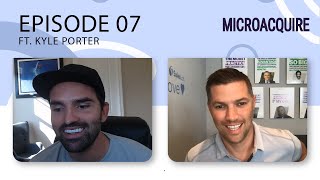
This is a YouTube video titled "Zero to $1m/ARR - Kyle Porter - CEO at SalesLoft" containing an English interview recorded in October 2020. The content features Andrew Gazdecki hosting Kyle Porter, CEO of SalesLoft, discussing the origins of SalesLoft, its mission, company culture, product evolution, and entrepreneurial insights on building a lasting business and making tough product decisions.
All right. With me today, I have Kyle Porter. Super excited to have you on the show today, Kyle. Thanks for coming on.
Yeah, sure, Andrew. I'm glad to be here and really appreciate you inviting me.
So, Kyle, you've revolutionized sales enablement, sales engagement with Salesloft, but there was a time when you were at zero and you didn't have this enormous company that you do now. And that's kind of what I wanted to focus on just to start things off. How did you come up with the idea for Salesloft and what does it do for people that might not even know?
Yeah, sure. Well, in a nutshell, what sales organizations around the world are looking to do is create repeatable and scalable sales process that they can forecast off of and achieve results in a predictable fashion. Right. And customers out there, they're expecting and deserving an incredible sales experience. But prior to Salesloft and sales engagement, those two things were wildly at odds. How do you give the customer an incredible sales experience and do it at scale? And so that's what Salesloft solves with our sales engagement platform. It's just a communication layer that sits on top of all popular CRMs, helps the company codify their go to market, execute on all their actions, use data to improve, and a whole suite of products to basically allow companies to maximize revenue while helping their customers.
So that's where you are today. What did the first version look like? What did the first mep.
Yeah, sure. I wanted to create a business prior to even knowing that we were going to go in the sales world. And I wanted to do that because I felt like there's all these amazing people out there that I had run into throughout my life and prior career that had talents and skills and capabilities. And I wanted to create an environment where others could come in, take those abilities, and put them to work to learn more, do more, become more, and grow in their fulfillment. And so that was the original mission behind starting a company in the first place. And then we started thinking about sales because I'd been a salesperson my whole life, going back to childhood. And so early versions of Salesloft were we had a product that would give you news on companies you were trying to sell to. So think about, like, a daily newspaper delivered to your email that would say, you know, of your 40 accounts that you're working in your CRM, here's all the articles that came out on them in the last 24 hours.
So like, like a blog was the first version. I think I read that somewhere.
But I Wasn't sure it was like. So it would. The first thing it would do is go to your CRM, see that Andrew owns these 40 ops, mine out all those counts, and then go look for news on those accounts every single day. And then in the morning, you'd wake up to an email from Salesloft that said, here's the daily news on the companies you care about. And it was like a stream of information. So it was like a daily dossier on your account. So you could do cool things, like click a button and it would pull down the names of the people associated with that contact in the email. And if you click that button, it would fire a draft email to them, like referencing the article. So it was a way to, like, stay in touch with your contacts based on news that was happening to them.
Nice. And then I know you launched Prospector. I was actually pretty bummed when you deprecated that. But I want to roll back on what you just said, though. So it sounded like when you started a company, you started with a mission first, rather than.
Yeah, it's more like a personal purpose, you know, that it was that personal purpose that, you know, I had been through a crazy childhood, been through a crazy college career, and, you know, I came to this point where I really matured quite, quite quickly. And I came to the understanding that I've been put on this planet for a purpose and I have talents and skills and I want to use those to make the world a better place and serve others. And then I realized lots of other people have that same desire. And I thought, if I can create a company, it can be an amazing vehicle to attract that talent, those people, and then give them an opportunity to find fulfillment. So that was the original purpose of starting a company in the first place. Prior to knowing, hey, it's going to be in sales or sales software or whatever.
I love that because, you know, culture is one of those things that if you get it right, like, you can do amazing things. And there's so many things that change when you're building a company. You know, that you can't control, but your culture is something that you can control. How. How important is culture to you at Sales Loft? And how do you. Is that. Has that changed over time? You've changed products. You just described one, you had Prospector. Sales Loft is what it is, you know, today this huge suite. But your culture was that, you know, the same on day one. Has it evolved over time?
Yeah, I mean, so culture is the big. Is our biggest sustainable differentiating advantage, period. Now, there's other ones as well, but that's the biggest one. And it's the thing that we have the most control over. To your point, right, the macroeconomic climate can shift and change. Competitors can come and go, new technologies can enter the landscape. But who we bring on board, what we value in those people, what we expect of them in terms of behavior and how we align with them on vision and mission. Those things I have complete control over as a CEO. And so I choose to invest time and attention and energy there and work really hard to have a team that's rowing in the same direction with the same goals, but also that values the same behaviors.
That's amazing.
And of course, it's changed over time, too, right? I mean, it's never the same. And I think every day that I'm the CEO of this company, which is almost nine years now, every day I learn something about how the values and culture are more important than I thought they were the day before.
What are the cultures and the values, if I can ask? You don't have to share all of them. But what's like maybe your favorite two or, you know, because I think a lot of founders describe two.
So the first one's customer obsession, and that one's critical. There's, you know, no need to explain that deeper. The second one is biased action. Don't be told what to do. Just act. Don't wait to be told what to do. Just act. Team over self. Team over self is, you know, my favorite analogy for that one is when Michael Jordan wanted to win the scorer's award, which is the best individual accolade. He never won a championship. Only until he started giving up on that goal of the scoring award and passing the ball more, not taking as many shots, did the team win the championship. And so if we as a team, you know, put our organization first, it's ultimately going to be best for us individually. So that's team of herself. The another one is Glass Half Full. This is one of my favorites. And it's not all this BS like the world's, you know, sunshine and roses all the time. It's really, I understand and fully grok the situation that we're faced with the good, the bad, the ugly. But I choose the positive path forward. I make a selection of the windshield versus the rearview mirror and visualize success on the other end. And so that's. That's the Glass Half Full. So I've got customers bias to action. Team over self. Glass Half Full. And then the last one is a focus on results which we just hijacked straight out of the Patrick Lencioni five dysfunctions of a team. We inverted them into five to thrive. And so the formula there is I'm transparent and vulnerable so that my team members know me deeply, so that we can dig in deep and have conflict over the issues that we're trying to solve, so that we can come to commitments quickly, so that we can hold each other accountable, so that we can be focused on the results. That's it in a nutshell.
I love that man. And I actually learned, I love the Michael Jordan quote because I learned that in the news documentary where Phil Jackson actually convinced Michael Jordan, you know, the best basketball player of all time, to shoot less to win. Because it takes a team to win a championship. You know, how do you inspire others on your team to, you know, have that mentality? Because that is how you win a team or a championship. You can win a couple games with talent, but it's the power of a team that wins a championship. How do you. Do you do anything fun with your team? Do you have any sort of like awards that encourage this sort of behavior? I'd love to dive into that a little bit deeper.
Yeah, we do a lot of stuff, but I think the biggest thing that we do is try to find it on the front end. Who values that in their life? Who's got examples of living and breathing and being that person over time? I think most people would tell you that that's something that they would aspire to, but do they have the concrete evidence of having exhibited it throughout their career? And that's where the top grade interview comes in, which we do on every single candidate we hire, regardless of, you know, what level in the organization. And that's sometimes a two hour interview where we learn about their past and we go chronologically from high school all the way up to where they are today. And it's what'd you learn, what mistakes you make? What would you do if you had to do it over again? Why'd you make this move from there to there? What was the experiences here? What'd you like about it? What'd you not like about it? All those things. And that really helps you identify whether or not they have that kind of bred into who they are. But then once on board, we're very, very clear on, here's the vision of the company. I see a world where sellers are loved by the buyers they serve. And that's a world we want to create. And then the mission we're going to empower our customers to deliver their customers with an incredible sales experience that helps them maximize revenue. And we're going to live through these values. And then I'm going to update them on weekly all hands meetings, weekly emails to the team, the mentors and the investors that has. I haven't missed a weekend Update email since 2012, so that's eight years of weekend update emails every Sunday night. And then sales Off Star is an award we give out to those who exhibit the core values best. We take on the 1 minute praises and reprimands. That is a kind of espoused policy inside the company. But yeah, all those things lead up to just reinforcing the culture and values.
Nice. And how important do you think it is for other entrepreneurs that are just starting their companies? How important is it to get those things right at the very beginning rather than like in the middle? You kind of figure out you have a culture issue. How important would you say getting culture is right first round?
It all depends on how long the company's going to be around. The longer the company's going to be around, the more important it is. You know, if you've got a business that you can build up and sell off in two years and that's what you want to do, it might not be the investment worth making. It's certainly at the same level that we have. But if you want to create a company that's built to last and you see this as a vision of a 20 year business, then it's hypercritical. So it is a balance because you never know in the early days whether things are going to take off, whether you've got the right ideas. So how much do you invest in that culture when you don't know what's the situation going to be 2, 3, 4, 5, 10 years down the road? It is a healthy balance. But if you believe in it and you're there for the long term, then it's a must investment.
Nice. And then so that's a good segue into just going back to the beginning. When, when it sales off, did you really know you were onto something? Like Was it your 10th customer? Was it your hundredth customer? Like did you ever have a moment when you were like, holy, holy cow, I'm not like you. You created an industry, a category. Was there a moment when you kind of like, you know, really felt that this is going to be big?
And yeah, so with the first product, which you mentioned, Prospector, we took that thing from zero to 7 million in about two and a half years. And Ended up canceling it to go full in on our sales engagement platform, which is now over $70 million ARR business. But back to the original one, I think we knew that one. It was maybe a little bit more technical. When we knew it, we had launched the product and we saw a bunch of people in India that were downloading the free version and abusing the heck out of it, just like really ripping into it. And that's when we knew there's probably a lot of demand for this thing. So I think that was kind of funny, that moment where we said, okay, there's something here. But with the second product, which is now the core platform of Salesloft, I knew that on a whiteboard because we had just seen. I had just seen the pains and problems and how customers were trying to solve them on their own. And all we needed to do was whiteboard it out for me to know this is the real deal.
Nice. How did you get your first few customers? Were you doing the initial selling? Did you have a co founder?
Yeah, I mean, I'm the sales side of the founding team, if you will. And yeah, I mean, the very, very first paying customer pre prospect era was a friend of mine, Mike Zito, who is running a technology company called Proximus Mobility out of the Advanced Technology Development center at Georgia Tech. And I think he paid me $35 a month for our news solution. And I knew him, and I walked into his office and I showed it to him. He said it looked cool. So I asked for him credit card and we went and off. I think that was early. And then somebody told me when I first showed them Prospector, I think we were charging like 125 bucks a month. And he said, if you can get me the phone numbers for these contacts, I'll pay you 500 bucks a month. And this product's worth 500 bucks a month. And I said, okay, let me retry my new pricing. Hey, man, I'm going to come out with phone numbers. I want 500 bucks a month. Can I count you in? He goes, yep, bring it back when you have it. So that was that one. And then I don't even remember on the cadence side, we were still working through, I guess we were next door to an incubator at the time. And we just walked over there and I just walked desk to desk to desk and got people using Salesloft Cadence and started getting feedback and just grew from there.
That's awesome. And one part I love about your story is just how much conviction you've Always had and what you've been building. And I remember Prospector, I used the heck out of Prospector. You got it to, you know, 7 million in revenue, and you had the conviction to shut it down. Like, that takes so much courage and just conviction, like the bigger opportunity in the market. How do you continue doing that in sales loft knowing that you. You had, you know, a substantial company, but you said, hey, this is a distraction. This isn't our future. This is the bigger opportunity. How did. Can you walk me through how you even had the courage to, one, make that decision and then two, just any sort of, like, tips for entrepreneurs that might be in a similar situation where they have a product today, there's traction, but it leads you to something bigger. That's a hard question, I hope.
Yeah. Our original Prospector product, it had a lot of hair on it. You know, one, we didn't own and control the environment because it was a data product that was capturing information from the web Web. So it was able to pull in information from LinkedIn through users in their Chrome extension. But I didn't control the environment of Salesloft Prospector. And furthermore, it was a data solution. So companies would use it and kind of use it up and move on and come back. And we had a monthly contract on that thing, and it was. People would buy it, upgrade it, cancel it, buy it again, upgrade it, cancel it. And so we had some awkward kind of economics in there from the way people were using it. But, you know, when I looked out into what Cadence was going to be, which is basically an operating system for the way that reps manage their day and execute on all their activities and hold themselves accountable and use data to improve, you know, I knew that it was to be going.
More from Andrew



The Buyers Who Made the Move: What They Bought, How They Did It, and What Happened Next






