Zero to $1m/ARR - Kyle York - CEO of York IE
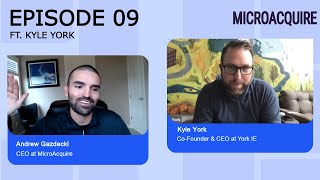
Kyle York, CEO of York IE, talks about his path from Dyn (acquired by Oracle) to building a company combining investment and consulting. He shares his approach to enterprise sales, go-to-market strategy, and what he learned scaling to $1 million ARR.
Foreign.
With me today of Kyle York. Kyle, thanks so much for joining me on this podcast.
Excited to be here. Thanks for having me.
Of course. And so you're doing a lot of things. You're known for being CRO of a company called Dyn that Oracle bought for a lot of money and now you're running York Ie just to kick things off. What is York Ie? What does it do? I want to go back to the Dyn story, but for the audience, I'd love for you to just go over what that is.
Yeah, for sure. I'm the CEO and co founder of Yorkie. We basically are as a hybrid investment advisory and operational growth firm. So in essence we do early stage seed stage investments. We focus predominantly on Enterprise Software, B2B SaaS Infrastructure, but we layer on go to market growth oriented consulting advisory services and we make it all hyper scalable by our fuel platform, which is our internal market data analytics competitive intelligence platform that we've built to fuel the investments business and fuel the consulting advisory business. Eventually we plan on bringing that also public to the market as a SaaS platform that people can self serve and buy. But we'll get there soon enough. We have a lot of things we're working on.
That's awesome. So you essentially, to just boil it down simply, you invest in companies and you kind of roll up your sleeves.
And you help them grow. Yeah, and we'll work with companies we don't invest into if there's a good fit. For our service modules. We've basically modularized our services into market and product strategy, business growth strategy and marketing communication services. So they're really well defined. We've tried to sort of downscope what you might work with a management consultancy for or a large scale analyst firm for or a large scale marketing or public relations firm for and tried to package it into a more, I think, entrepreneurially aligned partner. And so again, we'll definitely layer it onto the investments, but we will also work with companies and those engagements. Engagements without investing.
That's awesome. And I think this will transition well into the Dine story. So I assume a lot of the stuff that you're doing today comes from what you personally did at Dine. When did you join dine? How did that happen? What was the background? Because your run was absolutely epic and we had talked previously and I have so much respect for people that can scale a company to the point that you did. So what was the start? Let's go there.
Yeah, I mean, it's a crazy story. I mean, so I'M today in Manchester, New Hampshire. That's where we built Dyne. That's my home city. I grew up in a neighboring town, we're about an hour north of Boston. And yeah, it's crazy. I mean I was living in California working for my first tech startup and I got a phone call one day from one of the co founders of Dynamic, Jeremy Hitchcock, who is its CEO. And they were looking for a go to market leader to come in who had some experience but not too much to help them take what was their more consumer oriented e commerce delivered by E commerce technology to help you name your home network, put a domain name on your home router. They were trying to take that to the, to the enterprise and create a B2B sales engine and build the business. But you know, like many good entrepreneurs, technologists, engineers, CEOs do, they built the technology before they built any semblance of a go to market to attack the market. And so I saw it as a really unique opportunity to kind of take on an executive role. I was only in my mid-20s, the other founders were in their mid-20s, moved back home from California and you know, joined it. About 15 people. We were about 3 million of ARR at the time but it was all $20 tickets through the E Comm storefront and no enterprise customers. And we were able to take the business to 100 million ARR, 500 people, three global offices, 5,000 enterprise customers. And the enterprise customers were like Amazon, Twitter, JP Morgan, Netflix. It was the who's who of the most trafficked websites on the Internet who were trying to optimize the performance and security of their infrastructure. And they wanted to kind of dive lived at a domain name layer to do a lot of like intelligent routing and almost be. We called ourselves the Switzerland of the Internet. You know, we would help arbitrate clouds and you know, hosting environments, self hosted environments, multi cloud for these super high volume web websites. And I grew into the company's chief revenue officer. You know we did 11 acquisitions. We ended up raising 100 million of growth in private equity by the time we sold and ended up being the GM of the company after we sold the business to Oracle for about three years and helped run Oracle cloud strategy as they've tried to transition. I mean they're in the news a lot lately with TikTok and Zoom and lots of other things. That was a team that I helped drive strategy for for a few years. So just yeah, Wild run learned a lot from every scale of growth.
So obviously the business was a lot different when you first joined than when it what it is today. Can you talk to me about that transition like going from when you left the business. What was the average acb?
Was it enterprise when I left like after Oracle?
Yeah, sure.
Oh man. I mean the deals we were doing in Oracle were total 6 figure average ARR. But when we built the company, I mean dying to 100 million, our average enterprise deal size was 18k arrange our largest commercial, it was actually public sector account was 4 million. Our largest enterprise commercial deal was about 1.2 million. And you know, I think we had like a handful of over a million, maybe a dozen over 500k, maybe a few dozen over 100k. And then tons of deals that were, you know, 200, 500amonth type of deals. And we still scaled crazily enough. We still scaled the consumer e commerce business which became less consumer and more small home office SMB, $30 a year tickets and we ended up scaling that to around 25 million itself of the 100 million from the three when I joined. Very diverse.
I want to hone in on this because you work with a lot of startups and I'm sure 90% of them come to you and say hey, we need to go up market, we need to sell into mid market, we need to get away from SMB, enterprise, whatever. And you guys did that at time you had 20amonth on average deals, then you're up into six figures. What are some of the learnings or some of the things that you did or how did the product evolve? That's a crazy long question.
But yeah, no, I mean listen, I think now that I'm an investor, more full time private equity firms, growth equity firms, they tell all their investments to go up market. Why don't you have more enterprise accounts? Why didn't you have more six figure accounts? I think that's the fool's errand. And I think the enterprise field selling motion is incredibly cost prohibitive to 99.9% of startups. Most startups, even when they win big customers, they land and expand those customers in SaaS, right? Whether it's the freemium model, whether it's bottoms up kind of developer oriented selling motions inside sales, BDR selling motions. The story I like to tell the most is you'll love this Oracle, when they first signed a contract to be a dime Customer Back in 2012, they paid us $600 a month. I mean the procurement process wasn't even worth it. But we did it anyway because we saw them as a strategic logo that they were paying us around 900 grand of air when they acquired us in 2016. And not to mention they give us a multiple on our revenue. So in essence they gave us a multiple on their own revenue to us. So talk about the best ROI deal I've ever won in my career because it ended with a $600 million exit. But that model, it's really truly, I think, understanding your market, your buyer Personas, your value proposition, your repeatable use cases and your go to market motion to support them. It's okay if it's land or expand. You don't need to win the $900,000 ARR deal, the first deal you want win with that. And we just learned really quickly that we could get people up and running on our technology. We could have 35 to 40 day sales cycles, we win the account and we could expand into more consumption or more features or function or capability over time. And that model really proved out for us.
Was that kind of the go to market strategy. It was more of a land and expand. It wasn't a big, you know, it was grow the totally.
Yeah. Rather than just. Yeah. And even if we chase. Yes. I call it an inside out model. Like we didn't have field sales scattered, you know, in all regions of the world. We basically said, you know, we had, we had strategic and enterprise teams that were targeting those that segmentation, but we actually segmented based on Alexa rank, so web traffic rank, because the more web traffic you had, the more cloud computing services you consume, the more money you'd pay us. Right. So we ended up, even in those deals though, if we were winning a deal with Netflix or Twitter or Amazon or Airbnb, we'd just try to win whatever deal we could out of the gate. Even if it meant the QA deal or if it meant a sub second tier domain you hadn't heard of, we'd just get in the door and we'd earn it. Improve it by the technology of course, and its performance. But also based on the relationship cultivation and our ability to drive account expansion, we also just had a ridiculously loyal customer community. They became such great evangelists and advocates for the business. And you know, a lot of these folks that we sold, these system administrators, site reliability engineers, tech ops folks, Personas, they jump around, they'd move from one company to the other, or they'd have friends at other companies, or they'd be going to the O'Reilly conferences or the Interop conferences and they just walk in the door to their friends who are working at the next great fast growth startup or the other web monsters companies.
Word of mouth starts to kick in and get referrals from people.
I mean, in the early days it was horribly hard, right? I mean, it was like we had this consumer story. A lot of these tech geeks, you know, knew us from their home network, right? Because they were giving themselves like, you know, Kyle's, you know, kitchen.com and you know, looking at their CCTV cameras or something, right. They were doing like home hacking using dynamic. That actually made it. That was actually like good in one hand that they knew who you were, but it was also a negative because they thought of us as consumer and not good enough for their company. Right. So we had a lot of a kind of brand challenge early on. What we really did, I think was the smartest thing we did, and I recommend this to all startups even today, is we really defined the four or five key verticals that we were a must have for, not a need to have for. And you know, it was E commerce, it was SaaS businesses, it was media, it was ad tech. I mean, those four verticals, they only exist because of the Internet and their web application or infrastructure. So they needed us more and they were very high traffic. So what that meant is, you know, if a bank reached out or healthcare company reached out or a pharmaceutical company reached out, those guys from an Internet performance perspective wanted to look more like Twitter or Zappos than they did like the other banks or the other pharmaceutical companies. And so we sort of created this like FOMO strategy inside of our go to market that I think is really how we drove the top of funnel demand.
Nice. And with all the startups that you work with now, and as an investor, I'm sure you're one of the people saying like, hey, you got to go up market. Or maybe you're not.
No, I don't at all.
Okay, well in that case, I'm sure a lot of the founders are still saying, I want to go up market.
What investors are saying definitely too.
Yeah, yeah, I'm joking here too. But in terms of like mistakes that you see, you know, they have a great product, maybe it's serving a segment of the market that, you know, for them to go market, it's going to be very, you know, capital. There's going to be a lot of capital requirements. There's going to be some, Maybe there's some SOC 2 reporting requirements. You're going to have to do all this like enterprise stuff. Maybe they're not ready for. How would you like Advise a startup looking to go up market common mistakes that you see. I love the land and expand model where you can essentially get your foot in the door and then grow the account value over time. But what are like common mistakes? Like what?
Well, I mean it's interesting I think all this stuff like we do an exercise with all the companies we work with. It's our messaging hierarchy exercise which is basically vision, mission descriptors, taglines, elevator pitch, who you are, what you do, how you do it, who you do it for, you know, all the way down to market segments, key industry verticals, buyer Personas, down to value prop, down to repeatable use cases, down to product descriptions. When we do that with people and then we start to look at the comparative and competitive landscape pretty quickly you can sort of sniff test what the cost or price value trade off is for your service. Right. So I think what happens too much to startups is they, they get starry eyes that just because it's a big company they'll pay you more. But it really depends on your core value, the competitive set. Are you displacing a legacy player that's costing them hundreds of thousands or are you brand new entrant into the market that no one's ever heard of? Right. So I always advise people to sort of slow it down, like write their business strategy down, look at the data and do cohort analysis of their customer base and really ask yourself like am I an enterprise sale or am I not an enterprise sale? And it's really more rooted for me in the go to market motion than it is in the pricing than it is anything else. I mean the economics need to make sense. An example I'll give you, this is the company I'm on the board of, that's a later stage company, more 40, $50 million company. Now it was interesting for a long time the company's difference between an enterprise customer and a mid market Customer was a $7,500 ARR Delta between like 55,000 a year and 62,500. But they were selling the 62,500 guys with $400,000 fully loaded OTE with ote compensated field salespeople scattered around the country. And they were selling just for $7,000 cheaper, you know, low cost, younger high velocity BDR inside sales model out of Canada where they're located. So when you start to look at these things, it's really the go to market match with the pricing model and the market. And again I just don't think a lot of people slow it down and like think about that and actually educate whoever's telling them to do that whether or not it's actually a possible thing for them to go up market. I mean the best companies in the world look at the Hubspots, even the Atlassians, the Mailchimps. A lot of these guys have been very content being a more SMB to mid marketplace and have gotten massive doing it including Shopify. These are enormous companies who have sort of stayed true to their market segmentation. It doesn't mean they say no to an enterprise in a seven figure deal. It just means that their go to markets more built for what they can make as repeatable, scalable and sustainable. Sustainable as possible.
Nice. And so when companies think about going on market what do you what's like the number one indication you think would be is it maybe a big company kind of starts inbound and the conversation starts that way and the kind of natural sort of pull up market?
I think yeah, it's got to be proven a little bit more by the data like by either the data in your marketing funnel or the data in your bottoms up land and expand go to market motion. I think you got to look at, look at it that way. You can't just say we're going to be an enterprise software company, we're going to go after the Fortune 500 and we're going to show you a financial model Mr. Investor or Board that has we're going to win this many X number of deals per year at $500,000 per. Anyone can write that down on paper. But actually proving that out, improving the repeatability of that I think is one of the biggest challenges of a company. Call it like sub 1 sub 5 ARR. Like that's when you find that out like how many X number of customers at Y ARR per customer. That's how you're going to scale your model all the way out into the out years. Right. So you really need to be able to prove that out in that kind of up to 1 up to 5 million ARR time period.
Nice. And so you know transitioning over to what you're doing now with York I. E. Tell me more about like how did you start that? What was the thought process behind it? Let's go to the early days of that. You've now exited dime.
Well yeah.
Or let's actually. Can we, can we spend a moment on that like you exit dine. Did you do anything cool? You guys sold the company for $600 million. Did you?
Yeah. Here's the deal. Alongside building dime, right. And maybe this was out of fear early on because I was moving back to New Hampshire, not to Sunnyvale. I basically started vising in angel investing really early, probably long before I should have. And part of that was to create some portfolio diversification, but also career prospects and opportunity in case dying wasn't a good company or I sucked. It was one or the other. So I had to be sure that I had some, you know, some diversity. So a lot of what I'm building in York ie is what I was moonlighting on 1% of my time. And when I was leaving Dyn and Oracle, the challenge was, it was. I was like, like, if you look at the market landscape, I had to like make a choice, be an investor or be an operator. And I was like, the only way I can do both is if I build a company that has the SaaS platform that I can operate and build and scale, that can advise and consult to be an operational extension of the team's that we work with and that can also invest in the cream of the crop. Love. That didn't really exist in any manner that I could just go join a SaaS business or join a VC and do that in any sort of entrepreneurial way. It could only be built from scratch. So in essence, I kind of think about what Yorkie is, is the manifestation of everything I did operating in the startups I built, operating in Oracle, and also moonlighting as an amateur angel investor advisor and board member. So that's really what the manifestation of Yorkie is. It was kind of an interesting thing. When we sold the company, there was about five of us who were our core C suite, who built the company along the way. I know you've talked to the Orbit Group and Jeremy or Colby and Jeremy Hitchcock, you know, and Jeremy was the founding CEO. Jeremy was still on the board when we sold, but he had exited operating the business about a year prior. And so are the other three, three or four folks who were on the executive team. So I was kind of like last man standing, you know, like, like we sold the company, we got the term sheet, we signed the definitive agreement and I sort of looked around and I had of course, my lieutenants and my team that I had brought in over the years. And you always have those core loyalty loyalists and collaborators in a company, even if they're not at the, at the C suite. And actually two of them, Adam and Joe, are my two co founders of York ie. A lot of the team members of our 15 people come from Dyn and Oracle. Um, but, you know, I was kind of like left there and I was like, oh my gosh, I'm the one who needs to figure out how to, like, help Diane integrate and make sure we have a good experience inside Oracle and make sure we have a new and reshaped vision. And that's why I stayed nearly three years, right? It was like, so it was like, yes, I had some money in the bank and we exited the company. It was a huge high five moment. My wife and I, I think, took the kids and we went to Bermuda or something for like a long weekend as the like core celebration, right? And that was all during like Zika virus in Florida time period. And my wife was pregnant, so, like, she couldn't go anywhere. Actually, the day, I don't think I've ever told this story publicly. The day that we closed the deal for dine. November 21st of 2016, definitive agreement signed. I walked in my door that night after going to the bar with some colleagues. My wife had gotten me a little box, you know, that had the date on it said, congratulations, Dime sells. The Oracle is really sweet of her. And inside of it was a positive pregnancy test for a third kid and a little baby girl. So then we're like, all right, let's go to Bermuda. But pretty quickly after that, I had to go run it for three years and you find out a lot about yourself. Work is kind of like my hobby. I love this. And I do it all for, to create an impact on my family, on my friends, on my colleagues, on the startups I work. I love this stuff. As you can't if you tell.
I mean, I could definitely met a.
Few times now we're like, yeah. And I just love it. I mean, when people ask me like, what's your hobby? It's like, well, I like sports. I love my family. You know, I love startups and I love building businesses. I just, I think it's super fun. So anyway, it's been, it's been interesting. Definitely life changing, definitely foundational. I'm able to do York. I eat obviously on the backs of the success of Dime. And you know, at Oracle they pay you like a pro athlete to stick around. And, you know, it gave us a lot of great opportunities and tremendous experience that we, we really tried to be like sponges in that place and take the good, you know, that we like. But obviously it's very different, very different than early stage startups.
Nice. In terms of early stage startups, what are the ones that you love working with? What's Ones, you know, every, you know, angel. I've made a few angel investments. Not nearly as many as you probably, but you know, there's always a profile that I like in terms of an entrepreneur. Is there like one, like maybe a couple stories off the top of your head where you just, you met the founder, that's all you needed was basically this person and their drive or just some quality about them or their company. Do you have anything like that? Or are you.
I mean, I'm a little bit, I mean, I think I'm a little bit more regimented at this point. You know, I look at market, team, traction, product, IP financials, you know, we, we have a pretty rigid process now. I would say it's like an angel because now we run a syndicate model. So we've got 25 investment partners whose money is running through alongside our money. It's just a, it's, it's a profession. Right. And we have a fiduciary responsibility to it. As an angel though, I mean you make lots of bets for a lot of different reasons. You may not even love the entrepreneur's idea or technology or company, but you might love the entrepreneur and want to stay close and you sling a small check. But I would say pretty consistently for me, I've tried to have an investment thesis that's simple. If five years from now, seven years from now, ten years from now, this company goes public or has a strategic exit or flips it to a PE firm and has a life changing event, would I drop everything I'm doing and go to the closing dinner? It's a simple question, do I like this person enough that I would prioritize them over other things going on in my business life or my personal life and make that commitment to that. If they called me on the phone or texted me, when we hang up this interview, am I going to get right back to them because I care for them and they care for me and we have a mutual respect. Those are the types of things I look for. I always tell people like you can't advise or consult or be a colleague with a founder. I've worked for technical founders and with technical founders. My bosses have all been engineers. You can't work with them if they're not willing to be worked with and it's not collaborative and complementary parts and there's not a mutual respect. The hardest work I do is when the entrepreneur we back or that we work with really doesn't want our help. It's the most unfulfilling, non rewarding part. And So I think that's a big part of that, sort of like relationship cultivation upfront just to make sure it's like someone who will listen, someone who values your expertise, someone who my expertise and my team's expertise actually complements or plugs holes for. We can't be all the same. And so that's really, I think for me the biggest and most important piece.
That makes total sense in terms of, you know, you've done a lot in your career already. You could probably retire Kyle. Like, you know, you don't have to keep going, but let's think about, you know, the next five years for you. Where would you like York ie to be in 5 years or like 10 years? Or do you even like think that far out?
Oh, of course I do. I actually, everything I do in my entire life, I play the long game. I always say the two main core things that I do is play the long game and be loyal. And everything I've done from the moment I had a job was playing for how can I make the biggest and broadest level impact possible? You know, and I'd be lying to you to say that, you know, I don't also kind of use money to keep score. I mean it's a little bit of like how do you know you're growing and evolving and you know, being successful? Well, you know, I kind of do look at that. Whether it's the company I'm building and what revenue I can bring in year on year, what my growth rate could be, how profitable I can make it, how much of the, of the company can my team own and we don't have investors involved and things like that. Same thing. Personally, if you look at yourself as, you know, a company, Kyle York Inc. Or Kyle and Katie York Inc. How do you kind of grow the, grow the pie? And that's a big, big part of it for me. Right. It's not self serving or greedy or done for just personal gain to buy things or whatever. I mean it's just trying to make a bigger and broader impact. A lot of what I've done with the money I've earned and made over the years in successful startup exits as an angel or as an operator is reinvested into the next wave of entrepreneurs and technology companies and startups. I'm heavily concentrated in my financial picture into the private company startup tech game. Right. I just, I think that's where I can add, you know, create an unfair share. So yeah, I absolutely look really long game. I think if we flash forward on York ie in the long term, I mean, I'm building a much more modern Bain or McKinsey Consulting meets Gartner or Forrester IBC analyst firm meets V seed stage. Kind of flip the script on venture capital model like a Sequoia or a battery. Right. I think the opportunity for us is really that large and really that diverse and really that unique. And when I was creating York Ie, I was like, I could be a little I bank, it could be a little seed fund, it could be a little PR shop, I could be a little analyst firm or I could bite off and kick each of them in the shins a little bit, try to vertically integrate it all. And that could be the differentiation and the moat and the, and the larger opportunity for all of us. And that's what we're trying to create.
Nice. And where do you typically look for in terms of like company size, that UX or you enter a company, is it the series A, Series B, C or are you just.
Yeah. So on the investment. Yeah, on the investment side, we are like pre revenue, like earliest stage, like pre seed. Seed stage all the way to series A. We really don't go later because, you know, we still are a smaller syndicate and we're really trying to get in as early as possible to help shape their brand and go to market motion moving forward. I mean that that's our core differentiation. But the reality of a lot of our experience is that I took Dyne from 3 million to 100 and then 150 inside Oracle and helped run strategy for a billion plus P&L and Oracle cloud infrastructure. So when you look at it, our actual muscle and a lot of our expertise is growth stage and more later stage than even where we write checks. That's why we've expanded, expanded the advisory and consulting engagements more upmarket because that's not where we're investing today. Right. So it enables us to keep those muscles sharp and to add value to companies pretty much on a similar journey to what we were able to do at Dime.
I think it's awesome because you can also get certain things right in the beginning, like the go to market motion, you know, the marketing strategy, the sales strategy, helping them figure out if enterprise makes sense or if it doesn't make sense so they don't waste, you know, millions of dollars going on market.
We always tell the tier one venture capital firms who write bigger checks and come in later in the growth equity firms and the private equity firms, companies that are York ie companies damn well better be more mature, more sophisticated by the time they get to you right? And you'll be happy that we were on the cap table and that we were involved and we had our hybrid model and tentacles into these companies and hopefully they're in just a far better position for future scale because of it. Because I think a lot of tech founders, a lot of people, we back or SMEs from their space or their engineers, they typically kick like brand building and marketing and comms and you know, kind of like value drivers and all the things that we think is important and then obviously scaling go to market and building go to market, leadership teams, methodologies, they typically push that stuff like just a little later. And we just think if you can do that stuff earlier in cost effective ways. I mean I remember early dime we had like CFO consultants and sales training consultants and analyst firms and you add it all up, I mean it's literally highway robbery. For an early stage company with small budgets, even with budgets or vc, it's highway robbery. So is there a way to sort of down scope automate still provide the strategic value but also deliver transactional value? Like again that's what we're trying to do through a lot of the automation of our, of our fuel platform. It's more the constant steady beat of it.
That's awesome. I think the best part too is you've, you've been through this yourself. Like you've been in the trenches, you know what an entrepreneur like really is feeling you've been through that go to market or that product market fit, you know, pull when things are just going absolutely up into the right. So that's awesome.
I also don't, I also don't glamorize it. I mean I think the startups are over glamorized and you know this, I mean they're really, really, really, really hard to build. And you know, not everything goes great all the time. You, you have a key hire who pulls out on you, you have colleague or friend that you need to let go. You have a customer who you know, fires you. Bad things, micro crises happen every day. I mean everyone right now is talking so much about COVID and the economy and you know, it's like there's always going to be macro crises, there's always going to be micro crises. It's sort of how you respond, how you iterate, how you evolve, how you adapt. And again, I think it's really, really hard so be having an entrepreneur, having a team like us who are entrepreneurs in their corner thinking like entrepreneurs and we got to maintain that, right? Even as Investors, I think, is really, really important because if they view us as on their side helping build the company, having honest conversations about, hey, hey, CEO, you know, you're really, really not good at running product. Maybe we should hire a VP of product. You know, like, you're really good at the following things. Like, there's a way to give them the sugar, you know, into sour at the same time. And I just, I just feel like I lived it. I didn't think my VCs always had our best interests in mind. They had their LPs and their money's best interest in mind. I get they were always trying to do what they thought was right, but I felt like it was at the expense of a lot of headaches and a lot of sleepless nights that just didn't need to happen. So again, we try to keep that still very pragmatic and honest and direct. And the only way you do that is if you build relationships and good communication channels. And it's based on trust and it's based on living a day in their shoes.
Yeah. Do you ever play like the role of like a CEO coach? Because you're essentially, in a way, helping them see their blind spots. Like, yeah, not everybody knows good sales, good at marketing, good at product.
But I think we try to, we try to play executive team coach because I think what I mean, I love founders. I'm now. I'm now one. Right. I wasn't a founder of Don. I think a lot of the focus is on the founders and the founder, CEO, founder, cto. And I think it's important when you come in as advisors or investors that you embrace, you know, the company and the team and you make yourself available and you create mechanisms that anybody who might need some guidance. Just last week I was talking to a Markov, manager of a $3 million ARR company, because she wanted a little guidance and help on how to better work with the CEO. You know, like, that should be okay too. Right. But it's only okay if there's trust and there's a safe haven, that that's an appropriate thing. And it's not like the heavy hand of the board member or the investor coming in or like, you know, there's any squirrely back channeling for bad sake. It's got to all be for the positive because you're super alive again. That goes back, though, to the dating process and making sure that you can even ever get there. You're not going to get there on day one, but you can generally tell if people are going to be open to collaboration and feedback and all that. So, yeah, it's definitely, definitely, I think, a big part of it. We don't call it out and call it CEO coaching, but I'm sure if you talk to a bunch of our companies, that's what they tell you. You know, we want to be the first call.
That's awesome. So, you know, you've accomplished a lot in your work, career, life, but for just the final questions, Kyle, again, congrats on all your success. Like, you sound like an amazing individual.
Thank you.
Yeah, your accomplishments are incredible, and I love your approach that you're taking with entrepreneurs, not just adding, you know, financial capital, but bringing your experience to the table. I think that's amazing. But what do you like to do for fun? Like, what do you do? I know you said startup sports.
Yeah, yeah.
Sports team. What do you do when, like, you know, you're on the weekend? What's a little personal?
Yeah, so I grew up in a family of. I have four brothers, so there's five sons. And everybody's around here raising their families. So, you know, we all get together a lot on weekends. You know, I grew up. I played college football at Bentley and walpam, Mass. Division 2 football. And so big football fan. So right now it's crazy with the Patriots and different quarterback and Covid and so much crazy stuff going on. But, yeah, I mean, big sports fan. You spend tons of time with family.
Do you miss Tom Brady? How are you doing without him?
Of course I miss Tom Brady. He's, like, absolute legend. The best football player who's ever played the game. The best winner. But I loved seeing him do well in Tampa. But, you know, I like Cam Newton. He's kind of fun. You know, he's totally different, totally dynamic. He brings in a different energy of the team. We'll see how it all plays out. You cannot win every year. We've been very spoiled in Boston sports.
You definitely have. I have a friend in Boston, and he always jokes, like I said, how's everybody doing without Tom? And he's like, they're either mad or moving to Florida or something like that.
Yeah, exactly. And, yeah, I mean, it might be easier to go to a game in Tampa than it is up here, you know, post Covid. Yeah. So I get involved all that. You know, we. We're in the outdoors up here, so we spend a lot of time on the lake in the summers and skiing in the winters. And I got little kids, so, you know, a lot of our. A lot of our life is two boys and a girl. And it's just. It's just perfect. And I think that's what entrepreneurs need to remember, like, what you're playing for. Like, you can have all the success in the world in your day job, but make sure that. That actually you can bear the fruits of that in your home life and with your friends and your family. And that's the most rewarding part of all of it. I mean, I think it just opens up and enables so much if you let it. If you let the work consume you and you let the mental health challenges of building a startup consume you. Makes it really hard to be happy, and it makes it really hard to, you know, I think be fun to be around and create a good life for yourself. So just a good reminder for everybody to keep that balance.
Yeah, I agree with that. In terms of entrepreneurs you admire, what are maybe like the top two?
Well, I mean, growing up, I always. My favorite has been Richard Branson. You know, I always love the Virgin family of brands and sort of, you know, he chose like, very established markets and was just like, I'm going to be as disruptive as possible in each of them. And part of that was branding, part of that was the product and service offerings he brought to those markets. And a lot of that was just sort of bravado and going for it. And I just always, always have admired that. And Richard Branson, this day and age, you know, geez, so many of these entrepreneurs have become like friends and peers and contemporaries. And I just admire so many companies that are sort of bucking trends and sort of following different playbooks and having just tremendous success. I don't know if I want to name one in that sort of vein, but there's just so many that, you know, a lot of them are now investment partners with York Ie or, you know, starting new companies, calling us to back them. And I just, I'm just anybody who's willing to quit their jobs, make a bet on startups and doing entrepreneurship. I mean, I admire. I admire all those people who are the rebel rousers and those game changers.
That's awesome. And then maybe two favorite books or your favorite book to recommend anyone?
Yeah, I mean, there's two books I love. One, it was actually in college. I read it as part of my college internship. It was called Don't Send a Resume. It was a Jeffrey Fox book. And it was, you know, in essence, send a resume, but stand out and don't do what everybody else does. It's a. It's a very short read. I think it's even been called how to, like Be the CEO. It's got an evolved title now. But look up Jeffrey Fox. And the other one I absolutely love. An old classic by Napoleon Hill called Think and Grow Rich. It's just flips your perspective. I mean, I grew up in a great family. Small local business, family business, but certainly not from wealth. And you know, when you read a book like Think and Grow Rich or There's another one by Steve Seibold, how Rich People Think. They're great reads for people who are trying to climb the pinnacle of startup life and eventually find a monetization. Monetization event and create generational wealth. Those are two just phenomenal books as well.
Awesome. Well, Kyle, thank you so much for joining me on this podcast. If people want to learn more about you, where can they find you?
Online? Yeah, perfect. So, yeah, I'm all over the interwebs. You can find me @kyork20 is my name on Twitter, but Yorkie is @yorkie. That's our website. We're also at York Growth across all other social channels. So we look forward to catching up with you out there. Awesome.
Well, Kyle, thank you again for joining me on the show. I really appreciate it.
Awesome. Thank you.
More from Andrew



The Buyers Who Made the Move: What They Bought, How They Did It, and What Happened Next






