Zero to $1m/ARR - Wil Schroter - CEO at Startups.com
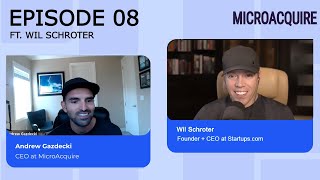
This is a YouTube video titled "Zero to $1m/ARR - Wil Schroter - CEO at Startups.com" containing an English multi-speaker interview or discussion recorded in October 2020. The conversation features Wil Schroter, CEO of Startups.com, and several other speakers discussing entrepreneurship, motivations behind starting businesses, the role of fear and passion, and personal experiences growing up with financial hardship. The dialogue explores themes of purpose versus passion in business and the challenges of building and running startups over time.
Foreign.
With me. I have Will. Will, thanks for joining me on the show.
Appreciate you having me, man. Lots to talk about today.
I know. So we've chatted a little bit before we started recording and I wanted to dive in. So you've started multiple companies, you've acquired multiple companies, you've had companies acquired, you've had a lot of success in your career. But I want to dive into, like, the motivations for you as an entrepreneur. What got you started early? You know, what. What got you to your first company? What was it? What did it do?
Sure. To be fair, I never thought in a million years I'd be ever be in business. To give you a sense for. I started my career as an actor. I don't mean like a theater actor. I mean like doing commercials like a bad actor, not like a Broadway actor.
Like a background ext.
I was person number six. I was like, you know, like, there's. I've done nothing notable. There is. There's no highlight reel of that part of my career. And that, that only came out of that. Not because I had any interest in theater or acting or anything else like that. Because it was the dumbest, laziest path I could take. When I was heading into college, to get into college, I mean, I literally went through the course book and said, what's the only thing that I can't fail at? And I saw a theater major and I'm like, how can I screw that up? So. So that was my career. But it didn't start like that. I just want to point out that my career didn't start with ambitions of being a CEO or even being in business. I think like a lot of entrepreneurs, my career started out of desperation. And people think desperation, like, hey, our startup started. We don't have a lot of money. I'm really desperate. I'm going way back. I'm talking when I was like 8. And you know, I grew up with a single mother. I hadn't met my dad. We were very, very, very broke. My brother had just been born a couple years later, and I was kind of his father, if you will, even at a very young age. And we have any money. And so for me, entrepreneurship or kind of how we would think about it actually had to do with going out and trying to figure out how to make money. In my case, I would sell now and laters at the bus stop every morning so I would have cash to pay for lunch every day. So for me, making money, making profit wasn't like a greed thing like that. Hey, that would be cool. It was a, like I had to do it, otherwise I wasn't going to eat. And I think when you grow up like that, when you grow up poor, but when you grow up desperate, it forces you to think about entrepreneurship because it's a survival mechanism. Like when you think about your own childhood growing up, where did you see that? Because I see that in a lot of entrepreneurs. I'm guessing it wasn't much different for you.
No, it definitely was not. So I also grew up without a father.
He passed away when I was six and we were on food stamps. So I grew up in San Clemente though. So there's a little silver lining. I was born in Detroit, terrible area. But then for some reason, God was like, hey, let's get this kid out to a beautiful beach town. But I think that's so fascinating. And I meet a lot of entrepreneurs like this. My previous angel investor, Christian Friedland, very similar story. Growing up poor. And when you grow up poor, money tends to be more top of mind than when you have money. So when I think about when I started, started, you know, businesses when I was young, it was in a similar vein of I need to make money because I don't have any money. And why does.
Yeah, yeah. And so that can be just such, you know, obviously it's not the ideal.
Way to grow up. I don't wish it on anyone.
But, you know, it's also a blessing in disguise. Would you agree with that? Because it's obviously motivated you in ways that, you know, nothing ever probably could.
You know, everybody talks about life being as simple as fear or greed, and there's a lot of shades in between. But let's just stick with fear for a second. Fear is a powerful motivator. It's also something, by the way, that I've never unwound. You know, I'm 46. I've been at this a long time. I've been a millionaire since I was 22 years old. I live in terror every single day of losing everything. There's never been a day in my entire life, my entire career, where I've ever said to myself, everything's okay now, I'm good. And it doesn't matter at this point. If I make a billion dollars at this point doesn't matter, I'm going to feel exactly the same way. That's just like hard coded into my DNA. I'll be honest with you, it's not awesome. It was awesome when I had to fight to survive. It was an important survival technique. But that's not the way I live anymore. But the fear is still there.
Right?
So it's a double edged sword. On the one hand, it's awesome when you need it, it's not awesome when you don't.
Right.
And it's way harder to unwind than people, than people understand or think it is.
So one thing that comes to mind that I can relate to is so when I was building business apps that, you know, I felt like that was my shot. That was my shot at a different life. Not just for me, but for my family, my children. I'm a dad now and successfully exited that business. Feel extremely grateful. But I look back and I literally was working 100 hour weeks, maybe even like 500 hour weeks, if that's even physically possible. I felt like I never slept, I was always drinking, like some sort of caffeinated thing. I was working every single weekend.
Yep.
Like, you know, sometimes like that drive it, it comes from a place, you know, in your childhood or just something that motivates you deeply. Like you said, fear.
Yeah.
My fear was I needed this business to be successful and I'm, I'm willing to do whatever it takes.
Right.
But when I look back on it now, sometimes I think, you know, why did I work that hard? Like, why did I push myself? Do you ever have any thoughts like that? Like where. Yeah, you look back and you built these enormous businesses.
Sure.
It wasn't easy.
I'm sure you put in a lot of similar hours.
Sure.
Are you ever like, why? Why the hell did I grind that.
Hard to get to where you are now?
You know, at that point it made, made sense. I didn't have anything, I was broke, I didn't know anything. So I had to work twice as hard to make up for all the things that I didn't know. The real question would be, why are you still working like that? Because now you've done this as long as you could possibly do this. I've done nine startups over almost 30 years. I've lived so many lives at this point. I run startups.com, i run a company that specifically explains to you how startups are going to work. It's like I keep going through high school, I already know what the answers are.
Right.
But I keep going through the same process. The question is, why do I feel similar anxiety or stress? Even though I already know how this is supposed to play out, Truth is I have less of it. Again, because it's like, yes, things are going to suck for a while. Yes, this is Going to be stressful. I kind of know it's coming. Still feel it.
Right.
If I tell you, hey, I'm going to punch you in the face no matter how many times you've been punched in the face, and you know exactly how it's going to feel, still going to hurt. You still have that, you know, that, that. That raw feeling. So, all that said, I think there's a time and a place for it, I think where that breaks, and I think that's kind of what you're alluding to. Like, you know, where does putting all that time and effort and all that sacrifice break? I think it breaks where you don't have an end game for it. In other words, once you've established safety, once you put a couple bucks in the bank and you're still killing yourself, at what point is it worth it? If I'm being honest, I've rarely seen people make it worth it, no matter how well they've done. The cost has historically outweighed the upside.
I think that's very.
This whole conversation is really hitting me because I can relate. On a smaller level for me, what I'm doing now, and we spoke about this on the phone, just, you know, what we're trying to accomplish in our careers right now is dramatically different than it was probably 10 years ago for me, 20 years ago for you. Just doing more of the stuff that we love to do.
Right.
Remember I told you about all the stuff I don't like to do?
Yes.
Involving meetings.
Yeah.
Don't like to be in feedback calls or, hey, meet this person.
You know, what do you focus on.
Like, doing that, like, gets you, like, super excited these days because you can do whatever you want.
Yeah.
I think part of it, too, is recognizing that you can do what you want and recognizing that there's shit you don't have to do anymore.
Right.
For example, about eight years ago, when we started startups.com, i had maybe one of the most cathartic moments in my life, which was me stopping in saying, man, I don't have to kill myself anymore. That's not the same as working a lot of hours or things like that. It meant I don't have to do a lot of shit that I don't want to do anymore. I'll give you some examples. I don't have to work with jerks anymore. I simply just don't have to do it anymore. I used to have to. I used to have no choice if my clients were jerks, no matter what they had to say. I had $10 million a month of payroll. It didn't matter what they had to say. I had to work with them. And people think, oh, you've got a big company, you've got optionality. No, you don't. When you owe that many people money every month, you know, in the form of salaries, payroll, what have you, there's no way to unwind that. You have to do whatever you have to do. And that didn't feel like success to me.
Right.
That felt like I was trapped. The other side of it was when I was raising money or I was working with big partners, et cetera, or hiring. I worked with a lot of people I didn't like. And to be fair, they didn't like me either.
Right.
You know, I'm no saint. And in both cases, I didn't want to ever be in that situation anymore. I was like, if I don't. If I don't like you, I just don't want to work with you. Life's too short, dude. If you don't like me, by all means, quit. Go to anything else. I'll help you find another job. But I don't want to spend a single minute in that situation. I don't want to spend time answering to other people.
Right.
I don't want a VC who's literally never built my business to tell me exactly how my business is going to get built.
Right.
That'd be like me telling LeBron James how to play basketball.
Right.
Like, I. I get that. I've watched basketball, but you're actually good at basketball. Like, I'm not going to tell you how to play it. I didn't want to be in a position where I had people doing that to me all day. Hence why we don't have any investors. The list goes on. But I think at some point I realized that I could take command of that destiny. Took me a long time.
Yeah, I can completely agree with that. And I think it's important for entrepreneurs to.
I've always.
Would you agree with this statement? A lot of people, some people say follow your passion. Some people say you don't need to be passionate about what you're doing to be successful. I've kind of changed opinions over the years with business apps. As an example, I was passionate because that was a path to a different life. My second company, Altcoin, wasn't as passionate about it, so it wasn't as successful as business apps. So I'm a firm believer if you're going to start a company, you need to be passionate about it. You need to be like, you need to like to get up. And there's always going to be things that you don't like in the company. That's just how a company operates. You still got to file taxes. You still got to let people go from time to time. Like there's just operational stuff you can't get away from. But my question here would be, in your opinion, for entrepreneurs, you know, thinking about starting companies, how important is it for them to be passionate about the idea they're solving their product market, whatever.
What if we split that? What if we said that there's passion, which is stuff you want to do, and there's purpose, which is stuff you need to do?
Right.
So my first few businesses, probably like yours, were based on purpose. I was broke. I needed this business to serve a purpose where it made me not broke. And so I needed this business to work and I worked my ass off at it. I wasn't passionate about it. We built webpages. It was Blue Diesel. We were one of the first web design companies. I was passionate because the Internet was so intriguing at that time. And I was passionate about learning how to be an entrepreneur. But I didn't jump out of bed because I was excited to build a pharmaceutical company, a website about some random drug. Right there. Was just excited about that at all. And so I couldn't even fake it. It paid well, but I couldn't fake it. So there was no passion. But it had a ton of purpose. I believed in the opportunity there. I believed in being able to grow something. I believed in giving people agency, people that we hired to be able to go do something great in their life. All that purpose existed. But I could give a shit less about that business. I then went on to start seven more businesses that I equally didn't give a shit about. Now, I learned this later. This wasn't. I didn't go into this with this understanding. So to be clear, it wasn't like I was like, oh, I don't care about this business, but I'm going to do it anyway. At the time, I didn't understand the difference between passion and purpose. But what would happen is I would find a business opportunity. Like, the last one I did was unsubscribe.com, which I think you mentioned that you'd used.
Yeah.
And it was just a cool idea. I wanted to get people off email at a time when unsubscribing off email wasn't really a thing.
It.
And so I called Jamie Simonoff, who's a friend of mine who started Ring the Doorbell company and Josh and I said, hey, I've got this idea for something. Let's go after it. And Jamie said something to me later on, years later, that I thought was really interesting. He said, I'll never do that again. And I was like, what do you mean? He said, I'll never do something that I'm not passionate about.
Right.
And he said specifically, he's like, well, that was your idea. And I just thought it was a cool opportunity. I don't ever want to pursue something that's somebody else's idea, somebody else's passion. And I'm just doing it for essentially what would have been purpose. And I was like, well, I'm glad you learned that. Then he did something he was passionate about in ring, and look how that turned out. I did something that I was passionate about in startups.com and now it's my frigging dream job. I mean, I get to do this all day long. It's awesome.
I think that is some wisdom right there.
Will.
Purpose and then passion. Cause, yeah, the first business, you know, I think entrepreneurs can transcend money, and then that's, you know, an opportunity to do a passion project.
For me, it might require helping other entrepreneurs. Similar to startups.com, but on a smaller scale, by a lot. But that's so interesting how you put.
That as purpose, and I think that's just so true. It is purpose, and it has more of, like, a deeper drive where you may not enjoy it, but you're doing it because you know it's going to lead you to, you know, a better life, other things, other opportunities that you know you're going to enjoy further down the line. That could even apply to people in careers, like people that are just starting their first job.
It's like, you got to put in.
The work now if you want to do the fun stuff later.
More from Andrew



The Buyers Who Made the Move: What They Bought, How They Did It, and What Happened Next






