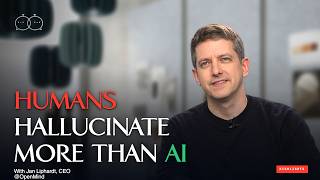
In this interview, Jan Liphardt, CEO of OpenMind, discusses the current state and future of consumer humanoid robots. He notes that large companies like Amazon have deployed millions of robots, but consumer-grade humanoids are still limited in capability. OpenMind is addressing this by releasing an open‑source software stack and a Humanoid App Store where developers can create and share apps (skill chips) that give robots new functions. The initial app categories are education (e.g., tutoring children), home safety monitoring, and health companionship (e.g., detecting falls and connecting to remote nurses). Liphardt shares personal anecdotes about his own son using a robot for math help and imaginative use‑cases like a robot alarm clock. He then turns to the problem of hallucinations, arguing that humans hallucinate just as much as AI, and explains OpenMind’s governance approach: a core LLM makes decisions while a secondary “mentor” LLM critiques and biases behavior every 30 seconds. The system converts vision and audio inputs into text so that models can communicate via natural language, which simplifies debugging and guardrails but limits decision speed to about one‑second cycles, making it suitable for high‑level tasks but not fast control loops. Finally, Liphardt reflects on the broader societal impact, claiming that the traditional model of a single lifelong skill learned in college is obsolete; continuous daily learning and adaptability are essential, and universities will split into generic, declining institutions and elite, evolving ones.
Chapters
There are some crazy people that have humanoids in their home, like in my house. The Booster is about a meter in height. It weighs 24 kilograms.
Where is this happening right now?
Amazon has deployed 1.1 million robots for warehouse operations. There's already really big companies that have decades of experience, and most obviously it's the car industry. The only reason OpenMind was started, because I opened a box with a humanoid in it in my living room, and I was super underwhelmed with what Humanoid was able to do. It could like get up and shake hands, but that was it, which is incredibly dumb.
If I get one in my house this year, what do you think I can do with it most likely?
Well, so there's good news, and the good news is that some of the software that's being built for humanoids is deliberately open. And contains things like an app store that developers can build apps for. So I may have guesses and preferences about what I want humanoids to do in my home, but your answer may be totally different. And that means that with the right software, you can go to GitHub, you can snap together different models and different prompts in such a way to bring about a completely new functionality that you may want for your home. And then if you want to, as a developer, you can make it available on an app store. So that's something we're doing at OpenMind. We just announced an app store for Humanoid, and basically this allows people to build apps or skill chips that add particular functionality to the robot. So my, my hope is that this future will be very open and there will be an infinite number of capabilities that people add to their humanoids and then share with others. But in terms of the initial apps that are on the App Store, there's really 3 categories. There's one category that is education, and a typical scenario there would be like math education or languages, and that is based on the robot being able to walk up to your child, ask questions, and also observe for example, the book the kid is reading and the material in the problem set that your kid brings home from middle school or wherever, and then being able to talk about that, ask questions, and try to teach material. Other use cases are really safety at home. So for example, your robot can go to different rooms, it can look around, and if it detects anything that is not safe, it can notify you. And the third set of capabilities is health companionship. For example, there's gonna be an app soon on the App Store that tells the robot to find you if it doesn't see you. And if it finds you and you're, for example, lying on the floor, then it will ask you, hey, do you need help? And if you don't respond, then a human nurse will be able to connect through a teleops backend. Observe the camera data, look at the chat transcript, and then if the human nurse concludes, oh, you know, this person actually needs help, then he or she can call 911. But the thing we've been most surprised by is that every single person we talk to wants their humanoid to do something different. It's really crazy. Here's one use case. Someone wants a humanoid to be the ultimate alarm clock. They want the humanoid to come to the bed and say, "Hey, it's late. Wake up." And then there's no snooze button because they want the humanoid to run away and then just from far away keep saying, "Hey, you really have to get up now," so that they physically have to get up and then go chase the humanoid, and then they're awake.
What about you? You said you have one at home. What do you use it for?
Well, the whole math education thing is really based on my 13-year-old son who's sitting at the kitchen table doing his math homework. And then he just started asking a quadruped dog for help with his math homework. We've all grown up with the joke of the dog ate my homework, but I was shocked to see that picture being reversed where all of a sudden the kid is just having a conversation and the dog is actually doing the math for Ben. I hope the Palo Alto School District is not listening to this, and I hope his math teacher is also not listening to this. But so then, of course, what you have to do as a parent is change the prompts that control the robot to make sure that the robot teaches as opposed to just doing the homework for him.
There's a dog that's actually helping, right? Yeah, no excuse. You have to do your homework.
Exactly. And if you had also the wake-up functionality in the dog, you would have the perfect scenario where the dog can now go wake up the kids and make sure they're not late for school. And then, of course, if they have questions about the homework, then you have the entire power of ChatGPT 5.2 at your beck and call.
Yeah, that's amazing. You know, my husband calls the kids to get up in the morning. He always says, like, wake up, wake up before you put on the makeup. We have to deal with hallucination, right? We are using a lot of these LLMs behind the scene anyway. It's all text. You must be facing this problem as well. How do you handle that?
Well, I have a horrible secret. I've been grading undergraduate homework for 15 years. And let me tell you that if you've ever submitted a problem set at 3:00 in the morning and you wake up and you don't remember what you wrote, let me tell you that the teachers and faculty grading your problem set have lost all illusion about hallucinations. And hallucinations are not a computer thing. It's something all of us do almost daily. I like to think that hallucination is a much bigger problem. Than it is about humanoids. Humans have developed a court system and juries and judges and so forth to try to figure out what people should and shouldn't do, or if they've done something wrong and so forth. And so in my experience, humans are highly imperfect. And many of the challenges that you have to deal with when you build smart humanoids just directly reflect that the models have been trained on human behavior.
Yeah, it's more the actions that they're gonna take instead of like saying something bad. Maybe writing something on paper at 3 AM is more tolerable than if you just wake me up at 3 AM, jump in my bed as my robotic companion, right? Don't do that.
Well, any parent listening to this, I'm sure you've also had to navigate situations where your 5-year-old has done things that maybe you also thought necessarily wasn't that awesome. One thing we found to be very useful is to have decisions made by a committee. So we typically have one LLM running in the middle, that's the core LLM, but then we have another LLM, which is, which we call the mother LLM or the referee or mentor. And what that LLM is doing, it's observing the robot interacting with people in front of it, and then every 30 seconds writing a critique. Stand up straight. Look at people ahead of you. And part of the role of the mentor LLM or the mother LLM is to bias the system towards good behavior.
So I was curious, does this mean that everything becomes text? You have the vision model and you have the sound. Is everything converted to text?
Yes. And that has a few massive advantages and a few massive disadvantages. A lot of people, especially if you're a computer scientist, um, think this might be ridiculous because if you've ever worked with video data, One thing you might want to do is you might want to push raw video data straight into some sophisticated model, and maybe you want to push raw audio data into this sophisticated model. And however, when you try to do that, you quickly run into either hardware or software constraints, or you end up with a system that's almost impossible to debug or almost impossible to understand what's going on or why certain things happened. And one of the benefits of having models literally talk to one another using natural language is that you can eavesdrop on what all those models are saying very efficiently and very clearly and very well. And if you find problems, you can very easily also apply natural language guardrails to different parts of the system, so you augment or prevent certain behaviors. So in our mind, all of engineering is a trade-off. And the trade-off we are making in our software stack is we only deal with very high-level decision-making. Um, and we are happy with the robot making big decisions every second or two, which for some robot use tasks, use cases, is way too slow. Imagine, for example, you're building a drone to target a tank. Of course, in the last few hundred milliseconds, that targeting loop needs to be much, much, much faster. Or Imagine you're building a ballerina humanoid to balance on his or her big toe. In that case, your loops, your stability and movement control loops need to be operating not at 0.5 Hz, but maybe 500 Hz. And the decision we've made as a company is we don't do like drone targeting, we don't do ballerina humanoids, we don't do onion chopping. We focus exclusively on use cases where a 1 or 2-second decision cycle is more than good enough to keep people safe, teach people things, keep your home safe, take things from a car to your front door or whatever the case may be. So that's the big limitation of this kind of software architecture. And because we are okay With focusing on some use cases, this kind of use of natural language to interconnect 10 to 15 different specialized models works out really well and then has the advantages of you can just see what all those different models are doing. You can fix things, you can update and improve one small part of the system as opposed to having to redo everything. And so There's some disadvantages, but many advantages, at least in our mind.
What do you think we should be preparing for? And, and what are the skills that's going to actually matter?
Unfortunately, I don't know. And my fortune telling or future telling abilities are limited. But what I've been telling my kids is this old notion that you go to college, you learn a skill, and that's what you do for the rest of your life, as far as I'm concerned, is completely dead. And one of the more obvious implications is that every one of us for the rest of our life should spend a moment every day learning something new. So this, this notion that Stanford also has been articulating of lifelong learning, that is more and more true. As the world around us changes quickly, we have to change quickly too. We simply can't say, oh, you know, I, I got a physics degree 20 years ago or whenever it was. That's good enough for me. No, all of us will need to be able to reinvent ourselves in terms of our skills and what we spend our time on. More and more frequently. So this property of being nimble seems incredibly important. So try to pay attention to what's going on around you.
University's dead.
Many of them are, but some of them will become even more important. So what you're going to see is a bifurcation where a university that offers a generic product and a generic brand is almost certainly dead. And then there will be some universities which are already famous and they will become even more famous and even more important.