1. Introduction to Human Behavioral Biology
The lecture opens with a dramatic case study of a seemingly normal 40‑year‑old man who suddenly exhibits violent, sexual, and financial misconduct, prompting the question of whether a single genetic mutation could underlie such drastic behavioral change. The instructor uses this vignette to probe students' beliefs about genetic, prenatal, and religious influences on behavior, then moves to a broader discussion of how hormones, brain lesions, diet, and anabolic steroids have been invoked in legal defenses for violent acts. The core theme introduced is the bidirectional relationship between physiology and behavior: bodily states shape the brain, and brain activity influences the body. The instructor critiques categorical thinking—splitting continuous phenomena into discrete buckets—and illustrates its pitfalls through language, color perception, and memory tasks. He argues that human behavior should be studied without rigid categories, instead tracing each behavior backward through neural activation, sensory triggers, hormonal milieu, developmental history, and evolutionary pressures. Historical misapplications of biological explanations (behaviorism, synaptic adjustment, Nazi eugenics) are presented as cautionary tales of “bucket” thinking. The course structure is outlined: the first half provides interdisciplinary “buckets” (evolution, genetics, ethology, neurobiology, endocrinology) with catch‑up sections for non‑specialists; the second half applies this framework to specific behaviors (aggression, sexuality, parental care, psychiatric disorders). Logistics—including unit count, sections, office hours, assessments, and required readings (including a controversial book on chaos theory)—are detailed. The overarching message is that all humans are behavioral biologists, and understanding the complex, interactive biology of human social behavior requires moving beyond simplistic categories.
Chapters
Stanford University. Ah. This is Bio 150, isn't it? Okay. Just wanted to make sure. Okay. So we start off with a scenario. 40-year-old guy, quiet suburban life, married 15 years, 2 kids, 3.5 dogs, everything's standard, everything's going wonderfully. And one day, out of nowhere, He punches somebody in the face at work. Totally bizarre, out of character. The guy is standing there by the water cooler and makes some comment on some baseball team, takes exception to it, punches him in the face. Utterly strange. Things are quiet. 3 months later, his wife of 15 years, happy marriage, discovers he's having an affair with a 16-year-old checkout kid down at the Safeway. Really weird. Then 3 months after that, he absconds with all the money at work and bezels it, disappears, and is never seen again. 3 possibilities. First one, this guy is a truly deep creep. Second, he is having the most immature midlife crisis you could ever imagine. Third possibility, he has a mutation in one gene in his head. And what we'll be seeing is this is exactly the profile that you get in a certain neurological disease where it's one gene that's out of whack. First demonstration of that. OK, just to get a sense of who's here, how many of you think there is a genetic influence on sexual orientation? OK. How many think it is possible for prenatal events to influence your political opinions 30 years later? OK. How many think that there is a valid way of using biology to understand who's religious and who isn't? Eh, not quite as many hands there. Okay, as long as we're in that terrain, how many people believe in God? How many people believe in souls? How many people believe in evil? How many people believe in free will? That's going to change. Okay. Oh, I might as well ask, is there anybody in this room who actually does believe in evolution? Just wanted to make sure, see what we're dealing with here. Okay. How many think that there is a genetic influence and that there's a basic biological difference, a sex difference in levels of aggression? How many think there's biological bases of sex differences in intelligence? Okay. Who thinks it's all explained by nature? Who thinks it's all explained by nurture? Who thinks there's a magnificent, fascinating, nuanced interaction between nature and nurture? Yay! Okay. Well, everybody's going to get an A+ then. You already have the course under control. Okay. So, we start off trying to can find something in common. Look at these 4 events here— or not, in terms of being scraped out there. But these are 4 circumstances that have something surprising in common. Having your period, having a brain tumor, eating a lot of junk food, taking anabolic steroids. Those of you who are not oriented to it, that's the ones that build up your muscle, like testosterone derivatives. OK, these all have something in common— having your period, having a brain tumor, eating a lot of junk food, and taking a lot of anabolic steroids. Anybody want to fathom a guess what's the commonality amongst the 4 of them? Yeah. Hormones. Hormones. Good. Okay, we're off and running with hormones. Good. Even more specific than that, something they all have in common. Oh, come on. Somebody want to guess? I see these brief movements of hands there as people change their mind. OK, it all has to do with hormones. They all have hormones in common, I say, trying to facilitate somebody making the next guess. Oh, come on. They all have something— OK, we've got to get out of here at some point. These all have 4 things in common. All of these have been used successfully in courts of law to explain the behavior of a murderer. In the first case— in the first case, a number of cases where the fact that a woman was having her period at the time of killing someone was part of what a jury said led them to exonerate the person, a literature showing that a disproportionate share of female aggression comes around the time of menses. Next one. There is an area of the brain you will know oh so much about over the next 3 months called the amygdala that has something to do with aggression and has something to do with fear. And you get a brain tumor there, and in a number of cases, you get someone who is uncontrollably violent. And this has also been used successfully in a court of law. Junk food. Any of you who are San Francisco history buffs will know 20 years ago, 30 years ago, Dan White, a disappointed office seeker, assassinated the mayor of San Francisco along with Harvey Milk. And as part of his remarkably successful defense for a double murderer that led to a remarkably short jail sentence was the famed Twinkie defense, the argument that his addiction to junk food caused wild fluctuations in his blood sugar levels, which caused him to do that. Finally, anabolic steroids— any number of cases of people having uncontrolled violence, arguing because they were weightlifters in a wildly abusive range of taking this stuff had something to do with violence. Put all 4 of these together and we get the first of the 2 points of this entire course, which is sometimes the stuff that's going on in your body can dramatically influence what goes on in your brain. Second critical point. Tonight, when you've settled back down and you're ready to go to sleep and you're nice and relaxed and your heart's beating nice and slow, think the following thought. You know that heart isn't going to beat forever. Think about— think about your lips turning blue after the— think about the blood flow slowing down. Think about your feet and your toes getting cold. And at that point, you will probably be increasing the rate at which that heart beats. And you will have just seen the second key thing in this course, which is sometimes what's going on in your head will affect every single outpost in your body. And what this course is about is the intertwining, the interconnections between your physiology and your behavior, the underlying emotions, thoughts, memories, all of that, and the capacity of each to deeply influence the other under all sorts of circumstances. Now, what we're going to be doing with this is trying to understand this under fairly difficult circumstances. If Everybody here was here because they really wanted to understand why all the wildebeest on Earth mate in the same week each year, we'd have a fighting chance of figuring that one out. But that's not what we want to understand. We don't want to understand why birds migrate and don't get lost. We want to understand human behavior. Worse than that, harder than that, human social behavior. And hardest of all, in some cases, some grossly abnormal human behavior. And if you're going to try to do that, there's a problem, which is officially, it's complicated. It is a huge, messy process trying to make sense of the biology of human social behavior. And just as all sorts of realms when one deals with messy, complicated problems that you need to think about in some wildly interacting way, we all have a strategy that we come up with a strategy to make things easier, which is that we think in categories. We think in categories. We take things that are continua and we break them into categories. And we label those categories. And we do that in various settings because it could be extremely useful. For example, somebody give me an estimate on how long this line is. A foot. OK. People who said a foot, what is it that went through your head to figure it out? You imagined how long a ruler is. This is 11.5 inches because it's 11 inches, an 8.5 by 11. But everybody in here has this category in their head, things that are kind of the same length as a ruler. A continua of lengths, and there's a category for that. Suppose I'm telling you I have some friend who's a runner. He runs the mile. He's incredibly fast. In fact, he's one of the best runners in the country at this point. How fast does he have to have run the mile or better for you to be deeply impressed? Under 4 minutes. And thus, we have another categorical boundary there of there's an infinite variety of speeds with of which you can run a mile, yet we have in our heads this boundary— people who are under 4-minute milers you are very impressed with. OK, now I want to impress you with another friend of mine who's a painter. And this person is such a great painter that they paint with 11 different colors. That doesn't work because that's not a category that we have. We don't classify the quality— hopefully not— we don't classify quality of painting things along those lines. But what we begin to see here is in the right areas, we have categories that we impose on things that are not categorical. Here's an example. Why should you do this? Where'd the example go? Here's one of the classic continua that we ever deal with, which is the continuum of color, the varying wavelengths that take the rainbow from violet to red. And there's an infinite number of spaces in between. And what do we do? We have rules in English that you divide the continua here and here or whatever. And that's what you call a color. This is red. Everything from here is red. Everything here is orange, so on. You take a continua and you break it into boundaries. Why do we do that? Because it makes it easier to store the information away. Instead of remembering the absolute features of something, you simply say, "It's a." It's a sub-4-minute miler. It's a line that's almost the length— that's about the length of a ruler. It's the color orange. How do you know that's the case? Because go and take people from other language groups where their language arbitrarily divides the rainbow at other points with completely different color terms, and they remember different profiles of color. Colors differently than an English speaker might. Take a color, and if the color comes right in the center of somebody's color categorization, if it comes right in the middle of the range of what counts as that color, people remember whether they saw that color or not far better than if you show them a color at the boundary. And people will show that as a function of what language they speak. Taking a continua and you break it into pieces because it's easier to deal with the facts. Another example of it. Here we have 4 objects. And as drawn here, simply because we have categories to describe the first 3, do one of those tests of show people a bunch of shapes and they come back an hour later and ask them, have you seen this shape before? And people are going to be far more accurate with this than whether they saw this or not because we don't have a word for it. We don't have a word that's at all sort of analytical. It's some squiggly whatever. We don't have a clear-cut category. Thinking in categories makes it easier for us to remember stuff. And it makes it easier for us to evaluate stuff. So that's a classic sort of response that we have cognitively to complicated things. But there's a bunch of problems with categorization. Categorical thinking. First example, and first one you can see from a realm of language differences, in that not only is there a continuum of infinite number of wavelengths, there's a continuum of sounds that humans can make. And different languages draw boundaries at different points as to what count as similar sounds or different sounds. There's like two different "th" sounds in English, which apparently We're not very good at hearing, but there's other ones we are. And that will affect your ability to remember stuff, what word it was, depending on whether it is on a dramatically different boundary, whether it is sound that sounds different to you or not. Example of this. Apparently, in Finnish, people do not differentiate between the sound of a B and the sound of a P, whereas we have no trouble with that. But people People from Finland do not make that differentiation. And I discovered this one day a number of years ago where, for reasons I don't even understand, I found myself needing to take testicular biopsies on baboons. Not having sort of learned that in junior high how you do that, I called up this guy, the urology at the med school who happened to be Finnish. And I explained to him what I wanted to do. And he sort of took me through the paces and told me what thingy I needed to buy and that sort of stuff and holiday packages of those where you can get a dozen and sort of telling me how to do that. And once we went through, he said, what I want you to do, the thing to do at this point is get some practice. I want you to practice on a bear. I said, what? He said, yeah, practice on a bear. And I said, are you kidding me? He said, I know it sounds crazy. It's a very good learning device. Either practice on a bear or an apple. Oh, oh, here we see the dangers of making mistakes about differences between B and P under certain circumstances. So we see one of the dangers there, which is when you are paying too much attention to categories, you can't differentiate two facts that fall within the same category. Next example. Remember back at various points of anxiety during exams and such back when where there was a world of difference between getting a 65 on a test and a 66 on a test? Not particularly different, but because there's this boundary drawn there between passing and failing, there is this dramatic differentiating we make. When you put a boundaries, you have trouble seeing how similar things are on either side of it. Next example, one additional problem that you get when you think categorically. And for this, everybody needs to turn over one of the pieces of paper, the paper you're going to hand in, the questionnaire. And what I'm going to do is read you a series of phone numbers, and I want you to write them down as accurately as possible. Okay, ready. 2432649. 6503260. 2565779. 8322449. 2913171. 2314026. 5932449. 7438840. 83152. 8, 7. OK. Now what that exercise is— and no, that doesn't count towards the grade. What that will show, I'm sure, when in some obsessive burst of procrastination I actually look through the answers tonight, what it's going to show is the accuracy is going to tank the second you go from the phone number pattern of 3 digits followed by 4, break up that pattern. And suddenly, we all get screwed up because we're saying, wait a second, I thought it was a phone number that was 1 digit. Now 2 digits. I can't— and it's gone. And you're on to the next one. And what we see there is the third example, which is when you pay too much attention to boundaries, you don't see the big picture. All you see are categories. All you see are, wait a second, phone numbers are supposed to come with 3 2 digits followed by 4. Another example of where we use categorical thinking. Okay, I'm putting up a number series here. Okay, what's— oh my God. Okay, what's the next number in this series and why? 42. How come? Plus 10, plus 9, plus 11, plus 8, plus 12. OK, so we're kind of oscillating all over the place there. OK, so that's as valid as anybody else's. Who else has an x number in line there? What's that? 45. How come? OK. Are you going to take that? 45. That's very— OK. What else? Let me make it a little bit easier here. OK. So what's the next number in that series? And what I'm telling you is if you If you think about the world with a certain set of categories in your head, you will know the next number in the sequence. So what's the next one? 7 billion. 7 billion. Choose out of anything. Okay. That one. Okay. 7 billion. That's another possibility. Although presumably it would be 7 billionth. Anything else? Any other guesses here as to what What happens next? 4th, 14th, 23rd, 34th. What's the next one in the sequence? Yes? 44. How come? Well, it's looking like you're just kind of going up, like, plus 10. The 10's common, but then when you're doing 2/4, and then the third number will be up first. OK, but remember, it's got to be 44th. What's that? Ordinal? Cardinal? Whatever it is. What? 42nd? How come? Subway? You were right! You were right! Anybody who is a New Yorker will know what the next one is. These are the subway stops. And you get a bagel with cream cheese. Can you pass it back to the mic? Just head it on back. Yay! You get New Yorkers and while everybody else is thinking logical things like 43 and 41 and 45 and 7 billion and all of that, you've got this whole world of dividing numbers by subway stops. We think in categories. We think in categories, but as you just saw, there are these problems. First one being when you think in categories, you underestimate how different two facts are when they fall in the same category. When you think in categories, you overestimate how different they are when there happens to be a boundary in between them. And when you pay attention to categorical boundaries, you don't see big pictures. Now, what our goal in this class is going to be is think about this big complex issue of the biology of behavior without falling into thinking in categories. What do I mean in this regard? Thinking categorically historically about a subject like this. There's some chicken. And the chicken is standing somewhere. And there's some rooster over there that does some sexually solicitative, exciting thing for the female. And in response to that, the female picks up and goes running over to the rooster. And thus we have our first behavioral biology question here. Why did that chicken cross the road? To get to that rooster. So you could answer that like an endocrinologist. Say, well, the female had certain levels of estrogen in her bloodstream which made this key hypothalamic area responsive to the stimulus. Or you could answer it like an anatomist of saying, well, because the fulcrum of her pelvis or whatever it is chickens have that allow them to run. Or you could answer it in the category of an evolutionary biologist that over the millennia chickens that didn't respond to sexually solicitive gestures from males left fewer copies of their genes, and there's all these different categories that we can use to explain what's going on. All of these different buckets. All of these different buckets which begin to pull you towards all of the problems we just saw. Having trouble telling how different or similar two facts are. Having trouble seeing big pictures. Overemphasizing the importance of the bucket you happen to live inside of, and thus suddenly Suddenly, everything about this behavior is explained by a gene, a neurotransmitter, a childhood trauma, a living inside one bucket. What we are going to be doing over and over in here is the main point of the course is looking at how what goes on in your body influences behavior, emotions, memories, how what goes on there influences your body, looping over, and at every one of those points, resisting pull to think categorically. Oh, this is the explanation for where this behavior came from. Here's what we're going to be doing instead throughout in terms of the structure of the class when we get to actual behaviors. For each behavioral category, we will start off by looking at what the behavior looks like, because often that takes a lot more objectivity than we initially assume. What does the behavior look like? Then we will say, well, what went on in that organism a half second before that behavior occurred to occur, to cause it to occur? Which is the world of what's going on with neurons, what's going on with circuitry, where's the explanation for the behavior. Aha, this behavior happened because this part of the brain got activated. But just as we're about to settle unhappily into that bucket, we push back back a bit and say, well, what smell, what sound, what sensory stimulation in the environment caused those neurons to get activated and produce that behavior? And then pushing one step further behind, okay, well, what do hormone levels, various hormones in the bloodstream of that animal or individual for the past few hours, how do those hormones change how sensitive you are to those sounds, smells, et cetera, that cause those neurons to get activated and produce the behavior. And all we're going to be doing is working our way back all the way through early development, fetal life, the genetic makeup of an individual, the genetic makeup of entire populations, species, the evolutionary pressure on, all the way back to there. How do you explain each one of these behaviors in the context of those outposts, and how are they not really outposts. All they are are different ways of expressing the same biological influences. If you say, "Ooh, here's a hormone that explains this behavior. This behavior is caused by hormone X." Hormone X is coded for by a gene. So suddenly, you're not just talking about endocrinology, you're talking about genetics. And if there's a gene there, it has been subject to selection. So suddenly, you're talking about evolution. If you were talking about what smells, sights, et cetera are the cue triggers for a behavior, by definition, you're also talking about fetal development that determined how sensitive those systems were to those sorts of stimuli. What we're going to be having over and over again is any one of these buckets that we spend some time in, all we're going to do is think of that bucket is at that point. The most convenient way of describing all of the influences that came beforehand. And in that regard, there's no buckets. All there are are temporary platforms, and each platform is simply the easiest, most convenient way of describing the outcome of everything that came beforehand, starting with millennia back in evolution. Okay, so that sounds great. That's what we're going to do. We're going to do this and we're going to be very sophisticated and fancy in our thinking about it and we're not going to fall for categorical thinking and all of that. Okay, this is a complicated subject and we're smart, so we're going to try to think about that smartly. That's great, but maybe this is just an irritating song and dance here of, "Ooh, we're not going to fall for categorical thinking like people out there." Obviously, when people are thinking about about stuff like behavior and they do this professionally, professional biologist, biology behavior type, yes, they understand also. This is just the straw man, ooh, we're going to be more sophisticated in our thinking than endocrinologists and geneticists and all of those. They obviously know that these things interact and there's not just one explanation and it's just the area they focus on. They understand that. Let me read you a few quotes to show just how much some of these folks don't understand that. First quote, "Give me a child at birth from any background and let me control the total environment in which he is raised, and I will turn him into anything I wish him to be, whether doctor, lawyer, beggar, or thief." This was John Watson, 1912, one of the founding fathers to the school of psychology called behaviorism. Behaviorism that sort of reached its apogee with this guy B.F. Skinner in the 1950s. This notion that if you could control the rewards, the punishments, the positive, the negative reinforcements, you could turn anybody into anything you want, whether doctor, lawyer, beggar, or thief. And we know that isn't the case. We know that's not possible. We know that all you have all you have to do is throw in one other factor like a lot of protein malnutrition during fetal life and you're not going to be able to do that. That being a crude example of just how wrong this guy was, you cannot have all the control over the environment and turn somebody into whatever you want. Here's a guy living pathologically in this bucket. That behavior could be explained solely by understanding reward and punishment. Interesting factoid, this John Watson guy, shortly after that, he was driven out of academia for a wild scandal that he was involved in, and he spent the rest of his career apparently as an extremely successful advertising executive. Going to show you something, he may not have been able to turn people into anything he wanted, but apparently, he could make them buy all sorts of gee-gaw nonsense. Okay, next quote, "Normal psychic life," —depends upon the good functioning of brain synapses. If you don't know what synapses are, don't panic at this point. They are ways brain cells connect with each other. OK, normal psychic life depends on the good functioning of brain synapses, and mental disorders appear as a result of synaptic derangements. Synaptic adjustments will then modify the corresponding ideas and force them into different channels. Using this With this approach, we obtain cures and improvements, but no failures. Synaptic adjustments. Synaptic— what do you suppose those little old synaptic adjustments are that this guy is referring to? Any guesses? Somebody shout it out. Electroshock therapy. Electroshock therapy. Electroshock therapy. You know, a little synaptic— you wish it were as gentle. As electroshock therapy. This is even more dramatic synaptic adjustments. Any other guesses? Yeah. Frontal lobotomies. You know, you want to adjust somebody's synapses, so you just slice off the front third of their brain or so. This was Egas Moniz, a Portuguese neurologist who invented frontal lobotomies. It had a different name at the time, but was the person who started this. Something that was done to tens and hundreds of thousands of people who had absolutely nothing wrong with them, one of the darkest chapters of where psychiatry gets in bed with ideology, massive criminal destruction of people's brains. This is what he had to say about the procedure on his acceptance of his Nobel Prize in Physiology and Medicine for having invented it. So here we have somebody pathologically living in a world of understand how synapses are working, adjust them, and with that, we obtain cures and improvements, but no failures. Final quote, worst one of all. The selection for social utility must be accomplished by some social institution if mankind is not to be ruined by domestication-induced degeneracy. The racial idea as the basis of our state has already accomplished much in this respect. We may, and we must, rely on the healthy instincts of the best of our people for the extermination of elements of the population loaded with dregs. Anybody want to guess who that was? Hitler. Hitler. Nah, Hitler, that behavioral biologist, he was a little bit busy at the time. This was instead one of Hitler's main scientists. Scientific propagandists. This was somebody living pathologically in a box, a box that doesn't even exist, having notion of race and ethnicity and genetics and all of that, saying, "Let me fix that one. Let me exterminate the elements of the population loaded with dregs, and I'll fix up that little problem of fixing something that ain't broken." Who was this? This was a scientist named Konrad Konrad Lorenz, who probably a lot of us are familiar with. Konrad Lorenz was one of the founding fathers of ethology. We'll learn all about that. But he, like everybody knows him winding up in all the little kid nature books, Konrad Lorenz discovered imprinting in birds. And he'd be going around. He was this little Austrian guy with this cherubic white beard. And he'd always have these little Austrian shorts and suspenders. And there would be a whole bunch of ducky duckies following him because they thought he was mom and he was totally charming and irresistible, this sort of old imprinting with his ducky kids. And he also happened to be a rabid Nazi propagandist who went to his grave saying that there was nothing wrong with what he did. These are not crappy fourth-rate scientists. These are not people working at the University of the Desert of podunk or whatever, these are among the most influential scientists of the last century. These are people who influenced how people were educated and when we decided it wasn't worth the effort of doing it. These are people whose influence led to the brains being destroyed of hundreds of thousands of people who had nothing wrong with them. These are the people who led to the notion that you fix up a problem that doesn't exist by exterminating 9 million people. These are not minor scientists. These are the most influential people of the last century coming out of science in many ways, living pathologically inside their own buckets and how they could explain the entire world. And thus, again, our goal is going to be to not fall for that, to think about human behaviors and in some cases, to think about some of the most disturbed, some of the most frightening damaged human behaviors, and resist the temptation to think inside a bucket and find the explanation. Again, every level we're going to talk about— genes, hormones, neurons, environmental influence, whatever it is— that point will simply be the easiest way of describing all of the influences that came before. They're not even temporary buckets. There's no buckets. That will be our goal. Now, thinking about this and approaching human behavior, the biology of human social behavior, often the biology of abnormal human social behavior, we're going to have 3 intellectual challenges. The first one is recognizing circumstances where there is nothing fancy about us whatsoever. We are just like every other animal out there. And where the challenge The challenge is to accept that. Let me give you an example. You are a hamster. You are a female hamster. And you're sitting in your cage. And as a female hamster, what you do is you ovulate every 5 days or so. And you're going about your business and everything's great. Now somebody puts another female hamster in the cage with you. And over the subsequent month or so, what happens is both of you will begin to lengthen your cycles and eventually synchronize them so that you are both ovulating the same afternoon on a regular basis. Amazing. This actually works this way. And menstrual ovulatory synchrony— people understand how this works in hamsters. It is done with olfaction, with pheromones, with chemical airborne signals from one female to another. And you can prove this by electrically recording from olfactory systems. Or if you don't have much funding, you could take like a paper clip over the female hamster's nose. And she doesn't synchronize then. It's all done with olfaction. And what's most amazing is you put the two females together and there's a way of disrupting it. Put a male hamster in there and suddenly the cycles desynchronize and shorten. And you break it up with male pheromones. And what's even more remarkable— remarkable is you put the two females together and it's not random who synchronizes the other one. The dominant female synchronizes the subordinate one. Totally understood. People have been working on this for years. And it works this way in goats and sheep and dogs and cats and pigs. Apparently, you could go to a 7-Eleven somewhere in Iowa and you You could buy a can of pig ovulatory synchronization spray and take it home and just run wild. I have no idea why you would want to do that. But nonetheless, that's how you— like, it's up there with the cans of Cheez Whiz or whatever. And it's that well understood. And what's remarkable is it works exactly the same way in us, us humans, where it is known as the Wellesley effect. The fact that over the course of freshman year— this was first shown in Wellesley, 1970— over the course of freshman year, women, freshman year roommates tended to lengthen and synchronize their cycles. And it was done with olfaction. Women who had olfactory deficits didn't synchronize with their roommates. They would synchronize unless they were having close intimate relationships with a male, in which case they they desynchronize. And what's most cool of all is it's not random who synchronizes to who. The studies tend to show is the individual who is more socially outgoing, extroverted, dominating is the one who synchronizes the other one. And this is well enough understood that when I went to college, people would sit around at the dinner table and say stuff like, oh, when we roomed together this summer, I had her synchronized by August 1st. This is what happened. If you hang out with biologists, but we're exactly the same. The challenge there is recognizing there's nothing fancy about us. At various points in the class, we will look at comparisons between the human and the chimp genome, and it's virtually the same. Some of the time, we are just a plain old off-the-rack animal. Second challenge is going to be circumstances where we appear to be just like everybody everybody else, all the other organisms out there, but we do something very different with the similarity. Let me give you an example here. You have two humans, two individuals who are going through a ritual. They are sitting at a table. They're absolutely silent. They're making no eye contact and they do nothing more physically taxing than every now and then one of them picks up their hand and moves a little piece of wood on the table. And if these happen to be the right two individuals in the middle of a chess grandmaster tournament, these people are maintaining blood pressure for 6 hours running that you only see in a marathon runner. These people are going through thousands of calories a day doing nothing more than thinking. And this is outrageous because you look at one of these chess grandmasters who's just taken taken down an opponent and took their queen or whatever, and they will have the exact same physiology as some male baboon on the savanna who's just ripped the stomach open of his worst rival. And we're doing it there just with thought. And some of the time what's remarkable about us is we have absolutely typical boring physiology, but we use it in ways that no other animal could. We get stressed by by the inevitability of our mortality. We get stressed by reading something awful that has happened to a child on the other side of the planet. We get stressed by somebody zooming past us in some sports car and we decide that we are now economically inadequate. And you never even see the person's face. You just see the car. We get stressed reading about something awful happening to a character in a novel. This is a whole whole realm of things that we could do that nobody else does. And on the flip side, we can feel compassion and empathy for a loved one, but we can also do the same for someone on the other side of the planet in a refugee camp. We can feel compassion for a member of another species. We feel badly when our pets are injured. This is another realm where the physiology of the response, the empathy, the emotional bonding, all of that. It's the same boring physiology as every other animal out there. And we are using it in a way that is unrecognizable. Now, some of the time, the challenge is the third category, which is when we are doing something that no other animal out there has anything remotely similar to. Let me give you an example here, a shocking example. You have a couple. They live together. They come back They come home at the end of the day from work. They talk. They eat dinner. They talk some more. They go to bed. They have sex. They talk some more. They fall asleep. The next day, they do the same exact thing. They come home from work. They talk. They eat. They talk. They go to bed. They have sex. They talk some more. They do this every single night for 30 days running. Hippos would be repulsed by this because hardly anybody out there in the The animal kingdom has non-reproductive sex, let alone day after day, and nobody else out there talks about it afterward. And what we've got here is a whole novel domain of human behavior— language use, aspects of our sexuality, this profoundly damaging human uniqueness of some individuals confusing aspects of sexuality with aggression. In some cases, we are going to be out there on our own. Trying to understand what's up. Okay, so that will be the general strategy for the course. We will resist categorical thinking over and over and over, not just because that's cool and nuanced and subtle, all of that, but fall into categorical thinking and you can do unspeakable damage in a realm of science that makes a difference. We will do so thinking constantly about ourselves as a boring species just like all the others out there, as a species that has the same boring physiology but uses it in ways that are unrecognizable, as a species that does some things that are simply without precedent out there, and constantly struggling with what does biology have to do with it. Okay, general structure of the course. The first half of the course is going to be an overview, an introduction to the various buckets, the various categories. And what we're going to go through is understanding sort of an introduction to evolutionary theory, an introduction to what molecular genetics has to do with behavior, behavioral genetics, ethology, the brain, endocrinology, each of these buckets. And you know what happens next, which is in the second half of the course, we will look at specific behaviors and in each case, ripped apart the buckets. And in each case, do the strategy of what does the behavior look like, what happened a second before, the world of neurons, what happened with the sensory stimuli that trigger those neurons, et cetera, all the way back to the evolutionary selective pressures. So the first half of the course is going to be the introduction to the bucket. And I will tell you right off the bat, it is a total pain in the rear because what we're going to be is like every 2 and a half lectures, just when you are getting the vocabulary down, we're going to jump to a completely different bucket. It is going to be dizzying and unpleasant and all of that. And then second half of the course, oh, the rewards finally come of then putting all the pieces together, looking at individual categories of behavior— sexual behavior, aggressive behavior, parental behavior. Schizophrenia, depression, personality disorders, language use. In each of these cases, what's going on a second before? What's going on 10 million years before? Where do all these buckets disappear in the interactions? So that's going to be the strategy for the course. Something critical about how the course was designed is it's got no prerequisites, because I really think this is a subject that everybody on Earth should be forced to learn about at gunpoint. And thus, it's a good thing, I think, to have this not be one of those upper-level bio classes. Let me just get a sense of who's here. How many of you are bio types, bio majors? Humbio? Psychology? Anthro? Are there any English lit grad students in here? Yeah. Yeah. OK. Good for you. Thank you for coming here. See what you think in 3 months. But nonetheless, the class has been designed explicitly to have no background whatsoever. How are we going to do that? We're going to do the usual song and dance of weekly sections and reviews and all that sort of thing. But in addition, during this first half of the course, when we're jumping from category to category, we're going to have each week additional sections a catch-up section, which is for people who have no background in that area, getting you through the basics and getting you up to speed so that you will be able to then know what's up during the lectures. So those will be posted. The first one of these is— let me make sure I've got this— yes, it will be this Thursday at 7:30 in the room next door. And this is going to be the introduction to evolutionary theory. And getting you ready for what will be the evolution lectures Wednesday and Friday of this week. If you don't have a strong background, go to these catch-up sections. The TAs who will be giving it are really expert in those areas, lots of background. And this will be your chance to catch up. Look through the handout. I think I have a bunch of terms there or something where if you're not terribly familiar with those terms in some discipline, that's a sign that you should probably go for some of the catch-up stuff. If you really are just doing this sort of being very adventurous with no background, if you can take it pass/fail, that will take off a lot of the pressure as well, because you could then actually pay attention to stuff here. And the whole point here is to be able to do this even if you don't have a science background. Because the obvious argument I would make is everybody has to learn behavioral biology because we're being behavioral biologists every time we serve on a jury, every time we vote whether or not money should be spent on solving some problem, whether it's a problem and whether it's solvable or not. Every time we try to make sense of a family member sunk in depression, are they having a biochemical disorder or are they just indulging themselves? We are behavioral biologists all the time, so it's probably a good thing that we be informed ones. So the catch-up Sections there, take advantage of them. What else? We will have weekly sections, the usual type. People are not assigned to sections. There's going to be, I don't know, 18 of them or so a week at various times. Go to whichever works for you. There will be a midterm in the middle, the midterm coming as we finish the last of those categories, last of those buckets. There will be a final. There's no paper or anything like that. So that will be the pattern. What else? Other stuff here. Office hours, my office hours are up on the handout. Other things. Breaks. We will, with any luck, be able to— we? I, with any luck, will be able to be organized enough so that during each stretch of class there will be a 5-minute break in the middle so you could stand up and just get to the front of the line for the bathroom. And then we will resume promptly before you get in there. So just to let you clear your heads a bit. Assignments, books, reading. There are two books that I have assigned for the course. One is by me. And you don't even have to read it. Just go buy a bunch of copies and bring me the receipt, and you got a great grade in there. OK, so that one's going to be pertinent to the second half of the course. We're going to give you a list of the chapters that make the most sense to read. The other book is is a book by an author named James Gleick called "Chaos." Chaos, year after year after year in this class, provokes the strongest opinions. A quarter of the people decide it is the most irritating, irrelevant thing that could possibly have been assigned in the class and hate it. About half the people never quite figure out what's up with it. And a quarter of the people, their life is transformed. They no longer have to meditate. They no longer have to have a— just, they are at peace. At peace, I tell you. Because what this book does is introduce this whole radically different way of thinking about biology, taking apart a world of reductionism. For 500 years, we all have been using a very simple model for thinking about living systems, which is if you want to understand something something that's complicated, you break it apart into its little pieces. And once you understand the little pieces and put it back together, you will understand the complex thing. And what chaos as an entire field is about— and this was pretty much the first book that was meant for the lay public about it— what chaos shows is that's how you fix clocks. That's not how you fix behaviors. That's not how you understand behaviors. Behavior is not like a clock. Behavior is like a cloud. And you don't understand rainfall by breaking a cloud down into its component pieces and gluing them back together. So read through that book. A lot of it is from physical sciences rather than biological, so we'll just be suggesting the chapters you should read. I will tell you, it is the first book since, like, "Baby Beluga" where I've gotten to the last page and immediately started reading it over over again from the front because along with Baby Belugas had the greatest influence on my life. I found this to be the most influential book in my thinking about science since college, so that is a sign. There will also be a bunch of lectures in the second half of the course covering these fields of chaos and complexity. And if you really think about it, it is going to force a change in everything else that you bring to thinking about subject. In addition, at this moment, there is not a reader. Because I'm trying to avoid having to get you guys to have to buy a reader, I'm trying to redo all the assigned readings so that will just be from papers that are available online, that you'll be able to download. I'm about halfway through getting them there. With any luck, there will not have to be a reader. But if it does exist, it's not going to be big. It won't be terribly expensive. But there will be a bunch of readings online to download. And it will vary. In some cases, it will be reading the whole paper. In some cases, I'll be suggesting you just read the abstract. In some cases, it will be to understand what's happening in the beha— in the paper in detail. In some cases, this is an example of how people in this bucket think about this problem. Just read the abstract. So all of that will be assigned and made clear. What other stuff. There's going to be a huge amount of information online. The coursework is going to be set up for the class. There will be copies of the handouts. There will be lecture notes, lecture notes that I have that will be about 5 to 10 pages covering each lecture, which we'll get to about the middle of the course. And I suspect I will run out of steam by then. So they won't occur for the second half. There will be commonly asked questions. There will be a Q&A. There will be course logistics. Some of the slides will be put up in there. Make use of that. There will be announcements about time changing for office hours and things like that. Make sure you make use of that. And people who are not formally enrolled, we are figuring out a way for you to get access to it as well. We've also made the decision that after this lecture, the handouts will not be on paper. And that's— That is because roughly for each lecture, we will go through about 5,000 pieces of paper, even double-sided. All of the stuff will get posted on Coursework the day before. And if that's going to make it impossible for you to follow what happens in class because you are the last human on Stanford who is not living off of a computer screen, come and talk to me and we will slip you an actual paper copy of the handouts. Most Most of the— with any luck, we can avoid using paper just because of how many people there are in here. Let's see, other stuff. Sections. Sections will start this Thursday, the regular sections. All of those will be posted, the times for that. Office hours won't start until next week. Midterm will be in an evening rather than during a class time. And if we're on schedule, the class time that day will be used for review. And anything else? Oh, a very good suggestion just now. Given that the class before here is humongous, and thus we have the impossible problem of a lot of people trying to get out of that while a lot of people are trying to get into that, it might work best for everybody to come in from the top so that you flow down the stairs seamlessly and drive out those other people before us out the door there. That might work a whole lot better. Final thing is we have a team of TAs here, and they are great. Here they are. TAs, stand up and be embarrassed. OK, stand up, guys. There they are. There's all but one of them who is in transit. There they are. These guys are great. They have either taken the course before, in some cases they've TA'd the course before. They are grad students in various of the bucket specialties. I would strongly suggest taking advantage of the sections. What will evolve after the first few weeks is there will be the regular sections going over the course material sort of in the usual way. There will also be more advanced sections for people who have stronger backgrounds. Take advantage— OK, you guys can sit down. Leaving them standing there awkwardly for hours afterward. Take advantage of the sections. Really greatly skilled TAs. OK, so that's basically what we got going here. Are there any questions? Units. OK, somebody emailed about units. The class is 5 units, and it's because we are meeting for so many hours a week. Actually, for a while, the class was a 6-unit course, and that was because of Condoleezza Rice. Because when she was the provost here, she totally screwed the biology department by upping our teaching requirements under really nasty conditions. So what we all decided was to find ways, every single sleazy trick we could do to puff up the number of units we were supposedly teaching. So for a while, the 5-unit class here would get you 6 units. But eventually, they caught us, so we stopped doing that. So first— First she did that and then weapons of mass destruction. So it's a 5-unit class at the moment. Say hi for me if you run into her on campus. So 5 units. The workload, I think, will be commensurate with that. But it's mainly because of heavy class time. One additional thing, lectures are going to be taped and put up online within a day or so on Coursework. The reason for that is given that this spans 2-hour block, a lot of people have to miss one of the hour blocks. And in the past, it has worked to be able to get the stuff up online. So that will be advantageous for some folks. OK, question. Yes, there was a question up there. That was— OK, you take it back. OK, any other questions? Bagel guy, did you get your bagel or did somebody eat it? OK, good. Good. The social contract comes through. Yeah? Do we have scheduled midterm and finals dates yet? What's that? Are there scheduled midterm and finals dates? Yes. May 3rd? I don't remember. May 3rd. May 3rd for the midterm. Yeah, 7:30. 7:30 in the evening. It is a Monday. June 4th. June 4th for the final. OK, more questions. Yeah. What's the format of the midterm and the final? What's the format of the midterm and the final? In an ideal world, given the whole emphasis here on no buckets, blah, blah, et cetera, it would be long essays and requirements of sonnets and sensitive haikus about the hypothalamus. But simply because of the numbers in here, we are reduced to sort of like lowest common denominator, a lot of multiple choice questions. Just to make things saner for the TAs, because it is an unbelievable job to try to grade this many papers that quickly. Broadly, intellectually, what the midterm is going to be about is just touching base, making sure you understand the basics of each of those buckets, each of those disciplines, a little bit of forcing you to think across disciplines. What the final is going to be entirely about is forcing you to think across the disciplines. Disciplines across the buckets there. So it's going to be sort of very different intellectual foci in there. Midterm, have the facts down. Hopefully it won't be quite as mindless as that, but that's the main function of the midterm. Okay, more questions? Yeah. Okay, TAs, did you guys decide to videotape the catch-up Probably audio. Audio, OK. Office section, office hours, ask questions there. OK, either office hours or it's going to be taped and put up online on CourseWorks. And if there's critical handouts, visuals, those will be posted there as well. Good. More questions? Yeah? Are those catch-up sessions going to be advertised in the coming weeks? Yes. And it's going to be for each— it's going to be in a in advance of the next 3 lectures. Yeah? What time is the final? Final is at 7:30 for 2 hours. No, the final. The final? Oh, the final. The final, 5:15. 12:15. 12:15. Just to get that up there, 12:15. More questions? For more, please visit us at stanford.edu.
More from Farzin
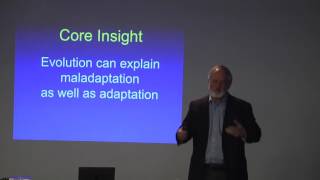
Medicine Without Evolution is like Engineering Without Physics- Randolph M. Nesse, MD