Medicine Without Evolution is like Engineering Without Physics- Randolph M. Nesse, MD
Dr. Randolph Nesse argues that evolution is essential to medicine, like physics is to engineering. He explains six reasons humans are vulnerable to disease: mismatch with ancestral environments, pathogen co-evolution, trade-offs, selection for reproduction over health, neutral genetic quirks, and defensive mechanisms we misread as illness. Fever and panic attacks are often false alarms built by natural selection.
Chapters
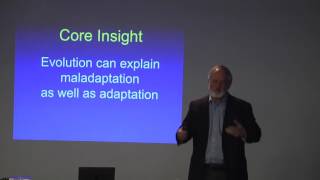
So this talk is going to be a little different. I'm not going to be able to deal with the kind of specifics that you all are getting into, and I really appreciate this wonderful opportunity to learn something from people. I wish I could spend more time. I've been gone the last two nights, and I'm going to be away all next week. My wife says, "You come home right afterwards." So I'm going to do that, but it's really been great to hear things. My theme is kind of a big one: medicine in general without evolution is like engineering without physics. Really, this is an introduction to evolutionary medicine, and I'm going to try to say a bit more about how I think ancestral health and mismatch theories fit into the larger picture. So Darwinian medicine now at 25 years old. This is the article that George Williams and I wrote 25 years ago with the grand title The Dawn of Darwinian Medicine. George said, "We've got to have that title." And I was a junior guy, and I said, "George, can't we say something like, 'Some Ideas About Evolution and How They Might Possibly Be Useful to Medicine'?" And he said, "No." So here we are. But it was true. There was a Science article a year ago talking about the drawn-out dawn because it has grown slowly. But if you wait long enough, ideas do grow. This is a graph done by John— or Joe Alcock. From University of Utah, leading emergency room doctor who's an evolutionary biologist also. And here we go. Exponential growth in papers in the field. So we're really coming along. These are the people who got it started. George Williams is my partner in the whole enterprise. Wouldn't have happened without him. Ernst Mayr, John Maynard Smith, Bill Hamilton, and Nico Tinbergen. So what is Darwinian or evolutionary medicine? It's very simple. It's using the basic science of evolutionary biology to solve problems in medicine and public health. Here's evolutionary biology. Here's medicine. And here's evolutionary medicine. You would think this would have been done like 100 years ago, but we're still really just getting started. Most doctors have never had a chance to really learn evolutionary biology, and these ideas are still growing very fast. What it is not: there's nothing radical about it. There's not a method of practice. It's not opposed to ordinary medicine. And it doesn't make any direct clinical recommendations. All these reporters always ask me, "Dr. Nesse, how should doctors change their practices tomorrow once they learn evolutionary medicine? How do you practice evolutionary medicine?" And I say, "No, that— maybe someday, but right now we have a really solid scientific theory like genetics or physiology or anatomy." and it suggests studies to do, but if you start making direct clinical recommendations from the theory, you're going to get in trouble. This reminds me of a fancy drink I had one time at the top of a big room overlooking the Brandenburg Gate. And the guy who was the head of the Wellcome Trust had had a few drinks, and I wanted to get him on board with evolutionary medicine. And I say, you know, Wellcome should really be supporting more evolutionary medicine. And he looks at me and says, "We don't need no evolutionary medicine. We don't need any more radical wild kind of stuff." He'd never heard of it. So this is what we're up against. You're in the Grand Canyon State. Please go up there if you possibly can. Evolutionary biology on one side, medicine on the other side, a huge gulf between them. And one of the challenges for all of us in evolutionary biology is helping people to understand just the magnitude of time that we're talking about. Let's imagine, for instance, that there's a little creek going through that spot. And every year, it wears away a thickness of earth equal to a dime. How long will it take to dig the Grand Canyon? Ah, diamonds, call it a million— a million years. That seems like a long time, right? But it's nothing. It's nothing. You know, it's 5 million years or so since we split off from our last common ancestor. 65 million years since there were dinosaurs wandering around these parts. Think about 65 miles deep or 65 miles high. Our human minds are just no good at grasping these immensities. So the thing that got me from my first days in medical school is how absolutely perfect the body was, or seemingly, and how absolutely badly designed it was. And I've spent my whole life trying to reconcile what works so well and what is so bad. Parts are really exquisite, uh, better than any Mercedes. Way better. By the time you start in clinic though, and you see the mundane things, the constipation and the hemorrhoids and the acne and the breast cancer and the heart attacks, you wonder to yourself, is it like a Yugo on blocks or something? It's almost like whoever designed this thing worked very, very hard until Friday about 3 PM, and then went out and got drunk and finished the job quickly in the last few hours. The question is why? Why didn't natural selection do a better job in making our bodies better protected against disease? Just in the last few years, after doing this for a while, I realized that the big picture here is transforming our actual perspective on disease from that of an engineer— that of a mechanic to that of an engineer. A mechanic knows how things work and what's broken and what to do about it. An engineer takes a step back and tries to understand not just how it works, but why it is the way it is. Why does it have weak spots? Again, incredible perfection. And it's so much fun to talk with physicians because I don't have to explain what the Loop of Henle is, and you all know how cool it is. It's just amazing. And the heart, of course. The eye seems really cool, except that it's not. Anybody who does hand surgery or even sees patients, and it's fabulous the way all those muscles and tendons and— fabulous the way it works. Works. This is the intrinsic pathway, grossly simplified, but you have to test people on things, so you have to simplify it. And finally, something that I just hated in medical school, and now, thanks to taking an evolutionary view, I've grown very fond of. Does anybody else have mixed feelings about intermediary metabolism? We all memorized it, and we heard some nice talk about aspects of it, Um, just memorizing all that stuff makes no sense whatsoever. But if you take an evolutionary perspective and you ask why it's ATP and how it got to be that way and how energy is transferred and what it's all for, it starts making sense. I'm trying to convince deans of medical schools that if you want to peep— have people memorize 10,000 things, you better give them a framework to hang it all on, and we've got one for them. So that's what works well. What doesn't work well? A lot of things. How many of you are really glad you have wisdom teeth? No. An appendix? No. That's a kerple— I mean, a Colles fracture. Did you ever wonder why it always breaks in the same place? I mean, people have been falling down on their hands for millions of years. Why didn't natural selection make it thicker? Then there's coronary arteries. Couldn't natural selection have just made them a millimeter larger? So nice. And then, what do women really want? A zipper. I mean, this, this whole idea of forcing a baby's head through a narrow rim of bone, it's crazy. And then there's the spine. All of our patients say, "What's wrong with me and my spine?" And if you have an evolutionary view, you start off by saying, "I'm very sorry you're having this problem, but it's not just you." It's 80% of humans at least have severe back pain at some time in life. That's a big problem. So here's the core insight, and I think I didn't really realize again until years had passed what George Williams and I had really done. We recognized that natural selection can explain why things don't work as well as why things do work. It's quite non-intuitive, isn't it? Natural selection makes things work better and better and better. And we're saying, look at things that seem like they're badly designed and ask why. The key here is discovering the right question. Jonas Salk said famously, "What people think of as a moment of discovery is really discovery of the right question." The new question is, why did natural selection leave us so vulnerable to disease? A complete shift in perspective, again, from a mechanics perspective to an engineer's, from describing the system to explaining how the system came to be the way it is and why it has these defects in the design. Not why some people get sick. That's all of medical research. We're trying to say why we all are vulnerable to diabetes and obesity and breast cancer and all the rest. What I learned in medical school, and most of you did too, I'm sure, is that the answer to that question was simple: natural selection just isn't that powerful and can't do everything, so get over it. And that's the right answer for some things, but the big advance is recognizing that there are 5 other reasons why bodies aren't better. And a lot of the aspect of evolutionary medicine I've tried to develop is to get people to systematically and carefully try to say for each disorder Which combination of these 6 things helps us to understand why? These are evolutionary questions. The 6 reasons, very quickly, are mismatch with the environment, most of which is the emphasis here, so I'm going to go into that in some depth. Second, coevolution with pathogens. They evolve faster than we do, so it's no surprise we still get infections. In fact, it's astounding that we can live at all without infections. It's just astounding. Every trait is a trade-off. Some people think that evolutionary medicine says the body is perfect. They haven't bothered to do any reading. Evolutionary medicine says no trait can be perfect, because if you make one thing better, you're going to make something else worse. There are some things natural selection just can't do, just like my professors told me in medical school some time ago. Here's a disturbing one that I'm still working out the implications for. Natural selection doesn't shape us for health, or longevity, or happiness, or smooth relationships. It shapes us to maximize the number of genes we transmit. Have you noticed that any of your patients sometimes do things that aren't good for them, but are good for their genes? Especially sexual things? Um, some of us get in trouble that way too. I mean, it's really serious. That natural selection gives us motivations and envies and all kinds of things that aren't good for us, but we can't help it because we're being influenced by our genes. And the last one is the clinically most relevant, and that's defenses. Now, these aren't really reasons for vulnerability, but these are the problems our patients bring to us. They're not pathology, but they often get confused with pathology. So in the next 10 minutes, maybe 15, I'm going to go through each of these and just give you a few examples emphasizing mismatch and trying to talk about how ancestral health fits into this larger picture. First, 4 cars, all of mine actually, or close to being mine, that won't start, just to illustrate that these are very different kinds of questions. This car is a little Italian Sunbeam, and my old babysitter, who was very attractive, drove up to my house in Michigan one winter with her boyfriend for coffee. I was in college. We had a nice chat. And she went out to that car afterwards, and he went out to the car, and it wouldn't start. Why wouldn't it start? Because the starter motor wasn't strong enough. That's the proximate explanation, the mechanistic mechanics explanation. What's the evolutionary explanation? That car was never intended to be even driven in Michigan, much less start in a Michigan winter. It's mismatch. This is a car I got when I was in medical school. It's really ugly, but it was really cheap. I put in SAE 40 weight oil. I went out one winter morning to get the rounds. It wouldn't start. Why wouldn't it start? Because the oil was too thick. That's the mechanical explanation. The evolutionary explanation is I wanted that car to last forever because I didn't have any money, so I put in extra thick oil so the transmission would last a long— engine would last a long time. Trade-off. That's why that didn't start. Finally had enough money to buy a car. Bought myself a Ford Fiesta. Bad judgment, but, you know, you're young. I went out one morning, says, "I'm supposed to draw blood at 5 o'clock in the morning," back when medical students were scut persons, and it wouldn't start. Being handy, I crawled underneath the car in the Michigan slush, and I found that the wire had fallen off from the starter motor. Why wouldn't it start? Because the wire had fallen off. That's the mechanic's explanation. The engineer explanation is that the Ford engineers were too cheap to even put any rustproofing on that wire, and it was gonna fall off. Finally, I took my family out west one time in an RV some years later, and we got to our first stop, and it was a Saturday night. Started it up Monday morning, or tried to start it up. Nothing happened. Krrk, krrk. I mean, we're trapped in a car lot someplace in northern Michigan. It's not going anyplace. And I tried, I called the owner. I said, "It won't start." The guy goes, "Any—" Nothing, nothing, nothing. And my family still knows not to actually remind me of why it wouldn't start. But unfortunately, I discovered it for myself. Otherwise, who knows about my marriage? It turns out that you have to put it in park before it will start. And that's a defense. Some engineer made it that way specifically so some fool couldn't accidentally jerk it around. By starting up. So these are the engineer's approaches to why things won't start, which are very separate. I'm just trying to— this is hard to get across quickly, but it's an entirely different kind of question we're asking. Mismatch and that little car. Diet and exercise are the huge emphases here, big factors in ancestral health. I'm going to go through a few things about that, and let me just emphasize to you that I don't know much about this. You guys do. And so you'll have to humor me a little bit. I'm just trying to provide perspective here. And I appreciate what I've learned here. First of all, these are 10 top causes of death. New England Journal article from a few years ago, 1900 and 2010. First of all, notice that death rates overall have been cut in half. Notice that diphtheria, senility, cancer— these things have been cut dramatically. Heart disease has gone up proportionately. Tuberculosis mostly conquered. Pneumonia mostly conquered. GI infections mostly conquered. Cancer growing. I'm not sure if this is age-adjusted or not, but we all know the general picture. More dramatic is this article about the epidemiological transition. We've had this tremendous transformation just in the course of my career where early on lots of people were dying from rheumatic fever, hepatitis, tuberculosis, measles, and mumps. And thanks mainly to vaccination, but partly to antibiotics and to better nutrition, we've made huge progress in conquering those. In the place of those diseases, though, we have new epidemics, and very few people are aware of just how huge they are and how fast they're still growing. We have exponential growth, not just in asthma, but in type 1 diabetes, in multiple sclerosis, in Crohn's disease. What's going on? Our health researchers are putting billions of dollars into trying to understand the mechanisms for these disorders. But what is it that's doing all of this? It's an unanswered question. There's good evidence about what's going on in multiple sclerosis. It's increasingly clear that individuals who don't have worms in their gut— worms stimulate the IL-10 system, which basically down-damps one aspect of the immune system. If you don't have worms in your gut, as all of us did for the past several million years, we're all quite abnormal, lacking worms in our gut. Then you're much more likely to pick up worm, get multiple sclerosis. This is whipworm prevalence in about 40 different cultures. If there are whipworms in people in your culture, hardly anybody has got multiple sclerosis. But if there's no whipworms, big time. What about diet? We should all agree that there's gigantic epidemics of chronic disease being caused by people eating diets that they have no business eating from an evolutionary viewpoint. And I think if we emphasize that instead of the controversies, we're gonna get much further with everybody and for our patients as well. Most people these days are eating diets that we're utterly unprepared for physiologically. Another thing though, everybody wants to know what's the normal diet? What's the ideal diet, Doctor, please? And I think an evolutionary view is pretty clear that there is no such thing as the normal diet. Or the optimal diet. There are different diets optimal for other, for different things. And again, most people are eating crazy bad diets. Almost anything they do to get closer to an ancestral diet is going to improve things. Now the big point is that all diets have advantages and disadvantages. Now many patients and others are really wishing that there was one diet that had all advantages. But I think The advance we're coming towards now, this being trade-off kind of thinking, is talking about the advantages and disadvantages of more carbs versus less fat. The advantages and disadvantages of more fat versus less carbs. And all of the other subtleties that interact to create diets. And it's also increasingly clear that different subpopulations have different dietary needs and respond differently. The amylase copy number variation in different cultures, I'm a bit skeptical about that. But I know my ancestors on a tiny island in the North Sea for the last 1,000 years basically lived on fish. And I think that's good information for me to make use of. Plus, omega-3s are good for us. And your omega-3 to omega-6 ratio is definitely related to inflammation for good physiological reasons. This is a scary slide, right? And I wish it was just other people, but all of us have some of this. The only matter is how much. And the dramatic data, this is back from, is it Loren Cordain, or I think it's Po Heaton actually. Here's the original paper, modern American cholesterol levels around 200. But these numbers, pre-industrial populations, hunter-gatherers, rural Chinese, 120 to 130. And here's a question I would love to talk with some of you about if there was more time. I've had patients who tried desperately to get their cholesterol down to those levels. They work out 2 hours a day. They don't eat any fat. And their levels stay up. What's going on? Is it something early in life that sets this cholesterol level? And it doesn't— there's a mystery here that I would love to be better informed about. Send me an email if you know the answer to why these populations have lower cholesterol levels. And again, cut that controversy. It's so hard to I mean, what do newspapers wanna publish? They wanna publish things that are extreme and controversial. And that makes it very hard for people who say sensible things about diet to get a lot of attention. But again, I would support anybody who says eating a diet similar to our ancestors instead of what you get in a modern grocery store with processed foods is absolutely a good idea. But again, it's all trade-offs. Every diet has advantages and disadvantages. Languages. A special treat here is to talk to you about Jim Neel. Jim Neel is the guy who invented the thrifty genotype. And if you go even a mile from this hotel, you'll come to Pima Road. You've heard of Pima cotton. And you've heard of the Pima Indians. That's where the whole thrifty genotype hypothesis came from. And the very first seminar I ran on evolutionary medicine was at the University of Michigan. And actually, the person I learned genetics from was Jim Neal, not in a proper class. I went in the doctor's lunchroom every day. And about 3 days a week, he was there, and we talked over lunch about genetics. And he's like one of the world's great geneticists, and I was completely ignorant. He says, Randy, you know, introns and exons are different. Would you like to know how? He was so generous. And he was just great. So this is— A picture of Pima Indians in 1899, just down the street from here. They are not obese. This is current data about the percent, age-adjusted, of diabetes. Non-Pima Mexicans, Mexican Pimas, and U.S. Pimas. It's now up to 50% that have diabetes. Talk about a really serious identifiable health problem in a subpopulation. What's going on? I've read several papers in preparation for talking with you just to try to get a bit up to speed on this. It turns out that the proportion of carbohydrates in their diet is pretty similar to what it was before. They were eating tortillas, quickly digestible maize products. Not a huge change. Yes, there's more high fructose and things in their diets now. But how— when does this transition happen? Over with obesity, I'll just show you this in the— or because of time. This is just from 1995 to 2010, a 15-year period, very recently since the already experienced some modernization. And during that time, rates of obesity went from 30%, uh, for men to more like 55% for women. I think this is huge. What exactly is happening? Is it that we found the right way to put the right combinations of fat and salt and sugar into food by companies, and that people don't have much money, so they buy cheap food like that, and they have remotes on their TVs and air conditioning. It probably is some combination of those things. I want us all to keep looking for other things, though. There are things like vitamin replacements for— vitamin supplementation for women in pregnancy, and folic acid is a dramatic changer of methylation patterns. And we know that methylation patterns influence tendency to develop obesity later by the so-called predictive adaptive response that Peter Gluckman has studied, and David Barker. So there, there— I want us to keep considering other possibilities about what might be going on here. On to cancer. I wrote a paper on evolution and cancer a couple of years ago, and I put my standard 6 things in there about which— does environment have anything to do with it? And I was astounded to learn what I should have learned a long time ago. A third of all cancers are due to tobacco. I didn't know that. I knew it was bad, but I had no idea a third of all cancers, and not just lung cancer, other cancers too, bladders and others. And then this one's big too. Did you know that a third of all cancers are attributed to diet by the American Cancer Society? That includes lack of exercise as as well. I'm not sure exactly how they calculate that, but it's important for us to tell our patients that it's not just attractiveness and heart disease we're dealing with here, it's cancer as well. Then we have infection and a lot of other things.
No, I don't think that's very scientifically accurate. It was probably created by a committee. Because I find it hard to believe that pesticides— I think that Industrial pollutants are a huge factor.
Um. So I'll confess, I found the most attractive one that had readable print to show to you. Um, the one from the American Cancer Society is essentially identical, but I suspect this was influenced by a pesticide company, and they probably got it. So good point. Thank you. Breast cancer. I ask every epidemiologist I see about breast cancer, how much more common is it —now. Boyd Eaton back years ago said 80 times more common. Seems extreme, but who knows. More reasonable attempts are 10 times. What's going on that's making it that much more common? Is it, for instance, estrogen stimulators and that kind of thing? Two things that we should consider are the number of menstrual cycles women have and the ages at which they have them. My colleague Beverly Straussman has looked at the number of menstrual cycles in an African population that doesn't use birth control. Birth control, it's 100 over a whole lifetime. And they don't start their first periods till they're 18. Modern American women, an average of 300+ cycles. The system was never designed to take that much endocrine stimulation, and many women are now starting their periods at age 12 or so, and the breast cells are dividing in a way before puberty that makes them more vulnerable to cancer. Some people are experimenting with artificial pube— artificial pregnancy for girls at high risk to see if that might reduce the risk. This is a dramatic one about different cultures and their levels of progesterone versus breast cancer. That's a pretty nice straight line, and the range here is almost— whoops— the range here is twofold, from USA at the top, higher rates than anybody else, to the Congo down at the bottom. What's going on here? Probably a simple good nutrition. Once you get nutrition that's beyond what nature ever intended, um, your hormonal system cranks up for good evolutionary reasons because it's sensing that it has opportunities to reproduce more than usual. And then you get these concentrations that drive the system beyond the limits it was designed for. Now myopia is a special interest of mine. Um, in medical school, I said to my professor when he t— told me it was a genetic disease, and it is a genetic disease. I said, "How could genes that make people like me semi-blind survive if we had to live on the savanna?" And his answer was, "Mutations happen. Natural selection's not that great." That's true, but is that plausible? How many of you have nearsightedness? Can you imagine being on the African savanna without your glasses? It would be, "Hello Kitty! Oh, whoops!" —Pardon me? Say again? If you lived as a hunter-gatherer, you'd be much less likely to get myopic. That's exactly my next point. Thank you. And that's been proven, not with the hunter-gatherers so much, although some people have done refractions on them, but with the Inuits. And they showed that back in 1910, there was hardly any myopia. And once well-meaning people came in and taught people how to read, myopia exploded to the regular 33% time. Now, Loren Cordain has written a paper saying that it's not reading and things early in life, that it's exposure to glucose. So there's an open question here about what it is that's changing the system.
Question? You've already passed your genes along at that point, right?
What?
You've already passed along your genes at that point.
You've already reproduced. Well, you're pretty blind starting at about age 10. But here's a really important point for all of us. A lot of people think that because something is highly heritable, it's caused by abnormal genes. But a large proportion of the genes that are causing chronic diseases in our time are normal genes that have no bad effects in ancestral environments. We've named them quirks because they don't do anything bad unless they interact with modern environments. So most of these genes, for instance, that cause atherosclerosis, in ancestral environments wouldn't have done much harm. And this is a list I keep above my desk just to remind myself. It's not just diet and exercise. There are all these other things we should be considering that are wildly abnormal in modern environments. There's night at— light at night. Do you know about the studies that show cancer rates increasing quite dramatically for people who keep night lights on at night and people who do shift work? In, in women for breast cancer and men for prostate cancer. Confirmed with mice by double crossover circulation studies. Melatonin seems to inhibit the division of cancer cells. Lack of daylight may be very important for— and vitamin D, of course, and depression is relevant. And just the timing of these things is relevant too. I mean, people nowadays stay indoors for months and then watch out as the next couple of days get you. Run outside in the sunshine and sunbathe and get a huge dose of solar radiation all at once. Our ancestors were outdoors without clothes most of the time. Did they just get huge amounts of skin cancer? I don't think so. I think they got steady increasing amounts of sun as spring came. And the sunshine induces DNA repairases in the skin, to say nothing of tanning. So just changes in timing of things. Likewise, our eating patterns. Many of you are knowledgeable about Diets where you fast a day a week, that's probably the way we all lived and our bodies may be expecting that physiologically. Sleep changes, drugs, antibiotics, heating and cooling has been mentioned, communication, sterile food, long-term marriage, birth control, mass media, vast differences, each of which needs to be identified. So that's number 1. What proportion of chronic disease is caused by mismatch with modern environments? At least half. This is what modern medicine has become. And we're trying to figure out what we can do about it. We give our patients advice, we try to find different ways of influencing them, influencing media, influencing organizations, and it's very hard because we're fighting evolved tendencies. Because the people who like fat, salt, and sugar on the African savanna did better than those who just like vegetables and like to exercise a lot. Co-evolution, second reason. Pathogens evolve faster than we can, and the costs of defending against them are large. Here's a cute one to make a transition from the pew— uh, people in my center recently published an article suggesting that maybe bacteria in our gut secrete substances that influence our brain to make us want to eat the things that are good for those bacteria. And they have some real evidence for this. This in mice and are conducting further studies. It may well be that if you eat sugar for a while, it induces certain kinds of bacteria that try to take over your brain to get you to eat more sugar. Very interesting ideas. I tell my medical students, why do you think in 480 soil samples taken from around the world that the average one has 8— the average One has— is resistant to 8 different antibiotics. And they say, "Well, people go around the world peeing a lot on the soil." But that's not the answer. The answer, of course, is that bacteria and fungi have been engaged in biochemical warfare with each other, not just for a million years, but for a billion years. Why do we discover our antibiotics in bacteria and fungi? It's because natural selection has shaped them there. Penicillin resistance, you all know all too well from your clinical practices what a terrible thing this is. You will probably also know the Surgeon General back 20 years ago said, "We finally conquered infectious disease." He said that 2 years before the HIV epidemic started and before we realized we're out of antibiotics for tuberculosis and even a lot of staph. What you may not know is that doctors are frightened of using the E-word, evolution. In biology journals, evolution is used routinely. In medical journals, the word emergence is used routinely. I don't know what's going on there, but if you submit certain grants to NIH, they'll tell you, "Could you please take evolution out of the title because we don't want to have to fight with people who are going to review these grants." Carl Bergstrom is a friend who's on my advisory board, a mathematical biologist from Seattle. And he took on the question of whether doctors who are trying to be evolutionary doctors were helping. With their strategy of cycling antibiotics. So all docs at a hospital started with the same antibiotic for a while, then they all shifted to another one after a few months, then they all shifted to a third one, then they shifted back. They were trying to prevent antibiotic resistance. Well-meaning, but this is not something you just do casually. And his calculations show that they may well have been maximizing the rate of creating multidrug resistance. If you're going to do this stuff, find a good mathematical biologist to collaborate with you, please. Likewise, Andrew Read, another fellow on my advisory board, uh, real leader in malaria research and infectious disease and evolution in general, has asked the question, "Is it wise what we advise our patients to do, to take every antibiotic pill in the bottle?" Many doctors tell their patients, "From an evolutionary perspective, we're all trying to prevent antibiotic resistance, so Even when you feel better, keep taking all pills in the bottle. And this is a really good example of someplace where you don't make clinical recommendations based on theory. You do studies. But the mathematics of this suggests that almost the only strategy that is guaranteed to not be very effective at preventing antibiotic resistance is telling people to take all the pills in the bottle. It depends on the organism, the individual, and the community. This is a nice one. Katie Hind, we recently hired from Harvard for my center. And part of her work is looking at the fact that mother's milk, 15% of it is oligosaccharides that the baby cannot digest. Whenever you hear something like that, as an evolutionist, your ears perk up and you say, "Whoa! Did natural selection goof?" Maybe. But in this case, it turns out that although the mother can't digest them, It's also the case that pathogens can't digest these oligosaccharides. However, bifido, which are the good bacteria in the gut, can. And what's going on here is that mothers give their babies a dose of, of nutrient that's just for those bugs, gives them a dose of those bugs, and the microbiome in the gut gets off to a good start. Any of you who work in an ICU for preemies, um, think very carefully before you require mothers to stay sterilize their pumped milk for their babies. You're depriving those babies of substances that actually have been very carefully programmed. And now we're back to my little cars. Constraints and tradeoffs. Again, it's tradeoffs all the way down. This is an article about atherosclerosis that I just put in there. Alan Wieter, who's the head of hypertension at the University of Michigan, and I wrote it. Even for atherosclerosis, why are there inflammatory cells in the lining of the blood vessels? 2 seconds' thought makes you recognize that that's a very important place to have inflammatory cells. You don't want, you know, pathogens crawling back and forth very easily. You want to catch them before they circulate in and out of the circulation. So there are big tradeoffs here. It would be very interesting to learn whether people who have more tendency towards atherosclerosis early in life, or mutations that make it more likely, also are more protected against sepsis. I don't know that anybody's ever addressed that question. Our eye is always held up as this really, really exquisite thing. So would you devise a camera that had a big black spot in the middle where no— that's kind of dumb. Or how about a detachable retina? The octopus doesn't have those problems. The octopus has nerves and vessels that come right through the back of the eyeball. No detachable retina, no need for wiggling the eyeball to get a complete —complete, you know, picture, no nystagmus. A better design. How come we got stuck with the bad design? And the answer here is that one I was taught in medical school. It's just bad luck. Uh, the layer of cells that became light-sensitive was different for us and the octopus. This is Josh Shiffman, a kid who came up to me after a lecture I gave 15 years ago and said, "I want to do a project." We did a project asking the deans of all the medical schools how much evolution they were teaching. Now he's a world-leading evolutionary oncologist at Utah. And this is his story in Utah, uh, in Newsweek. And the essence of it is Peto's paradox. Did you ever think about the fact— I mean, you talk about cells developing cancer because of cosmic rays hitting them and mutations, right? If that's the answer, then a whale and an elephant should have thousands of times more cancer than a mouse. But actually, a mouse has more cancer than an elephant or a whale. Why? It's because cancer has been a selection force that shaped multiple mechanisms to protect against it for larger animals. The fact that people who are taller, humans who are taller, have about a 20% increase for every few inches of extra height testifies to the fact that the general principle is workable. They even looked at p53 predicting that they would find extra copies of p53 in elephants, and lo and behold, they found them, which is so cool. Clinical implications: maybe we can either insert extra copies or better stimulate p53 in normal people. But again, with an evolutionary viewpoint, you don't imagine you're making something better. It's also going to make something else worse. Here's a— one of my favorite ones. I memorized this damn thing about 10 times in medical school. In school because you have to have— you gotta memorize, you know, the heme breakdown pathway and everything. I never asked myself why the body would take biliverdin, relatively water soluble, and use energy to make bilirubin, which is toxic and hard to get rid of. So this is a wild thing that George Williams and I put in the book. We said, you know what, maybe it's a good antioxidant for a long-lived species. And since then I found some data. Did you know that people who have Gilbert's disease Men my age have heart attacks at half the rate of other people. Could I please have a little Gaubert's disease right now, please? How do you test this thing, though? Are these things just so stories, untestable? Turns out that Saul Schneider, the great psychiatrist researcher at Johns Hopkins, did a knockout model on cells and discovered that if you knock it out— whoops. Was that my— there we are. That was the timeout on your computer. Battery. Uh-oh. I thought we were supposed to be able to get power at the same time. That doesn't actually— Well. It's not that kind of power. So our fancy new computers do have a limit, don't they? They do have a limit. It's a trade-off. It does. That's not going to work. That's right. These new Apple computers are very light. Perfect, thanks. And they have a USB-C port. And it says, oh yeah, you can plug in power and— It would work, but I don't have a power into it. Oh, there's no power in? There's no power in on this thing. So we could power this. Who's got a USB power thing for their phone or anything? Actually, I'll give the rest of the talk without this. Will it work like this? No. No? That would be fine with me. It's got to be a special connection. One moment. You know what? We would take 5 minutes just fiddling with this. Let me just talk to you about what else I wanted to say. Let's just do this then. Let's just plug in your machine. It probably will charge up in a minute, so I can— Get back on. So let's see, how far did I get? I got through mismatch, I got through— You were doing bilirubin. I was doing bilirubin. The punchline there is, you know, you knock out the thing that goes around and around. Every time that cycle goes around, it knocks out a reactive oxygen species. Okay, next is beta amyloid I was going to mention, the stuff that causes, or think is related to, Alzheimer's disease. A finding I think you will find splashed everywhere in the next few months is that beta amyloid is a very good antimicrobial. Natural selection doesn't make substances for no reason. It turns out that it entangles bacteria. And that's not too easy to prove. But I think you'll see a lot about that soon. I can go— go with that. Um, I'll just skip this in the interest of time. So the next one I was going to talk about is a very good story. Um, why has Type 1 diabetes become so much more common, and why are genes for Type 1 diabetes hanging around? The editor of a major paper called me up and said, "We have discovered the evolutionary reason for diabetes." It turns out that the genes for Type 1 diabetes are more common in Northern Europe, they're about 10,000 years old, and that many species have high levels of glucose in the winter to protect their cells from damage from ice crystals when they freeze. And this author published a paper in Medical Hypotheses, which takes great pride in being a non-peer-reviewed journal, saying that this was the explanation of diabetes type 1. I said to the editor, I said, 'Wait, diabetes type 1 kills you, which is like very bad for your reproductive success over the last 10,000 years. And, you know, if you showed me something that cranked up glucose levels and cells 10% or something, we could talk. But this is— it's an autoimmune disease. It's not something that happens to everybody. It's— this is crazy. Don't do this. And the person contacted me a few weeks later and said, Dr. Nessie, we do respect your opinion, but we've contacted two of the leading diabetes experts "who think this is probably the correct explanation." And I said, "I didn't say talk with diabetes experts. I said talk with evolutionary biologists." And this is the big deal here. This is why I'm dedicated to trying to help everybody use evolutionary biology properly. And this little example is to make it clear that it's not easy. These are very sophisticated people doing something that's just completely wrong. But you don't blame them. You just try to help people learn more about evolutionary biology. There also is a plug for one of my favorite papers. A bunch of people around the world have said, "Randy, quit complaining about papers that aren't good and put out some criteria for how to do it." And on my website, there's something— a paper called "10 Questions to Ask If You're Going to Test an Evolutionary Hypothesis About Disease." I really wrote it to because I was frustrated with my students. They kept sending me these papers about the evolutionary advantages of schizophrenia or colorblindness and stuff. And this— it's hard conceptual work in this area, very hard. And so I have these 10 questions, and if you go through them and answer them, it prevents many of the mistakes that otherwise mar work in the field. Next explanation is that health is not the goal of natural selection. Its reproduction. And the example there is the fact that half of you in this room have bodies that are really substandard. And you know, we know who we are, right? It's us guys. Why did natural selection leave us with bodies and minds that make us more vulnerable to so many diseases? It turns out the reason is that investing more in competition for males and not just human males, chimpanzee males and Drosophila males, um, gives an advantage because you get reproductive advantages. For females, investing more in tissue repair and being sensible, um, gives you a better advantage. This means that males die younger. So I got data from the World Health Organization that gives you mortality rates by age, by sex, by country, and by decade going back 150 years. And I had the greatest time analyzing these with a colleague. We published a bunch of papers about this. But here's the guessing game you can play with me. For every 100 women aged 20 in this county who are going to die this year, how many men are going to die? If you think that women die more at age 20, you're going to want to say 80, 70. If you think it's equal, you're going to want to say 100. If you think it's 20% more, you're going to want to say 120. And I will take your bids. 150. 150. I have 150 going once, going twice. 126. 200. 200. Twice as many? What's, what's raising?
200 would be 200 males for every 100 females?
Yeah. That's right. Twice as many male deaths per— at that age. I'm going to go 200. You'll go 200? 140. 140. So thank you very much for playing along with me. Your guess was mine. When I started this, I thought 20% increase would be about right. Then I looked at the data and I was bowled over. There are 350 men who die for every 100 women who die in this county at age 20 every year. Driving, drunk driving, bikes. Half of it, half of it, half of it is stupid male behavior. But the other half, I mean, If you look at the 20 leading causes of death, 19 of them are— have a higher mortality rate for men. Guys, our bodies are devised for competition at the expense of health. Very important. We know testosterone is bad for your health in many ways. Good reasons. And now we have practical clinical implication. A lot of guys are coming in and say, "Can I have some testosterone supplementation? It'll make me younger." No, it won't. It'll make you older. And fast. We did this, by the way, for 20 different countries. It's very— there's some variation. It goes from 250 to 350, higher than 350 in Russia after the perestroika, mainly because of vodka. In the Orient, it's more towards 200. Very interesting. So why is there aging? That's what got me into this whole business, is trying to figure out why natural selection didn't eliminate genes for aging. Aging. The old answer is it didn't do anything. Yeah, you can try plugging it in again. I might get a few more minutes out of it. Okay, we're going to go faster. And the gist of it— George Williams had an answer in 1957 which has revolutionized gerontology, and a lot of doctors don't know about it. A gene that makes things go better early in life when selection is stronger will be selected for, even if it eventually kills everybody. His example was a gene that changes calcification of bones and makes them heal faster, and also calcifies your coronary arteries. It's so profound. This has led to a bunch of papers I published, and more than that, here's my calculation of what would happen if mortality rates stayed the same in the United States as they are for people at age 20 for the rest of the lifespan. Answer: about a third of us would live to age 1,000. Senescence is the big, big thing. Defenses is last category. Half of the problems you see in your clinic are people bringing in things that are just the mechanism not working right. But half of them are defenses. That is, natural selection shaped these mechanisms to go off when they're useful. And they're not disorders. But they sure seem to happen a lot too much, right? And what we do in general medicine in particular is block these things. And they don't kill— we don't kill our patients routinely by giving them things that block fever, cough. We all know better than to drop— block cough in pneumonia, right? But fever? I mean, pain? And why is there too much? The quick answer is the smoke detector principle. Um, the smoke detector principle explains why we put up with smoke detectors even though they mostly give us false alarms. And here's the example. This is why we can block it fa— fa— fa— safely. We're going to make an example, very imaginary here, of panic disorder. I've treated hundreds of cases of panic disorder. And the question— I always thought, "What's wrong with you? You've been in a grocery store 6 times, nothing bad has happened, get over it." You know, not very empathic after a while. Then I started doing evolutionary biology and applying it to this. I said, "Why are there so many false alarms?" in these systems. Well, if that guy is coming around, you don't want to be anyplace nearby. That's what panic is for, is to get you the hell out of there. Imagine for a second that you're gathering water for your family, and behind a rock you hear a noise, and the noise is like this: grrr. It's not grrr, you'd run. It's not grrr, you wouldn't run. It's in between. How loud does it have to be? How great a probability of a lion before you flee? And the answer is, it depends on the cost of fleeing and the cost of not fleeing if there's a lion there. If the cost of fleeing is 200 and the cost of not fleeing is 200,000 calories, which is pretty much like your life— can you see where we're going? The ratio is 1 to 1,000. That means you should flee anytime the noise is loud enough to indicate a probability of greater than 1 in 1,000, meaning that 999 panic attacks will be unnecessary in the end of the day. —individual instance, but perfectly normal. This has huge implications for general medicine. This is why we don't kill people when we give them things to block fever, cough, and nausea, and all the rest. Because most of these systems are set to have massive false alarms. On the other hand, instead of just blindly giving people drugs, we should think about it using what we know about evolution and how it shapes these regulation mechanisms. This is the book that started it all. Uh, this is an edited volume by Steve Stearns. Another one, second edition, second edition, new textbook of evolutionary medicine, German book on evolutionary medicine, uh, article Richard Dawkins and I wrote in Oxford Textbook of Medicine, another textbook, and this textbook came out just a few months ago. I'm using it in my course now. If you want to learn about this stuff, it's out there. Special issue of PNAS. I run a little blog on Evolution Medicine Review. We have an Oxford Press journal called Evolution Medicine Public Health. Open access for anybody who's interested. Curriculum development. And what I've devoted my life to for the last 6 months is developing something called evmeded.org. And the plan is to have all available resources in this area available to— for anybody to use anyplace anytime. Giving a lecture to your students about problems in birth? Click, 10-minute video to stick into your lecture. Want to know about the costs of using antipyretics in influenza. Click, 10 minutes to stick into your lecture. And lots of books and audio podcasts, anything you could want is there. So I'm here at Arizona State because they allowed me to pursue this mission to bring evolutionary biology to bear on problems in medicine and establish it is a basic science. It really should have been done ages ago worldwide. And finally, I hope this slide lasts for long enough for you —write it down. We created a new scientific society last year, first meeting here. Our next meeting is at Duke in Durham, June 22 to 25, and abstracts are welcome for one more week. We're going to have a gre— we had a great meeting last year, 300 people came, mostly evolutionary biologists. We're looking for more physicians who are interested. Submit an abstract or just come for the fun of it. It's just a rollicking good time. EvolutionaryMedicine.org is how you can find it, and all my papers are on my website at RandolphNesse.org. And that's it. And my computer's still working. Good computer. Thank you very much. Their group is so on the ball, they know where they're going to be in the next 3 years. Tell us where else you're going to be. Well, in 2017, we're going to be in Gröningen, Germany. The Netherlands, in conjunction with European Society for Evolutionary Biology. And in 2018, we'll be at the University of Zurich, where there's a really wonderful evolutionary medicine program. So— 2019 will probably be UCLA, but that's not quite confirmed yet. And we're not coming back here anytime soon because there's too much work. Any questions or thoughts? Yeah, please.
I'm wrapping my head around the fact that if, you know, most cancers are, you know, happening after you reproduce, and how do you explain the heritability of cancer?
So a lot of people have the idea that, especially after a woman goes through menopause, that nothing she does or anything that influences her health can possibly be influenced by natural selection. But there's an important principle called kin selection. and the idea of kin selection, invented by Bill Hamilton, that's why his picture was up there, means that you can do things that influence the future of your own genes even if you don't reproduce, because your children have your exact same genes. So if you, as a woman 80 years old, does something that gives a slight advantage to your grandchildren, you are doing things that benefit your own genes. And if you get cancer and die, you're not going to do that. And there are a number of anthropologists who have done studies about what happens to children whose mothers and grandmothers live or die, and they find out that even if your grandmother dies younger, the kids don't do as well. So natural selection does not end just when you stop reproducing. Wow. You didn't know that, right? I didn't. These are like Evolution 101 that is so cool, um, and very— big implications for all kinds of things in medicine. Yeah? Are there— on the flip side of that, are there any benefits in early life to some of these?
Are there any benefits in early life to some of the genetic mutations that give rise to family cancer syndrome?
So there are two papers now showing that BRCA2 increases fecundity. Increases what? Women have more babies. Fecundity. Yeah. I'm not sure I believe it. I think that needs to be really tested carefully, but some people— if you look at a gene like that, there is positive selection on BRCA2, peculiarly. But if it was really increasing number of children reliably, it would go to fixation even though it caused cancer. Disturbing idea. I mean, I think there also may be trade-offs between aging and cancer. You probably know about telomeres, and every time a cell divides, the telomere shortens a little bit, and that probably in part is a safety mechanism so that cells that keep, keep dividing use up the telomeres and they die. Well, there are some inverse risks between, for instance, neurodegenerative disorders and cancer incidence. Which disorders? Neurodegenerative.
Like Parkinson's.
Parkinson's patients are less likely to get cancer and vice versa. Please send me something about that. That would be very helpful. And that's a classic example of the kind of trade-off we're talking about, which is the most central idea in evolutionary medicine.
It seems like we have all these new— I call them industrial disease, but basically all these new or relative to the history of industrial era diseases. And then how do you counteract that with the increased life expectancy data? Because people argue that on the one hand we've got all these problems we're dealing with, and on the other hand we still are living longer.
Yeah, but some people say, "Oh, Dr. Toshi, you're saying that life was better way back then?" No, it was much worse. Way back then. Life is much better in almost all ways, and we live longer and we're healthier, but it's still true that modern environments cause half of all diseases. That's not a contradiction.
And duration of life is not necessarily equivalent to a duration of good years of life.
That's true too. Yep.
And, you know, there's probably data out there out there on quality of life and how do you measure that, but, you know, spending the last 5 years in a nursing home in diapers drooling is not— if that's what 5 extra years of life is, then, then—
yeah. So part of my team is developing projects to look with data at really what the rates of disease are in pre-modern populations. One fellow, Ben Trumbull, who's joining us in August, has lugged a scanner into the jungle to look at calcification in coronary arteries and valves. He doesn't find any. And he also has done EKGs. Is it just in valves or is it coronary arteries? I don't know exactly. Probably calcification. Yeah, probably. But he doesn't find much. And he also has done EKGs on a lot of older men, doesn't find any evidence of past heart attacks except for one. So, I mean, I've wondered, I mean, we all say heart attacks are more rare back then. But we don't have really good data about that. Ancient Egyptians and mummies did have moderate atherosclerosis, so a lot of questions need to be answered here. The big one, I think, is autoimmune disease. What is it that's causing this epidemic of autoimmune disease? Is it really lack of worms? Or is it antibiotics screwing up our microbiome?
The Autoimmune Summit, which was online, are you familiar with that event? Event last year? No. Oh, October of— that's when I had my hip revision. October of 2014. Okay, great. Google Autoimmune Summit. Okay, um, or I'll send you transcriptions from the summit because it talks about environmental toxins, uh, and gut dysbiosis and increased intestinal permeability.
It's probably a bunch of things, but, um, it's so important try to figure that out.
Right, because, you know, Moises Velázquez in his work definitely tried to address the parasite problem very eloquently. And if you haven't read his book, Anatomy of an Epidemic, is that what it is? Moises Velázquez, about autoimmune disease. He's a reporter with alopecia, and he— the book opens with him driving off to Mexico to get whipworms, and they apply them on the skin and they go through your lungs. But it's not It's not all uniformly successful, but it is— there are some cases where it is really successful.
And this is one of those places where the FDA is actively interfering with people getting these apparently natural treatments. And is that smart? Because some people will get really sick from getting worms. Or is that really interfering with people's rights? And there's a big trade across the Mexican border.
But if it's a trade-off, if you're really sick from your autoimmune suppressing therapy and someone says, "Try these worms," and you actually get better and just keep replacing them every 6 months.
And a number of people who were in on this from the start are now working for drug companies trying to find ways to imitate what worms do without having to give people worms. Yeah? Are you familiar with Carl Horbe? I think that's how it's pronounced. He's a paleo— works in paleodemography, basically. And one of his quotes was that for the whole of human history, life expectancy was about 10 years? So let's— that's another— I skipped a slide early on in the interest of time. And one of them was challenging some misconceptions that are very widespread. A lot of people say, "Well, everybody was dead by age 30 back then, so it's no surprise that we—" But we have now really good data from archaeological sites about how long people lived. We also have data from current hunter-gatherers. And hunter-gatherer who lives, you know, to age 40 or 50 has mortality rates not that much higher than ours. And they don't age faster than we do. Some of them live to their 70s and 80s, and without heart disease, by the way. They lie in bed at night kind of racked by arthritis, 'cause everybody gets arthritis. Don't know why. Because we're standing up, which is a very— talk about an adaptation. It's gonna take us another million years to get used to standing up. Without all the complications that come from that.
When you look at those surviving hunter-gatherers that live on to later years, do women lose their survival— I would imagine women lose their survival advantage because of the deleterious effects of losing hormones in menopause faster than men do. Are there any data on that?
There are data and I don't know them. I don't know them. But the bottom line here is 50% of kids do die before age 10 in hunter-gatherer societies. So if you look at just the average, the average lifespan is about 30 years, but it's because so many babies are dying, not because people age faster or mortality rates are gigantic. But we're so better. Thank you so much.