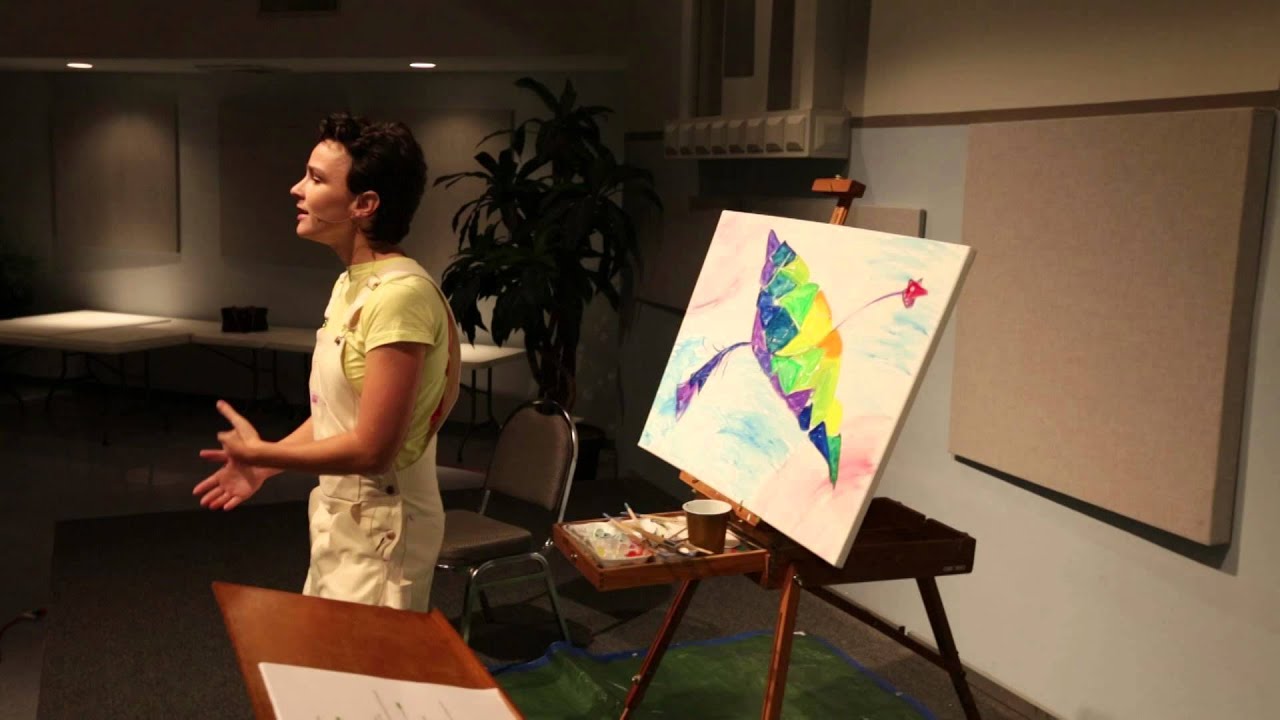
In this academic presentation, PhD candidate Anya Ezhevskaya outlines the Russian bardic music tradition and examines its transplantation to the United States. She begins by defining the genre—poetry‑heavy songs performed with a simple guitar accompaniment—and traces its historical roots in Russia’s literary culture, Stalinist labor camps, and mountaineering/outdoor traditions. Core characteristics are identified as high‑text‑load lyrics, modest guitar accompaniment, and a commitment to authentic, heartfelt expression. Ezhevskaya then discusses the massive post‑Soviet immigration wave of the 1990s, which carried bardic songs to America, and describes four primary venues where the tradition now thrives: private homes, organized concerts, community campouts, and Russian language education programs. The talk shifts to a theoretical framework distinguishing stable elements (guitar, poetic density, authenticity, intimate performance ethos) from malleable elements (author‑singer roles, melodic variation, lyrical content, performance context). Drawing on Brian Schrag’s “Artistic Dynamos” metaphor, she argues that the interaction of these stable and flexible components generates creative energy, enabling the genre’s resilience and hybridization in diaspora settings. Finally, she interrogates whether the genre’s emphasis on authenticity can survive transplantation, concluding that the liminal, marginal experience of immigrants both challenges and enriches authentic expression, allowing Russian bardic music to evolve while retaining its essential identity.
Chapters
Hello, my name is Anya Ezhevskaya. I'm a PhD student at Dallas International University, and today I would like to talk to you a little bit about Russian bards in America. So my presentation will consist of 4 different parts. First, I want to share a little bit about what that genre entails. The roots of Russian bardic music and its main characteristics. Then I'll talk about how the genre migrates to the United States, and we'll talk about even whether it's possible for it to migrate successfully. After that, I will talk about the malleable and the stable elements of Russian bardic music and how their interplay enables transmission resilience, and also gives rise to new hybrid genres. And finally, I will focus on the aspect of bardic music which is authenticity, and I will see whether it is possible for a genre to transplant successfully if at the heart of that genre lies this characteristic of authenticity. So, without further ado, Let us begin. A poem, a guitar, a voice— that's really all you need for becoming a Russian bard, and it helps if you are Russian. Some of the origins of Russian bardic music are listed here. One of the main ones is Russia's rich literary tradition, so there is a, a deep culturally embedded value of literature, and it goes back several centuries, and it's a tradition that has flourished since then. It's this conviction that literature is paramount. You need to know your literature, know your poets, your writers. You need to be able to recite poetry by heart and basically literature will save the world. Another place where Russian bardic music takes its roots is in the labor camps. So completely different place. In Stalinist Soviet Russia, many people from all walks of life, they were repressed and they were sent to labor camps where they were forced to do heavy manual labor. And here, true criminals intermixed with intelligentsia, intermixed with the working class, intermixed with scientists and poets and just anyone in between. And so these people, as they lived this harsh reality together, they needed a way to express themselves. And so they began to sharing ideas, sharing poetry, and begin to come out with songs. And then in the 1950s, when they were finally released, they came out with this almost formulated, rich musical song tradition. And then a third place where Russian bardic song takes its roots is in mountaineering. Mountaineering and outdoor adventuring in general is, is kind of a big thing in Russia. Russian people and people in the Soviet Union, they really enjoy being out in the outdoors. And especially during Soviet times, when in the centers of activity like in Moscow and in Saint Petersburg, there was a lot of this sense of Big Brother watching you. People really enjoyed going camping and just leaving all of that behind, leaving the rhetoric behind, leaving the false fake slogans behind, and just set up camp. They would pull out their guitar, and they would begin singing songs that for once could be truthful, could be honest and sincere. Then so those are. Of the roots of where the genre comes from. One author, J.S. Smith, he calls bardic song the folklore of the Soviet urban intelligentsia. That's a nice way to kind of summarize it. Some of the key characteristics, as I mentioned, are poetry, guitar, and authenticity. So poetry in Russian bardic song is paramount. You need to have high-quality, high-text-load songs. And mostly the way that the songs are created is first the person writes the lyrics and then they come up with some melody. The guitar is what provides the melody. And typically it's just a standard chord progression, a familiar set of notes or even sometimes the same tune that different verses are set to. So it's not critical to have a very elaborate, complex melody. You just need some solid chords to put your voice to a song. And a third central characteristic is this concept of authenticity. This is juxtaposed against what the Soviets lived with. And it was very important that the songs that they wrote, that they shared privately in their homes or when camping, that they came from the heart, that they represented the true realities that the people lived with, not the false reality that was impressed upon them By the oppressive Soviet regime. Let us just listen to a little bit of one song that is very well loved in Russia. This is sung by Bulat Akudzhava. Ила сукуцелой в espioniyakruviz. And that takes us to coming to America. Why they gather, and will the genre take here? That's the question that we turn our attention to next. In the '80s and especially in the '90s, millions of Russians immigrated to America, and they brought their bardic songs with them. There was no other way to do it. We ourselves moved to the United States in 1992 from Saint Petersburg, and one of our four luggage items was a guitar. So imagine millions of people moving. And they are bringing this new genre to this new place. In this new place, they are experiencing marginality. They don't speak the language. Often they don't understand the rules of the land or how the society is set up. But this kind of liminal space that they come into, it actually creates a sense of brotherhood and also enables for creativity to flourish. Creativity, as opposed to rigidity, is related to openness and fluidity, which is also the nature of diasporic experiences and identities. This is from the dissertation written by Kim Jung Kim. So, they come and they are bringing bardic songs with them, and they start to experiment, and after a while you see come to light 4 different ways that bardic song is expressed in America. And actually, it's very fortunate that they moved when they did, millions of Russians, because when the Soviet Union collapsed, the environment in Russia changed so much that bardic song was no longer popular there. So it kind of came here to the States and was preserved here. Now, 4 places where it became— began to flourish here in the States is in the home. So again, we have this familiar intimate structure. And next is also in shows. So there were different concerts that were set up where people performed bardic songs of old revered bards, not their own pieces, but they would even invite some bards from Russia and they performed on a stage. Also, at campouts, like I mentioned, there are chapters of Russian bardic song all over the United States, and they hold annual campouts where they bring their families, their guitars, you know, hundreds if not thousands of people gather and they sing around campfires or on a small makeshift stage. And also bardic songs became part of Russian education that is done here, like during Sunday schools or in Russian theater groups where Russian songs are sung to help the younger generations learn Russian because you are, you know, you are able to learn a language better through song. But the big question remains, what about authenticity? And that brings us to our next step, the malleable and the stable, and how those elements transfer over to America. So stable elements— there are stable elements and malleable elements in any artistic genre. Based on the descriptions provided by Brian Schrag in his recent book, Artistic Dynamos, a stable element in a genre is one that does not change. It basically forms the crux of the artistic tradition. It is a framework within which serious play is encouraged. So it's, it's the rigid kind of outside portion. And then the malleable elements of a genre, those are the elements where you get to play. They allow for variability and flexibility. And it's the interaction of that stable framework and the malleable parts that are allowed to be changed that generate energy and excitement, and that enable an artistic genre like bardic song to evolve gradually and to remain vibrant and to remain relevant. In Russian bardic song, you may deduce already that some of the stable elements are the guitar. If you have a song that is accompanied by a cello or a didgeridoo, you would struggle to call it a true Russian bardic song. You need high text load. It needs to be good poetry. Also, you need authentic expression of yourself. And finally, you need to have the right performance ethos. So it needs to be in an intimate, modest, humble kind of approach with which you deliver the song. If you have a big show, you know, floodlights, lots of paparazzi, uh, if the tickets are costing $100 apiece, That will not be bardic song. But some of the malleable elements— now, the, the fact that the author has to be the singer, has to be the composer— that's pretty flexible. Some bards prefer to sing songs of other bards. Some prefer to just write the poetry and have a more musical person write the melody. So there's some give and take there, although most bards, they do all of those 3. Obviously, the melody itself, it's up to you, although many melodies, especially in the traditional bardic canon, they follow a similar chord progression. The textual content, of course, that's, that's the, the meat and potatoes of the genre, and that's what the person gets to make up out of their own inspiration. And the context, that's also malleable. Like I mentioned, you can sing these songs in a campout, you can sing at home— typically in the kitchen is best— you can sing at a concert, or, or even just outdoors. This, by the way, is another great example of how you can look at the interaction of stable and malleable. This is a dynamo. It's a means of generating energy, and this metaphor also is put forth by Brian Shroff in his new book. So the dynamo is set up this way where the outside is stable magnets. They're called stators. And on the inside you have rotors. They are magnets that are rotating, and through this interaction of the stators and the rotors, energy is created. So this is a great way of thinking about how energy is created when you have the interaction of the stable and the movable parts. This will come useful when thinking about what happens to a chandra when you move it to America. So we have our bardic song and it moves to America. We have the malleable parts, the stable parts, and they, they go up and they come back and they land in a brand new world. And what happens next? Well, there's lots of creativity. People are in a liminal space. They are creating new songs. They are coming up with new melodies. They are sharing them amongst each other. And they have new approaches to lyrics and new