Why You Stay Up Late (Even When You Know You’ll Feel Worse Tomorrow)
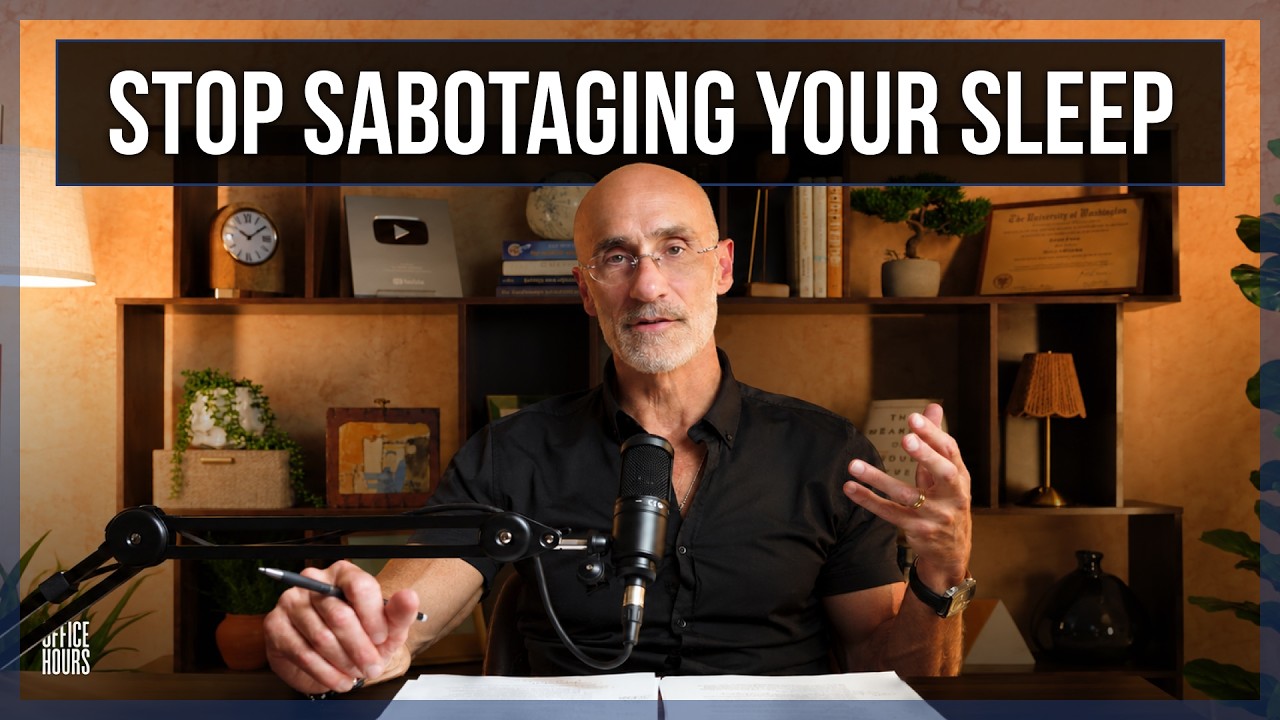
In this episode of Office Hours, Arthur C. Brooks frames chronic sleep deprivation as a public‑health crisis that is also a hidden driver of unhappiness. He begins by citing CDC data that roughly 70 million Americans suffer from chronic sleep problems and explains how sleep loss fuels irritability, threat perception, and a cascade of metabolic and inflammatory disorders. Brooks then shifts focus from the usual physiological explanations to a psychological one: most adults are not unable to sleep, they won’t sleep. He introduces the research literature on “bedtime procrastination” and its more extreme form, “revenge bedtime procrastination,” describing them as short‑term, self‑serving decisions that betray a deeper rebellion against internal authority. Drawing on Kahneman’s System 1/System 2 model, he argues that the solution is to move the decision to go to bed from the reactive limbic brain to the reflective prefrontal cortex through metacognition, concrete resolutions, and habit‑stacking. Practical tactics include: (1) eliminating device use an hour before bed, (2) avoiding food within three hours of sleep, (3) establishing a nightly ritual with a partner (reading, eye‑contact, shared prayer), and (4) using a simple self‑talk affirmation about the chosen bedtime. Brooks also weaves in spiritual perspectives, citing Hindu mystic Ramana Maharshi’s view that true consciousness resides in sleep and Catholic devotion to St. Joseph as a model of divine communication through dreams. He suggests a “metaphysical” use of sleep: pose a life problem before bed, let the sleeping mind work on it, and journal insights upon waking. Finally, he shares his personal supplement stack (Magic Mind Sleep, inositol, magnesium glycinate) and offers reassurance that occasional insomnia is acceptable if approached with a compassionate attitude. The episode closes with brief audience questions on ambition and male friendship, reinforcing his broader message that sleep is a lever for personal happiness, relational health, and spiritual growth.
Chapters
Today, I want to talk to you about sleep. I want to do something a little bit different when it comes to sleep, and that's the relationship between sleep and happiness, specifically the biggest barrier that most people actually have to sleep, which I believe is not what we often hear. Sleep problems are basically at epidemic levels. About 70 million Americans have chronic sleep problems. If you've noticed that you're grouchier, you're really super impatient in traffic, you're not able to put up with the slightest little annoyance from other people around you, like your kids, when you're sleep deprived, That's why. If you go to a sleep specialist, they're basically going to say, okay, there's a barrier to your sleeping that some circumstances that we can actually change. They rarely will talk to you about you actually being the problem. Very frequently when I'm talking to my students and young adults in general, this is what I find. Not that they can't sleep, that a lot of people unknowingly are engaging in something called bedtime procrastination. Hi everybody, and welcome to Office Hours. I'm Arthur Brooks. This is our show about love and happiness. I hope you're enjoying it if you're a longtime listener, and if this is your first time, welcome. I'm very glad you're here, and I'm grateful to you no matter if you've watched it for a year or less that you're spending time with us. I'm especially grateful to you if you're sharing these ideas with others because The whole idea of the show is for us all to become better happiness teachers. And in so doing, bringing more of it to our lives and more of it to the lives of other people. My mission is lifting people up and bringing them together in bonds of happiness and love using science and ideas. And I know that you want that too. How do I know that? Well, because you're watching the show or listening to it. Please, as always, when you have ideas for what I should be talking about, I mean, we're a lot of episodes in and any idea that you like, I'm probably going to like it too. So please do write in. with your ideas to officehours@arthurbrooks.com or put it in the comment section, which you'd like to hear about. Or if I say something and you say more on that, please more. Because sometimes I'll talk about something that I don't think is necessarily in the right pocket, but you might. So let me know what you'd like me to talk about. And also just your questions or your criticisms or your comments. Love all of that. If you want more information like this in written form, please do subscribe to my free newsletter. You can get that by going to arthurbrooks.com/newsletter. Every Friday, completely free. You'll get an email to your inbox. That's a lot like this podcast, but it's 300 to 500 words, just a little bite-sized piece of information to send you into the weekend. If you'd also like to think about getting together with other like-minded people who want to do more in the world of the science of happiness, you might consider a retreat. We have information on retreats that people are attending. You go to the website at retreats.arthurbrooks.com. Right now, you're like Neo in The Matrix. You can keep scrolling, experiencing a simulation of life, or you can wake up to how your attention is being harvested for profit. It's happening to people all over the world right now. You don't want to be productized like this anymore, but it's hard. Tech addiction is so potent because it's been designed to tap into your dopamine system, just like heroin, porn, gambling. You've got the cravings. You're addicted. Cravings. You don't like it, and I don't either. But I can't just tell you to stop doing it. That's hard. If you want to break free from the system, you need an incentive. Well, here's one. Why don't you join a phone company that pays you not to use your phone? If you want to reduce brain rot, get Noble Mobile. It pays you to use less data. It gives you an incentive to unplug. Noble Mobile is the phone plan that finally aligns incentives with what's good for you. Use less data, earn money back. And when you do, you'll be living once again in real life, and you're going to like how it feels. Today, I want to talk to you about sleep. Now, in almost any optimization podcast that you watch, longevity, health, whatever it happens to be, if there's somebody that you follow, you'll find good episodes on sleep. There are these sleep experts that are every place, and they give you unbelievably good information on what has become this incredibly common problem. And there's no reason for me to rehash that. A very fast YouTube search will send you to fantastic episodes from, you know, Andrew Huberman, who's covered this beautifully and exhaustively, as a matter of fact, on, you know, how to get your sleep habits right and the importance of sleep for your health and longevity. It's been very helpful to me, as a matter of fact, those episodes from Andrew and from others. And so I'm not going to cover that ground. I want to do something a little bit different when it comes to sleep. And that's the relationship between sleep and happiness. And specifically the biggest barrier that most people actually have to sleep, which I believe is not what we often hear. A lot of times we hear that the reason that sleep is so bad is because we can't sleep. I believe that the biggest reason that most people aren't getting enough sleep is because they, they won't sleep. There's a lot of will involved in this. And I'm going to give you this very interesting psychological literature that might set you free from you. You might be your own barrier to your sleep, not because sleep is hard for you, but it's because it's difficult for you to make yourself get in bed. The act of allowing yourself to sleep might be something that you're rebelling against. Okay. Now hear me out on this, because if you solve this particular problem, I virtually guarantee that your happiness is going to rise. And I've seen it again and again and again in many other people. And in point of fact, in me. Okay. Now let's start with some of the facts. And you've heard some of this before. Sleep problems are basically at epidemic levels. According to the Centers for Disease Control and Prevention, about 70 million Americans have chronic sleep problems. This is, that's unbelievable, right? And I've written about this at different times. I've written about the fact that electric lights and hectic lifestyles, and especially the advent of blue light that are coming from our devices, It's just screwing up our sleep, but 70 million Americans out of 330 million people, and that's largely concentrated among adults, which means it's really only about 200 million people, 70 million of them, or maybe a third have chronic sleep problems, insomnia, people who basically say they regularly can't sleep. They either can't induce sleep or they wake up when they don't want to. Um, is about a third to a half of US adults at any one, at any one time is what you find. About 13% of Americans take sleep medications most nights or literally every night. And physicians have told me again and again that there's a huge amount of abuse of sleeping medications and, you know, sleeping medications that do different things. They make you a little sleepy or they'll, there'll be something that's actually literally working on the GABA receptors in your brain that will induce sleep. Or then there's a new class of drugs, the orexin inhibitors, that actually just takes away wakefulness, which is a different thing as well. But the whole point is that a lot of people just rely on them chronically for years and years and years on end. One of the biggest problems that we have with the use of drugs in the United States is the inadvertent dependence on benzodiazepine drugs. So the Valium and its related drugs in that family. And the reason is not because they're inherently so super dangerous when you take them as directed, it's because so many people take them for years and years and years on end, which can have a really deleterious impact. And the reason for that is because they get used to it to relax and go to sleep. And then they feel sort of desperate at the idea of not using them. And just, you know, 2 weeks turns into 4 weeks, turns into 4 months, turns into 4 years. I get it. I mean, this is just, you know, life. And so that's what I want to talk about a little bit, but from a very different perspective than you've probably heard it before, having to do with how we're choosing to live our lives as opposed to how life is being imposed upon us. Now, behind this problem, as opposed to looking at it as just a horrible thing, there's actually an opportunity. There is an opportunity behind every problem, obviously, to increase our quality of life if we change our relationship with ourselves. Okay. You'll see what I mean here in a minute. Now, to begin with, let's deal with the obvious stuff that you'd get in sort of any podcast that talks about that. And that's the relationship between your sleep and your health. And it's a funny thing because it's actually kind of new that health journalists and doctors that have a public influential presence are talking about sleep. And it wasn't that long ago that it wasn't really something that people talked about very much. When I was a young adult, for example, I mean, the The assumption was you sleep kind of as little as you have to because you're sort of missing your life. And no big deal if you're going through medical school and you're getting 5 hours of sleep or whatever it happens to be. As a matter of fact, we always sort of look down on people that are sleeping 8 hours a night. It's like, yeah, man, obviously you don't have anything better to do is how it turned out. But lately, that's completely turned around. And the reason for that is because there's been a lot of epidemiological research that shows that when people are chronically sleep deprived, There's all kinds of terrible health problems that creep into their lives, metabolic disorders, inflammation, autoimmune disorders, all this stuff that actually happens. And once again, you can find that all over the internet at this point. And I don't have to rehearse that. Everybody knows you don't sleep and you're chronically sleep deprived. You're going to suffer and your health is going to become a problem to be sure. What I'm more interested in is the link between adequate sleep and wellbeing. And there's a lot on that. Now, when I say wellbeing, if you're a weekly listener to the show, you know that wellbeing has 2 parts to it. It has happiness and unhappiness, which are not opposites. Happiness and unhappiness don't exist on a slider bar where there's less happiness doesn't mean more unhappiness. On the contrary, the experience of happiness and unhappiness are different limbic phenomena because positive and negative emotions are not opposites from each other either. And so the result of it is when I say that something affects our wellbeing, it probably means that it, it can, it has an effect on happiness and it has an effect on unhappiness. And that's exactly the case when I'm talking about sleep. There's a 2017 study in Sleep, which is the official journal of the Sleep Research Society that looked at 30,000 UK residents. And it found that people who increased their quantity of sleep over a 4-year period got about the same wellbeing benefits. In other words, the increase in happiness and the decrease in unhappiness that they would've gotten from 8 weeks of therapy or winning $280,000 in the lottery. Okay. So get 8 hours of sleep. It's like winning more than a quarter million dollars in the lottery. I'm not so sure about 8 weeks of therapy. I've known a lot of people with 8 weeks of therapy who are not a whole lot happier, but you get my point. It has a significant and measurable impact. I'll put that study in the show notes. That's a study by Yang et al. from 2017. Changes in sleep duration, quality, and medication use are prospectively associated with health and wellbeing. Now, how actually, how does it actually affect us? Number one, on the happiness side, well-rested people, they tend to be more social and have more positive emotional experiences. And part of the reason for that is that it really works on the enjoyment part of your happiness. Remember that your happiness is a combination of your enjoyment, Your satisfaction and your meaning. And being well-rested actually allows you to enjoy things more. Why? Because you actually have more positive affect. You actually feel better. You tend to be more social and you're better at creating memories. Your enjoyment of life is pleasure plus people plus memory. And all parts of that are actually being positively impacted by getting a good night's sleep. So your happiness will rise because you'll enjoy your life more. Tons of interesting research on this related to each one of those levers that I just talked about. For example, memory recall, emotional memory recall is much, much better. You're able to make positive memories when you've slept adequately. The research also finds that to be sleep deprived, it raises your unhappiness. And the reason for that is that it tends to create a sense of threat. So, and one of the reasons for this is when you're not sleeping enough, your body is basically, it goes into fight or flight mode. It goes into I'm under threat mode. Why? Because your stress hormones are higher than they probably should be. And you're telling yourself, you're sending signals to your brain that there's a reason that you're awake a lot. There's predators about, there's something that you should be paying attention to. And the result of that is this kind of this scarcity mindset and this hostility toward other people. So if you've noticed that you're grouchier, you're really super impatient in traffic, you're not able to put up with the slightest little annoyance from other people around you, like your kids, when you're sleep deprived, that's why. It's because your brain is perceiving this as you being under threat. That's raising your unhappiness. So once again, your happiness is too low and your unhappiness is too high. When you're sleep deprived. Now, why can't you sleep? And again, I'm, this is not the focus I'm going to be talking about here is not that you can't sleep, is that you won't sleep. So hold this thought. But the reasons that people typically can't sleep, and this is when you, when you look at sleep deprivation and you look at the studies on this, they'll usually say that there's 4 reasons that people are sleep deprived. And this has everything to do with an obstruction of your own sleep. The 4 reasons are number one, physical conditions. So you're trying to sleep in a room that's really hot, or you're in conditions that are really, really loud. You're in the city, you can hear traffic, or you're sleeping next to a partner who snores, you know, that kind of thing. Your physical conditions are inadequate for you to get proper rest. That's number one. And so again, what is the suggestion? That you get rid of the obstructions, that you make it nice and cool, make it nice and dark, block out the noise, get a new partner. I'm kidding. Sleep in a different room. The second big reason is poor sleep habits, right? And the habits that you actually have. And this is going to bear on what I'm going to talk about here in a second, but some people, they just don't know. And they look at their phones until too late at night for the last hour of the day. For example, they're getting blue light, which interrupts the functioning of the pineal gland, which wrecks the natural production of endogenous melatonin, which then wrecks your sleep architecture. And so these, that's a perfect example of the most common sleep hygiene mistake that people make. The third reason people can't sleep right is work and stress and worry. So psychological conditions, your work gets you all hopped up, or you're really stressed out about your marriage or about money, or you're worried about something in your life that's actually going on, et cetera, et cetera. That will absolutely keep you awake because it will give you chronically higher stress hormones. And last but not least, there's something that's actually going on that you have to pay attention to. You're staying awake for very good reasons, or you're being woken up for very good reasons, like a baby. So, you know, who wakes up every couple of hours crying. That's, you know, the old joke is I sleep like a baby. You know, I wake up every 2 hours wailing. But those are the big 4 that people actually talk about that you can't sleep. And that's the assumption. If you go to a sleep specialist, they're basically going to say, okay, there's a barrier to your sleeping that some circumstances that we can actually change. They rarely will talk to you about you actually being the problem. And this Very frequently when I'm talking to my students and young adults in general, this is what I find, not that they can't sleep, but they won't sleep. That a lot of people unknowingly are engaging in something called bedtime procrastination. And this has received a whole bunch of research of late, but it's kind of new to the game that psychologists have been thinking about this for the first time. And my guess is that a lot of you, if you've watched every podcast on sleep, this is the first time you've heard about this, but this is a big and very, very common problem. It might be the difference between you sleeping and you not sleeping. As a matter of fact, this might be the penny dropping for you. Now, bedtime procrastination is you putting off going to bed because you can, because other things seem like they're more important at night. Now we make all kinds of decisions that are not good in the long run, but they seem good in the short run. And we have this short-termist mentality, which has everything to do with our evolution. I mean, there are, there, you know, when you're, for example, you will make the decision to eat the 3rd chocolate cupcake. That's a short-term decision that actually was rational to you in the short term, but it's irrational to you in the long term, which is to meet your weight and fitness goals, as well as your nutrition goals and trying to get the right lipid profile. Those are very long-term decisions and long-term goals that you've got, but they militate against what you want right now, which is your ancient, your Pleistocene brain telling you, get those calories because you might not actually get calories over the winter and you build up a little fat stores, you'll be better off. Short-term versus long-term, you know, the animal impulses versus the moral aspirations. We've got that little war going on inside us all the time. This is really, really normal. And a classic case of this is bedtime procrastination, where you will say, right now, I got something else that I want to do. And the cost-benefit analysis short-term is one that doesn't favor going to sleep, which by the way, you don't feel sleepy. That's the inertia problem. You know, the The tyranny of sleep is I can't get it when I, when I should want it. And when I shouldn't want it, time to get up is when I want it the most. That's the tyranny of it because there's inertia of being awake makes you feel awake, but being asleep makes you feel like you want to keep sleeping. And so the result of it is that it torques this short-term cost-benefit analysis that you're actually doing and other things like watching a little bit more television or reading a little bit more of that book or continuing to have that conversation with somebody or working a little bit more. It takes precedence in the short term, even though over the long term, you might even know I'm going to regret this. People even say, I'm going to regret this tomorrow, but what the heck, right? Is how they actually do this. And that's how nighttime procrastination actually works. Researchers find this is incredibly common. And that's, this is the reason nighttime procrastination, not noise or light or little kids or a snoring husband or whatever it happens to be. It's this. It results in almost a third of adults getting fewer than 6 hours of sleep per night on average. In other words, if this is true, which I have no reason to believe that this research is incorrect in any way based on good data, not sleeping voluntarily is the number one reason for our sleep crisis in America. Not because we can't, but because we won't. The problem is us in the mirror. If you want a good article on this to get started, Bedtime Procrastination: Introducing a New Era of Procrastination, as if you needed a new era in procrastination. That's written in Frontiers in Psychology. That's an absolute alpha journal in the field from 2014. Now, let me take it a step further than just nighttime procrastination where the cost-benefit analysis is not in your long-term interest. There's a pernicious variant of this called revenge bedtime procrastination, of course, where you are putting off sleep as a form of rebellion against you, against your inner authority. I don't know, maybe this sounds too Freudian. Maybe this sounds like I'm just going like full psychoanalysis on this, but this is really very common. And I see this an awful lot with young adults. And by the way, I remember this. I remember actually saying, you know, I should go to sleep, but I'm not going to want to know why not. Because I don't have to. That was especially true when I was in my 20s and I would suffer and I would feel horrible the next day. I was like, why did I do that? And the next night I would be like, yeah, because I get to make my own decisions. This is like, it's a question of autonomy. The great American poet Sylvia Plath, she wrote about this. She was a beautiful writer, came to a very sad end, but she wrote, I wonder why I don't go to bed and go to sleep. But then it would be tomorrow. So I decided that no matter how tired, no matter how incoherent I am, I can skip one more hour of sleep and live. In other words, you decide to live now because you can, as opposed to living tomorrow. Right. And that's a decision that you make on the basis of the exercise of your own autonomy. It's kind of a self-libertarianism, but it's a self-defeating one at that. We deprive ourselves of sleep to show some sort of independence from the inner adult. Why? Well, probably it has to do with the fact that there was the longest time when you were made to go to sleep by an actual authority, AKA mom and dad. Go to bed, go to sleep. I don't want to. And I was a kid. I never wanted to go to sleep. I never wanted to go to bed. Going to bed was the worst. Please, no. And it was the same thing with my kids. I mean, there's a whole suite of things they had to do that was like the big surprise every night. I remember You know, one of my sons, my oldest son, when he was little, I'd say, good time to put on your pajamas. He's like, what? Every single night, it was a huge shock that he had to put on his pajamas. And then I'd say, time to brush your teeth. He'd be like, what? Completely surprised. And he was bridling against authority. And by the way, he's turned into this unbelievably independent character who makes his own decisions. He's his own man. And I really admire it because he's built his life and his own way that's different than my own way. And I really, it's just great, but it manifests itself when he's a kid by every single night rebelling against my authority. And I noticed that when he was a young adult making his own decisions, by the time he went to college, he would stay up too late and be super tired every day. I'm like, oh man, you got to get your dorm room darker. Maybe is it too hot in there? I was going to get completely wrong. He had revenge bedtime procrastination. rebelling against his own inner authority, which was this manifestation of me when he was a little kid and his mom. And we do this all the time. It's sort of funny in its own way. It's not like something that needs some sort of deep therapy, but it does need deep understanding because when we don't get this right, we suffer. This can seem really illogical insofar as the perpetrator and the recipient of the revenge are the same person, you. And I know people who are even my age and they're still doing this. By the way, if you harbor some deep resistance to being told what to do, if you're the kind of person who's like, I'm going to do it my way. If you're the kind of person who would have moved west the first day you hear the sound of your neighbor's ax, great. I admire you, but you might be actually sleep deprived because of revenge bedtime procrastination. Personal control over your environment is very deeply connected to your emotional balance, right? That's good, but it can actually have some downsides as well. So your happiness goes up by making your own decisions, and then your happiness goes down and your unhappiness goes up when you feel horrible the next day, again and again and again. Okay. So let's talk about what actually to do about this. I mean, the advice that you'd actually get is Go to bed, you know, duh, go to bed. But it's not that simple, is it? Because we're actually, this conflict that we actually have within means that our short-term and long-term decision-making is in conflict. And I could go into the neuroscience of long-term and short-term decision-making, which a lot of people have actually done. And if you like, put it in the show notes, you'd like me to talk more about when you're at war with yourself in the short-term and really feeling a lot of regret in the long-term and how your brain is working on that. Hey, you can actually change your brain on that. I want to talk about this specific situation, however, because this is a solvable problem. I am making a very strong statement here. If you are sleep deprived and it's hurting your health and wellbeing, particularly if you're under 40, I suspect that the most likely culprit for it is not your sleeping conditions. It is your sleeping decisions. So how do we change that? Number one is to quell your inner tyrant, your rebellion against your inner tyrant. The fact that we don't recognize and correct the absurdity of revenge bedtime procrastination, it suggests that the whole conflict is governed by what psychologist Daniel Kahneman, the late great psychologist Daniel Kahneman, called System 1, which is our automatic reactive brain, our limbic system. The trick is to move the decision from your reactive emotional brain, which is like, no, to your system 2, which is your metacognitive brain, the prefrontal cortex, which is considering your own decisions, looking at them from an analytic perspective where you can consciously reason, analyze, and manage your decision-making, where you can do the things that you actually want to do. And there's 3 things to do. To put this into conscious action. So if you want to start going to bed earlier tonight and making the right decision, start with this. And this is a very common approach that psychologists suggest for many similar situations. Start by thinking about the issue and acknowledging the way that you're sabotaging your sleep. In other words, move the experience before you go to bed during the day to your prefrontal cortex from your limbic system. Don't just feel emotionally, I didn't sleep enough. Well, tonight I hope I do. No, no, no. Think about it deeply. What am I actually doing? How late am I staying up? What are the circumstances under which I do that? I'm engaging in revenge bedtime procrastination. Why am I actually doing that? Think about it. Because the more that you think about your thinking, that's the process of metacognition, and that's moving your emotional process into an analytic frame. And that's a very powerful thing to do. That's what a lot of, that's a lot of what Vipassana meditation Journaling, a petitionary prayer. Those are all techniques for you to take an analytical approach to how you feel and looking at it from some vantage point outside of, you know, just feeling it. Your feelings are liars. You don't believe it. You stayed up till 1 in the morning because of how you felt and it was bad for you. Your feelings were lying to you. The way to stop being lied to is to think about your thinking and Thinking about your thinking, not in the moment where you have to make the decision, but at a different time. Do the work. Second is make some resolutions on the basis of this. Make a set of bedtime that's realistic and sensible. And then 30 minutes prior to that, tell yourself, I have control over my schedule. I get to decide to do that. In other words, you are in charge. Don't rebel against yourself. On the contrary, make the decisions that you want to make. Say, I am choosing to go to bed at this time. Literally, Say this, if you have to write it out on a 3 by 5 card and put it on your bathroom mirror, I am choosing to go to bed at 9:45, whatever the time actually is for you to get proper, a proper amount of sleep. That self-talk might sound childish to you, but it's really the only way to deal with the situation maturely by quieting the inner squalling toddler that's saying, what? I got to go to bed? No. The 3rd step is to take an inventory of the other areas of your life. Where you're probably also doing this. Because if you have revenge bedtime procrastination, you're probably taking revenge against your inner adult in a bunch of other ways. And once you get this under control, by the way, you have unbelievable power over yourself and your life gets much better. I know a lot of revenge junk food eaters. They're like, yeah, I'm going to eat that because I can. Because I can. I remember doing that when I first moved out. As a matter of fact, I was just drinking too much alcohol and smoking too many cigarettes. And And eating a lot of pizza and getting sick all the time. I mean, my revenge against myself had physiological costs to them. Maybe you're a revenge late arriver. I mean, you arrive late to everything because you can, because you're on your own. You get to make your decisions. Maybe you're a revenge money spender. I'm going to spend money on that because it's my money. But what you're doing is you're taking revenge on yourself because you've imposed that parental relationship on yourself. You know that it's counterproductive. And yet we all do that. And when you go through this process of becoming metacognitive, thinking in an organized way about the activity and making resolutions on the basis of this, you can actually conquer the sleep issue and all the other related issues. The second thing I want to talk about to solve this problem is going from the physical act of sleep to the metaphysical act of sleep. Now, what do I mean by that? You might dismiss getting a proper you know, 7 hours of sleep, whatever, 6.5 to 8 hours of sleep, which most people need. You might think about that to get happier as, as an instrumental good. I want to get happier. It's kind of a necessary but boring investment in your own life, like eating your vegetables or paying into your Roth IRA or something. But that's actually a missed opportunity to understand your sleep as an intrinsic source of wisdom for you, which spiritual teachers have talked about for millennia across all different traditions. We don't talk about this in modern life, but it's very important that we understand this ancient idea. There's one strain, for example, of ancient Hindu wisdom that unique clarity comes from sleep itself. And it basically turns on its head something that we traditionally understand or that we assume, which is that consciousness comes when you're awake and unconsciousness is when you're asleep. There's an ancient Vedic principle that true consciousness is when you're asleep. And you're, you're sleepwalking when you're awake. I became aware of this from the work of the early 20th century Hindu guru Bhagavan Sri Ramana Maharshi, which some of you may have heard of. And if you haven't, his work is really wonderful. I have to say, and I actually studied with somebody who was his disciple. His name was Sri Nongshur Venkataraman. He taught me that sleep is a pure state in which there's full awareness in contrast to the total ignorance of the waking state. Okay. Now maybe it sounds hopelessly ambiguous to you or something like this, but let me take it to a more Western tradition and then let me make that idea more practical. In my own Catholic tradition, as many of you know, I'm a serious practicing Catholic. There is a statue that many Catholics have in their home. That's the sleeping St. Joseph. Now, St. Joseph, the foster father of Jesus, the husband of the Blessed Virgin Mary, in the Bible was spoken to by God in his dreams, um, a couple of different times. Number one was when Mary showed up pregnant of the Holy Spirit. St. Joseph, um, was going to divorce her quietly. And then in a dream, um, he was told to take her as his wife. The second time is after Jesus was born. Joseph in a dream was told to take Mary and flee with his family to Egypt to save the baby Jesus. This is when King Herod was killing all the the baby boys 2 and under. It was the slaughter of the innocents. If you've read the New Testament, even if you're not a practicing Christian, you know about this famous story. And Jesus saved that fate because Joseph was spoken to in a dream while he was sleeping. He was getting this unusual knowledge. And so the result of it is that mystical Christians for the past 2,000 years, people who have, you know, the desert fathers and hermits and the great mystic like St. John of the Cross and And still Catholic mystics today, they believe that there's a special kind of communication with God when we're sleeping. It's not that the significance of dreams per se, but there is communication that can actually happen that we are kind of like Ramana Maharshi talked about this pure state. As a matter of fact, Pope Francis, um, the late Pope Francis, he had a special devotion to St. Joseph, as many Catholics do. And when he had a problem, what he would do is he would write his problem on a slip of paper and place it under a statue of sleeping St. Joseph that he kept next to his bed. So it's like St. Joseph sleeping, and he put, he slipped a piece of paper underneath that, and he felt that it was his way of finding an answer, that he would work out the problem and God would help him work out the problem while he was sleeping. Now, again, you might say, okay, that's all hokum if you're not religious at all or not spiritual at all. But those are 2 major world religions, arguably the 2 biggest world religions that actually believe Effectively at their most mystical level, what is the same thing? Now, why should you take that seriously? Because modern neuroscience research is showing that there's something to this, not the God part necessarily, although not, I wouldn't rule that out. We just don't know. But because what we find is that there is research that shows that when you have a particular issue that you're trying to work through, if you think about it, not a stressed out way, not as something like, You know, that's actually freaking you out, but just a normal issue that you're thinking about. And if you think about it, as you're going to sleep, you will work on it to a certain extent. It's not like you're going to figure out how to solve a particular mathematical formula, but a particular issue that you're trying to work through, what you think about it and the best thing to do frequently when you take that to sleep, you'll wake up with an understanding. And we don't exactly know why that is the case, but there are experiments that show that this, this actually works, which is entirely consistent with these 2 spiritual traditions that we're actually talking about. And that shows that there is this something of a pure state. There is something neurocognitively going on that gives us unusual insight when we're actually sleeping. So to apply this, this pretty unconventional insight, before you sleep, you go to sleep tonight, Ponder for a few minutes, a life puzzle that you'd like to solve, right? Something about it. Something like, you know, am I ready for a career change? Should I think about living in a different place? Do I want to ask this person to marry me? Yeah. And it's become a real conundrum, a real puzzle for you. Offer that up to your sleep. Say, I offer this up to my sleep and then see what your pure state yields. After waking, spend your first few minutes, take some, a piece of paper with a pencil and put it next to your bed and write down what you learned overnight. It might be super weird. It might be, it might seem unrelated. It's probably not unrelated. And then keep a journal of your progress. So do this for a few weeks on this particular issue. You're going to like what happens. I virtually guarantee you're going to like what actually happens from this thing. It's like, I figured out that thing. Somebody helped me figure out that thing. So it's tempting to use all these insights in a really practical way, of course, you know, to solve your particular problems. But the truth of the matter is that this also might be one of the great secrets that you have to figuring out what your spiritual beliefs are. This is something that you might actually want to take to your pure state, to your sleep as well, to go to sleep thinking, What do I believe? What do I believe? And then as soon as you wake up, start keeping a journal with progress to actually have it revealed to you as was worked out during your sleeping state. Sleep is an opportunity, is the bottom line, is what it comes down to, to resolve non-sleep-related quandaries, to grow as a person and to advance spiritually. That's really important. Why? Because when you, when you take that truth into consideration, you won't want to take revenge on yourself with nighttime procrastination. What I'm saying is that you won't just have to become disciplined about it. You will realize that you can't miss this opportunity once you actually start using your sleep in a full way beyond just got to get those 7 hours. So I don't feel like garbage tomorrow when I go to work. Okay. Now, um, let me tell you a little bit before we close. About, you know, how I approach all of this about my own sleep routine. I try to take all these ideas and they're very practical. I try to take away barriers and then I try to take away the barrier that's me. And then I try to use my sleep. And so once again, the traditional sleep specialists will tell you to take away all the barriers about the light, et cetera, et cetera. I'm talking about no longer procrastinating and taking revenge against yourself. other words, going from can't sleep to won't sleep, taking away that. And I'm also talking about seeing sleep as an incredible opportunity for spiritual and psychological advancement. I want to do all 3 of those things. So how do I do that? To begin with, the biggest barrier that I have that everybody has is devices. So I resist the use of devices for an hour before I go to bed. And that's good because, you know, like I mentioned before, This helps me to make sure my pineal gland is working appropriately and I'm getting enough melatonin, et cetera. So that my sleep architecture is actually good. I'm also trying to have an ecosystem around me that for the longest time I had, you know, I try to block the light and I try to have the right temperature, et cetera, et cetera. But devices are the number one thing. Second, I try not to eat in the last couple of hours before I go to sleep, ideally 3 hours before I go to sleep, because that raises blood glucose and blood pressure and pulse, et cetera. The number one physiological thing that you really, really want is a low pulse. As you go to sleep and blood pressure. So not eating is the most important thing that you can actually do. Then I start thinking about the won't sleep part. To break down my nighttime procrastination, I'm working with my partner, with my wife on this. Now she's more of a nighttime procrastinator than I am. And I'm on the road a lot. I'm on the road 2 or 3 or 4 nights a week. And I have to cajole her to go to bed when I'm not there. So this kind of works more in her direction than it does in mine. She's Spanish. And, you know, I'm telling you, they'll, they'll, they'll stay up all night. But one of the things that we have found is that we can break down our nighttime procrastination, not the can't sleep, but the won't sleep problem by having certain protocols that we're really looking forward to. And so we read together, we read to each other, not together. We read to each other each night. You've heard me talk, perhaps if you're a longtime listener to the show about my marriage protocols. You know, the 4 marriage protocols, have more fun, always be touching, read or pray to each other and have more eye contact. That's really critical. These last 2 I'm talking about here, which are so critical that we use, we read to each other every night, every night, every night, real book before we— it's not obviously not off the phone. Even when I'm on tour, every week we do this by phone or by FaceTime. We read to each other as we're both lying in bed. It's ideally we're in the same time zone. And then the last is we have more eye contact. This helps when we're in person because eye contact over FaceTime or Skype or something is not as effective, but it's better than nothing where we're actually looking into each other's eyes. So we get proper oxytocin. What that's doing is it's taking away the incentive to practice revenge bedtime procrastination for both of us. And then we actually take an intention to sleep. And usually it's a spiritual or philosophical intention. It's a question, that we want to answer. There are certain prayers that we will actually have. You have yours, we have ours, but we try to take that to sleep. And I pay attention to the kind of progress that I can make. So I've taken away the physical barriers. I've taken away the psychological barriers, AKA my rebellion against me. And I've actually used that as a source of opportunity. And that's been a game changer. Now, one quick last question that people often ask me, what are the supplements that I actually like for sleep? And there are several that I actually take. There's a formula that I use. And I use it. I really like it, which is why I don't take it because they're a sponsor of the program. They're sponsored the program because I like it. And that's Magic Mind. They're actually best known for their energy and alertness formula, which is really good. But I like Magic Mind Sleep at night, which has really got the best supplemental recipe that I've ever been able to find. It works for me. Magic Mind Sleep. I actually goose it a little bit with inositol. I take 2 grams of inositol and I got that idea from Andrew Huberman. And then I actually put in a little bit of extra magnesium glycinate. I like to get an extra 250 milligrams of magnesium glycinate to get that number up. And that combination really works well for me is what I find. It's nighty night when I'm using that blend. And one last thing, sometimes I still have insomnia and it's okay. It's okay. One of the things that I found is that I believe if I'm taking a deep spiritual intention to my sleep and I still can't sleep, sometimes there's a reason for me to not sleep and it's perfectly fine. One of the things that I found is that I can perform. If I don't sleep one night, I perform just fine the next day and stressing out about it and feeling bad about it, the whole thing, that's just as bad as revenge bedtime procrastination. It's just another form of anger and rebellion at myself. And so I've relaxed an awful lot about them. Nights, which by the way, last night I had a really bad night. It's okay. It's actually okay. I didn't get too wound around the axle about that because it's just occasionally. Take some audience questions. First from Diego. I used to be ambitious growing up. What happened to me? Did my personality, goals, and dreams change? Well, Diego, you didn't tell me how old you are and what your circumstances are, but I'm going to make a couple of assumptions. I'm going to say that you grew up and you probably have a family now, and you don't have that fire in your belly to make a mark on the world that you used to, or at least you don't think you do. Actually, you probably do. What typically happens to people is that their ambition changes. Their ambition changes from making a mark extrinsically in the worldly marks of money and power and fame. And it goes to the intrinsic things, which is to make the mark on the world with respect to relationships and love. Diego, if I'm reading you right, what you feel is a lack of ambition is the kind of ambition that the world tells you is important ambition. You probably have plenty of ambition for what matters the most, which is the love and happiness in your life. If I'm right, congratulations. Second, this is an anonymous question from— it goes, it has come into the website. I have a group of 50-year-old men who meet biweekly. Good, good, good. Few men Our anonymous friend has noticed, have relationships, have friendships with other men outside their families. So this is an unusual thing he's observing. Women do. What's going on with men and why are they missing out on something that women typically find? And there's a bunch of different answers to that, but I've written about this extensively, that men are usually worse at relationships the older that they get. They're worse at friendship the older that they get. And the reason for that is that friendship requires practice. It actually requires reps and you can get really bad at it. A lot of guys remember their best friendships when they were in college, but after college, they got a job and they got married and had a family and they worked really long hours. And they realized that having buddies was stealing time from their family. And so they just didn't do that. And by the time that they were my age, they didn't really have any friendships anymore and they didn't know how to make them. And then when they retire, their wives will like take them on playdates with other 65-year-old men. It's the weirdest thing. Believe it or not, there's a, there's a movement in the UK called the Men's Sheds Movement, where the government of course has built sheds, like crafts sheds in these neighborhoods. And retired men will have their wives drop them off and they'll have a playdate with other men where they'll make like birdhouses and craft projects because they don't know what else to do. And maybe they can make some friends and And not incidentally get out of their wife's hair for a few hours. Men are worse at friendship, not because there's something inherently about a man that makes you bad at friendship, but because many men have forgotten how to do that. They have a lot of deal friends, but not so many real friends. So the case in point here is that it's really good, Anonymous, that your 50-year-old men's group is meeting biweekly. Keep that up. Absolutely. But for everybody who's watching this, who's younger than that, don't lose your friendships because that thing really will really go away. And that will lead to the isolation. That will lead to the loneliness that can be probably the most deleterious impact of your life that you would never wish on anybody else. And God forbid that you should experience yourself. Friendship matters a lot because love is happiness. We're done. Please let me know your thoughts at officehours@arthurbrooks.com. Like and subscribe. If you're not subscribed, please do. Please like this podcast, hit the appropriate buttons on Spotify, YouTube, Apple, wherever you're watching or listening to this. Leave a comment. I'll read it. We read them all. Thank you. Thank you for spending time with us. Please follow me on Instagram, LinkedIn, all the other platforms where we're really active and order The Meaning of Your Life, which is my latest book, if you haven't already. And when you're done, share it with a friend and sweet dreams.