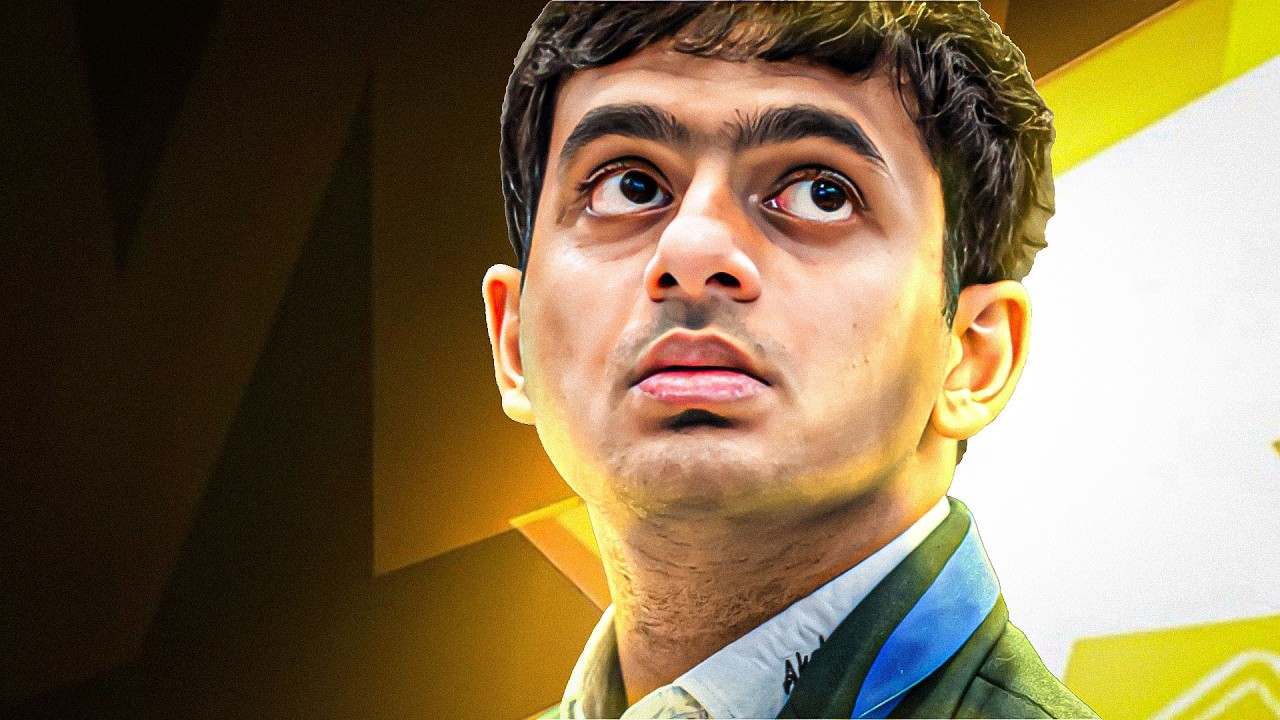
The video, narrated by chess commentator Sagar Shah, provides a play‑by‑play analysis of Grandmaster Nihil Sarin’s game against Italy’s GM Francesco Sonis on Board 4 of the 2026 Chess Olympiad. After a brief pre‑game scene showing Nihal signing autographs and his second Sethuraman, the commentary walks through the opening – a Torre Attack‑style setup with B‑g5, B‑h4, and a delayed e‑pawn – and highlights several unconventional choices: the early bishop sacrifice on f6, the surprising King f1 move, the aggressive h‑pawn push, and the rook lift to h3. Shah explains the strategic ideas behind these moves, noting engine disagreement yet practical merit. The middle game sees a series of tactical skirmishes, culminating in a powerful pawn‑storm, rook infiltration, and a series of forcing queen and bishop checks that force Sonis to resign. The win gives Nihal a perfect 3‑0 score and helps Team India secure a 3‑1 victory over Italy, with Gukesh also winning and the other boards drawing. Throughout, Shah expresses admiration for Nihal’s deep positional understanding and creative play, while also pointing out moments that were hard to grasp even for a strong grandmaster.
Chapters
We have Grandmaster Nihal Sarin signing autographs before his game. He is usually very, very kind, and you can see his second there, Sethuraman, who is just watchfully being there. And Nihal is playing a fine tournament right now. He's on 2 out of 2, going for the 3rd round at the Chess Olympiad. Against Italy and says goodbye to his second. And did he forget a line? Maybe he was asking him about the key to the room. And Nihal gets in. All his teammates have arrived. Nihal comes a bit late to the game, but he's there before the games have begun. निहाल इस वन ऑफ़ दोस प्लेयर्स फॉर टीम इंडिया हो वुड बी वी वुड बी बैंकिंग ऑन ही इस द मैन इन फॉर्म इट्स आल्सो द फर्स्ट टाइम ही इस प्लेइंग फॉर इंडिया ए टीम एट द ओलिंपियाड बट इट सीम्स लाइक ही बिलोंग्स देर इन दिस कंपनी ऑफ़ प्रग अर्जुन एंड गुकेश वेल द प्लेयर्स आर रेडी was extremely difficult. So we've decided to get a shot from this angle where, you know, you can see the game. Naturally, the frame is a bit blurred because we've zoomed in a bit too much, but I hope that the quality of the game will make you enjoy it more than the quality of the video. Okay, so Nihal's done adjusting his pieces now. And with the white pieces, he opens the game with— very focused— pawn to d4. He plays. His opponent Francesco Sonis, an Italian player who's rated 2539, goes knight to f6. And Nihal brings his knight out to f3. So Sonis goes b6 and wants to get his bishop on this long diagonal. And Nihal Sarin gets up, takes off his jacket, and sits back in. And he goes bishop to g5. Very interesting move. You can come in ahead with knight e4 if needed, but he goes e6. We now are in Torre Attack territory. This is quite a well-known system. Knight d2, it's a bit of a mix of the Trompowski And London System vibes. So one of the ways that you can play is to take, take, and push your pawn to e4. This is quite well known, but Nihal keeps the bishop. He goes Bishop h4. Now it will be difficult to play e4 because every time you do that, let's say for example e4, I'll go g5 and pick up this pawn. So e3 played here. By Nihal Sarin, and pawn to c5 played. Bishop comes out to d3, and it's a very simple line. You castle, you play queen e2, you push your pawn to c3. He takes on d4, he takes. d4 and Bishop to e7 is played here. White plays pawn to c3, now trying to put the queen on e2. d6. And Nihal takes the knight. Now this is a bit surprising for me, but Nihal takes it. Bishop takes. And why did he give up the bishop? I'm not so sure. And h4 played. Wow, there's some deep understanding that Nihal has about this position. Like if you castle here, maybe he wants to go g4 with a full-fledged attack. So Francesco goes knight d7, not committing anything yet, developing his pieces. Nihal brings his queen out, you know, playing a move as if nothing happened. But Nihal gave up a bishop, then pushed his pawn to h4. Now a6 in order to maybe stop bishop a6 ideas. a4 played by Nihal to stop b5. And queen comes up to c7. You can see black not castling, waiting there. And now this move, king f1. Quite a shocking move, I must say. A move that I did not understand. I haven't understood it completely. The engines say it's not particularly great, but it does have some meaning. If you want to bring the rook to e1 and keep the rook on h1, king f1 makes sense. On the other hand, the king does defend the g2 pawn, which means that the knight can move away at some point. Knight comes to e4, and I think maybe short castles should be tried out with an e5 break coming up. He goes knight to f6, and I think Nihal would be happy to trade here on f6. Yep, he takes on f6, and bishop takes f6 taken. Rook to h3. Maybe the rook will come in handy on the kingside. Queen c8, a move that is difficult to understand why Francesco played this. Knight d2, and here you can see a small advantage of the King f1 move. The g2 pawn is defended. Francesco now goes Queen d8, attacking the pawn on h4. Nihal simply pushes forward with h5, clamping down on the position. King f8 played by Francesco, and maybe this king f— king move is less successful, I'm sure, than what Nihal did, King f1. Bishop e4. If you take here, Knight e4, white is already better with g3, King g2 coming up. And so Francesco goes d5, pushing the bishop away, but in doing so, his own bishop on b7 becomes passive. Nihal comes back, bishop d3. In 20 moves, Nihal has made certain moves which are so difficult to understand that his opponent, who is a strong grandmaster, is completely outwitted. Bishop c8, maybe he wants to attack the rook here with some e5 plans. Nihal can simply bring his rook back here if he wants to. He can also bring his knight up. He goes rook h1, bishop comes out to d7, and now a possibility is to simply snatch the pawn. I guess the plan was queen e8, b3, and b5. Looking here, and that's the reason why Nihal doesn't even go for that pawn hunt. He simply goes g3. He wants to play King g2. a5 played, and now Knight to f3. The knight looks at a good square. b5 square is a bit weakened. Queen e8 putting pressure on a4. And he goes queen to c2, defending the pawn. b5 played, trying to get active here is Francesco. Takes, bishop takes. One of the things that you have to understand in this entire scenario is the role of rook, rook on h8. It's not in the game. And look at Nihal's rook now connected, the king on g2 perfectly positioned. Everything has worked out. He goes back bishop c six, but now Nihal has a very powerful move p four, and he plays it b four a b c b. You create a passer. You have the c file. You are just completely crushing it. Queen to d eight played. And now takes on a5, rook takes a5. The only thing nice about black's position is that the material is even. Everything apart of that is pretty poor because now takes. And rook takes a1. You may want to get your king into the game, but then there's check, and already that's so irritating. I mean, more than the king, you want the rook in the game. Queen c7, and now a very powerful move is is rook to c6— rook to a6 with all sorts of threats in the air. For example, king e7, you already have queen b4 check. King d7 is met with bishop b5 with a mating attack. So he goes bishop e7, Francesco, and now the knight jumps into e5. Bishop drops back to e8. The dream is to play f6 and wriggle out of the mess, but rook a8 just spoils everything. If f6, knight g6 check, and you lose the rook. Bishop d6 and queen a1, very nice move. Bishop takes e5, Nihal will take back. dxe5. And now you again once cannot come out because of Ra7. So Kg7 is being tried to come out from there, but tactics galore. Now Rxb7+, Kx, and Qx. Here's the beautiful part. If you move the king, you lose the rook. But if you play Qd8, I have check. King e7 and queen a3 checkmate coming up with queen d6 and queen d6. So he goes king e7. Nihal says thank you so much for the rook, and this is game over now. Queen takes c3. Nihal plays his bishop to b5, and it's time to resign. Francesco Sonis resigns the game. Nihal scores his 3rd win of the tournament, 3 out of 3. And this game really stood out for me for some very unusual decisions, starting with bishop takes f6, then king f1, uh, maybe even before king f1, h4, then king f1, then basically playing your rook up to h3. And everything really worked. I think Francesco just got very confused. What is Nihal doing? Why is he doing that? And he just trapped his rook on h8. With this very important win, Nihal actually made it easier for India to beat Italy, and the score was 3-1 with Nihal and Gukesh winning on boards 3 and 4, while Prag and Arjun drew their games on boards 1 and 2. Hope you enjoyed this game and wishing Nihal all the success in this tournament. This is Sagar Shah signing off. Bye-bye.