Vishy Anand's thoughts on becoming FIDE President, FIDE Elections 2026 and more
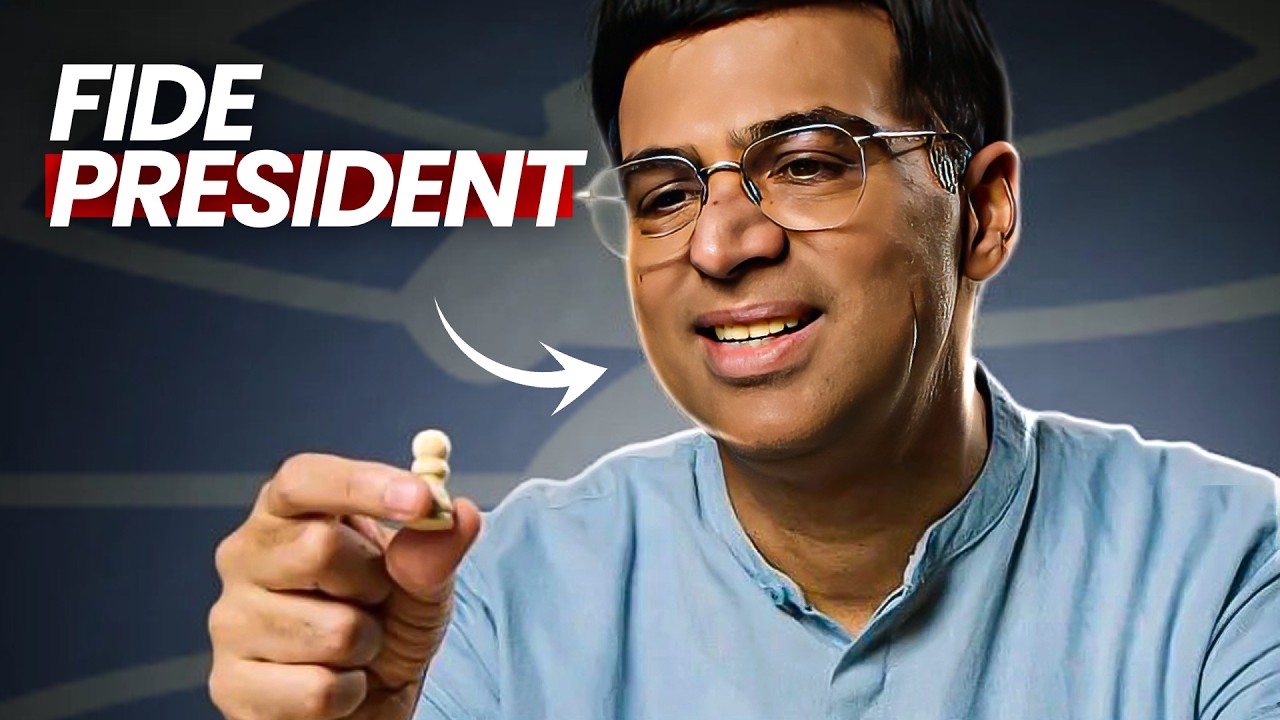
In this September 2026 interview, former World Champion Vishy Anand discusses his unexpected transition to interim FIDE President, outlining his responsibilities, the achievements of FIDE from 2022‑2026, and his motivations for joining the organization. He reflects on the challenges posed by geopolitics, the crowded global chess calendar, and the need to modernize rating systems and formats. Anand evaluates the key election candidates—Timur Turlov, Jan Buechner, and Vadim Rosenstein—highlighting Turlov’s digital‑business background and the upcoming Chess.com presidential debate. He also shares his perspective on the growth of online chess, the Global Chess League, grassroots development, and how he balances administrative duties with continuing to play competitively. Throughout, Anand emphasizes consensus‑driven governance, the importance of sponsor relationships, and the evolving nature of chess as both a sport and a digital product.
Chapters
Vishy, thank you so much for doing this interview.
We—
today is like, the interview is about FIDE and your role in FIDE and the upcoming elections and so on. So I, you know, I haven't spoken to you much on that. We've always spoken a lot about your tournaments and you as a player, so I am very glad that you are doing this.
Thanks.
My first question to you is that how does it feel to be right now the interim FIDE president?
When I joined the team, I remember being explained to that this is one of the responsibilities of the deputy president, that if the president for whatever reason is— but then it was also in a narrower sense where if the president can't be somewhere, I can come and exercise the president's functions on his behalf.
Which you have done in many closing ceremonies.
That sort of thing. But this particular scenario is more specific where being interim president, I am actually in a sense running PDA. Of course, the team does a lot of it, but oversight. And I think my role, I may even discover new parts of the role, new functions in the role. My role will become acute in Samarkand because then the conduct of the elections, all that will happen under my watch. So my job is also to hand over to the next administration, and hopefully it will be ours, but my job will also be to hand over there.
So this, like, I think it happened roughly a month and a half ago. It was 26th of July, I think. When this happened, or 25th, 23rd?
I remember because I was in Pune then.
Okay.
Uh, yeah.
And when that happened, what kind of feeling did you get? Because I believe that you never wanted this role, or in FIDE, to be like very intense, right? You were there as, uh, someone as an advisor, and I think you were helping the FIDE president Dorkovich. But now, like, you are in the hot seat. You have to take many of the calls?
Again, the thing is I've always functioned as part of a team. I mean, it's clear that not all my skills are administrative. Of course, Arkady has much more experience running big organizations. I mean, he was in government for many, many years and lots of big events he did, but The thing is, the team does advise you. So we have a lawyer, we have commercial people, we have advisors and things, the commissions. You know, FIDE has got the admin. And my job is to pretty much listen to, consult all of them, listen, and then, you know, I can maybe choose the advice. But the more specific Thing is that, as everyone knows, I was intending to step down.
Yes.
And I openly said that I wanted to spend more time at home, spend more time with the family, my son, and that I thought 4 years was a very nice experience, but I wanted to move on. But then, you know, I think it's tough if you're part of a team and the team loses both the— if they lose Arkady and me and they have to go on. So of course, when Arkady couldn't run, then I joined Timur's ticket. And I think that is the more— the bigger change in my life, because already I was planning a certain kind of thing.
Yes.
But I, you know, I'll cope. And, you know, and still I feel that we did a lot of very, very good work together as a team in the last 4 years in our last term. And of course, I want to support that.
What are some of the things that from 2022 to '26 that you feel particularly happy about that FIDE has done or you've been a part of?
In a sense, the Global Chess League, though I started it when I was not yet in FIDE, but I feel that I played a big part in bringing that one to what has now become a reality, 4th year of the Global Chess League. I think we have continued the stability already that was established round about 2018 with the World Championship cycles. Now they happen kind of regularly, very good venues— Dubai, Kazakhstan, Singapore, and now Geneva. So all very good prestigious locations, good relations with sponsors. And generally, I think a lot of organizational stuff has happened very well. I mean, we have very good competitions organized throughout the thing. And also very important that, and maybe I have a slightly bigger appreciation, I mean, I knew the thing, that how much of chess is related, you know, the elite events are very nice. Of course, they're the flagship events to showcase, but you also have to work backwards and realize how many junior, sub-junior competitions are held, all the age category events, how many arbiters you need. So the global work of FIDE, and I think that is even more important because that is the grassroots that, in a sense, almost all the top players came from those tournaments at some point and benefited from that. I think we have done very good work in the grassroots as well. Lots of education, lots of coaching to weaker federations, you know, to help them build up and things like that. And I think established good relationships with a lot of international sponsors in the last few years.
Hmm.
I mean, it shouldn't be forgotten that after '22, there was always going to be Some difficulty there, but I think we have managed very well. I mean, we had Google for the last World Championship. This year we have a prestigious one, and in you know the 21 match in Dubai, we have established a good relationship with Freedom Group, and of course it's. Timur is the president of the presidential ticket in, in our team, and so on. So a lot of good work I did, and I, I think I learned something these last 4 years of the other side.
Amazing. Do you find yourself in a slightly kind of situation which is a bit unusual, where you are right now the interim FIDE president, but you will If, let's say, Timur Turlov goes on to become the president, you will be the FIDE Deputy President. So does that create some kind of an unusual situation?
It is very unusual, right, this kind of thing. But again, I think the key is to remember that I'm interim president, which I think is kind of special. For instance, I generally don't take very big dramatic decisions. It's more about having a consensus, making sure that people are on board, and, you know, carefully keeping things going till the— so my role is limited. But yes, you're right, deputy, interim, and then deputy again, if hopefully, and so on. It gets very confusing.
I always had this question on my mind, which was that in 2022, when you decided to become part of FIDE. What was the reason, or what was the motivation behind it? Because for you, as a— you were a top player at that point, you still are, you were quite active, and there were WACA, I think the Westbridge Anand Chess Academy was going, you had many things. So what brought you into FIDE at that point?
I think it was simply the fact that I was asked, and And in a way, it was a direct post. I mean, Arkady could take me in his team. I would start off right away as the deputy. You know, that phase where you want to try different things, you want to expose yourself to some new— not experiences, but let's say learning experiences, if you like a better word. Going out of comfort zone, that sort of thing. And I thought it would be And it's an interesting experience. Um, I think that's kind of how it started.
And how, how, uh, tricky is it, or how difficult is it with all these geopolitical situations that are happening around, and you have to, uh, you know, be answerable to some of them, or, you know, talk— how, how tough is that?
Uh, it's more or less fine. I think, uh, during these 4 years, as I said, uh, Generally, I was part of a team which was navigating this, and it's only in these last 2 months that it became more pointed. And I think obviously it's coming a lot— coming up a lot in the election campaigns. But geopolitics is kind of where we are. It's not only Chess which is navigating this. Every business, every country practically is. shuffling everything. And it's true that geopolitically it's a very interesting time we're living in, and I'm not using interesting as a very positive adjective. I mean, it's just difficult for things. But specifically in FIDE, you know, once you have a relationship with the sponsor, once you have a venue, once thing, then, you know, you go ahead and do the event. We organize events Around the clock. I mean, the FIDE calendar is very cluttered because there's always— there's a youth event, there's a qualification event, there's a women's event, there's a continental event, something or the other is happening somewhere. And, um, I think that's not— geopolitics is kind of baked into it. It's not a separate thing.
And for the upcoming, uh, elections that are there What are your thoughts on Timur Turlup? And you would have spoken with him, you would have interacted with him. How do you find him as a person and as someone whom you are going to work with?
He's a very nice, you know, friendly person. I have had a chance to interact with him a fair amount because he's been one of our most important sponsors.
Mm-hmm.
Um, just so many Freedom events. The World Rapid Team and Blitz, um, Rapid and Blitz Team a couple of years ago, the World Championship in '23, uh, a lot of our flagship events he supports. The World Rapid and Blitz in New York, uh, and Freedom is one of our most, uh, important sponsors. And I think, um, it's a fantastic relationship to have because for FIDE we get, uh, A person who has started a Nasdaq listed company, who's you know who's able to navigate all those challenges and and run a global business. That will be very very helpful. That was very helpful to Fide. And now that he will be president and he has accepted further responsibilities, the Schools Federation. things like that. He's open to working a lot in education and just in education, in many, many kinds of events, and he's open to the idea, and that's great. And of course, to have— I think his flagship project is really about digitalization.
Yes.
And, you know, his company runs on an app more or less, so That will be a very, very useful insight for us.
Yeah, I think when I interviewed him, one of the things he mentioned was he intends to kind of— digitalization is one of the main things he would like to do. And the kind of hardcore chess bit of what FIDE needs to do, like for example, the rating system that needs to be maybe looked at, or let's say the format of the Candidates, or let's say the World Championship cycle, He would leave it up to you who understands chess much better. So, you would have like a much more intense role perhaps if you do become the FIDE Deputy President again.
Actually, in FIDE, you already have to accommodate 2 perspectives. One, of course, is not to lose our traditional— what we think of as chess and what it offers. and not to lose the tradition. It's nice for us that despite the huge popularity of rapid and blitz and many newer formats, the classical World Championship is our flagship event. And that's nice because it's nice to have this connection to tradition. But basically, we want to make sure the players' views are represented, but it can't be the only thing. In some sense, you will have to listen to sponsors as well. Typically, in the case that a sponsor says, yes, but this format or this innovation is important to us because it allows us to showcase what we want to highlight in our products, then we have to mix the 2 views. So far from it being him consulting me or leaving it to me or even the players, I think it just goes in both directions. He might throw something at us and say, can you live with this? comfortable or uncomfortable, things like that. But at the same time, we need to ask people outside from marketing, other areas, how can we make chess more interesting to a sponsor?
Hmm.
So, and we have seen this, right, with the insane number of changes recently because we're living in a new world. It's, I At least for chess, it's much more these platforms rather than television. We have been forced to adapt to that. Our anti-cheating measures are quite a lot, but we have to do it when you have these big events because that's a fire that can pick up pace very fast. It's already challenging, but chess is actually continually evolving. I mean, I hardly need to tell you, it's continuously evolving with— and, you know, we're slowly tweaking formats. One thing which is interesting is that I think I've come in a period when the calendar has become absolutely full.
You're insane.
There isn't a single month left, even a single week left sometimes in the whole year. And when a new sponsor comes, we are moving, you know, heaven and earth to find a date. Of course, this is not a bad thing. In general, if one set of players can't— are committed in a thing, you can have that event somewhere else with another set of players. It gives more opportunities. This is a nice scenario, and certainly other sports have trod this path earlier. But it's fascinating for me that we have hit a point where there's so only 52 weeks in a year, and this is all we can squeeze in.
Which is kind of great for chess in some ways that, you know, there's so many opportunities for the players. But on the other hand—
We do have to keep creating these opportunities for the players because a lot of them are trying to make chess their career and we have to make it as attractive as possible. So it's— I don't pretend that even as a player over so many years, That I've got to see all the sides of chess. But now I'm familiar with some of the other functions and things like that. I mean, it's one thing when you interact with them, bump into them at these World Cups and Rapids and so on, and you see all of them doing their thing. Then you, I think, you get a bigger sense. At least for me, it was very useful.
So you being a chess player, a very strong one, and also active one, you still play events. And also being part of the FIDE, I think these 2 points are quite relevant: the rating system and the calendar. Like, many people have spoken about the rating system being a little bit flawed, not representing things accurately in the world of chess, and the calendar being like, you know, people are not being able to follow chess in the way, like, they don't know what's important to follow. Many people have said, like, there should be Grand Slam structure, and properly. What are your thoughts on these 2 topics?
I think just like we do with many other things, we'll probably have to have a bit of everything. So I think we have our rating system based on ELO, and that gives a certain kind of output. It measures one thing, but sometimes people may want to say, well, But we want to measure something else. So we may need to have multiple rating lists. We may— a FIDE circuit is a crude way of saying that's a different kind of rating list.
Mm-hmm.
Any tour like a Grand Chess Tour or any cycle like that might have its own thing. As you say, you know, in tennis you get points through the year, but clearly they matter when they happen in slams. there are particular things. They'll say if you don't attain your result of the previous year, you lose points, things like that. There are lots of things which will turn out to be non-intuitive if you're used to ELO. And I find them quite disorienting because even with ELO, I can't keep up. But if you introduce too many new point systems, the question is, what are you measuring? Here, I leave it a lot to the experts. We obviously consult these things just like with anti-cheating. We have people we consult and so on. It's not obvious that just because you're a chess player, you'll know how to cheat. So to give you one comparison, and same with rating, I think, yes, we— for people, it is sometimes hard to tell what is important. You may have an event which is advertised hugely, it's the rapid and blitz or some version of that all, but it doesn't come into the Classical ranking. So you have to explain what is the rating list that covers that. And in general, you know, we have to expand a lot. The classical list has a kind of tradition. We are used to it. It's there all the time. But now we need other— we need to highlight what's happening in rapid and blitz more. I mean, it's already published daily and whatever, but the thing is you're not seeing— you're not familiar with it. Because you're not used to it being there forever. Maybe it's been there just a couple of years, whereas the other rating list has been there for longer. But yes, we, as the sport becomes more and more diverse and all sorts of different kinds of events, then you have to start measuring many things. And we may have multiple rating lists for different purposes. We may have a rating list for the circuit, for instance, which helps people track progress and performance over different years. I don't know, but in general, it will split up. I think there will be multiple rating lists depending on what you are trying to monitor.
Right. When I spoke with Arkady Dvorkovich in like few of the interviews before, like maybe a year ago or a few months ago, he would say like this is the period of expansion of chess. new ideas are coming forth. Like, for example, you can see, like, the Global Chess League is happening, the Total Chess Tour is coming in.
Yeah.
And there will come a time of consolidation. There will come a time when some ideas will drop out, but some will remain. Do you see, like, where chess is headed, especially with you being at the forefront of, you know, being the World Champion for 7 years and then being at the top, um, with so many different things happening in the world of chess, like Magnus being the strongest player not competing for the World Championship, What are your thoughts here? And I mean, the freestyle being there and so on.
Yes, so one thing, there is, as I mentioned already, the rating list. We will have multiple ones. There'll be some amount of splintering, but at the same time, we should think more in terms of abundance. If there are more tournaments, more formats, you choose the ones you want. It's important to know how to deal with all this. One thing, by the way, it's not only a lot of new formats are coming in at the elite level, but then later on they pass to the club level. Organizers everywhere decide, does this format help me or hurt me? Does this format, for instance, make the tournament shorter? What are the budgetary implications of that? Does that help me organize a better event? Can I raise the prize fund instead? Can I change things? And more and more, we live in a very busy time. So you can imagine that also a lot of players who maybe you can say amateurs, but who like to compete often and things, they may decide, well, then I prefer this format, so let me go for that event. I, you know, I want to try something new, I'm going to try this new format. And you can, like, you know, they may feel like trying 960 or they may feel like trying something else. And you're right, in a sense consolidation will happen when certain formats don't work, not only for the elite but also downstream, and certain formats succeed and become more popular. One change we have already seen, which is that Maybe 20, 30 years ago, rapid chess was just starting to come in. But now it's quite routine for clubs to have rapid chess events if that's what the fan wants. If somebody wants to come and they don't have time. So already we have to cope with the fact that how much time people have for their hobby. And the rise of online chess clearly demonstrates that that side is important. Now, is it the perfect system? No. But online chess addresses a need that's there, especially the casual chess fan who just wants to play a little bit. Online is perfect for them. They're not interested in the complexity of it. They just want to play a quick game with a couple of friends and move on. So, but you need that possibility. So hopefully it's a sign that we are addressing more audiences.
Multiple—
Our audience is increasing. Some will come for the jokes, some will come for something else, some will think— but it helps the sport.
I think Timur also mentioned that this online chess boom is something that FIDE kind of missed out on or didn't take full part into it. Do you also feel something like that, that FIDE should be more involved in online chess?
Um, possibly, yes. I wasn't there when FIDE really had the chance to enter it. And because I would put it this way, I don't— he may well be right, and perhaps the time has come. It might be part of the digitalization thing where he tries to see how— but, you know, we have to develop the platform, we have to develop all the things that a lot of online companies have managed already. I don't know what were the challenges facing it then. In fact, I think one of the reasons for the rise of online is that it was uncomplicated and easy to do. So perhaps we missed it. I don't know the answer to that, but I'll be certainly happy to hear from— hear his thoughts on that.
And about the elections, there are 2 more contestants who are going to be part of it. There is Jan Buechner and there is Vadim Rosenstein. What are your thoughts on them? Do you have any thoughts on that?
I think they have ideas, they have philosophies on how they want to run things. And, you know, I look forward to our ideas competing against each other in the General Assembly. I know that Malcolm, for instance, was doing a lot of events in the UK for a long time. Jan-Hendrik is slightly more recent. Vadim has also been in and around, organized a lot of stuff. So all these visions, we'll, we'll see what is decided.
There's also an interesting thing happening, you know, on 9th of September there'll be like a presidential debate with all 3 of them being on Chess.com with Maurice Ashley being the host. It's like first of its kind that might happen in the world of chess.
Yes, and again, I think this, at least on the FIDE side, this reflects the fact that of all the growth that has happened recently, and this is something you and me are constantly facing, we're talking to a different audience. You cannot always just say why Queen g7 is a great move. You also have to talk about other things, and it's really that. And I think here, This debate will be hopefully very interesting.
And lastly, Vishy, I want to ask you, away from all your roles in FIDE, when you choose something, because you have many options at your disposal, you've kind of transformed Indian chess, you've made it so big, you've contributed to the growth of chess across the world. Here is, you know, opportunities would be coming your way. When you choose an opportunity like this, that is Infide, is that something— I mean, I am curious to know how you select such things. It's a long-standing involvement. You have to give a lot of your time there.
As in many things, my decision was fairly intuitive. I spoke to Aruna. I remember her telling me, well, you know, you might not get a chance like this again. And, you know, you're not the type who's going to start one. Like, I don't know what's the equivalent of a political party in chess, but anyway, a presidential team or whatever. And I kind of decided it'd be interesting to try. Also, then I mentioned to them that I didn't want to like stop my chess career. I wanted to keep playing, but anyway, I was playing much less, um, or, you know, that trend was appearing for me. So in fact, I could combine a FIDE career. And by the way, speaking about online, we do a lot of our business online, and that is a relatively recent development. Um, I mean, this ability to have video conferences and meetings there. perhaps— I don't know how they did it— a little bit before, but it already, you know, it seems like everybody sent email things. And I don't know, I, I should ask. But, um, so a lot of our meetings also happen online, just like, uh, companies and organizations worldwide. But, um, anyway, I'm— I would say Arkady was generally very supportive with that. He, he said, um, you know, feel free to keep playing. And I think that's not a bad thing anyway, to also experience that side of it, because supposedly I'm bringing a player's perspective to it, so you can experience it yourself.
And will you continue playing?
Yes, for instance, here you do a lot of tours. I think I look forward to continuing that, and I look for a couple of events a year that I enjoy playing, and it's nice to keep in touch. Otherwise, I think you— it sounds strange to say for someone who's spent, what, 50 years in this, but you forget how to compete. A couple of years away and you forget how to compete. And that's also a perfectly natural stage in life. The vast majority of the world's population has not competed, just don't. But it's— we'll get there when we'll get there. But at the moment, I'm happy to be able to combine these things.
I can attest to, to that. I cannot play at the same level I was playing when I was active. So kudos to you, Vishy, for your strength. And also thank you for talking about your work as the current interim FIDE president and also the vision for the next elections. So thank you for that.
Thank you, Sagar.
More from Aryaman


The Global Chess League - Analyzing 4th season and future | ft. GCL Commissioner Gourav Rakshit
Clutch Queen Savitha Shri on Chess Olympiad 2026 | Individual Gold and Team Bronze

"Probably Gukesh had the best sense of humour" - Praggnanandhaa on Chess Olympiad 2026


An Unforgettable Closing Ceremony VLOG with the Indian Team! | Chess Olympiad 2026