4 Ways to Confidence
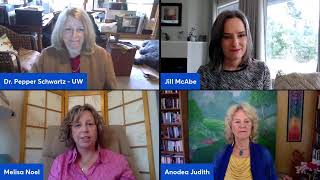
This YouTube panel (hosted by Melissa Noel, co-founder of the Irise app) is a recorded International Women’s Day discussion titled "4 Ways to Confidence" (panel date referenced as March 8/9 context). The panel’s theme is "Breaking the confidence bias," referencing a Harvard Business School finding that men rate their performance ~33% higher than equally performing women. Panelists Anodea Judith, Dr. Pepper Schwartz, and Jill share personal narratives about where confidence comes from (feminine power, incremental achievements, purpose-driven humility) and the internal and structural biases shaping confidence. The session includes an introduction, personal reflections, and plans to move into a smaller live Q&A in the app’s Zoom environment.
Chapters
Everyone, thank you so much for being with us and for being patient with the delay on our event that we had started at. Intended to start at 6pm UK time, 10am Pacific time. We had a bit of a technical issue in the background where my computer actually just decided to freeze and blow up all at the last minute. And don't you love that right when you're about ready to go on. So we're going to take it as a breath of fresh air to relax and to just really be together. Bring our humor in with this that we don't have control over so many things including technology, even with our best of inventions. And of course being the co founder of a technology company at this point I'm always learning new things all about that. So welcome. My name is Melissa Noel. I just mentioned that I'm the co founder of Irise app, which is an international app that is here to bring positive transformation and uplift a billion lives across the globe. This is an incredible moment for all of us to be together. We have Dr. Pepper, Schwartz, Grenade, Judith McCabe, all best selling authors and incredible women who have broken confidence biases throughout their lives in a variety of ways, certainly met thresholds and had to cross them to get to where they are now. And we also may agree that we, we're still continuing, I can say for myself, I'm still continuing to meet those things and learn from them and learn about that within myself, internally what I need to do and externally what needs to be done in the world to bring our awareness and to continue to move forward. So we are celebrating together International Women's Day 8 March International Women's Day is celebrated around the world and the theme this year is Breaking the bias, particularly regarding women and men and the differences in those genders. We've taken our own small spin on that with Irise to talk about Breaking the confidence bias inspired by an article or a study done by Harvard Business School on acknowledging or noticing that there is a bias between men and women in terms of how they rate their performance even when they perform equally on a task and how that impacts all of us in a variety of different ways. So today we're going to get to talk about our personal professional journeys around that. Some advice from our perspectives, particularly these perspectives of Anadea, Jill and Pepper regarding what we can do with these biases, how we discover them within ourselves and moving forward, moving through that. So I'm very grateful to have each of you here. I'd like to introduce each of you for those of you We've been excited and building up to this over the last couple of weeks. I'm excited to share a little bit more about you here. Now for those that don't know and aren't as familiar with one or more of you, Anadea Judith, I'm going to start with you. You are a best selling authority with books that are in 126 different countries in multiple languages. You are best known for your work with the chakra system in particular. You're also a psychologist, social change agent and you work with yoga as well. You have obviously broken a lot of barriers in your tenure and career in life personally and professionally to be where you're at. And we're really proud to have you here with us on Irise as a content provider, content partner and we've enjoyed your courses. I know I personally have certainly on working with energy and charge systems in particular. I also want to introduce Jill who is also a best selling author and a woman that has transformed from a career that was high stress, high pressure, went through a significant life transforming event, a car accident that then gave her the time to really reflect inside. And oftentimes isn't it true there are moments in our lives that do that and invite that and then gave you things came in for you that and insights as well that gave you the strength and the courage to say I want to be my authentic self. I want to step into something in my life that is emotionally nourishing and also abundant and in service to a greater way of experiencing life and being fully who I am. So welcome and thank you. You just got named Entrepreneur, the one to watch really female entrepreneur to watch for 2022 on Entrepreneur magazine. Congratulations on that. Well earned for sure. And then I want to talk about Dr. Pepper Schwartz who I met 20 years ago actually and have the pleasure of reconnecting with you now as someone that has broken amazing barriers at a time when a lot of things you were talking about were just not cool for women to be talking about them, including sexuality, romance and relationship. And you were known initially for your work with American Couples, co authoring that basically anthem that really helped launch your career. But it's still still talked about today and now a lot of people know you for your expertise on Married at First Sight, which is a program that really is bringing barriers of bringing an eastern philosophy of prearranged marriage based on wisdom of elders and experts coming together to connect couples and support them through the initial idea of commitment first, which is a really big thing to do in Western culture to transition something that's been very Eastern so far, bring it into the Western culture, bring it to TV in a reality TV show that's ranked the fifth reality TV show currently right now in the US for sure. So thank you for bringing everything you are bringing here. I also am just wanting to comment on the incredible. It's not just your accomplishments that I'm touched and moved by and that Irise is touched and moved by in terms of what you have brought forward to help us come together to bring this incredible information to people around the world through this app. But that who you are as human beings and that if we were just in a room just being ourselves and not having to be beyond experts, just being fully who we are, which will helpfully come out today in our talk, that I'm very moved and touched by each and every one of you. You're authentic. You very much care about the people that you serve and you work with. You very much have a loving heart and spirit and you're passionate about the mission that Irise brings to uplift humanity and help all of us rise. So thank you so much for joining us in that mission today. So we're talking about the confidence bias in particular today. And we have, we have this awareness of a study that was done on Harvard where science shows that men and women experience confidence differently and that there's a gender gap that was discovered in self promotion where men rated themselves and their performance 33% higher than equally performing women. So whatever the task was, if they performed it equally well, men rated themselves to 33% higher, women underrated themselves consistently. And that this is a striking example of a confidence gap and overconfidence bias that largely hinders women to feel empowered and at will to accomplish their dreams. So we have a lot today to tackle in terms of socio and structural inequalities that disproportionately impact men. And of course, this also impacts women. It's not just. I'm sorry, it also impacts men, not just women. This is a man and female and all genders issue, in all honesty. And that the bias is not just an external one that's out there in the culture that we face and we do face. It's very real. There are also internal biases that we meet. And the more we talk about this, the more opportunity we have to discover what that really is and what that means. So for each of you, we're going to start out today with talking for about 40 minutes. Actually. It's, we're gonna, it's Battle about a half hour at this point. We're gonna Talk until about 06:45 UK time, 10:45 PST Pacific Time about this and get introduced and warm everybody up into this topic. And then we're going to switch it over to our live events page and zoom environment on irise, which is a little more intimate. For further the conversation, do some Q and A questions and answers. Allow people to really interact and connect with you personally in a more intimate way. So let's go ahead and just kind of dive in here. My question, first question is confidence is a complex thing. So what does it mean to you and where do you think it comes from? It's different for each of us. It may be different in how we experience it and each of us or where we gained it, where it came from. And I'm really curious where it is for you and a day I'd like to start with you and just ask from you what comes up to mind when you think about confidence and where it comes from.
Well, I think of my years as a therapist dealing with people and their self esteem issues and what I discovered is that self esteem had very little with how much money someone made, the degrees they had whether they were good looking or not. Some of the most, you know, successful good looking people had no self confidence and other people did. It had to do with whether people were true to their will and if they were living in accordance with their own nature and those people had confidence and when they were not able to be true to their will, their confidence faltered. Now when you talk about women and this, you know, bias that we are referring to, I think part of it is that leadership is formed in a male model, a male archetype. It's modeled on an army general that has to lead his men into battle and has to be decisive and authoritarian. And we're seeing right now where that's taking us and women, that's not our way to lead. What gave me confidence in life was many, many years ago, 1985, when I was ordained as a prisoner priestess and I was given permission to take power in a way that was feminine, a way that sang with the power of nature, that worked with the power of love, that was creative, that was inclusive and a way that I could feel good about and gave me permission to take my power. You know, getting my PhD didn't give me that confidence, but having power granted to me in a feminine way did.
Thank you. So Pepper, I'm curious what you might have to say about that as well. Here you are in an academic or you've had a career in academia. And what would you say is confidence for you and how it came to you?
Well, with me, I would say it's a very long arc. And that is to say incrementally began to prove me to myself. For me, it was getting in a good graduate school, completing the degree. You know, starting the teaching, like most people do, is hit with the imposter syndrome, like, what am I doing here and why should anyone listen to me? But incrementally, you begin to believe in yourself because you get some traction. You do things that you didn't think you could. You impress yourself. And that also allows you to forgive yourself when it doesn't work out, when you fail, when you don't get the approval you thought you had, when you just bomb at something, but you start to build a floor, and that floor gets higher and higher over the life cycle. So for me, it was getting to a point where I had shown me, to me, that I owned something I valued. I mean, I agreed with Anardia that if you have a something, if you've achieved in an area that is inauthentic to your own values or in sense of self, well, what does it mean? But for me, I pursued something that was very important to me. Understanding human relationships, love, intimacy, romance, sex. Those are all things that I was somewhat disturbed, discordant with the general culture. I wanted to know more about what the general culture did, thought. Now it affected us all. As I gained more information and could apply some of it to my life, I began to think more of myself. And I do think it's extremely important to get to a place where you really think. Yeah, I respect who I am. And it doesn't have to be a degree, but it does often requires some. Some living.
Yeah. Thank you. And I can really appreciate that also because you chose topics that, again, were difficult to be talking about and speaking about in general and particularly for a woman in that time when you started so.
Well, I do remember not to interrupt. Sorry. That my. When I went to Yale and the person, the faculty member told me that when I told him what I wanted to study, he. He told me that I was ruining a perfectly good career. And somehow I think another thing I would add is kind of proving yourself right when people tell you you're wrong and that it helps a lot too.
That does help a lot. And I also like what has been said, that you can make mistakes and you come through them right, or it doesn't quite go the way you think. And it's not perfect. Like today we had a 15 minute delay. It's like, oh my gosh. So where do you find strength in that? Jill, what do you have to say about confidence and what it means to you? And even any of the comments to bounce off of what Ana Pepper says. What, what comes to heart, Your heart?
What, what comes to heart for me is the. So, so much I, I'm building on, you know, what I've heard. But I. What comes to heart for me is my personal struggle with confidence. I actually grew up extremely with, with extremely low confidence. I was diagnosed with dyslexia, severe dyslexia in grade two. And I was the youngest of four children. And all of my siblings were not just good, but exceptional. I had a twin brother who was scouted for professional sports and like one championship after championship, had a sister who looked a bit like Marilyn Monroe and was also good at arts and science and sports. I had an older brother who in Canada, after he submitted his master's thesis, got an invitation to be a US citizen because it was so brilliant. Then there was me who would get season Ds. And that was not even. It wasn't even like trying to get me higher. That's okay, honey. And so it was just accepted that I would be a low performer. So I really, you can imagine that that really impacted me for a long time. And in my first career, I did quite well by accident in the restaurant business. And I got this confidence, but I don't know that it was confidence. And I'm going to go with what Anadea was talking about, the masculine versus feminine versus confidence. And back then I had the masculine confidence. I had, look at me. I am a proprietor of a successful business. I am so good. And I had an ego about me. And anybody who knows what happens to people who have too much ego knows that I got smashed down a little while later. And, you know, I'm. I'm the classic story of like rags to riches, you know, early success. I got hit down. I was such a big head and I confused that with being confident and in, you know, then the car accident did make me reevaluate, you know, what really mattered. And I realized I had a lot of emptiness in my life. And so I'm pretty much the textbook example of what Anadea was talking about, which is I've now come to find my purpose. I work in my purpose, and I'm confident in a gentle way, in a way with humility, in a way that I'm just living the life that I know that I'm destined to live. And so therefore, I don't have to be incredible. I can make mistakes. None of it matters, because I'm actually living my correct life. And that has allowed me to have a humble, gentle confidence.
Thank you for that. All of you have a unique way of approaching it, which is why it feels important that we each have that way of expressing it, because we've had such different lives and different things that have brought us through to even talk about that. I know for me, just even thinking about this topic in the last few weeks, when we chose to do this panel, stirred up quite a bit about where have the internal biases been and when did I start to discover them? And they kind of are an awakening that have happened throughout life. So I grew up in it, being raised by a single mom of three daughters who was raised by a single mom of two daughters. And we were given a great deal of confidence as women. And I realized later that some of that also was a way to compensate for having to be out in the world and be strong and be on our own without the support or maybe the safety or protection or some of the other things that would have been lovely if a partner had been present throughout that whole piece. And also without the dynamics of the male, female, sometimes kind of underlying tones or dynamics, sometimes power struggles, whatever might happen in a household, I didn't have those same experiences in the same way. And so for me, I realized that there was a bias when I left high school, left home, and discussed the world was very different than what I was told it was growing up in order for us to make it and get through and survive. And I also noticed a shift during following the Metis movement, where I recognized, oh, my gosh, I've been deeply affected being born as a woman. And I didn't recognize that until that movement started opening up more conversations. What would you say to that for yourself? Like, have you noticed different phases of your life where biases became more apparent and aware? And what kind of difference did that make for you, Hubbard? Would you mind starting with that?
No. I mean, I. Yes, I'd be happy to do it. I think I grew up in a family where, you know, my parents were the children of immigrants. And, you know, that's a group of people who try to excel because failure is falling off a cliff. You know, you have to get traction in this new world. And as the child of those parents, they were highly critical, highly demanding. My mother had me write book reports she would grade, and they were Never A's. There were, you know, when actually I just worked very hard to get my parents praise, which were two very different people. My, my dad was a businessman and a lawyer. My mother was a intellect, a self created intellectual. She'd grown up really poor. And so I wanted to be whatever they needed to me. Be, needed, be. And so I was in that classic role of achiever and pleaser. And you're so anxious to do all of that. You know, you kind of like, you know, you can get lost into terms of liking yourself because you're so dependent on other people's grades, appreciation, pronouncements, whatever. And of course a lot of the culture leaks into that. The sense that I grew up with that women, you know, weren't good at science or that or engineering or pilots. And that also that whole thing of, of having to please men physically and not only take their pronouncements on you, influencing your psyche, but young women would grade each other on how cool or pretty or whatever somebody was. I mean, there's just sort of a cascade of bias about who you were supposed to be and how you could rise or.










