Everything You Need To Know About Trauma, The Nervous System & Healing
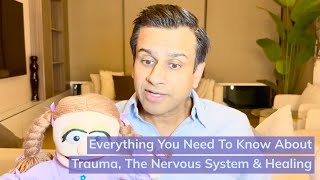
Ashok Gupta explains how trauma affects the nervous system and physical health, using the metaphor of Kyle, an inner child, to show the connection. He discusses how neuroplasticity and brain retraining can help reverse the damage trauma causes to the body.
Chapters
Does trauma impact on chronic disease and chronic illnesses? What is trauma? Because many people have different ways of describing it. And let me share with you our way here at the Gupta program of looking at it. And for those of you who know more about the Gupta program, you'll know that we tend to use puppets to describe certain experiences that people have because we find that that becomes a very powerful way of actually relating to these experiences. So what we're going to do, we're going to introduce you to Kyle, the inner child. All right, so this is Kyle. And Kyle, as she grows up, experiences certain events. And it could be said that the vast majority of events that we experience aren't necessarily just on their own traumatic, but they have the potential to be traumatic. Okay. And so there are certain experiences which people go through which are on that scale of potentially being traumatic. And on one end of that scale, for Kyle, she may have experienced neglect where she may have had a caregiver, a parent, perhaps it may have been a sibling or a teacher who didn't show her the care and respect that she expected herself. And that may cause some very, very mild trauma, that kind of neglect. And then along that scale, it can actually move to things which may be one off events, you know, maybe a criticism which ran very deep into that person. And then further along the scale, there could be what we call more developmental trauma where someone had repeated experiences not feeling validated for their emotions, or were criticized or put down. And a lot of these types of trauma experiences tend to involve putting down, not feeling loved, feeling neglected, not feeling like your self esteem is being supported right through to then potential bullying. And then at the other end of the scale, different types of abuse. And all along those scales, those experiences are potentially traumatic for Kyle. Now, what turns an experience into a trauma? It's often if Kyle doesn't have the support or the empathy or the resources. Okay. To be able to handle that experience. So it's when Kyle doesn't have the resources to process that. That event. Now, what do we mean by process? When we experience an emotion, if it's very intense, it could be fear, anger, sadness. Normally, we would observe that feeling within us. We would acknowledge that we have that feeling, we would validate it, and we would then look to be able to resolve it in our own minds. Because that emotion is trying to tell us something, it's trying to inform of something that we need to do. So we need to understand what those messages are. We need to understand why we're experiencing that emotion and process it, talk it out with somebody. You know, often what do we do when we have a difficult emotion? We'll speak to a friend about it. And by speaking to a friend, it helps us overcome that emotion or move through it, or we feel into our bodies and meditate whatever ways that we have the resources to do that. But as you can imagine, Kyle, if she's a child, doesn't necessarily have the resources to be able to process that emotion. And that can be very terrifying for a child. It can be overwhelming. So when we don't have the support, the empathy or the resources, then an emotion is overwhelming and we can't cope with that emotion. So the mind comes up with a very clever idea. What it says is, let me repress that emotion, that feeling, because it's too scary to feel right now for a child, let me repress that memory as well. So sometimes the memory becomes a bit hazy and becomes hidden. And that is a way that the mind says we aren't ready to experience that pain, that emotion, that negativity. So we're going to bury it and we're going to bury the memory and, or bury the emotion. And if you think about it, that's very clever of the mind to come up with that strategy. Now if those events are one offs, they may not affect Kyle so much. But if they are complex and developmental, so what that means is the trauma is experienced or the events are experienced again and again and again and again. So the trauma or the traumatic events build on top of each other. And that then means that the mind has to repress a lot of our childhood, a lot of those experiences, just to be able to cope and function day to day. Now, of course, it's not a perfect repression because some of those emotions keep fizzing up into the mind. So even though our mind is trying to protect us, those emotions still simmer up from our consciousness. And then we still experience glimpses of those pain, glimpses of those emotions. And what it actually does is create little buttons all over our body that when someone else does something similar to what we are repressing, it brings up the emotion again. So it becomes easy to push our buttons. Some people might call that a sensitivity. We often talk about the highly sensitive person where because they've been through a lot of those experiences and those traumas, their nervous system is more trigger happy, waiting to respond to something. Now, in order to protect Kyle, because these emotions can pop up, they can be re triggered at any time. There are what we call protector parts and defender parts. So what this means is Sometimes we have other parts of our personality that protect poor Kyle. As an example for those of you who know the Gupta program well, we have the achiever parts. So the achiever parts come and say, hey, my dear Kyle, you need protecting. And if we achieve things in life, then people praise us and they give us good rewards. And in that way we protect ourselves from the pain and the trauma of our past experiences. Or we might numb. In fact, I'll share some of these coping mechanisms here. So we might numb ourselves and we might think, you know what, I actually am going to take alcohol or drugs or become a workaholic or whatever it may be that helps me numb some of those experiences. Okay, so in terms of the middle there, we may cope by drinking, there may be self harm, smoking or drugs, excessive working, overachieving. And you'll see some of the other effects in the mind, some of those classic symptoms of an over inflamed system. So headaches, fatigue, increased heart rate, the stress hormones cortisol in the body, and then the mind, maybe if it's difficult for the mind to relax, so they can be more worrying, more fear, a lot of those other types of symptoms in the mind, all as a result of those effects of trauma. And just coming back to some of these experiences, as you said, it can be single events, they can be complex and repeated, and they can also be intergenerational, where sometimes if a parent or a whole lineage before us have experienced trauma or intense events, we now know that those events can be passed down from generation to generation. Or the nervous system responses to that can be intergenerational through epigenetic effects. So our genes are not just a fixed entity, but they actually interact with our environment and then that shifts the genetic makeup and then gets passed on to the next generation. And in terms of the impact on the brain, what trauma does is it increases threat perception. So we start seeing more threatening things in our environments, which is natural, because if we have had repeated experiences of trauma, then the brain becomes trigger happy, but also very cautious and ready to respond to the next threat. It's a beautiful quote from Peter Levine, which says, I've come to the conclusion that human beings are born with an innate capacity to triumph over trauma. I believe not only that trauma is curable, but that the healing process can be a catalyst for profound awakening, a portal opening to emotional and genuine spiritual transformation. And that's the hope that I want to give to all of us. And assuming that many of you have experienced mild to moderate to severe trauma somewhere on that Scale that whatever you have experienced, the brain is neuroplastic. That means our brain is flexible. It is not fixed, not a fixed entity. It's constantly changing. And sometimes we think, well, maybe it's changeable when we're younger, but once we're older, doesn't it become more fixed? We get fixed in our habits. And actually the recent research is showing that our brain is constantly rewiring, constantly changing. So I want you to know that your genes are not your destiny. Whether you've had intergenerational trauma or parental trauma, and your upbringing is not your destiny. That whatever you experienced in your childhood, in your teenage years, or any traumas after that, that is not your destiny. Your destiny is to be the potential within you, to be the most loving, the most wise, the most mature, happy version of yourself. That is your destiny. And all of these other things don't have to be fixed or dealt with. They simply have to be worked through and let go of. You're not trying to develop, becoming happy or becoming strong or becoming or over coming these things, but actually just letting go of these things. It's a practice of these old wiring in the brain being let go of. The first link is that a dysregulated nervous system reduces our immunosis, reduces immunity, reduces the effectiveness of our immune system. And a study by Kaiser Permanente looked at people who had a background of trauma versus not and then followed them for many years. And they found that people who had a background of trauma were twice as likely to get one of the chronic conditions that we are talking about. And now why would that actually happen in those circumstances? Well, what I want to do is introduce you to two aspects of these defensive systems in the body that we're going to talk about. So I want to introduce you to the nervous system, which is all the nerves in your body as directed by your amygdala. And that is going to be defended by or your nervous system is represented by your army. Okay, so you have an army that is defending Kyle. All right, so this is our little army guy here. You can see the little army guy. There he is. All right, so the army is your nervous system. And the army is designed to protect you from threats in your environment. But this army guy, if he has been experiencing repeated threats, he can sometimes become traumatized by war. And that's how war veterans in war situations, they come back to civilian life, but they're still traumatized. And so in a similar way, your nervous system can become traumatized by repeated experiences or traumatic experiences. And he is joined by your navy. Yeah, we don't know if this is a he or a she, but your navy is your immune system. And your immune system is there to also be defensive, but more against biological threats. So your immune system defends you against biological threats, viruses and bacteria, toxins, whereas your nervous system is protecting you against other types of threats. So those can be threats in terms of needing to run away, the fight or flight response. Now, these two systems work together hand in hand. Your army and your navy, Your nervous system and your immune system. All right, so those are the two systems in your body. And what then happens is if you've had repeated experiences of trauma, traumatic events, then these two parts of your defense system are over triggered. And they start fighting wars over here. And they start fighting wars over here because they think they're under threat, all these fake wars going on around you. But what that actually then does, it reduces the effectiveness of your immune system. Because your immune system isn't just about being on or off. It is about is my immune system refined? Is it operating at the optimum level? So your immune system can't be fighting lots of wars and be overstimulated. It has to be hyper efficient. So that's how a background trauma can actually reduce our immune system. And therefore that's something to be aware of. But the good news is that once again, people do overcome their dysregulation. So. So just because you've had a background of a dysregulated nervous system, it doesn't mean that that can't be overcome. When we go through a trauma or Kyle goes through a traumatic experience and some of those emotions are suppressed, then what happens is this has several effects. The first effect is that it makes our nervous system more stimulating. And we've talked about that. Then the second effect is that what happens is this also has an effect on our physical body. And more and more trauma specialists are realizing that the trauma is not only mental, but it gets stuck in our physical body. And when we talk about the physical body, we're talking about that nervous system becomes tighter. It's like we're holding on to tension in our physical bodies. And now there's a third impact. There's an energetic component where some of these emotions get trapped in our energy centers. So everyone on the call, I'd love you to share with me. When you have fear, and let's say some fear gets stuck in your body, where does it get stuck in your physical body? Everyone just point to where it gets stuck. And I'll flick through the pages to see where you're pointing. And we can't always see where people are pointing. Okay. Some people pointing to the back of their head, some people pointing to their chest, most people pointing to their, to their chest area. So what does that tell us? That tells us that there's an energy center in the center of our body. And that energy center is where a lot of this emotion gets trapped. Okay. So the emotion actually gets trapped there. And when we experience anger, where do we tend to feel it? We tend to feel it in our head. So if you have a lot of anger as a result of the trauma we've been through, we'll find that we are more prone to tightness around the head and headaches. Whereas if we're more fear prone, we're going to experience fear in the chest, in that energy center, and it's going to drop down into our stomach, which then causes the gut issues. So a lot of our gut issues, inflammation, gut dysbiosis are actually due to these emotions getting stuck in our physical bodies, which then contributes to this. So that's how trauma not only affects our emotional state of being and our thoughts, but also impacts on our physical body in terms of tightness and tension and also these energy centers. And the more that Kyle represses these emotions and doesn't feel them, the more they get stuck in our energy centers, which then means we are more trigger happy, that our emotions are more trigger happy. We're more sensitive to people and situations around us because these emotions are just bubbling under the surface, ready to get triggered. When we have had a background of trauma, our nervous and immune systems are more trigger happy. And it also means that our brain, specifically a brain structure called the insula, it is more prone to learning new immune threats. Now, what I mean by that is let's say you have a virus or a bacteria, your immune system kicks in to defend you against that virus or bacteria. Let's say it's COVID 19 and then your immune system goes back to normal. But if your immune system isn't sure if it's fought off, that virus completely hasn't fought off COVID 19 completely. It can learn to be conditioned. Now, what that means is it keeps firing off itself, the insula keeps firing off the immune system, even though the invader has been fought off. This is where the immune system gets stuck in the on position. All right? And that can then cause ongoing effects in the body over inflammation and cause effects all around every limb, every cell, every muscle, and in fact also impacts on the mitochondria in your body, making them less effective and less efficient. So having a background in trauma means that we believe it's a risk factor for a lot of the chronic diseases that we treat, Simply because the brain is easier for it to become conditioned to these new threats. It thinks that something else is going on. And I think many of you may have heard the analogy that I give, which is called the fairy tale analogy, that imagine you are the prefrontal cortex. So you are the king or queen of your kingdom, and your kingdom is your body, and you have your army and navy, which are defending your kingdom. And unfortunately, there's now a drought in the kingdom. So because there's a drought, the kingdom is weaker, your army and navy are weaker. And because they're weaker, when the invading army comes over the hill, which could be a virus, a bacteria, they have to work doubly hard to defend against that virus and bacteria. That's the army and navy. And as they do so, they become traumatized by that war experience. And even though they fought off COVID 19 bacteria mold, they wonder if it's still present, if the threat is still present. So they go into an overdrive mode where they keep firing off their weapons of war, their arrows, their cannonballs. They keep firing it off, and in doing so, some of those arrows and cannonballs fall back into the kingdom, which then causes some of those autoimmune effects. So the inflammation in the body itself, and then opportunistic viruses and bacteria flourish. Your gut bacteria, there's gut dysbiosis. You have less good gut bacteria and more bad gut bacteria. So there's effects in the gut. And the whole system is now inflamed. The brain can become inflamed as well. And that gives us all the classic symptoms of fatigue, headaches, extreme exhaustion, difficulty doing any kind of activities, complete lethargy. And we might get sore throats from the immunity, the immune system kicking in, and a whole suite of other symptoms that relate to a lot of these chronic diseases. Okay. And that as a result of trauma, it's more likely that the army generals and the navy generals can learn to become more reactive. We did a study on fibromyalgia, which, once again, is something which can often be as a result of trauma. And we compared the Gupta program to a relaxation program. We found after eight weeks, there was a 37% reduction in fibromyalgia scores, close to a 50% improvement in health and functioning, and a halving of pain, halving of anxiety, halving of depression compared to a control group. So independent randomized control trial. You can see this on our website, the study. And then we also did a study on Long Covid. And we compared the Gupta program to a wellness program. And this wellness program was a really active control in the sense that it had sleep information, diet, supplements and activity levels. And after 12 weeks, the Gupta program was four times more effective at reducing fatigue and exhaustion, twice as effective at increasing levels of energy, and there was close to a 97% improvement in energy levels, which was an incredible result for our first study on Long Covid. And we're doing further studies as well. So once again, if you're suffering from Long Covid or you know, people who are suffering from it, we really hope that you'll show them, share with them this information, this independent trial. And similarly, we've been able to improve sleep by 56% increase even working memory. And this study, you can show close to a 40% reduction in depression. And this study was an independent study which looked at our patients and looked at how well they did after 12 weeks using health and functioning. And you can see the percentage improvements in health and functioning across 16 different conditions there, 14 of which are worse, significant. All right, so you can see a 84% improvement in long Covid, 70% improvements in ME chronic fatigue syndrome after 12 weeks. And trauma can often cause a more dysregulated nervous system. So that's a more dysregulated Army. The second impact is it can then impact on our body, making our nervous system tight and also then meaning that informs the immune system that we're under threat to the army and Navy start working together. And then there's this complex interplay between your body, your brain and your gut, which then means that the army and Navy keep stimulating that immune system, causing these inflammatory type diseases. That third link that we talked about is that you have this overactive nervous system and that then directly triggers inflammation in your body, which then lowers overall immunity. So if the army and Navy are fighting a war over here, it means your immune system is less effective at dealing with opportunistic viruses and infections and things like Lyme. So that's how trauma, that's why we see so many people who have that type of background. The fourth link is that having a background of trauma may make the amygdala and insula more prone to conditioning, so they're more prone to learning new conditioned responses, which mean that once you have a virus or bacteria, they can sometimes get stuck in that overreaction. Which then becomes a risk factor for these inflammatory conditions. And finally, that our inhibition systems also are compromised. So it becomes harder for the brain to calm down the actions of the amygdala and insula to calm down the nervous system and immune system. But the great news is that day to day, every day, we see people healing from these chronic conditions, emotions that are in the center of our bodies. Why do some people move through life seemingly unaffected by trauma, whilst others are deeply impacted? Now, this is a really fascinating question. And they've done twin studies and various other studies where people have been brought up in the same environment by the same parents, in the same household, and yet one person may go on to develop developmental trauma or severe trauma, and another may not. And there can be many different factors that can impact on that. It can be that even those small differences in upbringing because there are different ages of the siblings, can make an impact. But even in twin studies, what we know is that there can be small different changes in our environment, whether it's different friends or it's different coping mechanisms. That can mean that one of the twins is more affected by trauma than the other. Now, that doesn't mean we blame ourselves. It is what it is. We were a child, we didn't know what we were experiencing or how to move through it. But certainly it can mean then that others have the remember those three things, the support, the empathy, and the resources. So the support and empathy are from outside of ourselves. And maybe some person, when they go through trauma, have more of that support. And then thirdly, resources. What internal resources do we have to manage those challenging situations to stop them from just becoming mildly traumatic to then severely traumatic and then staying as a legacy in the brain? How do we stop predicting harm to our bodies after experiencing medical trauma and ptsd? How can we balance caution with healing? And I think this is something where it's recognizing that those in the medical profession can also make mistakes. They can make mistakes, but that does not mean that a mistake that has been made is now going to be repeated again and again in any future interaction with a doctor or surgeon. And therefore it's recognizing that. And that is the brain retraining, that's training the mind step by step through new realizations that you are safe in those environments. It.










