Harmonies of the Heart | Mike Robeson | Ashok Gupta |
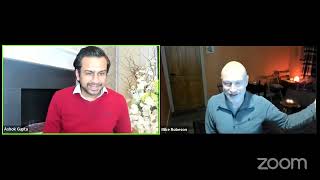
A live interview hosted by Ashok Gupta (founder of Irise) with singing instructor Mike Robeson promoting a free live Zoom harmony workshop. They cover Mike’s personal journey into singing (a breakthrough at a Findhorn Foundation workshop), the emotional and physiological benefits of singing (connection, oxytocin/endorphins, somatic release), how online/muted group singing can feel safe for beginners, and a brief demo of a layered Hawaiian harmony (teaching parts and layering). Logistics for the free workshop and where to find the Zoom link (iriseapp.com → Live Events) are given.
Questions this video answers
6pm UK, 1pm Eastern, 10am Pacific
iriseapp.com (Live Events tab)
Chapters
And a warm welcome to our IRISE Live event here on Facebook. It's fantastic that you're with us. I'm so glad you could join us today and give you a bit of background to this. My name is Ashok Gupta. I'm the founder of irise. And today we are very, very fortunate to have with us Mike Robeson, who will be interviewing all about his singing workshops. Yeah, he's a fantastic singer instructor and we've worked with him a couple of times on various projects and our audience has always had a lot of fun. So what we're going to do today is I'm going to interview Mike here, and then at 6pm UK, 1pm Eastern, 10am Pacific, we're going to go onto a live Zoom event with Mike for an hour and a quarter, hour and a half, and he'll be taking us through a singing workshop. And if you haven't experienced this before, I cannot emphasize enough how amazing and wonderful it really is. I'm not just saying effusive praise for the sake of it. It is an incredible experience. And, you know, something that reminds me of is something I talked about in the last event, which is, are we the teapot or the tea cup? Right. That often in life we wait for. We are the teacup, and we wait for life to fill our cup. We look for the outside things to make us happy. And what Mike manages to do is make us realize that we're the teapot. We're already full of tea. And when we stop identifying with a teacup and feel empty, we start feeling full. We start feeling like the teacup pot. And the amazing thing is the teapot always gets filled up first before the teacup. That inner joy, that inner love, this pours out of us. And singing is a root to that inner joy. So that's why I'm so excited to have him with us. And just to give you a bit of background to Irise. So Irise is the, what we call, the only personal development app you'll ever need. So We've got over 600 courses, classes, missions on this brand new app that we've just launched. And we also have live events. And live events aren't just courses and classes and workshops, but we want to broaden the definition of personal transformation. So last week we had an 80s dance party. This week we're having, obviously, Mike with us singing. So it's about uplifting the spirit. I Rise is here to empower humanity and uplift a billion lives. And it is a movement because once we uplift Ourselves, we want to uplift others around us. So enough of that. Let's go over to Mike right now. Mike, how are you? Thank you for joining us.
Good to be here. I'm great. I'm really looking forward to this evening with you guys. You know, I've been singing all day, so like my throat's already croaky, but I feel so good, you know, it's just singing is like part of my daily life, so doing more of it is just like, yeah, okay, I can do that. That's fine.
That's exactly. When your work is also your joy, then we have.
Then I have everything. Yeah, it's a blessing, real blessing.
And how did you first get into singing, Mike?
Well, you know, I was this stereotypical person. I had this deep core belief I can't sing, so I never sang. That's fine, you know, not a problem. And then I went to a workshop in the Findhorn foundation spiritual community located in Scotland. And I went to their experience week and they just said, oh, here's the experience. We meet every day and we're going to do certain things. And. And we met on the Saturday and they said, okay, so we're here to do singing today. And I went, sure, see you later, I'll be in the cafe. And they went, well, now you need to experience it. And I had so much resistance, I can't sing. And they wanted me to sing religious songs. They wanted dance. And it's this. I had so many no's to this. But they said, look, this is the experience week. You need to experience so that you know where you are with everything. So reluctantly I went in and we started learning songs. And I had straight away negative reactions to religious type words and movements. And it was like, no. And then we all got up in a circle and we started singing. And I don't know what happened, but something in me cracked open. It was like something was suddenly allowed to come. And I broke within 15 minutes, I think, of being around here, I was just broken. Somehow something had broken open inside me. And I thought, I need to explore this more. What is this that's opened inside me? So I went every day, every morning to the Taze singing, where we were learning religious songs, spiritual harmonies, songs of the earth, a variety of different traditions, different languages, different religions from all around the world. And although I was still of the belief that I couldn't sing, I knew that something important was happening. So I would hide somewhere and just. I couldn't, of course I can't sing. So I just would Hide. But something was continually happening through me. And one day the teacher said, mike, why don't you stand over here? And I went, what? Because this is a different part. I went, mmm, I don't even know what you're talking about, because this is where the men can get into their heart space. And I went, yeah, okay. And I stood in there and he taught me a different tune. And suddenly I found a voice inside me that was singing. And it was like. Because I hid. I used to hide in the choir. Lots of people around. I could just stand at the back and I could sing the bass part, which I couldn't. I can't actually sing bass at all. My bass voice is not very good. But I realized that if I stood over here, something in me moved and I suddenly thought, oh, I can sing. What's this? It was a transformation. And I thought, I have to keep exploring. So I visited a number of singing teachers, Susie Prater, Judith Silver. And I found one in Ireland called John Bowker. And he opened me up to seeing singing in a very different way. Really allowing yourself to sink into a song and not just sing a quick song and move on, but allow yourself to sink in and allow the song to sing. You and I, that's.
That is beautiful. And I really want to pick up on that point about how can people make the boat the best of this workshop that we've got coming up in terms of sinking deep into it? Because, as you say, we all have our resistances and we feel self conscious when they come into this workshop. How can they really sink deep as you've just described it, and let go?
Well, the interesting thing about singing online, I was once again very resistant to teaching singing online because, you know, I can't hear anybody. But it actually creates a very safe space for singing. So you allow yourself to be free because actually, you can't be judged by others in an online group because everyone is muted. So you can really start to sing and feel the song and allow yourself to get it, to lose it, to not even have it, but allow yourself to start being heard. This is the key. It's like there's a. Like a wound that I'll speak for myself. There's a wound that I carry which says, I can't be heard. And it's like, I need to heal this wound and be heard. And that's why I decided to start teaching singing. Although I've got no musical background, I don't know how to read music. I can't play any musical instrument. I have a Little tootler here. It's got some letters on it and that helps me out. That's all I've got is this and my voice and what I think is going to come and yeah, it seems to be here in the body and allowing the voice to come through, allow the song to come through the words. And, you know, you said, you know, it brings so much joy and love. It also allows you to touch the grief. It allows you to touch the pain. We can't, we mustn't forget about those aspects, those parts of us, because we do exile joy, we do exile love. But we also ex grief, exile our holdings, exile our trauma. And it brings all of it. If you allow it, it brings all of it up.
Right. I love that. You know, it really is something that I think a lot of our viewers can relate to. You know, many of us have been through challenges in our life, relationship breakups, trauma, even difficult childhoods. And what happens is, as you say, that trauma gets trapped in the body, but the arts allow us to express that, to kind of bring it up to the surface and release. And, you know, on Iris, for instance, we have art therapy classes, you know, which is very left field, but a lot of people have engaged with that class and found, wow, I'm able to release my emotions through art and then dance as well. Right. That's the kind of sense of. Kind of somatic embodiment that by movement, through dance, we're able to express and extinguish though those hurts within us. And now you're bringing it to singing, which for me is kind of my chosen form of expression because I love karaoke, although, and a lot of people don't like karaoke. But that is for me and an amazing way of really bringing up that joy and feeling like I'm getting back to my authentic self.
Yeah, yeah, I can see that. I've personally also never done karaoke, but I can imagine the joy from it. I can. Yeah.
Yeah, no, absolutely. Well, Mike, what would be great is could we have a kind of short demonstration perhaps of, you know, the kinds of things that people can look forward to in this workshop and kind of how it works before. Actually, before we do that, quick question I had. What benefits do you find your audience get? Because I've certainly been doing some research on singing and people generally have researched and found that your well being increases, you feel more connected to those around you. We know there's actual changes in the brain, so oxytocin and endorphins are released, so boosting mood. I Mean, I remember there was a friend of mine going through therapy and was on antidepressants. And she came over and we did karaoke for literally half an hour, 40 minutes. And she was like, wow, this is way better than therapy, which I thought was really funny. So what do you find people really get from it?
You know, when you said, this is better than therapy? Because there's a part of the mind that has a potential here, an opportunity, like an invitation to switch off. You know, I give words and people are going, oh, my God, what language is this? What does this mean? And then we start singing and everything drops away. And the vibration that we create in our bodies, you know, imagine the vibration effect on the body, the body vibrating, the organs being free to move, the breath starting to release because we're so tense. What do I need to do next? What do I need to do next? And it's like we get an opportunity to breathe in and to release ourselves and breathe out and really touch aspects of our breath, of our body, of where we're holding tension and pain that we'd never necessarily have noticed if we're just walking through a daily life. So, yeah, there's a lot of those benefits. Yes. You mentioned connection with others and with yourself. You start connecting with yourself, the mind starts going, but you start hearing the mind, and then the mind seems to get further away the more I sing, the further away the chatter gets.
Yeah. And that is something that we all want to do, Right. If you ask most people, what's the challenge in life, it's this little, you know, clump of gray matter up here. It's the busyness of the mind, the stress of the mind, and it's something we identify with. So we identify with the mind and those thoughts, and we get stuck in it. And I hear what you're saying, that we get an opportunity to step away from the mind, to kind of observe the mind, and it kind of dissolves into the background. And then this teacup and saucer analogy that I'm talking about here is we're actually disidentifying from this kind of busyness, a sense of emptiness and going more to a state of fullness, that kind of deeper state within, beyond the mind. And it's amazing, isn't it, that in most cultures until our own in modern day life, people would dance and sing around a campfire. So tribal communities, fishing communities, that's what you would do at dusk, is that sense of community, that sense of doing what comes naturally. And yet now the television is the modern campfire of our civilization, we've moved away from that inner joy and we're trying to find it by passively just watching a square box in the corner of the room.
Externalizing, we're changing the focus outwards onto something material.
Yeah, Something that entertains the mind versus something that is an expression of the soul.
It's a quick way to switch off to entertain the mind. And it's the work of expressing your soul is deeper, of connecting to that inner what is inside us. And of course, connecting to people around through that as well. I remember I was reading about the Celts in, I don't know, AD5, and just before, just after that sort of time, the Celts around England and how they had the warrior and they had the dreamer. The dreamer would always be with the warrior, sort of foreseeing what was coming. And then you had the singer, the storyteller. You know, this is how we pass the news through song, through story. And it was like, oh, right, yes, of course, yeah. This is the work of the ancestors. This is the work that we need to do now to reconnect.
I love it, I love it. And hopefully this is what we're doing at irise here. It is our mission to empower humanity. We want people to go back to their root, back to their source, back to their authenticity. And that's why each Friday, Fun Loving Friday, we're going to have something on. Dance, singing, music, joy, karaoke, you name it. Something that brings us that joy on Fun Loving Friday. And I'm so glad you're going to be doing that with us today. A little sample that I'd love for you to share with our audience. And then once again, for everybody who's watching at 6pm UK. So just in 10 to 15 minutes or so, we'll be going onto the IRISE platform. So if you don't know about IRISE, you can simply go to the website iriseapp.com and there click on live events and you'll see the zoom link for us to go onto our live workshop. And that would be just in 10 to 15 minutes or so. You're going to love it. And it's free to all, so it doesn't require any subscription. We're offering this particular workshop for free. And yeah, here's a quick sample from Mike.
Okay, well, we had a chat just before our meeting. What shall I do? And I gave you an idea and you went, yeah, that's great, I've changed my mind. And this is the thing with music, I can't. It's what comes from you that dictates what I'm going to do next, really. So I've decided instead of doing some backer lullaby, which feels like an ending to something, I want to do something that's going to begin and I'm going to do something Hawaiian that if you've ever sung before, some people may know it's called Mlama. And I think we did it at your workshop in. In your home once, I think, if I'm not mistaken.
That's right. We did it in the back garden and it was so beautiful. And my neighbors, I could see them opening the. Their windows, like looking in. It was so funny.
Brilliant. It was brilliant. And the words are Emma lama ika he ao. Here are the words that we're going to say today. You will need to stay on mute when I do this, if that's okay. And that's the beautiful thing. You've got complete safety now. Emma lama ika hey malama ika hea are the first two lines of this song. And then the third line is very similar to the second. It's. And then we end with an A at the end. And what I'm going to do, I'm going to teach the women's part, which is the tune. And it's very basic. It's just two notes. And if I can get this going, I can give you a very quick demo of what it sounds like when I bring the other parts in. And that's what I'll be doing on your workshop. I'll be teaching each part. Like, here's a part for women who can sing high. Here's a part for women who want to sing low, etc. And then we'll slowly layer parts on.
Top of each other.
But because this is a quick demo, I'm just going to teach the women's low part. And I'll try my women's voice today. Sounds like that. And it goes like this. And we do that twice. Let's do it twice together.
And again.
And then we add the pono in by going like this. And then we stick on this final note and it's quite nice and long. And again. And again. This time we add the pono. Finish on an A. Now what I'm going to do, I've got my little station over here. I'm going to kick that off on my little station over here. And then what I'm going to do, I'm just going to layer over it so. So you can get a feel for what it sounds like. When we come into harmony. Very quick demo. Let's see how this goes. Let me test the sound. Let me try that again. I'll do it in my high voice. Here we go. Bit squeaky. I am. Today, I think. I'm going to bring the top part above it. It's going to go like this. Come back to your part. See if you can hold those two notes. Do it two more times. One more time. It's going to be something like that, you know.
Wow. Mike, thank you so much for sharing that. That with us. I think this is probably this. The first harmony workshop's ever been done live on Facebook, I'm sure. So that was wonderful. So thank you so much, Mike. And for those of you who've enjoyed what you've heard and you'd like to find out more in five or 10 minutes or so. Actually, 6pm UK, just in about seven or eight minutes, we're going to be going live on a Zoom Workshop and you can access this for free. Cindy, go to iriseapp.com we're going to go much deeper.
We're going to take our time with these. That was a rush job. Bit spontaneous. We're going to take our time with the sound so you can really feel every harmony as it layers up. Yeah, I really. Yeah. Really looking forward to seeing you there.
Yeah, absolutely. And if you've always been someone that perhaps has never sung or think, oh, singing isn't for me, then I'd encourage you even more to come to this workshop because you discover something new about yourself. You discover that actually you can hit a note if you truly want to and even if you can't, it doesn't matter. But you actually start enjoying it. That's the key thing. Until we try it, until we practice it, we wouldn't know. And once you start getting into it, you suddenly realize, wow, where did this joy come from? Where did this feeling come from? I didn't know I could experience this. So I really encourage you to join us live on the Zoom event. So iriseapp.com and if you want the exact URL, it's iriseapp.com live events. So you can just go to iriseapp.com and just look at the Live Events tab, or you can get it on our app as well. The Zoom link is there and we'll see you in just a few minutes or so. So thank you for watching. Remember, our next events next week include Facebook Live at 5:30pm UK next Wednesday, the 2nd of Feb, where I'll be talking about the deeper meaning of meditation. So many of us love to meditate because, you know, it makes us feeling feel nice and relaxed. But it's recognizing that meditation is far more than that. Far many gifts are bestowed upon us when we deeply meditate. And so I'll be exploring that. And at 6pm UK time next Wednesday, the 2nd of Feb, we'll be going on to once again the Irise platform for a private zoom discussion. And that's free to all, once again on the deeper meaning of meditation and reflecting on your experiences. So it's a wonderful discussion group. We're having every Wednesday, what we call Wisdom Wednesday. So thank you so much for watching. Please do download the Irise app and we'll see you very shortly for our singing workshop. Thank you and goodbye.
Thanks.










