How To Have a Mindful Stress-Free Holiday | Ashok Gupta
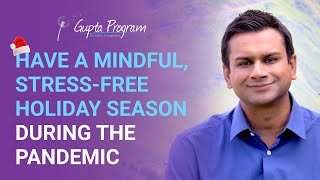
Ashok Gupta walks through managing pandemic stress during the holidays using mindfulness. He names the emotions you're likely feeling: survival anxiety, depression, isolation, grief. His approach: observe without judgment, practice self-compassion, retrain your brain to shift perspective, and relax your nervous system through meditation, sleep, nature, and exercise.
Questions this video answers
December 17, 2020.
Meaning of Life Experiment (free, not-for-profit).
guptoprogram.com
Chapters
Well, hello and a warm, warm welcome to our Facebook Live event with myself, Ashok Gupta. I'm so glad that you could be with us today. And today we're going to be talking about how to have a stress free, mindful Christmas given the pandemic, given the situation that we're in right now. So hopefully some very interesting insights that we can share with you today and things that you can practically put into practice. So I know that there's many of you joining us from around the world and what we're going to do is this first half an hour, we're going to go through some content, some ideas around how you can have a mindful Christmas and then we'll stop this broadcast and then we'll start another broadcast which will be a Q and A, which will give you the opportunity to ask questions and for me to find out where you're tuning in from. So firstly, what we're going to talk about today is really looking at the kinds of emotions that people are experiencing as a result of the pandemic. And this is a unique Christmas, a unique set of holidays. What are the emotions that you're experiencing right now? Have you been able to make sense of them? So that's what we're firstly going to cover. And then we're going to look at how we can retrain our brains out of some of these emotional responses to the pandemic, how they impact on our Christmas. And finally, we'll give practical suggestions on how we can not only retrain our brains, but actually indulge in some relaxation. And therefore, I want to make today really, really practical. How can we have a mindful, stress free Christmas, a happy Christmas, Genuinely saying happy Christmas. How many times do we say to people, oh, have a happy Christmas, have a Merry Christmas. And yet inside, we don't feel that they're just words, we're just saying, can we truly bless others and truly bless ourselves when we say that? And have we got the skills and the abilities to be able to become aware of our emotions that are challenging that and break free? So a core part of this is going to be something that I heard the other day. Do you know how Santa makes sure he's stress free with some elf care? Yeah, I'm really sorry about that. I just had to throw that in. The team weren't happy that I was going to do that, but I just had to. I'm sure there will be a lot more worse jokes that you're going to experience on Christmas Day out of your crackers. I'm sure. So, in terms of our holidays, this is something where we often want to live up to a certain expectation or ideal. You know, we see that wonderful, I suppose, Hallmark films or something that we've seen on tv where it's this beautiful Christmas and the family are gathered around the fire and everyone's smiling and everyone looks happy. And then the realism kicks in and then the expectations, oh, I must produce the perfect meal for the family. Oh, I must make sure that everyone's really happy with their presence. So all of these other things start building above Christmas that are nothing to do with the holiday season, but they're part of just the culture which has valued our achievements instead of what's really underlying Christmas, which is that joy, that love, that happiness, that sense of community and family that a lot of us are missing out on right now. So I think the first thing to say is this pandemic Christmas, if we dare call it that, let's call it the Christmas during these challenging times, is an opportunity to go deeper into the meaning of Christmas and the holidays and deeper into understanding why we are feeling the way we're feeling right now and what we can do about it and to genuinely share in those human values that we all share. And I think the first thing I want to share is this idea of a mindful Christmas. Now, what does mindfulness actually mean and how does it relate to our emotions? Well, the first thing to say is that the way that we're feeling right now, often we judge those emotions. We judge those feelings. We say, oh, I shouldn't feel like this. I'm embarrassed to feel like this. Or it's a sign of weakness if I have such and such emotion. And yet by doing that, we repress our emotions. So as a result of the pandemic, there's so many different emotions we might be experiencing, and if we push them away, if we feel embarrassed, we actually make it worse. Just like if you have a spring and you push the spring down, the more the pressure builds up within that spring, the more the pressure builds up within us. Or another way that we handle our emotions is to indulge them, to actually think, oh, no. Yes, I am feeling anxious. That must mean we are in danger. Oh, dear, things are really bad right now. So we get caught in that whirlwind of negative emotions. And either way, either indulging the emotion or actually removing the emotion from our minds and ignoring them and repressing them, either way, we cause ourselves more challenges. And that's really not what we want to do. And of Course, things have become worse in the last 10 years, down to one thing, having social media and other apps on our phones. So we know that in the last 10 years, people have become more distracted, they've become more anxious, more depressed. And a lot of that is being put down to the fact that we have this always on life. And before, we used to process our emotions. So if we felt sad, we felt angry, we would have time by ourselves. Whether it was in a doctor's waiting room or on a bus, or sitting at home, we wouldn't be constantly distracted. But right now, when we have a difficult emotion, we can simply distract ourselves with the comfort of a YouTube video, or surfing on Facebook or going on to TikTok and watching some amusing videos. They are actually genuinely funny. And that becomes a way of blocking out the discomfort that we feel within. In some ways, we've gone back spiritually in the last 10 years as a result of this phenomenon. And now it's time for us to really recognize this and see how it's impacting our lives. And so during this Christmas, can we go into a state of mindful awareness of what we're experiencing now? What does mindful awareness mean? Well, instead of repressing the emotion or instead of indulging the emotion, we observe how we're feeling without judgment. So the first step is even to become aware of what we're feeling rather than distracting ourselves away from it. But then secondly, we're not judging our emotions, we're simply aware of them and witnessing them. And in doing so, something magical happens. We envelop that emotion with a blanket of love, a blanket of awareness, and that emotion has the opportunity to then transform and transmutate. You can't shift an emotion straight away, but what you can do is give it a loving embrace. And really, what is an emotion? If we go even deeper? An emotion is an unconscious response to a situation or an event based on our past conditioning. So we respond to our outer environment, to people and situations based on how we responded before and the day before, and the week before, and the year before. These are habits of responding. And those emotions are designed to come up, stay with us, and then dissolve away. But now, as a result of the ongoing situation that humanity finds itself in, those emotions are being re triggered again and again and again for society. And that's why we find that there are so many people, so many more people suffering from anxiety, depression, grief, isolation, all of these types of emotions. And a recent survey found that nearly half the population of Western countries are experiencing some kind of sadness or anxiety, Especially during any given week, which is, you know, far higher than any pandemic of the virus. There's a pandemic of anxiety and sadness. So let's go deeper into that and understand how we can become aware of that, what's causing it, and how we can have a more mindful stress frequentness. So the first thing to say is the reason that we're experiencing that anxiety is because this situation has gone to the core of what we call survival anxiety. Anxiety is the fight or flight response, or more the flight response, which is the fear response, the runaway response. And anger is the more fight response. And because of this situation, we're finding ourselves in survival anxiety in terms of the health impacts on ourselves, the potential health impacts, the health impacts on our family and our friends and just the people around us. So there's that kind of survival anxiety. And more and more what's coming up is the survival anxiety around our finances. What will this situation be like next year? Will our business survive? Will our job make it through this, through this upcoming recession? And all of those questions and all of those anxieties are perfectly normal and understandable. But what's important is for us to observe it and be aware of it and acknowledge it. So the first thing that I'd like us to do is not distract ourselves from our emotions during this holiday season, but instead use it as an opportunity to become more aware of how we're feeling and push away not the emotions, but the devices, the screams that are screening out life. We're screening out our kids, we're screening out our emotions. And this is incredibly dangerous for us as human beings to be doing this. So instead, in this mindful Christmas you now want to have, let's become first of all more aware of our emotions and then secondly, accept and validate those emotions. It's okay to have this emotion. So with that self compassion, we can validate and say, it's okay, this is a normal emotion. I'm okay, I can be compassionate with myself for having this emotion. Whereas usually we might once again push it away or tell ourselves off for feeling like that, or say, why can't I be stronger than this? And that anxiety that we're experiencing is because of the changes to our way of life. If we're having any depressive episodes or sadness, this is because when anxiety burns out, it can lead to depression. So anxiety and depression are the flip side of the same coin. Anxiety is our worry about the future. And when we become exhausted from that worry, we then can unfortunately Slip into that state of depression. And once again, if you're experiencing depression or very depressive symptoms, it's very important that you speak to your doctor and work through that in that way. Thirdly, we're experiencing isolation. And that's not just the physical isolation, but the social isolation. It's so funny, I noticed that in April and May, I was getting contacted by so many people to join Zoom calls and have online get togethers and parties. And because people are so fed up of being on screens now, that's kind of died away. And we're not engaging with people around us, our family, friends, as much as we used to. And it's incredibly important that we, we don't just kind of slip into that morose feeling of, oh, well, we're by ourselves and there's nothing much we can do but to actually make sure we are reaching out. And if we're feeling lonely, how much more lonely are other people feeling? How can we solve our own loneliness? By reaching out a hand to others, reaching out our hand first to others who may be feeling isolated and lonely. So maybe that's something that we can think about to have a more mindful, stress free Christmas. How can we help others feel stress free? How can we help others feel less lonely? That could be a beautiful gift that we give to people. And that might be elderly relatives, that might be people who are going through challenges, friends who are going through challenges. And that is a gift, that is a true gift that we can give from the heart. And finally, the sense of grief. You may have heard of the grief cycle. Not many people talk about this, but actually the pandemic has triggered this sense of grief and isolation. And if I can just share a slide here which describes what I mean by grief or the grief cycle. So the grief cycle is this idea that when we have a shock, it moves us through different types of emotions. So when the pandemic first hit, there was shock and denial. People saying, I don't know what this means, is it really real? And there was a numbness of how could this be possibly happening? And then there's anger and fear that comes as a result of that, the anxiety, the frustration. And as I said, once anxiety burns itself out, it can turn into depression and detachment, where we have a numbness to what's going on, we know that something's not quite right and we don't feel good inside ourselves. And there's a depression, a detachment, a sense of helplessness, a sense of victimhood. So just see if you can recognize any of These emotions that you have been going through or are going through now. And remember that these aren't linear cycles. This is why these little curves in the cycle, you may have one emotion, then another emotion or another feeling within this whole process. Then there's this idea of dialogue and bargaining where we begin to try and make sense of a situation, to find meaning and try to work through our challenging emotions and our shock. And finally there is acceptance. This is often the end of many cycles, many emotional cycles where we understand that it doesn't help us to stay stuck in this cycle, but instead to move to a place of surrender and acceptance, of letting go and then beginning to return to some semblance of normal and meaningful life. So where do you think you are in terms of this cycle? How are you feeling right now? Have you ever asked yourself that? Or have we been too distracted by the glittering lights of the world around us? And instead a mindful Christmas is about going inwards for that self care, that elf care. That's the joke that keeps giving. So let's just go back to what we were talking about. So there is this idea of letting go of the grief, looking to find renewed meaning. And in the Gupta program, we talk about how whenever we want to sail through life with peace, we want to act like a dove. Now, what does the dove need to fly? It needs two wings. So one wing is the retraining of the brain. The second wing is the relaxing of the nervous system. And the tail feathers give us direction, which we call re engaging with joy or indeed finding purpose and meaning in life. So if we start with that first wing of how do we have a mindful holiday? The idea of retraining the brain. Now, how many times do we hear people say, oh, 2020 is a write off, you know, we might as well write off that year. It wasn't a great year. And we can sometimes feel like that, oh, what a horrible year 2020 has been. And I want us to really completely turn it on its head and look at this from a completely different perspective that can help us end this year with a sense of upliftment and positivity. So I want to talk about why we feel these emotions and how we can shift this perspective. We feel these emotions because of the mind, because the mind has overtaken us. The egoic mind as it's sometimes called. The mind and the ego working together. Now, the mind is like a car. Now what do we do with a car? We walk out of our house, we jump into the car and we drive somewhere and Then we get out of the car. That's how the mind is supposed to work. It's a tool, it's a utility. We jump into our minds, our mind is able to help us process the world around us. And then we're able to switch off the mind and go back to peace and stillness. But instead what happens? We jump into the car and the car goes on autopilot like you get these self driving cars now. And we become a passenger and the mind has now taken control. That which was a tool has now become the driver and we're overtaken by the mind. And instead what we want to do is learn how to step out of the car and not let the car overtake us, not let our minds overtake us with these emotions. So that's the role of the mind. What about the ego? The ego is that sense of individual identity or separation from people around us, from God, from the universe, whatever you believe in. And hand in hand with the ego is this sense of here I am alone in this uncaring, lonely universe, which is unsafe. Do we sometimes recognize that there's this background feeling of dread, this background feeling of uncertainty, that sometimes we don't feel fully comfortable and at peace with life and ourselves because we feel that once again we're in this uncaring, lonely universe. And that is one of the roles of the ego is to then try and overcome that sense of dread, that sense of insecurity, that sense of I'm not good enough. By then shooting out into the outside world and through our self image, our achievements, helping others, whatever it may be, we look to validate ourselves, to validate our sense of insecurity, validate that gap within can we recognize that within ourselves? And sometimes we even do that with Christmas. Once again we set ourselves those expectations of putting on the great dinner or making sure we've got the best present, or making sure that everyone's having a great time. With all that pressure and expectations, we burn ourselves out. And it's all down to this individual ego. Now along comes the pandemic. What the pandemic has done for many, it is magnified that sense of egoic mind or a background sense of dread. Because suddenly now, everything that we took for granted in life, that sense of safety, that sense of we know what's coming next, has all been thrown out the window. We suddenly realize we are not in control. We don't know what's going to be around the corner. And that for many people has been challenging and created huge amounts of anxiety and depressive. Thoughts and grief that, that what I took for granted is no longer true. So let's just recognize that. But that's okay, because the most important thing I want to say is 2020, as challenging as obviously the number of people who have passed away. And we feel great sorry for that as much as that has happened. At the same time, these kinds of situations in life we can use as an opportunity to bring forth what was unconscious within us. That anxiety that you're experiencing right now about what's going on in the world, that was always there within us. It was just below the surface. That sadness, that depression that has suddenly come forward, that was always there within us. It was never resolved. That sense of isolation and loneliness that we might feel, that was always there below the surface. It's just that this pandemic has brought it to conscious awareness. And the people and the situations and the events of our lives are designed to do exactly that, to bring it up to the light of consciousness. So we all are aware of what's going on within us, of our vulnerabilities and to build strength and resilience within us. Look, you got through this. You're here right now. No matter what has happened this year, no matter you've lost loved ones, no matter you may have had financial difficulties, you're still here, you're still alive and kicking, you're breathing. And I want to give you that hope now that there is this powerful human spirit within us all that can get through these challenging times and can find that resilience and that strength within to get through this in a stress free way. And so one of the ways that we can do this once again is not only accepting and validating our emotions, but beginning to share our vulnerabilities with people around us. We want to talk more. When was the last time you actually had a deep discussion with your friends or your family or somebody around you? See, the reason this egoic sense of dread is getting worse is because we're not communicating with as many people. We're doing zoom calls and whatever, but we're not meeting as many people. So these emotions have another reason that they're not being validated and accepted. So can we share our vulnerabilities with people around us? Can we reach out our hand and ask people how they are doing? Because what we choose for ourselves, let's give to another. If we want to relieve our anxiety, can we really help relieve someone else's anxiety? If we want to relieve our own sense of isolation, let's relieve someone else's sense of isolation. And we shall be healed too, because what you give to another, you receive tenfold. And of course, that's not the reason that we do it. We do it because the nature of our soul, if we go beyond the mind, beyond the car, the nature of our soul is to want, to share, to give, to uplift ourselves and uplift those around us. That is the glorious invitation that we are given each moment of our lives. And therefore, this is immensely healing. This is what the world needs right now. It needs you. It needs you to step up and become more mindfully aware of your own emotions and then support the coaching and healing of those around you. And we are all each other's coach. Of course, we may not be formally trained as a coach, but just deeply listening to what someone else is going through can be transformative and can uplift. You don't know what healing, what salvation you may bring to a soul around you, just through the power of your empathy and the power of your voice and the power of your listening. And so for ourselves, if we become aware that now the anxiety we're experiencing is an opportunity for us to become more aware of our responses, our past conditioning and our ability to shift perspective and to see this pandemic as not in and of itself positive, but as an opportunity for us to grow, become more resilient. So with anxiety, we become aware that, that we're not in control. It's like flowing down a gentle river. We can resist the flow of the river and cause ourselves even more stress and anxiety and be pushing against the current, or we can learn to accept and surrender to what is so and just. At the moment that we think we've accepted and surrendered, another challenge comes into our lives to take us to an even deeper level of surrender. People say, Ashok, I'm fed up with growing. Why does it have to work that way? That's just the way it is. We're here to grow, to expand, to become the next best version of ourselves, to reach our potential. And in terms of depression, have we been indulging in self care recently? Have we really looked after ourselves? Or what are we attached to that is causing us these depressive thoughts? Same with anxiety and depression. That worry is being caused because we want things to be a certain way. We're attached to a certain outcome. And when things don't go our way, then we feel that suffering, that anxiety within us, that tightens within our chest. And the antidote to that is to retrain our brain to say, I'm not in control. The only Thing I can do is float through this, accept and let go and surrender with isolation. Do we find it difficult to be in our own company? Do we use others as a way of distracting from our own sense of aloneness, Our own sense of that feeling of dread, of having silent moments or being in our own company? There is much joy and much expansion to be found in that sense of isolation. But it's not really isolation, it's a sense of being with oneself. So if you are on your own this Christmas, if you're finding that challenging, first thing we've said is reach your hand out first to others, but then secondly, become aware of that feeling of loneliness, go deeper into it and just witness it and you'll transmute it into something positive. And the same with grief. Are we like an oak tree or a willow tree? An oak tree stands strong in the storm and gets uprooted, loses its sense of groundedness. But a willow tree is able to float, it is able to backwards and forwards with the ebb and flow of life. Can we have that flexibility? And finally, so that's the retraining of the brain. So we can retrain our brain through taking this new perspective. And of course with relaxing the nervous system, that second wing of the dove, let's indulge in that self care this Christmas. Let's realise that although we may be in isolation or there may be lockdown, parks are not cancelled, nature is not cancelled. This is an opportunity for us to really commune with nature and deeply relax our nervous system. And of course eating well, sleeping well and exercising all of those good things we know we should be doing. And mentally and emotionally, can we make sure that we are meditating? Regular meditation is the antidote to that sense of isolation or that anxiety we're experiencing. Study after study has shown that. So I'd love for you to do is to start up a practice of meditation. And we have a free not for profit app called the Meaning of Life Experiment. So you can go to app store or play store, type in Meaning of Life Experiment and you can download our free not for profit app to help you meditate. Lots of 10 and 20 minute meditations there. And of course mentally, emotionally, can we become more mindful? So when we're feeling stressed, let's just take a slow deep breath in and as we breathe out with a smile, how can we shift perspective? And perhaps we say to ourselves, this pandemic, this situation is helping me become stronger, helping me become more aware of that anxiety within. And of course, gratitude, the antidote to a Lot of these emotions is to feel grateful for what you do have in your life. There are a billion people on this planet who are suffering through the pandemic, but also don't have guaranteed access to clean water. There are billions who are malnourished right now, who are economically insecure. They don't know what's around the corner for them in terms of survival. That's true survival anxiety. So let's feel grateful for what we do have in life and focus on that during this period of time. And finally, let's be the source. Instead of looking for the outside world to be dependent on, for our happiness and our joy and our sense of being. Instead of being dependent on Christmas or festivals, let's be the source. Let's recognize that we have all the joy within us. We have all the love within us. We can be the source of that which we are looking for in the outside world. And that is the irony. We're like a hungry beggar looking for that in the outside world. And yet our place is full. We just don't realize it. So let's soothe and reassure those who are anxious. Let's listen and uplift those who are feeling depressed, those who are isolated around us, let's reach our hand out first. And when it comes to those who are feeling grief, let's know that we are not alone. There are people around us who are there for us and the universe deeply loves us. Reminds me of that song. You are not alone, I am here with you. Though we're far apart, you're always in my heart. So let's remember those messages deep within us. So all it's left for me to do is to say that you are being looked after. There is a deeper love within this universe that is taking care of us all. And when we let go of looking for these things in the outside world during this period of time, let's recognize the joy which wants to spill out of us, wants to emanate from us. That love wants to pour into the lives of others. Let's connect with that. And for the resources, please do download our not for Profit app, the Meaning of Life Experiment. If you're suffering from any kind of chronic illness, then please do have a look at our website guptoprogram.com lots of brain retraining and neuroplasticity techniques to support your recovery from chronic illness. What a great time. This is time on our own to go deeper into our own healing. And of course, during this Christmas, let's let go of expectations. Let's accept ourselves and our achievements and our ability to put on a good Christmas. Let's just be happy with ourselves and contented with who we are. That's the deepest gift that we can give ourselves during these holidays. Let's be that peaceful dove that flies gracefully through this period of time. So the dove flies with two wings and it needs tail feathers, a sense of direction, sense of engaging with joy. So on New Year's Day at the same time, or perhaps we might do it later on New Year's Day, I'll be doing a special New Year's message which we all about how we can use 2021 to really discover our goals, discover our joys and live a life of purpose. So I hope you do join me again on New Year's Day. So now we'll be going to another Facebook Live on the same Facebook page. We won't be on YouTube but we will be on Facebook. So once again we'll start that Facebook Live just in a couple of moments time. So please do refresh the Gupta Program page on Facebook and you'll find the new stream and I'll answer some of your questions about how to have a stressful, mindful, stress free, mindful Christmas. So thank you for watching. Please do share like and comment. Please do share this video with your friends, your family on your personal timeline and groups because we want to spread this message that this is a time of joy. No matter what situation the world is in, this is a time for joy, peace and love. And let's really share that with others. Thank you for watching. See you next time. Thank you and goodbye.










