"What's Self-Love Got To Do With It?!" - Interview with Anodea Judith
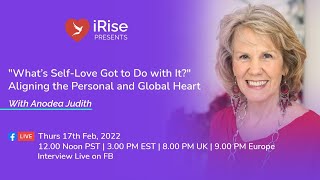
Anodea Judith lived off-grid on a mountaintop and now teaches that individual self-love and inner work drive global transformation. She uses chakra metaphors to explain how the heart chakra integrates our being, and contrasts healthy self-love with narcissism. Judith is developing She Leads, a system of 40+ female leadership archetypes.
Questions this video answers
February 18, 2022.
163 countries.
28 languages.
Thursday 24th February at 7pm UK time.
Tuesday 1st March at 7pm UK time.
Chapters
Hello everyone and a warm, warm welcome to our Facebook live with myself, Ashok Gupta and our special interviewee today, Anadeya Judith. So for those of you who are new to Irise, we are here to empower humanity and uplift a billion lives. We're here to really make a difference in the lives of people around us and for the planet as well. And we're very privileged to have Anadea Judith, who's a very accomplished writer in this particular area. Now, before we go to our interview, I just want to share a couple of very important events that are coming up that we want you to be aware of. So firstly, as part of our self love awareness week next week we have a workshop with Anna Francesca Celestino called the greatest relationship you'll ever have. That will be on Thursday 24th February at 7pm UK time. And Derek Hart, a relationship coach, will be conducting a workshop called from hurting to healing in 10 minutes. His strategies for fast interventions in relationships. That will be on Tuesday 1st March once again at 7pm UK. So I hope you can join us for that. And once again very honoured to now bring Anadeya on. How are you, Anadea? Lovely to see you.
Thank you, Ashok. It's great to be here. I'm really in a great place. I'm vacationing in Hawaii at the moment.
Yes. And we're so grateful for you that on your vacation you've still made the time and effort for it to be interviewed today and uplift people's lives as part of our Self love awareness week. So thank you so much from the bottom of our hearts.
Well, I really believe in what I rise is doing, so I want to support you guys.
Yeah, thank you. So Anadea is a best selling author and thought leader on the topic of chakras, psychology, yoga and social change and she's director of the teaching organization Sacred Centers. She holds a doctoral degree in human health, a master's in clinical psychology and advanced yoga teacher certifications. She's a globally recognized teacher whose courses have reached 163 countries, published in 28 languages and she's been called a prophet for our time for a social change book. The global heart Awakens. What a beautiful title that is. So Anadir, once again welcome. When we have these interviews, we're always very intrigued to know the background that people have come from that's made them become a teacher of transformation. Many of us been through our own challenges in life which has sped us along this journey to want to help others. When was the moment for you when you knew that this was the work that you wanted to do. What was that kind of aha moment for you?
Well, I don't know if it was a moment, but from a young age I was interested in metaphysics and I was also loved nature. And so there was a time when I gave up everything I had, except for what would fit in the back of a little four wheel drive jeep. And I lived off the grid actually for a period of time alone on a mountaintop in a tent for several months. And it was at that time when I looked around and I realized that my relationship with the trees, the sky, the earth, it cared nothing as to whether I had a dollar in my pocket or $100. It didn't know what I had in my bank account, didn't care whether I had PhD after my name or whether I had written a book. None of those things that are important in our everyday society and held as values in the world of nature made any difference whatsoever. And it actually freed me from all that to a direct state of being. But as I sat up there on my mountaintop alone, sitting by my fire each night and gathering water from the rain and you know, working with the elements, I realized really all my knowledge of the chakra system came to me. Well, not all of my knowledge, but the basic gestalt, the basic understanding of the chakras and their elements and the connection between heaven and earth just came to me during that period of meditation and, and retreat and isolation. And then I would look down from the top of my mountain and I would see the pollution crawling up the valley and I would see the noise crawling up the valley. And I realized that if I didn't come down off the mountain and you know, do something that interfaced with the world, that that pristine place wasn't even going to be there anymore. So I knew then that my path was to take this knowledge back down into the world.
Yeah, that's beautiful. It really is actually. When we connect with nature, I always say nature doesn't have an agenda, whereas everything else in life seems to. And certainly with our modern world of social media protecting our self image, projecting a certain way, a certain manner, has become so stressful for our system. So when we commune with nature, suddenly we realize I'm free. I'm free from all of that. And it sounds like that's something that you really went deep into and channeled something so powerful for humanity.
Yeah, and it was more than really. I mean, I actually got free of all that for a period of Time, you know, and the muscles in my legs meant more than the money in my bank account, you know?
Absolutely. And obviously, this theme that we have this week is around self love. And I know that you very much talk about how the individual transformation is so crucial and important right now as part of our global transformation. How do you see the concept of self love and taking care of ourselves in that way, relating to these bigger concepts of where humanity is right now?
Well, I believe that humanity is going through an initiation to our next era, our next state of consciousness. And in many ways, if you look at evolution from the earliest cells to humans that can stand in their hind legs and text on cell phones, what evolution does is it becomes more complex, more intelligent, more creative, more powerful, and that we're moving toward the divine, we're moving toward godhood, you know, that we have the power that once was attributed to gods. And so our initiation is that divine awakening. And here's where it ties in with self love is that the self is something in service of a larger matrix of awakening. And we are the instruments playing in the Grand Symphony. And so if I'm going to play in the symphony, I need to practice, I need to hone my instrument, I need to take care of it. I need to. Whatever we do with our consciousness, the highest consciousness we can be in, we will do it more clearly, more directly, more divinely, more creatively. And so self love comes in to really make our vessel the best vessel it can be for the purpose of playing in this symphony.
Beautifully put. Beautifully put. It is that idea of, I often say to people, are we really here to wake up, go to work, get stressed, come home, watch Netflix, go to sleep, rinse, wash, you know, rinse, wash, repeat. We're here for something deeper, as you're kind of describing there. And when we realize that bigger purpose and you say, I love this idea of the instrument, that we've got to clean our instruments, that if we don't take care of that instrument, which is our own individual consciousness, how can we be of benefit or a gift to society or humanity?
I guess that's right. I mean, in an orchestra, if one of the violins is mistuned, it can throw the whole thing off. So it's part of our tuning to take care of ourselves.
And I'd love to just share this quote from yourself. So love is not a matter of getting connected. It is a matter of seeing that we are already connected with an intricate web of relationships that extends throughout our life. It is a realization of no boundary that we're made up of all the same stuff, riding through time on the same spaceship, faced with the same problems in the world, the same hopes and fears. It is that connection at the core that makes irrelevant skin color, age, sex, looks, or money. And I think this is relating to your idea of the instrument that, as you say, we often just look at ourselves as this isolated small being. But actually, when we see ourselves as the great orchestra connecting together, then we go beyond those boundaries. So could you speak more to the idea of being connected to love? What does that mean to you?
I think of love actually as an entity, a huge, colossal entity that wants to make more of itself. And every time love breaks out, every time peace breaks out, every time joy breaks out, that entity cheers in a way. And so we are part of this coming back home to our connection to. You know, when we were living in nature, we were connected. There was no separation. Then we put up walls, and then we walled our cities, and all of that gave us this separation. That was a stage in evolution that was important to realize we had a separate self to take care of that self, to awaken that self, to do the practices that have been handed down to us by our ancestors to, you know, practices like meditation and yoga and tai chi and various things that are, you know, the practices that help us play well in the symphony. And so as we do that, that's part of our self love to take care of those. And to know, even in an orchestra, every instrument is playing its own tune. You know, the horns and the cellos don't play the same tune, but they're all playing something together at a higher level. So we each have our own individual expression that is part of the grand symphony.
Absolutely. And I guess if we aren't connected, we're going to be just playing our own little tune for ourselves, but without realizing our position in the. In the bigger picture. And then it all sounds horrible. And that's the challenge is. So essentially you're using this metaphor. The challenges on the planet right now is because we're not in sync. We're not in symphony together. We're all isolated beings, probably operating from the ego for what's in it for me, rather than what's in it for the collective good.
Exactly. And here I would like to distinguish, you know, self love, which is your theme, from what I call narcissism or selfishness, which is so much emphasis on the individual. And, you know, one thing we can see this in is, you know, how dare you tell me to wear a mask? I have My freedom to breathe on anybody I want, you know, and the kind of things that are being done in that. It's not looking at the collective. You know, how do I contribute to the collective? And even what personal sacrifices are we willing to make? But we are more willing to make that when we have taken care of ourselves to begin with, when we have that self love as a ground and a basis, then we're. It's like the cup is filled, and then we can dispense what's inside the cup to others.
Yes, yes, I. I totally agree. I totally agree. And I'll be interested to understand. How do you think people get separated from this connection? So if this connection is so vibrant and it's with us continuously, how do we get separated? Is this something that happens in our childhood? Is this our wounding that magnifies that sense of separation, or is it something else?
Well, I think that sense of separation is part of our development because there was a famous quote, thus, for love's sake is the universe divided. That separation gives us the yearning to come back to the union again. And that yearning is what drives people to spiritual practice. It's what drives people to self evolution. It's what drives people to reach further, to serve. And it's almost like that wounding is necessary to feel the self so that we have the self and we honor the self. And then from that we serve something larger. Yes, it's a both and.
Yes, it's a both and. And it is this idea of almost breathing out which creates a sense of separation and different things. To be able to breathe back in, to come back to oneness. And the idea of sometimes we forget the truth in order to discover it. And the. The journey of rediscovering that, that truth is the beauty of that journey.
Exactly. And I think the wounding, you know, I was a therapist for two decades, and the people who had the deepest wounding sometimes had the most depth in their soul and they had the most openness because they had been through the trials. And so for people who are listening, you know, if you think you've had a hard time, that means, you know, sometimes I say that the divine gives the hard time to the ones they love the most because they want them to have that humility and that opening so they can serve better.
Yeah, yeah. It's like the analogy of cooking the rice. The rice is hard and brittle, but we cook it so it becomes soft and fragrant. Now, that rice is very tough initially, and it goes through that painful process, but it's that metamorphosis. Into something bigger and brighter. And I share that with you. The idea that our challenges make us stronger. And they also, as you say, bring that empathy and that, that love, that sensitivity to the nature around us. On that note, I know that you've written quite a lot of books on women's empowerment and you're writing a new book, you're about to publish a new book as well. Do you see a difference between men and women in terms of this particular journey back to love, back to connection?
I do. And I think that women are always teaching their men how to open the hearts. You know, in general, we're the ones. You know, you talk about that softening of the rice, right. And I think, you know, the men, the dog eat dog, man's world out there is a tough world. And men have been in that world, working hard, competing. It's, it's, it's just a hard place. And they come to women for that softness, for that softness. And I think, you know, from an age old when the priestesses, they say, used to sleep with men to take the war out of them, you know, women have been the softening of men and bringing them into the hearts. And of course, we come into our hearts through the crucible of relationship, and that is where we have our laboratory, if you will, to learn how to love.
Yeah. And I hope that men who are listening can, Can. Can hear the beauty of that sentence that we. There is a gift that men are giving to women, that women are giving to men to kind of grow and empower each other. If we can see it in that way, rather than having conflict over the differences, seeing the gifts that they bring, what a better world we could, we could definitely create.
Oh, absolutely. And we need the masculine contribution, we need the feminine contribution.
Yeah, absolutely. Can you tell us more about the book that you are. Has it already been published or is about to be published?
No, no, I'm working on it at the moment. It's called she Leads and it's about archetypes of women's leadership. And what I realized is that women take leadership in different ways than men do. And our models for leadership are sort of based on the general that has to lead his soldiers into battle. And so you need somebody that's powerful, that is dictatorial, that says this is the way they're decisive. And, you know, they don't have a soft moment. They have to go into battle. And we have attributed that to our CEOs, to our presidents, to our prime ministers, to, you know, whatever we have. And when Women try to lead. If they don't seem masculine enough, they think, oh, they don't have what it takes to be a leader, especially in politics. And if they are masculine, then they are, you know, oh, she's too masculine, she's too bossy, she's a nasty one. And so we have a tough choice, to lead from our own hearts or to act like men, which is fine for men, but not for us. So I realized that there's different archetypes for women's leadership. Even things like one of my archetypes is the shepherdess. The shepherdess brings people up from the rear. She makes sure that everyone is taken care of. Well, you need that in an organization. You don't need everybody just out front calling the shots. You need people who are caring. You need the creatrix who brings creativity into it. You need the mistress of play who makes it fun. And then there's the ancient archetypes like the priestess and the midwife. And so I've got about 40 archetypes that I'm describing and there will be a card deck with it, so you have pictures. And it is to empower women and taking power in the ways we naturally do.
Anadea, that is beautiful. I can't wait for that to come out. And I'm really glad that you've written that book because certainly a lot of work that I do, I present at these various conferences. And sometimes there is this idea that to succeed, as you say, in a man's world, women need to be more like men, embracing those typical male type archetypes. But in doing so, all we're doing is keeping the same systems stuck with male energy and not bringing the balance of male and female energy. So it's not about succeeding in a man's world, it's. It's shifting the energy of that man's world to more represent the complementary energies and being them being used at the appropriate time. And so I think your book sounds like it's something which can really empower women to nurture and be grateful for the female energies to be brought into workplace. Is that how you see it?
Yes. And hopefully men will read it too and begin to recognize women's leadership in these roles and, you know, honor them for that, recognize it, reward them for it, you know, not just look for the leadership in the male way that every organization needs these leaders.
Yes. And in fact, could men even begin to nurture and engender those particular archetypes within themselves? Because obviously we're all a mix of male and Female energy and in different forms at different times. And maybe is that a way of potentially shifting the system to this kind of global transformation you're talking about?
Absolutely. And just, you know, I mean, ultimately to get beyond gender somewhat and say these are just ways that we can lead and ways that we can serve. But a follow up book I think is going to be on Archetypes for Men.
I definitely look forward to that one as well. Great. Wow. There's so many things. Anadea, we could, we could talk, I could talk to you for hours on this. But I wanted to come back to a point you mentioned around self love and the differences between that and narcissism because I think people are very kind of interested in that. How can people differentiate the two and make sure they're not going down that road of narcissistic self love, which as you say is something that's becoming more and more individualistic in society itself. How, how can people differentiate and make sure that they stay on the self love path, which is nurturing.
Well, for one thing, the narcissist by definition doesn't have a very strong sense of self. That's why they need their self affirmed by everybody else. So they say, look at me, tell me I'm great, look at me, give me your attention so that I can actually feel like I am somebody. The person who really practices deep self love, self connection, self listening, self presence, they don't need to be affirmed by everyone outside of them. They don't, you know, the narcissism really. And even as a psychologist, you know the classic definition, it's someone who lacks so much self they can't find it unless they're affirmed by others.
Yes.
So the deep true self love actually prevents narcissism.
Exactly. Because the arrogance and narcissism is actually a lack of self love. It's a, it's a protective shell over the soft wounded core that many people have, isn't it?
That's right, that's right. Yeah.
And a day you specialize also in the, the chakra system. Can you talk more about the heart's chakra and how that relates to love and some potential practices people can engage in to nurture that?
Absolutely. So in the chakra system of seven chakras, the heart is right in the middle. It is the central chakra. In a system of seven, it's number four. So there's three above and three below. And its symbol, the six pointed star is two intersecting triangles. Think of, you know, the star of David. Two intersecting triangles Spirit coming down into matter, matter rising up into spirit. And they're perfect, perfectly balanced. So the heart chakra is that balance point. It's the integration of mind and body, spirit and matter, heaven and earth, masculine and feminine, inside and outside, self and collective. So all of these dualities that we're talking about come together in the heart chakra. And so I actually see the heart as the great integrator. And that is why when we get hurt, when we have lose a loved one, we get rejected, we disintegrate, we fall apart, you know, and we even say, oh, I've got to pull myself together. But that's disintegration is what we have with a lack of love. The love brings us back into integration. It brings things back into relationship. And in relationship we become whole.
Beautifully put. And I certainly notice in my life and many of my patients that when there's a lot of fear in life, as you say, that kind of disintegration or a lack of love, people feel this sense of sinking feeling from the heart down to the stomach, to the stomach chakra. But when there is love, there's a kind of expansion and an upliftment from, from this area of their bodies. Is that what you're talking? That's what you're referring to?
Absolutely. And it's, it's like when we get that hurt, it actually that when someone gets rejected, they're asked to fall back on themselves. And mostly, you know, people say, oh, but I gave everything I had to hurt. And you know, oh, well, that's why it was taken away. So you can come back home to yourself and hold that in balance. That's that sinking feeling. But when we have too much attachment to that, then we have this uplift that takes us more into the upper chakras.
Yes.
Which are more universal. And so the heart is the balance point, the balance between the personal and the universal, between the practical and the spiritual. It is the integration of those. And to me, in the chakra system, the journey is to go all the way up and then come down and integrate the upper and lower chakras to each other.
Yes. I highly recommend your books and your courses. So in fact, for Self Love Awareness Week, if they want to find out more about your work, your course From Crisis to Awakening is available on the homepage of irise. So I really recommend everybody to go onto IRISE and watch that course. It's fantastic. And you'll gain a lot from that as well. So, Anna Day, just as we're finishing off our interview today, there's so many questions I could ask you, so many places we could, we could take the conversation where now for civilization. And you talked about how we're almost like a teenage boy on a couch. That civilization is currently the teenage boy on the couch that needs to go through that awareness and awakening. Where do you see the world going next? And I think we've touched on this idea of male and female energy so bringing love more into the day to day dynamic. And we're even hearing politicians talking about love now. Whereas love before was an unspoken word, now it's something that they're bringing into the dialogue. How can we bring love into our day to day systems processes into civilization?
Beautiful question. And you know I come to the subtitle of my book on the global heart which was humanity's rite of passage from the love of power to the power of love. And in this I talk about the love of power being an organizing principle, a top down obedient power over organizing principle for society which was important in its time. Now we are growing up through the initiation, we're going through our adolescence into our adulthood. We can have peer to peer networks. We have a web of connection rather than a chain of command. So the power of love is a new organizing principle. How do we organize our societies around more equality, more diversity, more inclusion, more plurality. And this is really what's up in the world. And how do we coordinate all that? Because it's very complex. And so I think part of moving from, and that's moving from the third chakra, which is oriented to power, to the fourth chakra, oriented to love. And so in the third chakra we want to get our sense of individual, individuality, we want to get our ego solid and in command. You need an ego and then you can transcend it to something larger. So it's like, you know, consolidating everything in the practical plane for people so that our basic needs are taken care of and then we are ready to serve.
And it's also about, I guess navigating from the heart. So normally we're navigating from this kind of chunk of gray matter up here. And there's this journey from the head to the heart. I call it the one and a half foot journey or it's longer or short depending on how tall you are from, from up here, the kind of cerebral aspect, the kind of top down aspect as you so probably more male kind of energy incorporated into that. And now dropping into the heart and navigating from the heart which may traditionally have been Associated with more kind of female energy. And. And how do we. How do we navigate that process? How do we transform to navigating life from the heart?
Well, one key is the breath in the chakra system. The heart chakra is connected with the element air. And so that tells us to create space in our lives, to create breath. And breath creates spaciousness in the body. And when there's spaciousness in the body, you can drop down. There's room to drop down. So part of it is embodiment and connection with the body. And when you connect the body, you find the heart is right there talking to you. You know, studies have shown that the heart knows the future. And, you know, when people were shown slides of positive and negative images, and they measured the brain firing and the heart firing, the heart fired before the brain, and it knew what the pictures were going to be, and it had a positive reaction just six seconds before that picture was shown. So when we drop down, we realize our heart is longing for a future we can love, a world we can love. And, you know, Joseph Campbell said, follow your bliss. And if we really deeply listen to our hearts, it is calling us toward a future it wants to become whole. There's an organic process of the body, and the mind can't figure that out. The heart knows something that the mind knows nothing of.
What a beautiful sentence. I love that, absolutely. Coming from the heart and realizing that that can navigate us, that there's so much joy that can come when we connect to that chakra. And as you say, the breath is certainly a very dynamic way of reconnecting to that, and that's something we encourage on Irise. There's plenty of breathing techniques and meditation techniques that can really get us in touch with our true selves. And as you said, I've also read that work on intuition, essentially, where our heart. There's, as you say, little pulses that they recognize even before someone is showing the picture, which shows that navigating from the heart is also the place that we can become more intuitive beings and discover those gifts within ourselves to know how to navigate life. So, yeah.
And when we do just that state of harmony with our environment, it's so rewarding. You know, when people are really giving, they find they're happier and more rewarded than ever.
Yeah. Any final words you'd like to leave our audience with in terms of where your journey is taking you now, what your passions are, and how you're kind of supporting this movement towards a global transformation?
Well, what I want to say to everyone is, you matter who you are, what you do, what you say, how you are matters. And the more you dedicate yourself to evolving your consciousness, to taking care of your body, to tuning your instrument, the better your life will be and the better it will be for everyone. You raise the bar. We're all in a net together. This web of connection, different than the chain of command. The web of connection means every point in the web is related to every other point. And every time you elevate yourself, you're elevating the whole web for everyone. So take yourself seriously. But I don't mean serious. Have fun too. But you matter. And your heart matters. And where you're going matters. And so treat yourself as a sacred being. You are a vessel of the divine. And the divine awakening is where we're going.
What a wonderful way to finish off our interview today and our Self Love Awareness Week that you matter. And part of that self love is recognizing the sacredness of who you are as you're describing. So everyone, if you'd like to hear more from Anadea, she's kindly agreed to be a speaker at our International Women's Day event during that week. So Tuesday 8th March, we'll be having a panel discussion on women's empowerment and confidence and their role in modern society. And obviously because of Anna's recent work, I'm sure you'd love to hear about those archetypes as well. I certainly am really looking forward to that. So I want to thank you, Anadea, for taking time out of your sacred holiday, of course, to speak to this today. It's been absolute joy and absolute pleasure and I know that a lot of irises will really want to find out more about your work on our platform so they can watch some of your courses there. And we really look forward to having you back on the platform soon.
Thank you, Ashok. It was a delight.
Yes, thank you, Anade. Namaste to you. So thank you to all of you for watching. Please do share this on your social media. We want to spread this message of love around the world. Please share it on your own social media, on groups that you may be part of, and we look forward to seeing you on some of the upcoming workshops. So thank you, Anadea, thank you to everybody and much love and peace. Thank you and goodbye everyone.










