AMA: The Future of WordPress - WordCampSG 2017
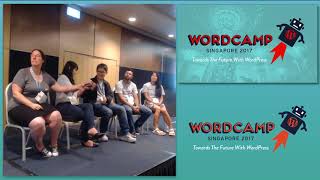
Transcript of a WordCamp Singapore panel (AMA) where WordPress practitioners from Bangladesh, Japan, Singapore and Australia discuss WordPress usage, community, development (PHP/PHP7), content distribution/SEO/AMP, project management tools, and short predictions for WordPress in 2020. The session is practical and audience-driven: introductions → audience questions on blogging monetization, AMP, outsourcing tools, PHP7 performance and upgrade advice → country-by-country community snapshots → one-line 2020 forecasts.
Chapters
Future of WordPress but basically ask anything about WordPress, agency, work, products, web development, Google, things like that. Bear in mind everything they say is based on their own personal opinion, it's not on their companies. So just to make sure that everyone's on the same page. All right, so I'm going to introduce myself. I'm the moderator, I'm sort of hands in my fingers in many pies. I used to be a developer, I'm now doing regional role with sales and accounting accounts. Sorry, not accounting. And what else do I do? Oh, I do community work too. So I'm going to ask him a bunch of hard questions if you the guys don't ask anything. So I'm going to get everyone to introduce themselves. They only have one mic, so bear with that. Asif? Yeah.
My name is Asif. I am CEO of WeDevs. It's a WordPress product company. We created several WordPress plugin serving in a lot of different other functions and I work very closely in content and content distribution. I spoke about like why the spread and everything matters and I'm personally working with the WordPress ecosystem for almost 13 years. I started using WordPress since 2004 and I love these conversations like what we as like plugin business people or plugin developers feel is WordPress is going in which direction and what we will see in 2018 after Gutenberg and also maybe what the future lies in 2020 or even beyond. Thank you.
Thank you. Zion, I wrote you as PHP expert from Singapore.
Hi, my name is Zion. As he said I'm from Singapore, I'm a Zen certified engineer so I currently senior software engineer at a startup we kind of do like mobile apps for clients such as Kofu Bundonki so I developed a bit with other languages like a bit of Android, a little bit of Java, Ruby, but mainly PHP. So WordPress I use mostly on a personal basis. Some years back when I was doing freelancing I used WordPress for my clients as well.
Next we have Moriyama Mayuko from Japan.
Hello.
I'm Maya Moriyama and I'm a freelance web developer and I work by myself and I.
She does a lot of community work like mentors, work camps. She helps meetup survive and grow into something bigger. She travels around Asia to make sure that everyone gets the help they deserve as much as from the foundation as possible.
Did I get it?
Thank you.
So Jenny.
Hi guys, I'm Jenny. I think among all the other people here I'm probably the most beginner when it comes to WordPress so personally I'm a blogger as well. I like to blog about my travel journey and I just recently moved to WordPress but I know that's not interesting but like professionally I work for Google. I work with a lot of web publishers, particularly for actually for the whole Southeast Asia, but particularly for Indonesia and Philippines. And if I can say 70% of my publishers are using WordPress. So yeah, that's me and WordPress.
That's a good choice. Thank you.
Thank you.
Thanks for dtu.
That leaves me. Listen to her, I guess I'm a former freelancer, I was going to say reformed freelancer. I been working with WordPress basically since 2008 and I built a lot of websites and now I help other people build websites as a project manager for Human Made.
That's a lovely description. So they're here to answer any of your questions about agency products, WordPress maybe how Google works with WordPress, how PHP, you know, handles WordPress, you know, definitely development to products to community stuff. Well from the hot topics to the user topics.
So.
And project management definitely. Right. So if you got questions about a JavaScript that might work too within WordPress. Right. So anyone has got any questions? Yeah, there's a mic coming to you.
Hello everyone.
Is it on?
Not yet.
Hello. So I want to ask that for a blog to be very famous and to earn money, should it be a business blog only or it can be.
Like a stories or a philosophical kind of a blog.
I don't want to answer that question.
So can I repeat, your main goal is revenue, is that true?
Yeah, if it has to get famous and when noted.
So there's a lot of pathways that you can do. If your goal is revenue, there are certain depending on the pathway that you want some publisher they look for for niche topic, they are currently underserved. So in the way that they don't really have much competitor, they have the market share for that topic and then will be even a plus if that topic is the kind of topic that is bidded by the advertiser and you can make significant amount of money out of that. And there's also publishers that write out of their hobby. So because their quality content, even though the topic, even though the the vertical has a lot of competitors, but because the fact that they're passionate about it, they are an expert on the topic, people still choose for that website and there's also people who want to easily get a lot of page views. So even though that topic probably are not bidded by the advertiser that much so it depends on what you like and what you think is your strength. If you feel that your strength is building exposure, then getting a lot of page view to get a lot of revenue. Probably the good pathway. But if you think that your strength is a certain particular topic that may be quite niche, still create for it anyway because there might not be much competition. People are looking for it, there's a demand for it and even best maybe advertiser actually bidding for it. So I hope that answers your questions. Thanks a lot. Welcome.
Follow up answer.
Yeah. So let me talk from the content perspective. Just two weeks ago in War camp Ahmedabad I had this session actually the title of the topic will explain. The title of the topic was like we all say the content is the king, but if you don't know the distribution, you will not actually reach anywhere. So content is very important, it's very creative, it could go to long length. But at the same time you need to understand your demography. You need to do everything right in terms of the description so you could create your first blog post. Nobody will read it if you don't distribute it properly. And there are so many lies, there are so many like wrong information online about SEO. So that's very important to getting found in online. So the important part will be like instead of trying to cheat Google to rank better in search is very important to do it properly. So you could like really read, write for like normal people. Not for the bots, not for the Google Google bot and other things. So that will be the main goal.
I have a question with Jeannie. Can you please help me with this question? You know, log into Google AdWords, right? You're able to see the CPM rate and all the demand. That is a good like because the lady was asking how to get famous and revenue is that a good data source? Or to check whether the topic or niche because you know your Google Ad was quite powerful and they've got the niche, got the keywords. So do you recommend that to check for the niche to research on a niche that we should go into using Google AdWords for AdSense. Isn't it the reverse way of you check the demand for.
Well, if you have AdWords account you can always do that or you can even use the Google keyword planner that I think our friends from Damien oh was sharing. But in case you're wondering is there like any tool to specifically looking at the rpm we will say no. Because the reason why its demands and supply is the one that determining the revenue per impressions, right? So if we state A currently there is no demand and people hear about it and then people write about it. Suddenly supply increase, it's just like stock market, the price will decrease. So that's why it is something that is really dynamic, I would say so. Again, one thing that I will emphasize and one thing that maybe I really like about Demi and O's presentation is that first always focus about the users and then write something that you're really passionate about. Not for the short term, but for the long term. Because if you're always looking for the content that has a high rpm, it takes some time for you to create that content to get the traffic. And then maybe if, let's say the RPM happened to drop, you haven't got the yield yet, you won't receive anything. So always have the right motivation first.
Thank you. I have a second question for the second question for Dee, who is also expert in project management. How do I utilize Google Apps for outsourcing? Offshore outsourcing? This is a more direct, more targeted question. Do you think Google Apps? No. G Suite. There's a Google G Suite. Have you experience in outsourcing offshore with G Suite? Do you think it works?
Have I experienced outsourcing using G Suite?
Yes. Google, no. What software do you use for. Don't mind you share. What software do you recommend for your projects?
Okay, now that's a question I can answer. It varies from project to project. So for some clients we're using Jira, which is. So we're working at an enterprise level and that Jira is great, but it's huge and heavy and difficult to configure and kind of a pain. So it does all of the things that we need it to do, it's just difficult to get there. So next level down we use ZenHub, which is if we're working on a software project and we're using a repo in GitHub, ZenHub is a layer over the top of that that helps add project management tools and that's really, really useful. It's free if you're using an open doing it on an open source project, you pay per user if you're doing it on a private repo. But that's really, really helpful. And in terms of using Kanban boards and all that kind of stuff, zenhub's got you covered. And the third one that I also use is Asana that is free for small agencies. You can invite clients into that. So they can actually. You can use it as an issue tracker. You can actually use boards because we use Kanban and Scrum boards to manage visually your projects. So those are the three Jira, Zenhub, Asana. There are so many out there, you just often have to find the one that works for you. But those three are really good places to start.
So I'm going to ask a question to Zion. So often see that WordPress is not viewed as the best software even by the people who are writing PHP where WordPress is, you know, strongly based on. So how does the PHP community view WordPress in Singapore? Well yeah, gotta ask him.
Okay, I don't really have a concrete answer to this. So we know that WordPress powers about 27% of the websites in the world. And what problem is we do not know how the distribution is. Like is it mostly in the US or in Europe or in Southeast Asia? For example in Japan it's quite easy to check the stats because they probably use Japanese translation and you be easy to check. Okay, so many users, so many WordPress sites in Japan but also in Singapore. Now in Singapore unfortunately probably there's kind of mentality where you want cheap, good, fast. So in hockey we call it Ipi CI Ho. So basically sometimes we have more users and probably developers or wannabe developers. Probably some secondary school kids say okay let me just download WordPress and I will set it up and then okay, I'll set it up for client and I earn my pocket allowance. So the WordPress is intimately linked to PHP. So let me talk about PHP also in developers eyes PHP seems to have a bad impression. When you mention PHP or WordPress people say no good. That's because PHP and WordPress is easy to pick up. Now let me give you an analogy. Give a ballpoint pen versus a Chinese calligraphy pen brush brush. Now ballpoint pen is very easy to use. If you pick it up you start writing. Anyone can do it, even a two year old kid. But the two year old kid handwriting will look terrible. But there are some people who can actually use a pen to create artwork like Zentangle so they can create masterful masterpieces. Whereas for a Chinese calligraphy brush, by the time you can even manage to write legibly, you look as if it has a certain sense of quality. So people say oh well, this is a very good instrument. I should learn calligraphy brush. But if the person using the brush doesn't upgrade himself, doesn't continue to improve or learn, his standard will stay there. Whereas a person using a ballpoint pen, if he continues to improve himself and to pick up new skills, new design patterns and to learn from Others, his penmanship will look much more better than the person using the brush. So, and the question is, if in, let's say in your childhood years you are told that you have to use a calligraphy brush to pick up writing instead of a ballpoint pen, how many of you will actually give up? So it is question actually because PHP and WordPress is so easy to pick up, everyone's picking it up. So there are varying standards of quality. So it leads to this impression, say oh so many php websites. Php powers about 82% of the websites in the world. But some of them got vulnerable attacks, but we do not know the developers behind them. So the key thing is actually a programming tool like PHP or CMS and WordPress is ultimately two the key thing is about problem solving, solving a problem. So you have to choose the correct tool. So actually the question how the local PHP developers are thinking about WordPress is yeah, they are just using it I would think superficially. No one is actually doing like deep work or like the US, the United States, the White House, they are using WordPress to part of the website. Not so for the Singapore government. You don't really see a big WordPress agency in Singapore actually serving enterprises or they're like probably freelancers and probably small companies. Okay. No, his company is quite good. Yes. Okay.
Yeah, but that's a great answer.
Lovely.
Yeah, yeah. Okay, so this one is going to be a longer question. Sorry.
I have a question for Jenny. Yeah, so this is on amp.
This is all going to be about SEO, right?
Yeah.
So I know that Google is increasingly integrating the AMP with the search results, right. So basically the sites are opening up within a Google shell by default and you will have to click, make an extra click to go to the website itself. Is there a way to. Because I know Google does it. You don't have a control over when Google does it to your website. Is there a way to opt out of it? Meaning that not open inside the shell but open your website instead. Is there a way to do it?
So first thing first, let's take a step back and see why is that done. So, so the reason why it's open on Google Shell because it enables the AMP catch to happen. So it makes the website to load almost instantly when user click on the Google search result. And of course as a developer you have the right to remove it. All you need to do is that you just need to break the link between canonical with the AMP HTML. But I strongly not recommending it because it defeats the purpose of you having an AMP website and also just want to highlight just in case you are not aware, even though they go to the Google shell, actually publishers have the credit to that traffic. And then you can still see the analytics content. If you use AMP analytics, just a normal thing that you see on Google Analytics. And then also actually there's a lot of feedback from you guys as well to make it easier to go into the canonical page instead of the AMP page. And in fact, Google has been doing a lot of adjustment to that since January 2017. If you share the page, you can quickly go to the canonical page. And if you're sharing that page to your messengers, to your email, the one that is being shared is actually the canonical page instead of the AMP page. So to wrap up, it's possible to do that. You just need to remove the link between AMP and the canonical, but it will defeat the purpose. I hope that answered the questions.
Thank you. So, my turn. Right, so I want to know a little bit about the WordPress committees in the various countries. I purposely make sure there's a Japanese, Bangladesh, Singapore. Well, she was born in Indonesia and Australia. Yeah. So, okay, so tell us a little bit about the WordPress community. Xiong country, starting from Mayuko Baht. This is a long topic. I want it in 10 sentences or less. Tell me, tell us a little bit about the WordPress communities in your country. Yeah. There's no question.
Just tell me.
Yeah, Community.
Yeah.
How would you describe the Japanese community?
Japanese community.
Yes.
Yes. Where can I start? I already talk today, but we started translation of WordPress over 10 years ago. I didn't study WordPress at that time, but I heard the story and they started first wordcamp like 2008 I think. And we had work camp this year and there was 800 people and. Yeah. So yeah, Tokyo. Yeah. And Kyoto also had work camp and I heard 350 or something. So yeah, we have two work camps this year and in this room I. I can see a lot of book authors and plugin authors. They also come to this word camp. So yeah, our community has a lot of.
How many percent of websites are WordPress in Japan?
Yes, I saw their stats about CMS website which use Japanese. They use 80% WordPress. Yes. So it's a lot.
And basically our base in Asia, WordPress.
And whole WordPress user, 6% use Japanese version.
Nice.
Yeah, yeah.
So if you realize there's this little creature thing that looks a little bit like Pikachu, but it's not Pikachu. And every country and every word camp, we Create one based on the local city. So the one this time we have. Well it's based on our theme which is towards the future. So it's a roboto Wapu. So if you've got a sticker and they have made Kenshin wapu, Makkah Wapu and so on. But the designer came from Japan. The first ever the original Wapu. Cool. What about you Asif? 10 sentences or last.
Bangladesh has a very big WordPress community. I remember like back in 2014 WordCamp San Francisco. I spoke about our community and why I am involved in WordPress that much. In that time I shared an stat that in 2014 only in Odesk there was over 40,000 WordPress programmer only from Bangladesh. So WordPress is extremely popular in Bangladesh. If you ask me the same question, like how many percentage? I would say probably over 90%. We have successfully popularized WordPress in Bangladesh. We have a successful WordPress meetup groups. In some of our meetup we have like over 400 people and because our venue could not support that so we had to limit in 150 or something. We have not had any what cams yet. We are trying to work on that. I applied for almost four years ago. We have some issues and going back and forth. I hope like it will happen very soon maybe. Yeah, they're all helping and we have a lot of like plugin developers and especially theme developers. They developing themes in ThemeForest and there is a good analogy like in US if you go to a bank, if you ask a banker like do you know WordPress? Most of the people will not. But in Dhaka if you go to like educated person who understand web, if you ask him do you know WordPress?
They will know.
Yeah, I know WordPress. If I want to make a blog, I will make it in WordPress. So WordPress is very popular in Bangladesh and we are looking forward to have a good Word camps in future as well.
Awesome. Really cool. You should teach us.
Actually the organizer of the WordPress Singapore meetup is standing at the rostrum. He will actually answer the question better. So actually I started attending meetups about two years ago when I was doing freelancing and I also started helping out with engineers SG our guys who are recording webcam this year.
So.
So sometimes I have to record the WordPress meetup. So compared to the other tech meetups in Singapore, WordPress meetup actually has a kind of good mix of developers and what you call lay people, non techies. So yeah, some people who are starting their blogs who are going to do business, you want to do E commerce. They want to find out more about WordPress. So usually the numbers, I think about 20, 20 plus. Is that correct? Yeah, yeah, he's nodding so it should be correct.
Oh, sorry.
The numbers are 20 plus, right? Or 20.
I'll say 30 is a nicer number. The biggest we have was 80 per meetup. Yeah, but that's because it's SEO related. All right, thank you.
I'm nervous now because I will be very honest with you guys. This is the first workcam I ever attended. So I did mention to you guys that I moved to WordPress recently. Do you want to know why? So in a Google's perspective, I just had amp roadshow Indonesia, where there's a lot of website owners, when we asked who use WordPress, 50% raised their hand. So that's like a benchmark. And then I personally work with AdSense publisher, meaning that publisher that monetize their content with Google AdSense. And about 70% of my publisher actually using WordPress. And that motivates me to move to WordPress.
Nice.
Did you move from Blogger Confidential?
Because that would be tricky. Oh, I work for Google, but I don't blog. I'm a blogger. I'm a New Zealander and I live in Australia, but I've lived there for so long and Most of my WordPressing has happened in Australia. The WordPress community, much like the population of Australia, is actually not huge and is spread around the main centres. So we have WordPress meetups in all of the main centres, Sydney, Brisbane, Melbourne, where I live, Adelaide and Perth. And we have at least one or two word camps every year. Next year, I believe there are going to be wordcamps in both Sydney and Brisbane. We keep getting some pressure to have a WordCamp in Melbourne. If you want to help me organize that, go right ahead because I'm not going to organize it on my own. And WordPress gets competed a lot with by Adobe in Australia, I think in a lot of cases, certainly at the kind of scale that we're operating at.
So.
So.
Yeah, but the community itself was really active and engaged. We have about two and a half thousand people on our mailing list in Melbourne, but the number of people that show up to a meetup varies between kind of 50 to 60, month by month.
Thank you. Yeah, so we got two. We got no more time, but I'm going to take two more questions from the crowd. You just have lesser time to eat, but I bet most of you are very full from lunch. So I think we're fine there. So anyone wants to ask any questions? Preferably not SEO related. Yes.
This is probably for Zion.
Okay. WordPress started when PHP was version 4.
And then it got stuck with version 5.6 for a few years. And recently people have been we have seen increased adoption of version 7. How would this affect WordPress users and also developers? And how will it affect the near future of WordPress?
Talking about PHP7 so WordPress has kept itself up to date, so moving to PHP7 will be no problem. PHP7 versus PHP 5.6 itself, that's a two times increase even let's say just by changing the PHP version, you are not changing your code, you're just changing the php version. Your code will run at least 2 times faster. This has been tested even like WordPress, even like Magento or other popular CMS Systems. So for PHP7 by itself comes with a lot of nice new features. Error reporting and catching up errors, syntax parsing. So actually and a lot of vulnerabilities have been patched. Of course it's still ongoing. So One thing is PageSpeed is easier to stay if you get a domain hosting, let's say with your own domain name, let's say wordcamp.com you can't default with the LAMP stack, Linux, Apache, MySQL and PHP. And that doesn't cause anything extra for you to upload php file or set up WordPress. So going in the future, actually this is good. There are some time where people think that PHP is dying. So like even Facebook came out with a new VVM for PHP to kind of because they find PHP insufficient. But with PHP7 now Facebook says that okay, HVVM, we can kind of retire it. You probably use it internally. So some of the features have already been merged in PHP7, so it's a good way forward. So WordPress is based on PHP and of course this will bring WordPress in the future as well. Thanks.
So I'd like to add a little bit that@the WordPress.org level. So we have been engaging the web hosts around the world to make sure they upgrade from 5.5, 5.6 or worse to 7. Honestly there's no reason not to upgrade because WordPress is incredibly backwards compatible and when we do patch we make sure it still somehow works for older PHP versions. And if you are still on 5.55, that's not supported anymore, it's insecure. If you're on 5.6, that's almost going to be not supported soon. So yeah, it should move to 7 like you update your apps, right? Update everything. Yeah. So should I not update everything?
I've gone from seven point something to.
7.7 and seven one.
So I've gone from one to the other. So I'm on and I go to the next one.
Yeah.
And my site won't load.
So I'm like probably one of the BET plugins.
Well, it's a thing or a plugin. So then you have to kind of do all that kind of stuff.
So.
So don't. What I'm saying is don't do it live.
Yes.
Do it testing. Yes, we, yes, we should upgrade, but don't. Yeah, don't do it live. Do it in staging before you actually go there.
Agreed very strongly. So last question.
All right.
Then I get to ask mine. So tough one. Where do you think WordPress will be in 2020? I want a one liner. I don't want a big paragraph. Everyone give me a one liner. Who's ready to speak?
The dashboard will be customized. People will create and like theme developer will create their own dashboard. So it will not look like WordPress. The theme will be almost plugin or like it will be more like page builders. So WordPress will be very different in 2020.
Awesome. He's basically taken off your answers.
My answer will Definitely be the WordPress Rest API. It opens up a lot of new possibilities. So right now as a developer, instead of coming out with my own custom database, my own custom CMS to power my new mobile app. So right now I can just write an Android app and iOS app that actually is reading off the WordPress Rest API. In fact there's an app on App Store called Nomad Base. So first version was done using React JS and the second version was done using React Native and they are actually calling the WordPress REST API. So it's running a WordPress backend. So you don't need a techie guy to run SQL statements to key data into a database. You can have your marketing personnel just go into the super user friendly interface in WordPress keying your data and it automatically appears in your app. Simple and easy.
Thank you for advertising my products.
Connected with in Singapore.
Yes, I made them do it. Okay, but he didn't want explain what Nomad Base is. If you are traveling and you're a developer, writer, whatever, you want to meet people who travel as well. That's an app for you to meet them. It's not for dating.
Right.
It's just to meet working friends.
Okay.
Sounds like there's a story there.
Testing 1, 2, 3, 4.
I was thinking 2020 WordPress.
Yes.
Okay. I'll from translation view.
Sure.
You know there are a lot of, you know, like 10 years ago nobody consider about translation but now we have a lot of language like 180 something. I forgot. But maybe, maybe I'm not sure. Google it please. But so, so yeah, so yeah, now most theme or plugin is not translated yet, but we want to translate 100% then for most language then. So you know, for people who don't speak English, it's more than English speaker in the world. So if we want to make WordPress pariah free, so we have to do that I think.
Nice. So you think 2020 translations would be close to 100%. And like a Japanese person instead of downloading the 10 themes that translated, they can download 5,000 themes. They're on WordPress.org big job depending on you. And I think we have Ginny, Andy.
I think in 2020 I see huge potential for WordPress to scale because I see a lot of entrepreneurs, content creators that are currently offline, especially in emerging market, they start to look into go online. I see WordPress as a huge potential to enable them to do that easily.
Thank you.
It's a really, really good way of looking at it. I see big because so much of what I do is at enterprise level. I see there being more events and things happening for WordPress at enterprise level, not just small and medium business. So I'm hopeful that in the next couple years, certainly locally in our kind of regions, not just in the US we'll see more and more conversation happening there and see more and more adoption of WordPress that enterprise.
Nice.
That'd be great.
Yeah. In the US they have webcam for publishers. Maybe one year we'll do it like a webcam for banks, publishers and so on. That'll be super awesome. Cool. So that's all for the ama. They are still around. Catch them and ask them anything. Try not to, you know about WordPress it's not just all about SEO. All right, so thank you for attending. I'm gonna hand it back to Xiao and thank you speakers. Thank you Dee. Thank you Ginny, Zion, Asif and my goal.
Okay, so right now we'll go for tea break. We'll.
More from M

How to Deploy EmDash CMS in One Click on xCloud: A Fast, Lightweight WordPress Alternative

Self-Host OpenPanel in One Click on xCloud: A Privacy-Friendly Google Analytics Alternative

xCloud September 2026 Release Notes: Site Security Pro, AI Caching, Docker Backups & More | xCloud







xCloud August 2026 Recap: App-First Deployment, 250+ One-Click Apps & DeepSeek Harness Hosting

Deploy Vaultwarden Password Managed on xCloud (Self-Hosted Open Source Password Manager)