Our 13-Month, 55-Stop World Route: Can We Really Do It at 51 & 62?
James and Rob plan a 13-month, 55-stop trip starting in New Zealand in November 2026, ending in Cape Town. They're aiming for an unhurried pace with at least a month per country, balancing James's detailed research with Rob's flexible approach. They're locking in long-haul flights and must-do experiences like Milford Sound and Machu Picchu while keeping accommodation cancelable.
Chapters
I absolutely loved planning this trip.
And I absolutely haven't.
That's not quite true, you like having a plan.
Well, I do love having a plan, but I don't particularly enjoy spending 3 evenings comparing where we should stay, whether it's 4 nights or 5 nights in Chiang Mai.
Somebody has to do it.
And thankfully I'm married to him. So last week we showed you the big journey that we're about to take, but we didn't show you how on earth all of this turned into an actual route.
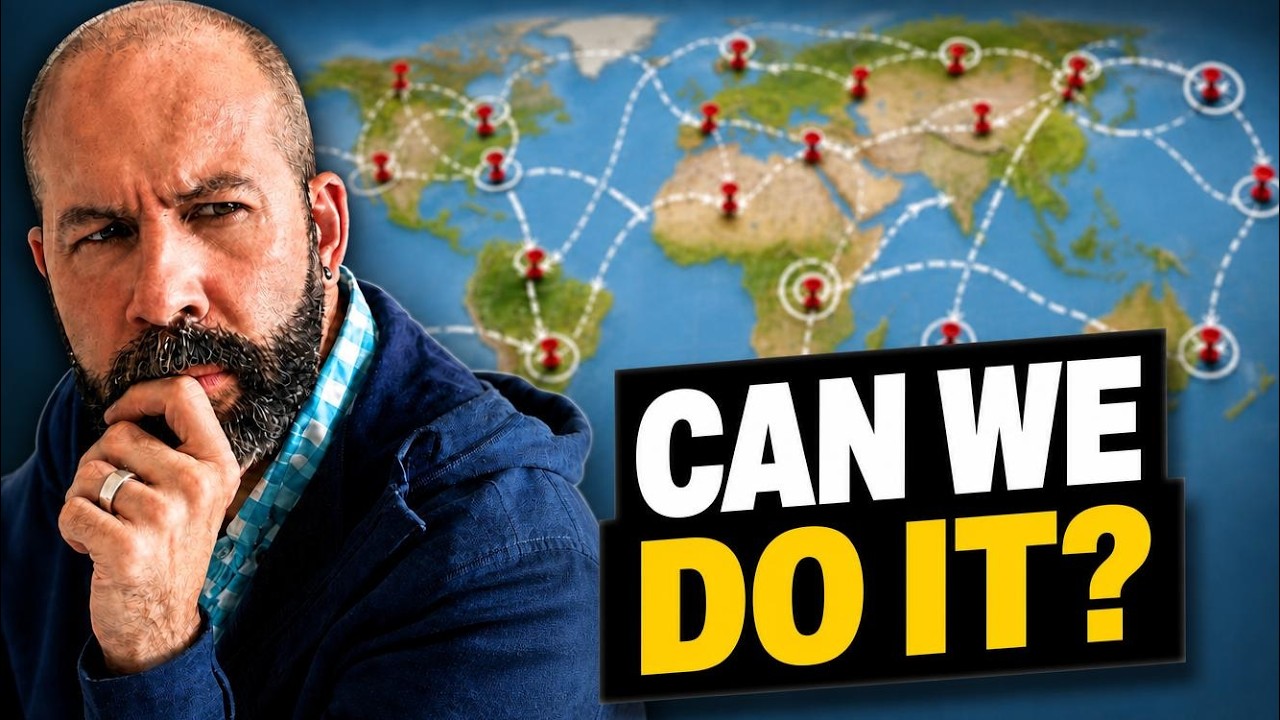
11 countries.
55 stops.
And more than a year traveling the world.
And so how do you actually plan for 13 months around the world?
The first thing we realized was that we couldn't start by saying, where do we fancy going? We had to decide what kind of year we actually wanted.
So as we said in last week's video, we leave on the 23rd of November, and we are going traveling for a year rather than trying to race around the world, right? So I guess one of the things we have to do is work out what sort of speed and kind of travel we wanted.
Yeah, well, that was one of the main things we talked about last week is we don't want to burn out. So we worked out we're doing it slowly, spending at least a month in each country, up to a week in each town. Some of the smaller towns will be less time because otherwise we will be bored out of our skull. And also trying to work out weather-wise We're trying to get away from the winter. That's the whole point of why we're looking at retiring abroad.
But that's quite hard, isn't it, when you're trying to do a trip that does go mostly around the world, to try and make sure you're in the right place in the right season is nigh on impossible, as we found out. So most of the time we are in the right place, aren't we? Like New Zealand in their summer, but actually when we get to parts of South America, it will actually be their winter. But fortunately they have pretty mild winters, don't they?
Yeah, unfortunately you can't get away from it if you're going to be traveling a whole year. you will always catch one of the seasons.
Yeah, and as we're going to outline shortly, we'll share our budget with you, but we— I guess we're sort of doing this at a mid-price level, aren't we? Because we don't want to do backpacking staying in hostels. Sadly, we're too old and grey to do that, but on the other hand, we don't have the budget to stay in 5-star luxury hotels. So what's kind of the compromise?
Compromise? We're moving a lot more, I would say, middle of the road, so we're looking at Airbnbs, 3-star hotels, so not the bottom end, not the top end.
And places with a washing machine so that we can basically pack for a week and then do our laundry at least once a week, and also have somewhere where we can spend time working each week on editing and uploading these videos. So as we said last week, one thing was fixed: Cape Town was always going to be our end point. The puzzle was everything between the UK and Cape Town.
For me, the planning is genuinely part of the fun. I love researching places, working out routes, comparing hotels, and figuring out how everything fits together.
Whereas I really like knowing that we've made good decisions, we're spending our money wisely, and that the important bits are sorted. I just don't enjoy spending 3 evenings researching 14 different options that gets us there.
Which is why I do it!
Exactly! So you do the research, you give me the shortlist, and I'm very happy to solidify the plan, and 99% of the time I just nod my head and agree. So I am not anti-planning, I'm just anti-spending Saturday afternoon comparing 14 hotels in Osaka.
Whereas that sounds quite a nice Saturday to me!
In fact, James was just doing that before we just started recording this video. Now, as I said, we didn't expect perfect weather in every part of the trip. The aim was simpler: try to avoid the really bad seasons where we possibly could without flying backwards and forwards across And actually quite a lot of it worked out really well. So we start off in New Zealand, don't we?
So basically, as it's going into winter in the Northern Hemisphere, we're heading the furthest south we can go. So we're going to be in the Southern Hemisphere for their summer.
Yeah, and what's the— one of the challenges about being in New Zealand, which is quite an expensive country, is that we're going to be there for Christmas and New Year, aren't we?
And yeah, we're going to be in Queenstown on New Year's Eve.
That's super expensive.
But that comes with the territory.
After we leave New Zealand, we're then heading to...
Asia. So our jumping-off point will be into Singapore. We're going to be there for a few days. I've never been to Singapore, so that would be a great little thing for me. And then we make our way northwards into Thailand.
And the weather should be okay then, shouldn't it? It's gonna be humid, but it's okay. And then, and then we head into Vietnam.
Oh no, not yet. So we're going to Laos.
See, I don't even know where we're going!
Yeah, so we head north Thailand up to the border near Chiang Rai, then we're going to do the slow boat down the Mekong into Laos, and then from Laos after a month we go over to Vietnam.
And the weather should be pretty decent then, isn't it?
Yeah, I think we're going to be just before the burning season in Laos, I think. I'm hoping. Hopefully we are.
Yeah, I think this is one of the places where James's really detailed spreadsheet really earns, earns its keep.
I hope so.
So then the next location is going to be interesting because we arrive in Japan in April, and what is April in Japan?
Sakura season.
So that's the blossom season. So hopefully we'll get to see some amazing cherry blossoms, but we're also going to have to contend with the crowds, aren't we?
And prices. Yeah, so that was one of the trade-offs. In order to make everything work, to get the best weather, unfortunately we had to jump into Japan right smack in the middle of their cherry blossom season. So prices are higher, drastically higher.
But I mean, yeah, and hopefully we'll see some blossom, but of course we can't guarantee what nature will bring us. So then we leave Japan and we head over to Mexico, don't we?
Yeah, and that's, I think, just before or just after the rainy season. So we are catching it.
Yeah, it's just beginning the rainy season, isn't it? According to our notes anyway.
We'll find out.
Like I know.
So I think it'll be shoulder. So as we start crossing the equator, we're going to catch a couple of spotty bits.
And at some point you realize that if you wait for perfect weather in every single country, then you are never going to leave, or you're going to be zipping all over the place. So the plan was never really to chase the summer or chase the sunshine everywhere, but rather to avoid the worst weather where we possibly could, while still moving around the world in a route that actually makes sense.
And then there are things that you can't control at all, like governments changing the rules after you've built the route.
Yeah, and that's happened in Thailand, hasn't it, potentially, which we'll talk about in a future video. And so even when you think the spreadsheet is finished, somebody somewhere can change one rule and suddenly you are 4 days over your allowed Now at some point we stopped trying to describe this as a holiday or backpacking or even just long-term travel.
We realized what we actually wanted was an unhurried gap year. 55 stops sounds like a lot, but spread across more than a year, it is very different from trying to tick off a new city every 2 days.
Yeah, because as I said, we want time for laundry, editing, a supermarket run, a night in, a day where we do absolutely nothing. and enough time in places that they stop feeling like destinations and they start feeling like somewhere that you're actually living for a while. The important thing is that we don't want every travel day followed by another travel day. We want enough time to actually enjoy being somewhere and just to be and soak in the sights and the sounds. So yeah, so when we started planning this, it was— we had a lot more countries that we sadly had to knock out, didn't we? So just name a few of them.
So we had Colombia, Boo! Cambodia.
Boo!
The Philippines.
Boo! And then other places that I was really keen to go to, one that we both are really, South Korea, Taiwan, and plenty of others. So I guess this just teaches you that the world is a big place, and although we're going to 55 countries, we are still not visiting a lot of them. And to make this manageable in terms of time and budget, we had to drop sadly Colombia, Cambodia, and the Philippines, but next time.
Yeah, it gives us another excuse to go around the world.
And the problem is that every extra country means another flight, another border, another packing day, and less time everywhere else, and of course a bigger budget.
Flights, accommodation, how long we stay somewhere, when we travel, even which countries made the final route— the budget affected it all.
And we've built a full budget for the year, and next week we're going to show you what we think the whole year is actually going to cost us.
Fingers crossed. Eventually we had to accept that traveling around the world does not mean visiting the whole world.
As I said, South Korea and Taiwan, they're definitely not rejected, they just are for another trip, and that's something that we are already talking about.
The route itself is very planned. That does not mean every part of it is booked. The majority that we've booked will be the long-haul flights, so the air bridges taking us between, say, New Zealand Asia, Japan, Mexico. So those big airbridges, we kind of put those in place because those tend to sell out quicker.
Yeah, and also some big holidays. So obviously we needed to book our accommodation in New Zealand for Christmas and New Year pretty quickly, and there are also some big festivals happening that we needed to book.
Cusco.
Yeah, Cusco, to go to Machu Picchu. We had to book that accommodation and that excursion because It's during a festival so it's all going to sell out. This is where our 2 planning styles have probably been really useful. James stops us turning up somewhere with nowhere to stay, and I stop James booking every single restaurant for next August.
Rude! So last week we showed you the broad route. What we didn't show you was all the details sitting underneath it.
And now you've seen the weather compromises, the visa uncertainty, the countries that we have to cut and the things that we've already booked, this is what those decisions produced.
Well, it looks like one line around the world is actually 55 different stops, with some places only a few days and others becoming our home for several weeks.
This is what we mean by an unhurried gap year. I think that's the best way of describing what we're doing— a lot of places but enough time built in that we are not constantly racing from one place to to the next one.
For me, knowing where we are staying gives me confidence. I don't want to arrive in a place we have been looking forward to for 2 years to discover everything decent sold out 6 months ago.
And I want the flexibility that if we arrive in a place and we don't like it or didn't meet our expectations, that we haven't already paid for 2 weeks accommodation so we feel absolutely obliged to stay. So it's all about getting that planning balance right, isn't it?
The compromise we have is I'm booking accommodation that we don't have to pay upfront and has free cancellations, so at least we know we are securing the budget long term. I'll keep an eye on accommodations over the next few weeks, months, if something cheaper comes in or if we decide we want, we want to completely get rid of that place, move somewhere else, we can do that easily.
Yeah, and I think James is doing that because we are trying to make sure that we can stay within our budget and even During the planning phases of this, prices have increased significantly. Of course, oil prices have gone up, so flights have got more expensive, but also accommodation has got more expensive as well. So booking some cancelable accommodation is a good idea, and a few excursions, but most of the excursions that we're going to do, we kind of will do it on the hoof.
The main things we booked were, for example, in New Zealand, booking Milford Sound. Those big-ticket items, they sell out, so we wanted to get those in.
Yeah, and actually I did a bit of planning here because I booked a restaurant for New Year's Eve because obviously that's going to sell out as well.
You booked the restaurant, not me!
So that's the fine line that we are trying to kind of tread— enough certainty that we know we have somewhere good to stay, but enough freedom that the year can still surprise us. So now you know what sits behind the route we showed you last week and why almost every line on the map involved a compromise somewhere.
We've worked around seasons, visas, Christmas, cherry blossom festivals, and a whole lot of research that one of us enjoyed considerably more than the other.
And we've deliberately left enough of the non-essential detail open that hopefully it could still feel like an adventure when we actually get there.
Of course, planning where we're going is one thing.
Working out what all of it actually is going to cost is another, and that's what we are going to cover in next week's video. So if you want a detailed breakdown with all our costs being completely open and transparent with you, as we're going to be throughout the whole trip in terms of comparing our original budget to what it actually costs us, then make sure you tune in next week. So of course, hit the subscribe button if you are not subscribed, and give us a thumbs up if you enjoyed this. And where would you sit between the two of us? Are you, uh, big planner like James, or are you someone that wants a little bit more spontaneity like me? Do leave us a comment and let us know. But otherwise, this is James and Rob signing off for now, and we will see you next Sunday.
Bye!