Physical AI : The Rise of General Purpose Humanoid Robots Seminar & Live Demostration
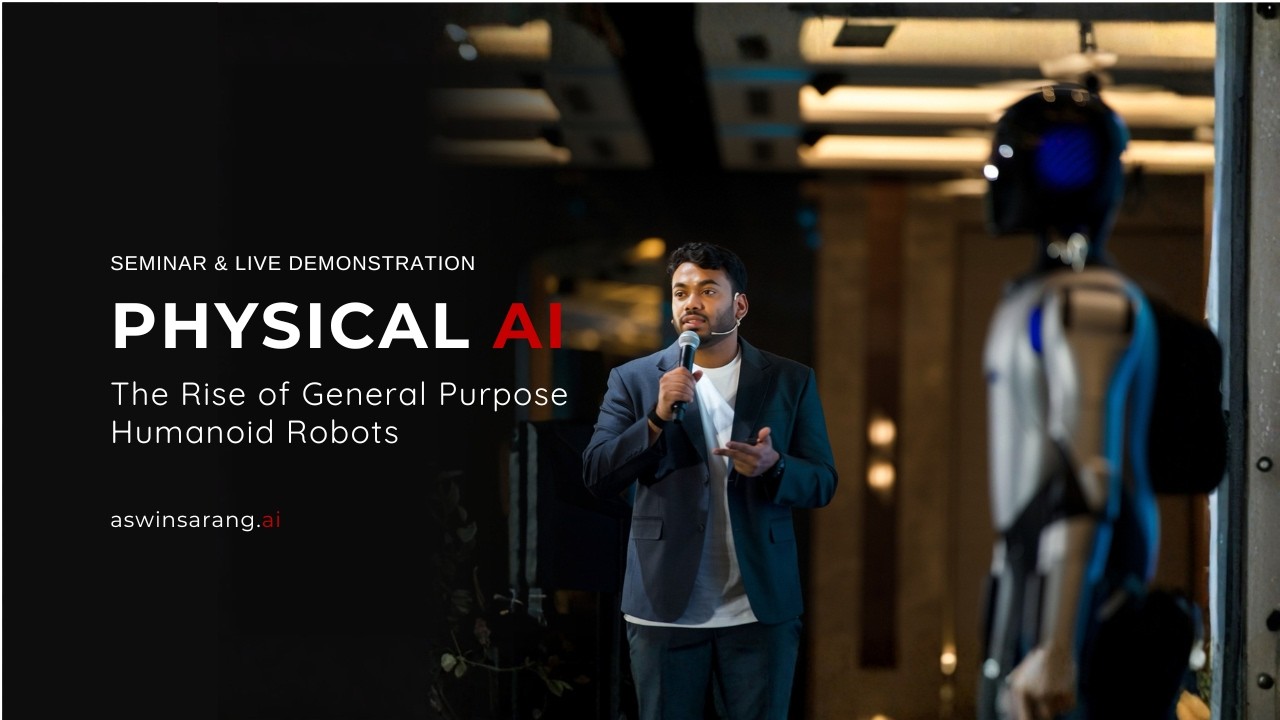
In this live seminar, Aswin Sarang, Managing Director of Reliable Robotics, introduces Agent LUCA, a general‑purpose bipedal humanoid robot, and uses the session to illustrate the concept of “Physical AI.” He begins with a 2‑minute AI‑generated video to demonstrate how generative media can evoke emotion and foreshadow AI’s impact on filmmaking. Sarang defines Physical AI as any system that perceives, thinks, and acts in the world simultaneously, distinguishing it from purely digital AI (e.g., ChatGPT) and traditional industrial robots that perform fixed tasks. He explains why a humanoid form factor is advantageous because the built environment, tools, and daily tasks are designed for human bodies. Technical details of LUCA’s perception stack—LiDAR, multiple cameras, point‑cloud generation—are shown, along with a live demonstration of autonomous navigation and object interaction. The talk covers robot training pipelines: real‑world data collection via haptic gloves, massive trial‑and‑error, and cost‑effective simulation using digital twins that model physics, friction, and gravity. Use‑case examples span warehouses, healthcare, filmmaking, and even a chess‑training robot in the UAE. Audience Q&A touches on regulatory gaps (no global body yet, UAE import‑export controls) and societal implications, including the notion that in the next decade humans will use robots, not be replaced by them, and speculation about universal basic income and future workforce dynamics. The session blends technical exposition, philosophical reflection, and practical demonstration, highlighting both the promise and the challenges of deploying general‑purpose humanoid robots.
Chapters
I have someone more special along with Agent Luca that would come in. He's the brain behind Agent Luca. His name is Aswin Sarang. He's the Managing Director of Reliable Robotics. And he started building one of the first— Dubai's first robotic companies when this wasn't even the market. And when I was speaking to him, He told me something very interesting. He said that when he started this business, like he literally had to explain people that robots are real and it's not science fiction. And from that day to today, he's not just building robots. He has shaped an entire industry. He is someone who played a pivotal role of getting robotics officially recognized as one of the business activities in Dubai. And this opened doors to what we are seeing as a full-fledged ecosystem. And before I leave the stage, I'll leave you with this one final thought, which he told me, and it really stayed with me. He said that in the next 10 years, it's not that robots will replace humans, But it would be humans that use robots will replace the humans that don't. So on that note, let's not just talk about the future, let's see it in action. Please join me in welcoming the man with the machine, Aswin Sarang and Agent LUCA.
Thank you.
Good evening, everyone.
Good evening.
Oh, come on. I thought you guys are going to be a lot more excited to see a robot.
Great.
Amazing. Before I begin my session, I should say something. 7 to 8 years ago, I did a similar presentation, right? So then the conversation was very different. Nobody knew what AI was. Nobody knew what robotics was. So it took a lot of convincing for people to understand. And part of me, I would say 80% of me was convinced, but at the same time, that's because I work in this industry, right? The rest 10% of me was still curious to see what's going to be happening, right? Now, I don't want to quickly jump into this presentation and give you information about robots. I want to show you something. I'm not going to say anything about it. I want your attention for the next 2 minutes. It's very important. And I'm going to show you a small video clip. Your primary goal is to judge it. When I say judge it, observe it really well. Can we have the video, please? Thank you guys. Thank you for that great round of applause. The last 2-minute video that you saw, nothing in that was real. Every single character was AI-generated. I'm sure it evoked— that video, 2-minute video evoked certain emotions in you. Yes or no?
Yes.
That's what AI is about. This is the best practical example or case that I can bring in front of you what AI is about. We can talk as much as about robotics, we can talk as much as about how it can influence our life, how it can change our life, but this is what it's about. What you saw here the last 2 minutes is the future of filmmaking. Now, why did I show you this? It's pretty interesting. Now, when I wanted to— primarily, before I got into all this stuff, I just wanted to do something that is practical, which means I want to use my hands, something interesting. I didn't want to do a desk job, primarily. That's primarily my goal, because it bores me, because I understand myself. So I thought, okay, engineering is something where I could go and build things and enjoy myself. Because if I don't do that, I might bore myself to death, I might quit sooner, and I don't want to do that. So I got into engineering. And I'm not so good in academics, so I thought, OK, computer science, because somebody told me computer science is the easiest engineering program. So I took that up. Now, I'm in the first year of engineering college. So I happened to find out the same college happened to have something called mechatronics engineering. Back then, Robotics engineering was not available widely as a degree. So my only option was— this seemed really cool. Let me find out what this is. I did a bit of study, and I thought, I'll pick this up. I had no plans how it's going to turn out. I didn't know where I'm going to head. I only picked it because it just sounded cool. Mechatronics as a word sounds really cool, and even after 15 years, I find it really cool. Back then, I had a friend. His name is Shivangiri. Now, he also did mechatronics with me, but our paths went in 2 different directions. I got more into robotics, he went more into filmmaking. Yesterday, when he came to me with this project— this film is actually by him. He's right there, he's hiding behind the table. If you guys could give him a big round of applause, it would be amazing. Thank you guys, it means a lot for me. Thank you. We are both from two different industries, but our paths converged. Why? Because that's what we're heading into. It doesn't matter if you're doing finance, if you're doing accounting, if you're doing business, if you're doing engineering. Five years from now, all of our job profile will be the same. Is because AI going to influence and transform every single sector? I've seen it. I've been at the first hand of it. Now my fear is. 5 years from now, I'm not even sure if I'll have my job.
Okay?
So let's get started. Let's get deeper into the conversation. I'm sure you are all fascinated by that robot there. I'll get to it. Before that, let me show you some cool stuff. Now, I'm sure you noticed the title, Physical AI: The Rise of Bipedal Humanoid Robots. What is physical AI? Physical AI is any kind of machine that is capable of perceiving the world, thinking, and acting in that world, at the same time adapting to that world. Now, you see in this video— the reason why I put this video is because it makes more sense for you instead of me just showing the use cases. Now, mind you, this entire presentation was done by Claude. It took me only 2 minutes to generate this. The reason why it took me only 2 minutes is because Claude already knew What my background is, what I teach, what I study, what I work with. So it took me to generate it. The only work that I put in was to edit the videos in certain ways so that it makes more sense for me and for you, right? So physical AI, it can be a robot, it can be an autonomous car that you see on the roads, and it can be any system that can perceive the world around. Now, going a little bit more deeper, I'm sure that ChatGPT and Claude has been part of the conversations for a very long time. But what is it? It's primarily digital AI. It's something that lives on your phone. You're able to interact with it. It's able to reason and give you the output that you're looking for. It does not have a body. But in simplest terms, it does not have a body. Now, a different system, industrial robots. These robots are robots that are primarily designed to do a particular task. All those cars that you drive on the road today, they're all manufactured by these industrial robotic systems. They've been around for 60-plus years, and they are doing different kinds of operations like cutting, welding, gluing, and something called body-in-white, to convert a sheet into the shape of a car. This is a primary objective of these robots. Now let's look at the third category of robots. They are called general-purpose robots. These robots are supposed to do any kind of task that you give it. They're not designed for one single primary task. They're not required to be preprogrammed again and again by an engineer. You can just tell these robots a single task, Luca, pick up that object, and he'll actually pick it up. Now, let's see how they work. Before that, let me show you some cool robots that is about to enter this market. Now, I've just manually triggered Luca to come forward. Let's see what he does. If you guys want to pull out your phones, now is the time. Most probably, he's going to give you a performance.
Let's see.
He's currently fully autonomous. He's able to judge the environment. Good evening, everyone.
My name is Luca. I am a general-purpose humanoid robot designed to work alongside humans. Today, I am here to show you what the future looks like.
I'm sure many of you have seen one robot outside, something shorter, something around 1.3 meters in height. That's called G1. That's the most affordable robot available in the market, primarily designed for research and development. We use that robot platform to develop these systems. Now let's have a few great performance learning clips. Come on, guys, where is the applause? We are looking at 60+ years of research and development for a robot to move from point A to B and perform something like that. It took years of effort. Years of research, years of development, trial and error, and documentation, and data collection. So, I'm standing next to it just so you can get an idea of the scale. He's about 1.7 meters in height. If the camera could zoom in.
Are you guys—
can you— Okay, all right, perfect. Let's do one thing. Let's not get into LUCA. Let me ask you a simple question. Do you guys think that— why this design? Why humanoid form factor? Do you guys think? It could have been any kind of design. It could have been anything, any other system that has multiple arms and legs, or something that looks like an octopus or a refrigerator with wheels. Why this humanoid form factor? Because we are humans. Who can answer? Can we have the mics around? Okay, there you go. Can we have the mic for him? Thank you, guys.
There are more than one reason that why we want a robot to be human-like. The first is the end use, that we want it to do what humans are doing, because the commercial viability is when they will replace or do some of the work which human can do. Like Amazon is now in a testing phase, beta phase, where the homework they want to replace. This is the one, one task, because most— like if you have a fridge-like things It can do the storage, but that is not commercially viable. The more money will follow if they will do the work to save and make it more productive. So they want to make more like humanoid, like which humans are doing. Humans are doing the work at home, which is the one. Secondly, the caring, which you can see Japan, it is being used left, right, and center. There is a book called bold, if you say the 2012, where it is mentioned that in the healthcare, which is, is a highly pro— the employee-oriented or human-oriented, the profession is there. It is the best things it can work. It can work in logistics, which where we have to take in minus degree some of, some of the goods which you can install, like the cold water, fish, and other thing. So usability is the main reason. That's why the money will follow, and that's why the productivity will follow. This is my opinion.
Thank you. That's a very interesting answer. Any other answer? I want it in a single sentence. Yes, go ahead. One microphone there. Thank you. On a side note, anybody watching IPL? I'm here on your left side.
I say fear.
Okay. Yeah, human can relate to human better, and that makes the communication easier. And that's the reason this, you know, robots have taken the shape of humans. That's what I understand. Great, great answer. Any other interesting answer? There you go, one microphone there, please.
I say fear, actually, because if it doesn't look like a human, people get fear. So it has to look like human. If it is having 4 hands, People, you know, all these years they see humans. I mean, like, they want to represent, you know, a human. It should look like human. If it is something else, you know, they get fear and they don't use it.
Great, great, great. Very interesting answer. Any other answer? Yes, one more, sir. Just, just to make the fiction movies true so that human can think about the existential threat. It's quite a funny answer. but interesting. Any other? There you go.
There.
The best of the best and the highest evolved species is human. That's why that is the best form to replicate it. It's a very philosophical answer, something that I agree with. Let's see. Let's hear more, right? Let's see what people think. There you go. I think form follows function. So like some of the cooking robots do not look anything like humans. So ultimately, it's going to come down to the task, I think. Great, great. Very interesting answer.
I think when we talk about humanized robot, we need to think about futures and where we are heading. The world is changing. I think in the next 1 or 2 decades, or maybe in 3 decades, we're leading towards a universal basic income. And that's where the robots can play a significant role. And that's what Elon Musk also mentioned, that money will lose value and robots will take over. And by the end of 2040, there will be more robots than the humans. Yeah, I mean, that's where we are heading, that how we can be more productive so that humans can, you know, I mean, the work may not be compulsory in couple of years. Yeah, so that's the thought.
Okay, great answer. We have one more person here. I think I— okay, that's a lot of people. I don't think we will have time for all. Hello, go ahead please.
Hello. So I feel it's because of the cognitive ability to think. That's the reason why people want to replicate like a human. So innovation, everything human can do, and that's what people want to replicate it from AI or the human robot form.
Got it.
So that's one of the primary factors where robots are built like human is basically because we as human have a lot of data on human beings, right? So that data is now being collated and kind of transferred into robotics. Got it. Very interesting answer as well. They can make wonders more than human beings. They want to prove the point that they can— this job, what exceptional human being can do, they can also do the same way.
Absolutely.
Allow me to repeat the question one more time. The question is, why the humanoid form factor, as in why the design? Let me just take all the inputs that I got from you guys. I think one reason may be like the human body is unique, right? So humans want to do the similar thing, like they want to reduce our workload and the robot can do their things. And second, maybe to threaten the employee, don't ask for the salary raise. Maybe you will get replaced.
Fair enough.
All right, that's all the answers I'm taking. The real answer is something even more simple. Our world is built by humans for humans. That's it. It's as simple as that. Now, let me explain a little bit more in detail. Now, for a human to work or perform any kind of his responsibilities or task, He has to interact with different kinds of objects around him. If you have to go from one door— sorry, one room to another, you have to hold the doorknob open and open and go to the next room. Now, a doorknob is designed in a way that a human can handle and interact with it. So we live in a human-friendly world. It's not cost-effective to change the world and get it to adapt to humans. It's actually cost-effective to build a robot that can adapt to our world and work alongside it. I hope that makes sense. Now, something very important. What are these robots primarily designed to do? They are supposed to make our life easier by doing the tasks for us. Now, what do we use to do our tasks? Tools. Now, if in our house a little bit of leak or water leak is happening, we'll pick up the tools and do a little bit of plumbing. All these tools are designed for human hand form factor. Now these robots are also supposed to use the same thing. Because these tools to develop, it took years of research and development to build these. We cannot go back and change things. So it makes more sense to use robots that look like humans so that they can interact with the world.
Clear?
Yes.
Look alive, people, look alive. It's a very interesting topic. Thank you, thank you. Now, what do you see on the screen? A small question for you. Broccoli. Anyone has a different answer?
Frozen.
Frozen. Frozen broccoli. Now, that answer has 2 things. It names the object, also names the nature of the object. I'm not sure if you can see it, there's a little bit of white, whitish thing on top? It's probably frozen broccoli. Okay? Now, how did you identify it?
Experience.
Experience. What is experience? Can you define it in simple terms? Seeing that object, it comes to our mind, it's a frozen broccoli.
Yes.
Now, we are able to know this object because we've seen it somewhere.
Hi.
Hi. Yeah. So, we've seen this object before. We are identifying it by noticing its color, its shape, its texture. Now, let's just say your eyes are tied. How will you know what object this is? As a human, how will you identify this object? I don't think it's a good idea to put something in your mouth that you haven't seen.
Right?
Yes. Exactly. So second thing you could do is feel the object in your hand. If your eyes are tied, you feel the object. You know that if you felt a broccoli before, you know that it feels certain way. You will try to feel every direction, get its texture. That's how you identify it. Now, Something just came up right now. How does the broccoli taste like? Does it have a taste? So there is no way to taste test it, right? That's how humans perceive the world because we have data from the past saved, right? A baby that is born today wouldn't be able to identify it, right? It requires years of conditioning in detecting objects, understanding it, learning it. We call it human conditioning. Human conditioning is required for robots as well. There we call it robot training. Does it make sense?
Yeah.
Now, we as humans— just to give you an example, now if I were to walk from here to there, several factors I have to understand for me to move. One, first I need to know where I am. Then I need to know how far I have to move. Most importantly, I have to see it. Me as a human being, my brain knows how long is my leg, how far the object is. Accordingly, I will move. Now the interesting aspect of this. Now when I'm standing here, my primary destination is that door, right? If I'm standing here. The measurement between me and that door is static. It's not changing until I start moving. Yes?
Right?
So what is happening really? As I start moving, the measurement is changing, my visual input is changing as well. As I move, things are zooming in. So in this motion, what's really happening is we are collecting billions and billions of teraflops of data. into our visual cortex. Because in real time, we have to collect information. As I move, my distance is changing, my brain is able to calculate there is a stair there, how much I have to put my leg in order for me to get down. Now, when a baby is born, can it do that?
No.
It will slowly start to learn to turn around, then starts to crawl. It takes around 3 months to 6 months For a baby to start walking. In that 3 months, it's mostly crawling. Now, that's constant conditioning. The baby is not sitting idle. It's constantly trying and doing trial and error, understanding its environment, understanding its body, because a brain doesn't understand how long the arm is, how long the legs is. It's starting to train itself to do that. Similar to that, robot also uses different kind of sensors. Now, like we have our eyes, robots have something called sensors. For Luca, if you can zoom into Luca, please. Thank you. There is something here under his head, something called a LiDAR. Luca uses LiDAR to measure his environment. What Luca is right now seeing is the outline of this wall. A single beam of light goes into that wall, detects it, and knows that that first wall is far from it. Reason being, he's standing on a stage. Now, if he's standing on the floor, he'll be able to see all of you. Now, secondary thing, he's using these secondary cameras to identify the objects around him. As he moves, he's able to measure any kind of static and dynamic objects. Static objects are non-moving objects. Dynamic objects are humans that can walk around the world. Now, how do they think? Similar to humans, robots have to perceive the world, think, and act at the same time, or else next thing that's going to happen is it's going to either fall down or going to crash. In this video, You're able to see what the robot is seeing. What you see around him, you're able to see a few obstacles here and there. They are the same data that is coming from those cameras. We call it point cloud. Similar technology is there in your iPhones. Your Face ID is using that. Not only it's collecting the color of your face and the texture and shape, it's also collecting the shape of your face. If a robot has to pick up an object, it also knows what is the shape of the object. Because until or unless you don't know the shape, you wouldn't know how to pick it up. Something— an example is a cup. You wouldn't pick up a cup from top. You would ideally pick it up from the side because that makes more sense. Because there is most friction, you can hold it in your hand. Now, there are so many robots that we've worked with. That is working in a warehouse, something like this, and in the healthcare industry that does operations. And this is something that you can see on the screen. These are so much data that is collected in doing different kinds of tasks. Now here, you can see the robot is being trained by a human using haptic gloves. Now, we do it millions and millions of times, and all this data is collected, So the robot understands that. How do I pick up an object? Should I pick it up from the side? Is that the most ideal option? Should I pick it up from the top? Is that the most ideal option? We use different kinds of sensors to train that. Now, the most challenging aspect of that is, in order to train it that way, not only do we have to have a controlled environment, we need to have samples of all these objects to train it, and hundreds of robots to train as well. That's not very cost-effective. It's very expensive. So what do we do? We train them in simulation. Train them in simulation means we create digital twins of all these robots in a simulated software environment similar to our world. What do we have in our world? If I were to drop this object, it will fall down. Why? Gravity. So in a software environment, we have to program all these things. Gravity. We call it real-world physics. Friction, wind, light, gravity, so many different factors. They're all hardcoded as software. Then you place these robots into that software, train them in trial and error. Hundreds of robots trying out different kinds of tasks, trying to move, trying to jump, trying to do all kinds of things. That's how we train. I actually would like to spend more time trying to teach you guys how robots function, but my time is limited. So I would directly get into taking any questions, and using questions we can explore more.
Yes.
Yeah, sure. Sorry to keep you guys waiting. I hope all of you are hungry.
This is Dr. Abdullah. I also, I am chairman of Fujairah Chess Club. Today also in Fujairah Chess Club and in the region that we are using also robot for chess. This is, I think, the first time in UAE or in the Middle East there is robot chess. So we have robot chess for player to teach him, to motivate him, So they have more than 10 million games in their bot. So this is one idea of our club to develop players to be smart. This is what— this is the note that I want to say about their bot. Thank you.
Thank you. I'm very happy to hear that. Very interested.
Thank you so much. Can you please give her— sorry.
Yeah, I'm having one question. Can I ask?
Yes, please.
Hi, Ashwin. The session was very good.
Thank you.
I just want to ask you one thing. Is there any international body or organization like there to control or restrict the capabilities? Like they can put the control on countries, so they can restrict the capabilities of the robot? Because I'm having one afraid because I was watching one video in China. So they— robots can do martial arts and everything. So any country can produce number of the robots, they can put all the robots in border area. They can, they can, they can give them weapons and everything so they can easily invade any country, you know. So is there any international body or organizations like available? Any, any restriction?
I'll give you a very honest answer. There is no global regulatory body as of now. But at the same time, let me mention, in UAE we have a regulatory body for autonomous vehicles, self-driving vehicles. Robots are not available in the market that widely, hence it doesn't— it's not there. But at the same time, there are import-export regulations. These import regulations stop you from importing these kind of robots in war zones. I hope that's clear. That's as much data we have available at the moment.
Thank you, thank you so much, Aswin and Luca. Can we have a very big round of applause for him for giving us this practical experience? Now I call upon our chairman, C.A. Rishi Chawla, our executive committee member, Mohendra Khiani. I would also request 2 members, Mr. Kareem and Shruti Mishra, to come along the stage to felicitate Luca and Aswin. Please give them a very big round of applause. Sorry, Luca, we don't have a memento for you.
More from Aswin

Building Emotional Resilience - Mastering Emotional Intelligence Guided Meditation
Cultivating Self-Awareness - Mastering Emotional Intelligence Guided Meditation


The Age of AI: Preparing for Jobs That Dont Exist Yet (Talk Highlights) | Aswin Sarang

Aswin Sarang - Digitising the Cleaning Industry: My Insights on Its Future Impact
Finding Strength After Tough Times: Understanding Post Traumatic Growth | Aswin Sarang
