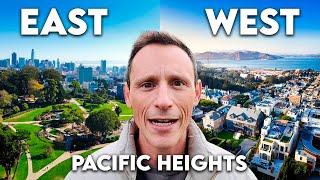
In this video, San Francisco‑based lawyer‑turned‑real‑estate‑agent Austin Klar explains how East and West Pacific Heights differ and what each area offers to prospective residents. He defines the dividing line (Fillmore Street) and outlines the geographic boundaries of the neighborhood. He then compares the two halves across several dimensions: property types (single‑family homes and low‑rise buildings in the West versus mid‑ to high‑rise condos and co‑ops in the East), traffic and transit corridors (lighter traffic on Divisadero in the West versus multiple busy streets and a hospital in the East), amenities such as parks (Alta Plaza and the Presidio in the West; Lafayette Park in the East), shopping and dining options (more varied, higher‑end options on Sacramento Street for the West), commute considerations (closer to downtown and Union Square from the East, easier Marin‑bridge access from the West), and market pricing (higher per‑square‑foot prices for West single‑family homes, higher condo/co‑op prices in the East). He shares personal preferences, noting he favors the quieter, less dense West side for its views and proximity to the Presidio, but acknowledges the East side’s advantages. The video concludes with calls to action: links to related videos, subscription prompts, and an invitation to contact him for real‑estate assistance.
Chapters
Pacific Heights is routinely ranked one of the best, most desirable places to live in all of San Francisco, with beautiful tree-lined streets, incredible food and shopping, panoramic views, stunning architecture, and gorgeous park spaces. But I can tell you from firsthand experience, not all of Pacific Heights is created equal. This is Austin Klar, your lawyer turned real estate agent in San Francisco and Marin County. I've lived in Pacific Heights for over 4 years, and I can tell you from touring hundreds of different homes all across the Pacific Heights neighborhood with clients looking to relocate to the area that not all Pacific Heights share the same characteristics. And in this video, I want to give you the breakdown of East Pacific Heights versus West Pacific Heights so that if you're thinking of relocating to the area, you have all the information you have on the differences in one place. So let's get right to it with an overview of where I'm drawing the line between East versus West and how property types differ in those areas. So where exactly is East versus West Pacific Heights and how do you draw those lines breaking it up? The broader Pacific Heights neighborhood runs from California Street on the southern end to Green Street on the northern end. And then from Lyon Street on the west to Van Ness Ave on the eastern end. Within Pacific Heights, you can break east and west up starting at Fillmore, which is the main commercial corridor of shops, bars, and restaurants running north to south through the Pacific Heights neighborhood. For purposes of this video, anything east of Fillmore will be what I call East Pacific Heights, and anything west of Fillmore will be West Pacific Heights. And the first major difference I want to go over are the different property types that are more concentrated in each of those areas. For the most part, the eastern span of Pacific Heights is more dense than the western span. On the west side of Pac Heights, you'll find a higher concentration of single-family homes or low-rise multi-unit buildings. These might be like old Victorian homes that were converted into 2 or 3-unit buildings, maybe 3, 4-story buildings with condos or apartments, but that's a lot more rare. You're not really gonna find large, like mid-rise or high-rise buildings west of Fillmore Street in Pacific Heights. It's really gonna be a lot more of those large, single-family homes that you think of when you think about Pacific Heights. Now on the east side, you're certainly going to have your fair share of those, but you're going to find a lot more mid to high-rise buildings, you know, 5 to 10 stories or even taller. You have modern condo buildings with amenities like the Pacific, which is east of Fillmore on the corner of Webster and Sacramento, one of the nicest buildings in the city built by Handel Architects. And then you have historic pre-war co-op and condo buildings don't really have amenities, but might have a doorman, for example. And those go as much as, you know, 10 to 12 stories up. Some of these buildings are still very luxurious, each unit taking up a full floor, and others are more, you know, common types of multi-unit buildings with several units per floor, a lot more dense. And not a whole lot of these buildings in East Pacific Heights have amenities. The Pacific is an example that has a lot of different amenities, but most of the buildings that you find are going to have maybe a rooftop, probably not a gym, maybe a doorman. For the most part, they don't really have amenities. So if you do want to live in an amenity building, or you want to live in a building at least with a doorman, an attended lobby for added security, or you want to live farther up above from the ground level, maybe you want the most expansive views possible from really high up in the air, or you just don't want to live that close to the street, probably should focus more of your attention on East Pacific Heights than West Pacific Heights. [FOREIGN LANGUAGE] Pacific Heights. But if you want a larger lot, a larger single-family home, or you want to live in a less dense multi-unit building, maybe with just one or two neighbors, then you should probably focus more of your attention on the western span of Pacific Heights. By the way, if you want to learn more about the Pacific Heights neighborhood as a whole, I've got several videos on it. One of them is a walking tour of the entire western span of the Pacific Heights neighborhood. I'll link that in the description. Another one is my honest review, pros and cons of living in Pacific Heights. After being there for several years. I'll link that in the description below as well. Definitely worth checking out. And if you like videos like this about living in San Francisco, current events, new developments, the housing market, definitely subscribe to my channel because I make videos about that stuff every single week. And if you're ever thinking about purchasing a home in the Pacific Heights area, definitely reach out to me. I've helped numerous people relocate to the area from both within San Francisco and from all over the country, and I'd be happy to be a resource for you as well. I'll link my contact information below in the description. Reach out anytime. Now back to the main differences between East and West Pacific Heights, and the next one I want to talk to you about is traffic. Traffic is definitely heavier on the eastern side of Pacific Heights compared to the western side. The main transit corridor on the west side is along Divisadero Street going north to south through the neighborhood. It's pretty common for people traveling into the city from Marin, for example, on the other side of the Golden Gate Bridge to use Divisadero Street to get into the city, and it's pretty common for people who commute north into Marin that live in, you know, the central part of the city to use Divisadero Street to get out of the city. But aside from Divisadero Street, there aren't really that many other main transit corridors in the western span of Pacific Heights. That's really the main one. In contrast, the east side has several different transit corridors, and each of them are more heavily trafficked than Divisadero Street on the west side. Those are going to be Gough Street, Franklin Street, and Van Ness Avenue, and each of them are going to run north to south through the eastern span of the Pacific Heights neighborhood. Franklin is a one-way street. It is really, really busy, much noisier than Divisadero, and that's because Franklin is mostly traffic lights. So cars can travel much faster on a one-way street, whereas Divisadero in Pacific Heights is all stop signs and it's two-way traffic. So you don't have, you know, cars traveling as fast in between each street. Gough is partly one-way, partly two-way with a mix of stop signs and traffic lights. And Van Ness is by far the largest and busiest of the streets mentioned, one of the largest transit corridors, not just in Pacific Heights, but in the entire city. The east side of Pacific Heights also has the main hospital in the area, so you do get a lot of traffic coming to and from the hospital in addition to people traveling north to south through the area. In my view, if you want to live in a more peaceful, uh, quieter part of Pacific Heights, you should probably focus more of your attention on the west side. There are certainly quiet streets and peaceful streets on the east side of Pacific Heights, but you're more likely to run into heavier traffic and for it to be a little bit noisier on the east side than on the west side. The next big difference I want to go over are amenities like parks, shopping, and food. On the eastern side of Pacific Heights, your main park is going to be Lafayette Park. It's an absolutely beautiful park surrounded by some of the coolest homes in the city. Best example, the historic Spreckels Mansion where Danielle Steele lives, as well as some of the most desirable pre-war buildings in the city. It has gorgeous tennis courts, a children's play area, open green space. It's very pretty. On the west side, you have a similar park, Alta Plaza Park, but I like Alta Plaza Park more than Lafayette Park. Alta Plaza is a terraced park surrounded by historic homes, also has tennis courts and a children's play area. There are also basketball courts. And like I said, I think it's the better park, first because it has better views. There are less, you know, mid-high-rise buildings on the west side of, uh, Pacific Heights, like I mentioned, so your view is less obstructed from Alta Plaza Park. So if you want to have a picnic with A+ views, you know, that's the park to do it at. You're going to get better views of the city to the east, the city to the south, and the bay to the north. I also like the older historic Victorians that surround Alta Plaza Park more than the homes that surround Lafayette Park. In addition to Alta Plaza Park, the Westside also borders the Presidio, which is hands down one of the best parks in all of San Francisco. The Presidio is a national park just west of Lyon Street with its own golf course, walking trails, picnic areas, tennis courts, baseball fields, insane views of the bay and the city. It's easily one of the most beautiful places in the city, and it's walking distance if you live on the west side of Pacific Heights. Another difference is the shopping available on the west side versus the east side. No matter which side you live on, you're going to have pretty easy access to Fillmore Street, which is the main commercial, like restaurant shopping area going north to south in Pacific Heights. But if you live on the west side, you also have access to the shops on Sacramento Street as well as, you know, Michelin-level food on Sacramento Street. It's also home to a ton of interior design stores, home goods stores, architecture firms, developer offices. So there's more variety on Sacramento Street than there is just on Fillmore Street. Living on the west side gives you access to both. Living on the east side, not so much. A benefit though that the east side has over the west side is that the east side is closer to downtown. So if you have to go into the office multiple days a week or you want to go to do some luxury shopping in Union Square, for example, easier to get to from the east side of Pacific Heights than the west side. The last major difference I want to go over is home prices. As a general matter for the Pacific Heights neighborhood as a whole, the further west you get and the further north you get, the more expensive single-family homes are going to be on average. Over the past year, single-family homes on the west side have sold on average for just shy of $1,600 a foot, about $7.4 million, whereas on the east side, single-family homes on average have sold for about $1,200 a foot, just shy of about $5 million. This is because homes on the west side are on quieter streets and tend to have better views. The trend is actually the opposite for condos because condos on the east side tend to have better views if they're in taller buildings. There are also amenity spaces in a lot of these buildings on the east side compared to the west side.. So when you have better views and better amenity spaces, you have higher condo prices. Condos on the west side have sold on average for about $1,160 a foot, about $1.75 million. On the east side, a little bit higher, about $1,240 a foot, $1.95 million. So they're not that much more expensive than each other, but on average, more expensive condos are going to exist on the east side compared to the west side. And some of the most expensive condos in the entire city are actually on the east side of Pacific Heights. So it does drive that average up. And And it's not just condos. The most expensive co-op units, which is a different legal form of ownership, but similar style of living to a condo, those are also on the East Side. And you see some of the higher-end co-ops routinely sell for more than $3,000 a foot. And there are some on the market right now for closer to $5,000 a foot. And with that, you get, you know, full-floor units, 360-degree views of the city, things that you're not really going to get in a condo on the West Side. Well, there you have it. Those are the differences between East Pacific Heights and West Pacific Heights. Which area is better for you obviously is going to depend on your personal lifestyle. Style preferences and what you need to do on a day-to-day basis. I personally prefer to be in a quieter, less dense area. I also really like being close to the Presidio and closer to the Golden Gate Bridge. My boyfriend works in Marin County, so commutes to Marin every single day. It's easier to get to the bridge and commute to Marin from the west side than it is on the east side. But there's literally nothing wrong with living on the east side of Pacific Heights. It is gorgeous and you can lead a very happy life.. So which one's right for you is really going to depend on your preferences. If you're thinking about relocating in Pacific Heights and have questions about the market, definitely reach out to me. Like I said, I've helped people relocate in the area from all over the country, and I'd be happy to be a resource for you as well. I'll put my contact info in the description below. Definitely reach out. And if you like videos like this about living in San Francisco, current events, new developments, definitely subscribe to my channel because I make videos about that stuff every single week. And make sure to check out the pros and cons of living in Pacific Heights and the walking tour I did of West Pacific Heights. I'll link those videos in the description below as well. I hope you enjoyed this one, and I'll see you in the next one. Bye.