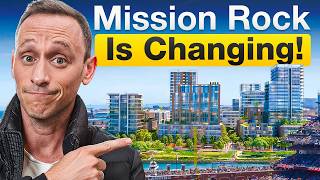
In this video, former lawyer‑turned‑real‑estate agent Austin Klar provides a deep dive into Mission Rock, a multi‑billion‑dollar, public‑private waterfront redevelopment on San Francisco’s northeastern Mission Bay edge. He traces the site’s evolution from 19th‑century tidal marshland to 20th‑century industrial parking lots, explains how the Port of San Francisco, developer Tishman Speyer, and the San Francisco Giants formed a partnership in 2007, and outlines the master plan: a 28‑acre, four‑phase project delivering roughly 1,300 housing units (including deed‑restricted affordable units), 1.4 million sq ft of commercial/office/lab space, 8 acres of parkland, and extensive waterfront promenades. Klar details the first phase’s completed components – the Canyon (MVRDV) and Verde (Studio Gang) residential towers, Visa’s 300,000‑sq‑ft global headquarters, and China Basin Park – highlighting unit mixes, rent ranges, amenity stacks, and the synergy of shared amenities. He also surveys the emerging retail and dining scene (e.g., Arsicault Bakery, Quick Dog, Via Aurelia, Flour and Water, Ike’s Sandwiches) and notes marquee office tenants such as Nvidia and the Golden State Warriors. Transportation links (Muni on 3rd St, Caltrain proximity, highway access) and the flat, walkable terrain are presented as connectivity strengths. The video concludes with a preview of upcoming phases (Pier 48 activation, additional mixed‑use buildings, streetscape completion) and a discussion of climate‑resilience measures (site raised 5.5 ft, storm‑water systems, drought‑ and saline‑tolerant landscaping). Throughout, Klar intersperses calls to action for viewers interested in relocating to San Francisco, positioning himself as a knowledgeable resource.
Chapters
The San Francisco Giants have partnered with one of the most prolific real estate developers in the country to transform parking lots, industrial land, and tidal marshes into a beautiful, brand new, multi-billion dollar mixed-use community right on San Francisco's coastline with over 1,000 new homes, 8 acres of park space and waterfront promenades, 1.4 million square feet of commercial space, and some of the best amenities you'll find anywhere in the Bay Area. This is Austin Klar, your lawyer turned real estate agent in San Francisco and Marin County, and developers have been working for basically two decades decades to create Mission Rock, a cutting-edge, environmentally sustainable mixed-use community right on San Francisco's waterfront. And in this video, I'm breaking down all things Mission Rock, from the site's history and the developer's vision to all the incredible commercial and residential buildings and restaurants that are already open at the space, and all the great things that are coming to one of the most ambitious developments going on in the city right now. Let's get right to it with an overview of where this new community fits within overall San Francisco and the site's unique history. Mission Rock sits on the northeastern edge of Mission Bay, directly across Oracle Park on the other side of McCovey Cove, stretching down to Pier 50. And for most of San Francisco's history, this area was largely tidal marshland. Mission Bay itself was a shallow inlet filled with waterways, wetlands, and mudflats, and the shoreline that exists today is nowhere near the shoreline that existed historically. The current Mission Rock development sits on what eventually became artificial fill in the 19th and early 20th centuries. In the 1860s through the early 1900s, the city undertook one of the largest landfilling operations in its history, filling over 500 acres of open water to make room for rail, industry, and warehousing as the city boomed from the impacts of the California Gold Rush. But by the late 20th century, almost all of that industry had faded. The site became primarily used for surface parking to support what was then called PacBell Park, now known as Oracle Park, and it basically sat unutilized during non-game days. But the Port of San Francisco and a pair of very ambitious developers saw a ton of potential for this vastly underutilized site, and that's when the multi-decade-long journey to create Mission Rock began. Before I get into the details of one of the most ambitious developments going on in San Francisco right now, if you could do me a huge favor, if you like videos about developments going on in the city, San Francisco real estate, lifestyle, history, current events, subscribe to my channel because I make videos about that stuff every single week. And if you're thinking about buying a place in the city and want to understand how all the changes we're seeing across San Francisco right now are impacting our local real estate market, reach out to me. I was a lawyer at one of the biggest law firms in the world before getting into real estate, and I've helped numerous people relocate here from all over the country. I'd be happy to be a resource for you. I'll put my contact info in the description below. Reach out anytime. Now back to the Mission Rock development. And one of the things I find most interesting about this project is who the developers are. Mission Rock is the result of a public-private partnership between the Port of San Francisco, developer Tishman Speyer, and the San Francisco Giants. So sports franchise is part of this redevelopment project. And their involvement in the early stages of planning for this development go all the way back to about 2007. That's about when the grand vision for turning this underutilized parking lot space into a brand new community really started to gain traction. At that time, Mission Bay looked nothing like it does today. It was still mostly empty. UCSF had just started expanding its campus. We didn't have Chase Center, we didn't have Thrive City, we didn't have Uber, we didn't have so many different things that are there right now. From between 2008 and till around 2013, developers worked to strategize a plan to convert what was this underutilized space on non-game days into something that was sustainable and usable basically year-round. And they wanted to strategically position this new development between two very large economic engines, the stadium and then what would become the area that we know as Mission Bay today. The aim was to create a network of interconnected spaces to link that stretch of the waterfront to other parts of the city via the Bay Trail. Think things like new housing, affordable housing especially, new amenity spaces, ground floor retail spaces that would serve future residents, future office workers, and future visitors. And of course, they wanted to prioritize the incredible views that you get from the site, from the San Francisco skyline to the ballpark to the Bay Bridge, all the way out to the East Bay, and of course, the bay itself. It's crazy that an area like that, right on the water with these incredible views, went so underutilized for such a long period of time. And as we know today, this wasn't just some pie-in-the-sky plan. After several successful ballot measures to change zoning restrictions, planning commission hearings, environmental reviews, all that government regulation for a project of this size, the development officially got underway. Construction broke ground in early 2020. The overall vision was a 28-acre development that would be constructed in 4 separate phases. In total, it would seek to create about 1,300 new housing units, hundreds of which would be deed-restricted affordable housing, 1.4 million square feet of commercial space, lab space, office space, restaurant space, you name it. The initial phase was the largest undertaking of the 4 by far. On top of all the infrastructure work needed did to get the site ready for development. We had the completion of two high-rise residential buildings, a high-rise office building, and a brand new park. And I'm going to highlight all of that for you right now. We're going to start with the two residential high-rises that are already open and available at the development, Canyon and Verde SF. Canyon is this large dark red building here, 23-story residential tower designed by MVRDV Architects, their first completed project on the West Coast. The Canyon consists of a podium structure rising 5 stories that leads to a 23-story high-rise comprising 380,000 square feet with 283 apartments. There's also ground floor retail there and 2 stories of office space above the retail space, and the residences are above that. 30% of available units there are below market rate housing, and the amenity stack there is nuts. Rooftop terraces, fitness center, lounges, sauna, pet grooming station— it has everything you would need in a residential building. Rents for market rate units range from a little over $3,000 a month for studios, $4,500 a month for 1 bedrooms, between $6,000 to $7,000 for 2 bedrooms, and over $8,000 a month for 3 bedrooms. Verde, which is the other residential high-rise that was built in this initial phase, has a similar flavor to Canyon in terms of overall profile, but it is much different architecturally. 287,000 square feet, 23-story high-rise apartment building with 254 units, all designed by Studio Gang Architecture. And the amenity stack here is also top-notch. You have another fitness center, and it's actually like really large for a residential amenity, like fitness center, outdoor terraces with grilling areas and fire pit. There's a 24th floor roof rooftop with incredible views. You can see into Oracle Park. There's a game room, a golf simulator, a media studio, lounge space, catering kitchen. And best part of living in either of these buildings is that residents have access to the other building's amenities. So you get 2x the amount of amenities living in these buildings. Not only is that great to have just more amenities available to you, it also helps develop a sense of community for residents there. They have an opportunity to meet and interact with more people. Studios for market rate units start closer to the $4,000 a month range. Two bedrooms go north of $7,000 a month. It's definitely expensive, but it is new construction. There are a ton of amenities and you have big-time views, including unobstructed of the ballpark, the Bay Bridge, the bay itself, and my favorite amenity of the area, China Basin Park, which I'll talk about in a minute. And it's not just residences that have opened at Mission Rock. There are smaller offices and coworking spaces that have opened in these buildings, plus the staple high-rise office building of this new development, which is Visa's brand new global headquarters. It's a 300,000-square-foot, 13-story building designed by Henning Larsen right next to these residential high-rises. This was a huge deal for San Francisco at the time these spaces opened. It's still a huge deal for San Francisco now. At the time that this opened, the office market citywide had basically cratered. Vacancies reached their peak, close to 38% citywide. Companies had been moving out in droves because of remote work, because of how expensive it got to have real estate in the city, and because an overall decline in city conditions in certain locations. But Visa was doubling down on San Francisco, moving their headquarters to the city at a time when nobody else was. And they were early to the party because the office market in San San Francisco right now is a complete 180 from before. It's one of the hottest office markets in the entire country. Demand for new office space is exceeding pre-pandemic levels as the city makes its comeback and as more and more people move back to the city. And a huge portion of that new office leasing activities happen in Mission Bay and in Mission Rock itself. Nvidia has brand new office space at Mission Rock. The Golden State Warriors have brand new office space at Mission Rock. Major, major players are leasing space place at this new development. So you already have thousands of residents and office workers either living in or visiting Mission Rock every single day. And what would a neighborhood be without great food to support all these new residents and office workers and visitors? Well, luckily for them, Mission Rock has become one of the culinary growth hubs of the city, along with the broader Mission Bay. In Mission Rock specifically, there's a brand new Arsicault Bakery, which is widely considered one of the best bakeries in the entire country. Quick Dog just opened, which is a sister restaurant concept to the very popular Trick Dog Bar in the Mission. Via Aurelia just opened, which is a sister restaurant to Che Fico, a very popular Italian spot near Alamo Square. Also with the pizzeria in Mission Bay at Thrive City. Flour and Water has an outpost at Mission Rock. Ike's Sandwiches has a spot at Mission Rock, and it's also next door to all the awesome food at Thrive City at the Chase Center. So there is a ton nearby, all within walking distance. Mission Rock also has its own waterfront park, China Basin Park. It's a 5-acre park designed by Scape Studio. It has a huge lawn with cypress trees, a man-made beachfront with sand. There's a paved walkway along the coastline that's all part of the Bay Trail, which is a many miles long stretch of coastline that connects the entire bayfront of the San Francisco Bay Area. The views from the park are incredible. Across from the ballpark, the Bay Bridge is right in your face. It is a great amenity for people who live here, work here, or just visiting. The views are right in your face. It's incredible. There's also a LuxFit SF, so if you live in the area or you don't want to use your building's gym, there's a separate gym geared toward personal training right in Mission Rock. And Remember I said earlier that a big part of this development is to serve as an interconnected gateway to other parts of the city, and they've definitely accomplished that even without having completely finished the development yet. Muni goes right next to the neighborhood on 3rd Street. It'll take you directly to Dogpatch and Potrero Hill if you're going south, or straight to the Financial District and SoMa if you're going north. So it is a great place to be if you work in San Francisco, if you work downtown, easy to get there by public transit. The entire neighborhood is also basically flat, so if you wanted to walk to these places,, you definitely can. Also a great place to live if you work in the South Bay because it is really close to Caltrain and it's also close to the highway. So pretty much any way you might want to commute, you can do it from Mission Rock. Overall, a great location. They're building a robust community that's sustainable on its own, but that's also connected to so many other great parts of San Francisco and the broader Bay Area. And this is all just in the early phases of this development. There's a lot more that's going to happen there. We have several additional phases that will be constructed over the next decade, additional mixed-use buildings, rehabilitation of Pier 48. That's— will see the creation of a new food and beverage space, new event space, waterfront restaurants, completion of the streetscape buildout on the remaining parcels, new office spaces, and full completion of the waterfront buildout. So what's already becoming a vibrant new community will be even better in the coming years. And none of this would matter if the entire community was going to be underwater in a few years because of sea level rise. And that's why a ton of money has been spent to make it resilient to those eventual changes, to those changing environmental conditions. The entire site was raised 5.5 feet to accommodate conservative estimates of sea level rise over the next century. They've also installed stormwater management systems along the coastline, drought and saline tolerant landscaping to maximize climate change resilience. So the hope is for this community to be a mainstay of the city for the foreseeable future and to continue growing as the city mounts its epic comeback. Well, there you have it. That's what's going on at Mission Rock. I absolutely love this development. It's great to see something that's been in planning for so long actually come to fruition. You can actually go visit it and enjoy it right now. We have so much major development in our pipeline right now, but this one is real life. It has happened and continuing to happen. You've got new parks, new restaurants, new homes, new offices, everything in a new community already available. If you're thinking about relocating to that neighborhood or to other parts of the city and have questions about what all these changes we're seeing across the city mean for you and for our local real estate market, reach out to me. I've lived in San Francisco for over 13 years and I've helped numerous people relocate here from all over the country. Be happy to be a resource for you, I'll put my contact info in the description below. Reach out anytime. And if you like videos about new developments, current events, history, lifestyle, or all things San Francisco real estate, subscribe to my channel because I make videos about that stuff every single week. And before you go, if you want to learn more about some of the other waterfront developments going on, on San Francisco Central Waterfront, right next to Mission Rock, the Pier 70 development and the Potrero Power redevelopment, I've got separate videos on both of those. I'll link those in the description below. So really exciting time for the San Francisco Central Waterfront. It's going to be entirely different from what it looks like right now in the coming years. Really cool to see. Go check them out. I hope you enjoyed the video and I'll see you in the next one. [FOREIGN LANGUAGE]