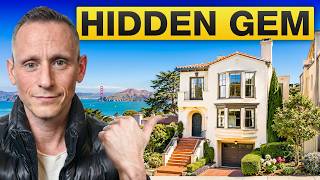
In this YouTube video, lawyer‑turned‑real‑estate agent Austin Klar gives a comprehensive tour and market guide of West Clay Park, a tiny, ultra‑exclusive residence‑park enclave in the northern Richmond District of San Francisco. He explains the neighborhood’s precise micro‑location—sandwiched between the Presidio to the north and the slow‑street Lake Street to the south, bounded by 22nd and 24th Avenues—and how that geography creates a private, park‑like atmosphere with milder weather than nearby western districts. Klar traces the 1910 development by the Boston Investment Company (George Lyon and engineer William Hoag) as part of the early 20th‑century garden‑suburb movement, highlighting the terraced lots, underground utilities, stone gates, and strict design approvals that gave the area its cohesive, suburban‑retreat feel. He describes the varied yet harmonious architectural styles (Colonial Revival, Tudor, Craftsman, Mediterranean, Shingle) and the unusually large lot dimensions (up to 60 × 120 ft). Notable historical residents, especially photographer Ansel Adams, are mentioned to underscore the cultural pedigree. The lifestyle section emphasizes the natural amenities—direct access to the Presidio, Lobos Creek, Baker Beach, Lincoln Park Golf Course, and nearby vibrant commercial corridors on Clement, Sacramento, and Union Streets—while noting the absence of commercial activity within the park itself, which enhances privacy and provides abundant parking. Klar then shifts to market dynamics: only 50 homes exist, turnover is extremely low (four sales in 2.5 years), and when a property does list it sells quickly and above ask, with recent 2026 examples ranging from $4.95 M (selling for $7.2 M) to $8.7 M (selling for $11 M). He concludes by positioning himself as a resource for buyers and sellers, encouraging subscriptions, newsletter sign‑ups, and linking to related videos on the Presidio and San Francisco real‑estate trends.
Chapters
There's a neighborhood in San Francisco that is so small, so private, and so insulated from the rest of the city that most San Franciscans have never even set foot in it, and many have never even heard of it. The most famous photographer in American history grew up there. It's got some of the most coveted views in the entire city, and for years has been one of the most desirable residential real estate enclaves in all of San Francisco, and only a lucky few dozen people get to call it home. This is Austin Klar, your lawyer turned real estate agent in San Francisco, and I'm talking about West Clay Park, one of San Francisco's coveted master-planned residence park communities community is designed over a century ago as a suburban retreat from an otherwise very urban environment, a place for people to live who want to escape the hustle and bustle of the city without actually having to pack your bags and move to Marin, the East Bay, or the South Bay. And in this video, I'm breaking down everything you need to know about this extraordinary neighborhood, its fascinating history, the lifestyle it affords, what homes are like there, and how much they cost. Let's get right to it and start with where this neighborhood is within the broader San Francisco, because its precise location within the city dictates a lot of the lifestyle there. West Clay Park is located located on the northern tip of the Richmond District, sandwiched between two incredible spaces. To the north, directly behind the homes along West Clay Street, is the Presidio of San Francisco, a national park spanning nearly 1,500 acres. Truly one of the best amenities that any city has in the country. I've got a separate video giving you a full tour of the Presidio, its awesome history, all the amazing things to do there, places to eat, museums, the food festivals, beautiful vistas, you name it. Go check it out if you want to learn more about the Presidio. I'll link to that video in the description below. To the south, the neighborhood opens onto Lake Street, which is one of the few remaining slow streets in San Francisco. Slow streets were set up during the pandemic to provide people who are stuck at home with safe spaces outdoors to exercise, walk their dogs, ride their bikes, et cetera. To the east, West Clay Park is bound by 22nd Avenue, and to the west, 24th Avenue. So the footprint here is teeny tiny, literally just a couple of blocks, but those couple of blocks feel like they're own little world within San Francisco. From a weather perspective, because it is on that northern edge of the city, very close to the Pacific Ocean, it is one of the colder and more foggy and windy parts of San Francisco, but it's not as bad as other parts of the Richmond and Seacliff, other areas really far out west like the Sunset as well, because you are shielded in part by the Presidio. Because this area butts up right next to the Presidio, a lot of the cold and fog fronts don't come all the way in through the trees and get into the neighborhood. So even though it is very far west and very far north, it's a bit milder than some of the other neighboring areas. But honestly, if you're living out in West Clay Park, you're not living here because you're prioritizing weather, you're prioritizing other things. Maybe it's the historic pedigree and the architecture, or the beautiful things that surround you. Before I get to the incredible history of West Clay Park and what makes it such a unique neighborhood, if you can do me a huge favor, if you like videos about San Francisco neighborhoods, lifestyle, current events, new developments, or all things San Francisco real estate, subscribe to my channel because I make videos about that stuff every single week. And if you're thinking about buying or selling a place in San Francisco and have questions, questions about what all the changes we're seeing across the city are doing to our local real estate market, reach out to me. I was a lawyer at one of the biggest law firms in the world before getting into real estate, and I've helped numerous people relocate here from all over the country. Be happy to be a resource for you. My contact info is in the description below. Reach out anytime. Now back to how West Clay Park became one of the most sought-after exclusive neighborhoods in the entire city. In March of 1910, the Boston Investment Company, headed by its president George Lyon, filed a subdivision map with the city of San Francisco drawn by engineer William Hoag. Lyon and worked together to develop what is now known as West Clay Park, which they named after an internal street that they created as a nod to Clay Street over in Presidio Heights, about 22 blocks east. That was a very tactical and very smart marketing decision designed to align the neighborhood that they were creating with one of the most prestigious corridors in San Francisco at the time, and still today. The development was part of a much broader movement in residential real estate, thoughtfully designed residential enclaves in big cities called garden suburbs. Think things like coordinated landscaping, coordinated architecture, setbacks, and very strict use limitations on property. These garden suburbs or garden parks were popping up all over the country, and San Francisco's version of these garden suburbs is called residence parks. It was a garden-like enclave built within city limits, designed to offer a suburban retreat from an otherwise very urban space. And West Clay Park was one of 8 such residence parks developed in San Francisco around this time, along with several others you might have heard of, like St. Francis Wood, Jordan Park, Ashbury Terrace, for example. But what set West Clay Park apart from its other fellow residence parks is its precise location within San Francisco and its topography. The site slopes downward from Lake Street to Lobos Creek to the north, a natural elevation change that the developers took full advantage of. They terraced the land, creating 3 terraces of lots, each about 25 to 35 feet above the one in front of it, so that homes on the upper terraces have marine views to the north views the developers literally engineered into the plan by moving thousands of cubic yards of earth. The original subdivision consisted of just 50 lots, so it is a very exclusive enclave, and some of those lots were as much as 60 feet wide and 120 feet deep compared to a standard 25 by 100 San Francisco lot. So not only did these lots have big views, they were also quite large. The street plan was also intentionally designed to discourage through traffic, adding to that garden-like or, you know, suburban retreat-like feeling of the neighborhood. Both 22nd 24th Avenue's end in cul-de-sacs within the development, and 23rd Avenue doesn't even extend north of Lake. So in essence, the development creates a loop road, a quiet private circuit that insulates it from the surrounding street grid, all designed to give West Clay Park a separate identity from the broader neighborhood setting. Lyon and Hoge placed the first advertisement for the West Clay Park development in the San Francisco Examiner in April of 1910. They touted the ornamental stone entrance gates, the terraced lots, the underground electrical service so you don't see you wouldn't see the ugly electrical poles sticking out of the ground and blocking your views. They touted the insane views of the Pacific Ocean and the Presidio. They talked about how it was connected to downtown San Francisco by the electric streetcar on California Street at the time. They touted the trees, the shrubs, and the flowers throughout the development, and they advertised a minimum cost to build a home there of $5,000, which in 1910 was a serious barrier to entry. There were also race-based restrictions on who could purchase the land. It was originally limited to people of the Caucasian race only, those, you know, provisions still remain on a lot of the deeds in the area. You can see them, but they're obviously not legal or enforceable. By January of 1911, less than a year later, Lyon and Hoge were claiming it a brilliant success, one of the most successful residential real estate developments ever. Half the lots had already been sold and 6 houses had already been built in the development. And that development style caught on very quickly. The developer of Forest Hill, R.C. Newell, modeled that development off of the West Clay Park style. And when Lyon and Hoge launched their next project in 1912, Ashbury Terrace, another San Francisco residence park, they advertised it as another West Clay Park. And there's one resident from this era who deserves special mention. Ansel Adams and his family were longtime residents of West Clay Park. The family home at 129 4th Avenue was originally built in 1902, so actually predated the original development of that entire neighborhood. And it's where he spent his childhood through middle age. And you can tell from a lot of his photography how influenced he was from Lobos Creek and the Presidio, the beautiful views of the ocean and the surrounding neighborhood that he grew up in. That's a remarkable bit of history for a neighborhood that has just 50 homes in it. And just as remarkable is the feeling that you get when you walk into West Clay Park. It really does feel like you're stepping into a different world. You enter through stone gateway structures at either 22nd or 24th Avenue with metal placards reading West Clay Park. It's a signal that you've just entered into something special. Inside, the sidewalks are 6 feet wide adjacent to 6-foot planing strips between the sidewalk and the street. So you have grass, you have trees, and you have a lot of different landscaping that have evolved over the decades. The houses are uniformly set back from the street, so you get a consistent band of shallow front yards. You have a big brick retaining wall lining Lake Street on the— that side of the development, and you have historic streetlights still standing on West Clay Street today. The houses themselves are generally 2 to 3 stories. Some of them are larger. Most of them are detached from their neighbors, and they're in a variety of different revival architectural styles— Colonial Revival, Tudor, Craftsman, Mediterranean, Shingle Style, you name it. And even though there are a bunch of different architectural styles there, it still feels like a very coherent neighborhood because of the consistent setbacks, the consistent scale, and the consistent build quality across the properties. And because all the original residences there, many of which still stand today, had to get approval for their designs by the Boston Investment Company. And it's awesome to see that a lot of what was originally built there still stands today over 115 years later. And I'm going to talk about how much those homes cost at the end of the video. So that's what homes are like there. But what's it actually like to live in the neighborhood? Well, the whole point is to feel like you're living in a private retreat away from the city. So because of the, you know, initial restrictive zoning when the development was set up, there's no businesses there. You've got no restaurants, you've got no shops, you've got no coffee shops. None of that. It's just houses. So the level of peace you get there is very hard to achieve in other parts of San Francisco that don't have that zoning restriction. 14 of the original 50 homes sit on the backside of West Clay Street, on the north side of West Clay Street, directly abutting the Presidio and Lobos Creek, which is the last free-flowing stream in San Francisco. So nature is front and center there, really adding to that peaceful environment. From West Clay Park, you can walk directly to Baker Beach, which is one of the most dramatic urban beaches in the entire world. Straight-on view views of the Golden Gate Bridge and the Marin Headlands. You can hike or bike the Presidio Trails, which extend for miles. You can access Lobos Creek Valley Overlook. You can walk to Lincoln Park and golf at the Lincoln Park Golf Course, which wraps around the peninsula with views of the water. You can get to Lands End and the coastal trail there. You can go to the Legion of Honor, which is San Francisco's Museum of European Art, which is in Lincoln Park just a few minutes away. You are not that far from China Beach as well. And even though you won't find like shops or restaurants within Westclay Park itself, yourself, you're not very far from all of that. The most immediately accessible commercial hub is on Clement Street in the Inner Richmond. It's a very walkable, diverse corridor filled with independent restaurants, bakeries, coffee shops, specialty food stores, bookstores, some of the best Asian food in the city. And just a few minutes east of that, you can hit Sacramento Street in Presidio Heights, which has a ton of interior design and home goods stores, coffee shops, antique shops, and Michelin-level food. And right next to that is Laurel Village, which has multiple grocery stores, casual restaurants, and retail. And if you do happen to want an off-night out in a hustle and bustle part of the city, then you can get over to Union Street in Cow Hollow or Chestnut Street in the Marina and go to the shops, bars, and restaurants there. And what's great is when you're ready to leave all that, you can retreat back to your idyllic little village right in West Clay Park. And one of the most underrated advantages of living in West Clay Park, in my opinion, is the parking. If you're coming from a place like Russian Hill or Pac Heights or Noe Valley that is a lot more dense and parking's hard to find, you— it'll be like a breath of fresh air living in West Clay Park. You have so much more parking available in West Clay Park, or at least very close to it, because of how not dense it is. All right, so all that probably sounds awesome to you. Real question is, how much is it going to cost to actually own a place there? Unfortunately, short answer, a lot. West Clay Park is firmly in the top tier of residential real estate submarkets in San Francisco. It is not the place you go to find your starter home. It's usually the end goal, the absolute pinnacle of real estate there. Inventory is almost always limited because there are just 50 lots in the neighborhood. It's very rare that multiple lots come up for sale at the same time. There's also, as a general matter, very low turnover. When people get into the neighborhood, they stay for a long time. To put that into context, only 4 homes have sold there in the last 2.5 years. So when a home does come to market there, it gets a ton of attention, and it gets attention from people who are looking for something very, very unique that they cannot find in most other parts of the city. And what that does is create a very frenetic, fast-paced sales environment, multiple offers, homes trading meaningfully over ask. 29 West Clay Street is one of the most recent examples demonstrating how rare it is homes come to market. When it came on the market in April of 2026, it was the first time the house had been for sale in 70 years. So when I said low turnover, I really meant low turnover. The house had been renovated over the years but still had a lot of original details. And the clients I had looking at it, they were both interested in doing a lot of work to it. And when you factor in both the purchase price and the potential construction price, it was just too much for them. It listed for $4.95 million and sold for $7.2 million, about $1,900 a foot, in just 8 days on the market. And on the extreme high end of the spectrum, a completely renovated home on the Lake Street side of the development just sold in May of 2026. I don't have photos of the interior, but because it was perched up on the Lake Street terrace, it had views of the ocean and Golden Gate Bridge from every level. It was detached from its neighbors, so had awesome light, had multiple outdoor spaces. It listed for $8.7 million and sold for $11 million, almost $2,200 a foot after just 9 days on the market. So for buyers who want the peak of San Francisco residential real estate, they want quiet, privacy, historic pedigree, West Clay Park needs to be at the top of the list. And for sellers who own there, that enduring scarcity is a very powerful tool, especially in a market like we're seeing right now. If you want to learn more about West Clay Park or any other residence parks or other neighborhoods in San Francisco and how the real estate markets are doing there in light of all that we're seeing across across the broader San Francisco right now, reach out to me. I've lived here for almost 14 years and I've helped numerous people relocate here from all over the country. Be happy to be a resource for you. I'll put my contact info in the description below. Reach out anytime. And if you like videos about San Francisco neighborhoods, lifestyle, current events, new developments, or its incredible history, subscribe to my channel because I make videos about that stuff every single week. And if you want to learn more about the Presidio, which is one of the best amenities of West Clay Park and of all of San Francisco, go. I've got a separate video giving you the full breakdown of its history and all the incredible things to do there. I'll link that in the description below as well. I also have a newsletter delivering the week's best San Francisco real estate and lifestyle news directly to your inbox. The link to sign up for that's in the description too. I'd love to see you on there. I hope you enjoyed the video, and I'll see you in the next one.