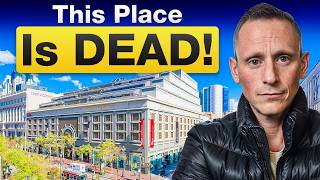
In this solo‑narrated YouTube video, former lawyer‑turned‑real‑estate agent Austin Klar chronicles the full lifecycle of the San Francisco Centre Mall (formerly the Emporium and later the Westfield Shopping Center). He begins with the Emporium’s 1896 origins, its iconic Beaux‑Arts façade and glass dome, and its destruction and rebirth after the 1906 earthquake. Klar then details the early‑2000s Westfield‑Forest City redevelopment that merged the historic Emporium shell with a new adjacent mall, creating a 1.5 million‑sq‑ft mixed‑use complex that opened in 2006. The mall thrived through the 2010s, achieving 96 % occupancy, over $1,000 per sq ft in sales, and roughly 10 million annual visitors. Klar explains how the COVID‑19 pandemic, accelerated e‑commerce, remote‑work trends, rising crime and homelessness, and a collapsing office market eroded foot traffic, driving occupancy below 50 % by 2023 and turning a $44 million NOI into massive losses. He outlines the financial fallout: missed mortgage payments, surrender to lenders, anchor closures (Nordstrom, Century Theater, Bloomingdale’s), lawsuits, and a plummeting valuation (‑75 %). The property was rebranded as the Emporium Center, but remained 93 % vacant. Klar discusses the stalled auction, numerous speculative redevelopment concepts (residential conversion, stadium, college campus, office/lab space), and the practical obstacles: high construction costs, rising interest rates, and a critical land lease held by the San Francisco Unified School District that expires in 2043. He contrasts the mall’s decline with broader positive trends in San Francisco—falling crime, rising tourism, improving retail and office vacancy rates, and renewed tech investment—yet emphasizes that these macro‑improvements have not yet rescued the mall. The video concludes with Klar’s personal reflections, a call for viewer input, and an invitation to contact him for real‑estate assistance.
Chapters
How does a place so beautiful go from being one of the most vibrant, best-performing shopping centers in the entire country into a symbol of retail's downfall and the problems plaguing downtown San Francisco during and after the pandemic? At a time when the city's finally starting to bounce back from its pandemic woes with falling office vacancies, falling retail vacancies, falling crime, falling homeless encampments, rising tourism, a rising housing market and jobs market, rising investment in our local companies, vacancies just continue to mount and valuations continue to plummet at what was once the crown jewel of shopping in San Francisco. This is Austin Klar, your lawyer turned real estate agent in San Francisco and Marin County. And in this video, I'm breaking down the history of the architectural marvel that is the former Westfield Shopping Center in downtown San Francisco, from its early days as the Emporium and multi-decade run as the Westfield Shopping Center to the mass exodus of stores that left the skeleton of the mall that sits there today and what the future might hold for this once great site. Let's get right to it and start with the mall's location and history. Long before it became known as the Westfield, the big name for shopping on Market Street was the Emporium. The Emporium Capwell Company was an American department store chain founded in the 1800s. In 1896, the company opened the Emporium flagship in San Francisco on the 800 block of Market Street, the department store that became an anchor of shopping in downtown San Francisco for decades. Most of the original building was destroyed in the fires that followed the 1906 earthquake, but as the city started to rebuild itself, the Emporium did as well, preserving the iconic facade and expanding its presence on that 800 block of Market Street. And by the mid-1900s, the Emporium had become one of the most highly regarded retail centers, with beautiful Beaux-Arts architecture, a gigantic glass dome that in and of itself was a destination for city residents and visitors alike. It was the heart of a then-thriving Market Street— until it wasn't. By the late 20th century, as department stores across the country struggled and as Emporium's parent company experienced its own unique economic troubles, the flagship closed and left an historic shell in the heart of downtown San Francisco. But that But that wasn't the end for the Emporium. A few years before Emporium had closed, a brand new mall opened immediately next door on that 800 block of Market Street that was owned by Westfield. In the early 2000s, Westfield and a company called Forest City that owned the vacant Emporium site struck a deal to jointly redevelop the building and create a massive mega shopping center complex, a single complex on Market Street that combined the two separate spaces. And the budget for this redevelopment was insane, nearly half a billion dollars. The redevelopment preserved the Emporium's original facade and iconic dome structure, but it completely overhauled the interior. It lifted the dome 60 feet, upgraded seismic infrastructure, made a completely new layout that combined the spaces, a brand new movie theater, grocery store. In total, it became a behemoth 1.5 million square feet mixed-use space that opened in September of 2006. Westfield formally assumed responsibility for operating the entire now combined shopping center, and it was basically an immediate success.. It was named as a finalist for and won design awards, but it wasn't just a design success, it was an operational success as well. By the late 2010s, it was absolutely crushing sales. Occupancy peaked at about 96%. Sales over $1,000 per square foot for the space, putting it in the very upper tier of performance for malls. Nearly 10 million visitors every single year. And it wasn't just a mall, it was a circulator. It was a place for all the office workers in the surrounding area in downtown to come run errands or grab lunch. It was also connected to transit. It also connected Market Street to Mission Street, which had a ton of businesses around them. It was the pride and joy of indoor shopping in San Francisco. And then came 2020. Before I get to how things shifted there leading up to and during the pandemic, if you could do me a huge favor, if you like videos about San Francisco's history, about San Francisco real estate, current events, new developments, or the San Francisco lifestyle, subscribe to my channel because I make videos about that stuff every single week. And if you're thinking about purchasing a place in the city and you want to know how all the changes that we're seeing across the city are impacting our local real estate market, reach out to me. I was a lawyer at one of the biggest law firms in the world before getting into real estate, and I've helped numerous people relocate here from all over the country. I'd be happy to be a resource for you. I'll put my contact info in the description below. Reach out anytime. And now let's get back to the rise and fall of what is probably the most infamous mall in the entire country. Malls throughout the country, not just in San Francisco, experienced a downturn leading up to and definitely during the pandemic with the rise of e-commerce and an overall trend in shrinking retail, you know, brick and mortar footprint. And zero doubt these changes were exacerbated by the pandemic, and especially in San Francisco because of some unique factors that were more prevalent in San Francisco than in other places throughout the country. Rising crime and rising homelessness, in particular close to the downtown hub of San Francisco where the shopping center was, led to an overall decrease in foot traffic to our retail hub. The prominence of remote work and those declining city conditions led a lot of people to leave the city. We had a 10% decrease in our population pretty rapidly in that first year of the pandemic. So that obviously led to less foot traffic to our retail hub. The office market completely cratered, reaching over 38% vacancy at its peak. Conferences— the number of conferences in our city fell. All of that meant less foot traffic to our retail centers. The advantages that really powered that mall, that connector mall, its proximity to transit, its proximity to all the businesses on Market Street and Mission Street— all of those previous advantages basically became liabilities one by one. And in some cases, many by many retailers shut down their stores at the mall. By early 2023, visitorship to the mall had fallen over 40%. Retail occupancy went from almost 100% before the pandemic to a little over 50% by 2023. The mall that once generated over $44 million in net operating income in 2019 was now losing tens of millions of dollars. The mall became worth hundreds of millions of dollars less than the outstanding loan balances that the property secured. In June of 2023, the owners of the mall, which, which included Westfield and Brookfield, announced that they were going to stop making mortgage payments on the loan and hand the building over to their lenders. That same summer, Nordstrom announced that they were going to be closing its doors. So one of the mall's big anchor tenants was closing down, the first real signal that this is probably the end for the mall. The Century Theater multiplex also closed that same month. In September of 2023, American Eagle's owners filed a lawsuit against the mall's management, claiming negligence allowing the mall's conditions to get to the point that they had gotten to, failure maintain common areas, creating unsafe conditions or allowing unsafe conditions to percolate around the area, which led to the store's ultimate failure. Over the next many months, store after store closed down. Lego, Adidas, Hollister, J.Crew, Madewell, Lucky, Aldo, Zara, Sephora, American Eagle, Ted Baker, Michael Kors, Rolex, Panerai, IWC, Sunglass Hut, Kate Spade, Coach, and the list goes on and on. In early 2024, after the mall was surrendered lenders, a receiver was hired and rebranded the Westfield to the Emporium Center of San Francisco. Great nod to the site's roots, but a rebrand was not going to save this mall. By 2024, the mall's occupancy had fallen to about 25% and valuations for the mall had fallen about 75%. And to pile on all of that, in January of 2025, Bloomingdale's announced that it was eventually going to close its doors as well. So the last major anchor tenant of the mall was leaving. That store officially closed in April of 2025. And somehow there are a few stores that have managed to limp on over time, but so many stores have closed down since. As of today, the mall that was once 96% occupied is now about 93% vacant. Only a couple restaurants in the food court remain open as of October 2025 when I'm filming this video. Rent rolls have just been absolutely gutted. Valuations, absolutely gutted. Everything that was once great about this mall has been absolutely absolutely gutted. And because nobody is making payments on the mortgage, the debt load continues to mount. Eventually, it was announced that the mall was going to be auctioned in 2024, so hopefully a new steward could take over, potentially right-size the ship. But the auction that was supposed to take place over a year ago has since been delayed multiple times. We're now up to 8 delays, and we still have no prospect in sight for a potential new owner and no idea when an actual auction might actually take place. There have been a ton of ideas of what might come next or what should come next for the building, some of these ideas more plausible than others. None none of these necessarily tethered to the economic realities of redeveloping a space like this in today's economic conditions. I've heard calls for residential conversion with smaller office footprints. I've heard proposals for a soccer stadium in the heart of the city. I've heard proposals for a mixed-use, you know, college campus. I've heard proposals for major office and lab spaces. All of these sound potentially cool, and maybe all of them are, you know, becoming slightly more feasible as interest rates fall and as San Francisco embarks on its comeback. Believe it or not, retail is improving in the city. Retail vacancies are falling. Crime is down dramatically. Homeless encampments are down. Tourism is back on the rise. Office vacancies are falling again. The housing market is rising again. There's hundreds of billions of dollars of investment coming back into San Francisco into tech companies. BART and Muni ridership are up. There are so many things happening for the better right now in San Francisco, except at this mall. I've separate video going over all of those trends in more detail. If you want to learn more about San Francisco's impossible comeback that it's already started, go check it out. I'll link it in the description below. But despite that overall uptick citywide, the problems persist and continue to mount for this mall in particular. The reality is, with interest rates where they are and construction costs where they are, redeveloping something of this scale is extremely expensive. And complicating things even more is that part of the land the mall sits on is actually owned by the San Francisco Unified School District, which leases that space to— or leases that land to the mall's owners, and that lease is up for potential renegotiation in 2043. So if somebody were to come in and buy this now and spend several years redeveloping it, by the time they open, there's not going to be that much time for them to operate and make their money back before those renegotiations and eventual rent hike occur in 2043. So it's just making the prospect of, you know, investment there even less tenable. My guess is that the building might eventually be broken up into, you know, more financially manageable pieces, and different things will be developed in different spaces, but ultimately it's anyone's guess at this point. It's just such a big space and it makes it so difficult to have like a full-blown retail redevelopment there. Obviously that's just what I think. Would love to know what you think in the comments and what you would like to see there. The city has done a lot to pave the way for new development, streamlining a lot of the very complicated processes, removing a lot of the barriers to entry from like a legal and regulatory perspective, but the financial markets are still really difficult, making redevelopment there very tough. It's really sad. This used to be one of my favorite places to shop. I would come here after work when I used to work downtown all the time. I would love to see it return to its former glory. It remains one of the most beautiful buildings in San Francisco. That dome in the middle, it's an incredible space to experience. If you want to be kept in the loop about updates to the building, make sure to subscribe to my channel because I'll definitely be keeping you posted of new news. And if you're thinking about relocating in San Francisco, I've lived here for over 13 years and I've helped numerous people relocate here from all over the country. Be happy to be a resource for you. I'll put my contact info in the description Reach out anytime. And before you go, make sure you check out that video I mentioned earlier, all about San Francisco's impossible comeback, all the positive trends we're seeing across the city right now. I'll link that in the description as well. I hope you enjoyed the video and I'll see you in the next one.