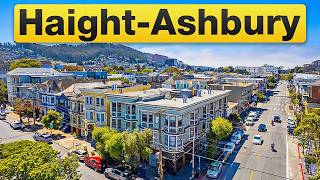
In this 2025 YouTube video, former lawyer‑turned‑real‑estate agent Austin Klar delivers a comprehensive, single‑speaker guide to San Francisco’s iconic Haight‑Ashbury neighborhood. He begins with a geographic overview, noting the area’s borders (Golden Gate Park, the Panhandle, Central Avenue, Buena Vista Park) and its micro‑climate, which is cooler than nearby districts due to the open expanse of the park. Klar then traces the neighborhood’s evolution from 19th‑century sand dunes and farmland, through the 1883 Haight Street Cable Railroad that spurred Victorian and Edwardian residential construction, to its survival of the 1906 earthquake, the early 20th‑century amusement and baseball venues, and the 1960s Summer of Love that attracted musicians such as Janis Joplin, Jimi Hendrix, the Grateful Dead, and Jefferson Airplane. He discusses the subsequent demographic shift toward a middle‑class, family‑oriented community while retaining a lingering hippie aesthetic. Architectural highlights include a high concentration of preserved Victorian/Edwardian homes, many converted into condos, alongside mid‑century modern and newer infill projects, with strict historic‑preservation rules governing landmark properties. The video outlines the neighborhood’s abundant amenities: proximity to Golden Gate Park, the Panhandle, and Buena Vista Park; a vibrant commercial corridor on Haight Street featuring cafés, vintage shops, breweries (e.g., Magnolia Brewing Company), markets (Augustus Market), and cultural events such as the Haight Street Fair and art‑center pop‑ups. Transportation connectivity is emphasized, with the Muni N line and multiple bus routes providing easy access to downtown, Ocean Beach, and the Embarcadero. Finally, Klar presents 2024 real‑estate market data: only seven single‑family homes listed since early 2024, selling in ~3 weeks at an average price of $3.85 M (≈ $1,100/ft²) for ~3,600 ft² homes; 30 condos sold in ~3.5 weeks at an average $1.32 M (≈ $1,100/ft²), both figures modest compared to pricier neighborhoods like Pacific Heights. He concludes with a call to action, inviting viewers to subscribe, contact him for relocation assistance, and watch related videos on Golden Gate Park.
Chapters
The Haight-Ashbury neighborhood is more than just a tie-dye-ridden hippie relic. That's definitely a part of what makes it so special, but there is so much more. From the high concentration of historic homes, vintage charm, and tree-lined streets, to proximity to iconic San Francisco parks, a robust food and bar scene, and an immense musical pedigree, there are few neighborhoods that feel more quintessentially San Francisco than the Haight-Ashbury neighborhood, especially at the price point. This is Austin Klar, your lawyer turned real estate agent in San Francisco and Marin County, and in this video, I'm breaking down what might be the most famous and iconic neighborhood in San Francisco. From its rich history and its cultural and retail ecosystem that still thrive there today, to the incredible housing options available and how much they cost. Let's get right to it and start with an overview of where the neighborhood is and what the weather is like there. Then we'll dive into the history, the lifestyle, and what homes cost there. So where is the Haight-Ashbury neighborhood? The area borders Golden Gate Park to the west, the Panhandle to the north, Central Avenue to the east toward Buena Vista Park and parts of Waller and Frederick Street to the south. The area is often referred to as Upper Haight. There's a separate area called Lower Haight that is to the east of Haight-Ashbury or the Upper Haight area closer to Market Street. The Haight-Ashbury neighborhood's climate is quite varied because of its proximity to Golden Gate Park. Generally speaking, as you move your way toward the city center, the weather tends to get more mild because you have a bunch of buildings, neighborhoods around you that are breaking up the cold and fog fronts that come out from the west, from the Pacific Ocean. But because the Haight-Ashbury neighborhood, which is in the center of San Francisco, is right next to Golden Gate Park, and Golden Gate Park is a very wide open space with not a lot of buildings in it to block those cold and fog fronts, the Haight-Ashbury actually trends cooler than some of the other neighborhoods nearby in that central San Francisco area. There are definitely sunny days there. It's not doom and gloom all year round, all day, but it trends colder than some of the neighboring areas like Cole Valley, for example. You'll definitely want to have at least some layers on, or at least available to you throughout the day. Although honestly, that's pretty much anywhere you live in San Francisco because the weather can change on you on a dime. The fog rolling in against the backdrop of the trees and the beautiful architecture, it is really pretty to see. I'm going to talk about all that stuff in a couple of minutes, but first, if you can do me a huge favor, if you like videos about San Francisco real estate, current events, new developments, lifestyle, history, subscribe to my channel because I make videos about that stuff every single week. And if you're thinking about buying a place in San Francisco and are wondering how all the changes we're seeing across the city are having an impact on our local real estate market, reach out to me. I was a lawyer at one of the biggest law firms in the world before getting into real estate, and I've helped numerous people relocate here from all over the country. Happy to be a resource for you. I'll put my contact info in the description below. Reach out anytime. Now back to what I think makes this neighborhood so special, its incredible history. The name Haight comes from Henry Haight, who was a local banker and politician, and the name Ashbury comes from Monroe Ashbury, who served on the Board of Supervisors of San Francisco in the 1860s. They were integral in planning the neighborhood and the nearby Golden Gate Park, so it is very fitting that they have not only street names, but an entire neighborhood named after them. And to really understand the neighborhood in full, you have to go back in time before the bohemian hippie area, all the way back to when it was sand dunes and farmland. In the 19th century, early streetcars and cable lines were the key to unlocking urbanization in this part of San Francisco. In 1883, the Haight Street Cable Railroad was built connecting this area to the central hub of San Francisco on Market Street. And that connection really spurred development, residential development in this neighborhood. So that's around the time when you start seeing a lot of Victorian and Edwardian architecture start popping up in the neighborhood. And because this neighborhood was one of the few neighborhoods in San Francisco that survived the 1906 earthquake and fires, a lot of that original Victorian and Edwardian architecture that was built in the 1800s still is there today. And I promise I'm going to show you a ton of that architecture later in this video. Over time, the area really became an entertainment destination. There was an amusement park on Haight between Cole and Clayton in the late 1800s, early 1900s, and there was a baseball stadium in the late 1800s. 1800s, and this whole area was the gateway to Golden Gate Park. So for those reasons, it became a very popular area for entertainment and eventually became a hub for middle-class society, more accessible than some other areas like Pacific Heights, Nob Hill, those types of, you know, more affluent locations. By the 1950s, the Haight-Ashbury area started drawing in artists, writers, musicians, counterculturalists, and racial diversity. And that grew into what would become a defining era, at least from the world's perspective, for the neighborhood, the Summer of Love in 1967. Tens of thousands of flower children converged on the Haight, drawn by ideals of peace, protest against war, spiritual and chemical exploration, and artistic expression. The Doolin-Larson Building was an epicenter for that movement, where Janis Joplin and Jimi Hendrix reportedly shopped for clothes. There are plans in the works for adaptive reuse of the Doolin-Larson Building, and I'm going to make a separate video about that building specifically once we know what those plans are. But so many artists and musicians spent time in the Haight-Ashbury area during that time period. The Grateful Dead, Jefferson Airplane, like I said, Janis Joplin, Jimi Hendrix, and so many others. They either lived in the area, they performed in the area, they spent time in and around the area. Over time, these types of celebrations led to issues of overcrowding, of substance abuse, and grew into, you know, tense times with authorities. So eventually a lot of the hippies started to move on, and by the 1970s, 1980s, demographics in the area started to shift. There was definitely still a stamp of hippie culture on neighborhood, and you can still see that today. But over time, it became more middle class, more professional, more family-oriented. So that's why you see that mix of like elegant historic charm with that like tie-dye hippie vintage clothing and record vibe. And I'm going to talk about the architecture right now. So as I mentioned before, because the Haight-Ashbury is one of the few neighborhoods that survived the 1906 earthquake and fire, the original Victorians and Edwardians that were built there in the 1800s, many of them are still intact today. Over time, a lot of these big houses were subdivided and turned into to multi-unit buildings, basically condos or apartments. You actually have a high concentration of condos there compared to single-family homes, even though historically most of what was built there was actually single-family. But most of what's there today, of whatever type it is, is one of the unmistakable charms of the neighborhood. Streets are lined with elaborate Victorian and Edwardian homes, gorgeous millwork, stained glass, decorative brackets, cornices, corbels, turrets, doors, molding, and so many vibrant colors. And it's not just a neighborhood stuck in the past. There are some homes that were modernized, mid-century modern type homes and other modern homes in the area. The neighborhood is actually a potential target for new housing development to help alleviate our housing affordability crisis and meet current demand because of its central location, so close to so many great things. One noteworthy project is an affordable housing complex on Stanyan. It's definitely unlike anything you would have seen, you know, 150 years ago when homes were first being built in area. So there's definitely some tension between past and present, but because of the very strict rules on historic preservation, especially with landmark status or Historical A buildings, a lot of these original Victorian and Edwardian homes remain intact there today. And aside from the incredible architecture, it remains a hub for entertainment and recreation because of its central location. From a park standpoint, you'll be hard-pressed to find neighborhoods in closer proximity to so many great parks. You've got Golden Gate Park to the west, which is one of the crown jewel parks of San Francisco. I've got an entire video on its history and all the awesome things to do there. Go check it out. I'll link that in the description below. You're also right next to the Panhandle, which is a 3/4-mile-long open green space connected to Golden Gate Park that looks out at a lot of the iconic Haight-Ashbury and NOPA area architecture. It's a great place for basketball, picnics, jogging, walking your dogs, just hanging out. To the east, the area borders Buena Vista Park, which is one of the oldest parks in the city, and because of its elevation, one of the best spots for views of San Francisco. So if nature is something that you're looking for in a neighborhood, the Haight-Ashbury area has it in spades. You've also got Haight Street, which is the main commercial corridor of the Haight-Ashbury neighborhood. On Haight Street, you'll find cafes, vintage clothing stores, vintage record stores, bookstores, boutiques, galleries, bars, breweries, nightclubs, specialty food shops, grocery stores, delis, tea shops, exercise studios. You name it, you can probably find it in the area. Favorite place to go for me is Magnolia Brewing Company. It has a long history. Been in and out of bankruptcy, and it actually just reopened relatively recently after being closed for some time. So really great for the neighborhood. I'm really happy it's open again. There's Augustus Market on Haight Street, which is a local grocery store, but they also have a really awesome deli. Great place to get sandwiches, especially during the week when you're on the go. The neighborhood is also home to some awesome events throughout the year. The Haight Street Fair, which usually happens every summer, features live music, street vendors, arts and crafts. It's It's kind of a nod to the hippie movement in the 1960s. There are pop-up performances and exhibitions happening at the Haight Street Art Center. There are community associations that host block parties, walking tours, and historical commemoration events. And even though it's a relatively hilly neighborhood in the north to south direction, it's generally quite walkable because in the east to west direction it's relatively flat. And also the area is relatively small, so everything is pretty close to anywhere that you're going to be living in the area. Another great feature of the Haight-Ashbury neighborhood is its connectivity to other parts San Francisco, which I alluded to earlier. Major Muni routes run through several streets in the Haight-Ashbury area that connect to a ton of different neighborhoods in San Francisco. No matter where you live in the area, you're walking distance from the N line, so you can easily take the light rail all the way to and from Ocean Beach and the Embarcadero. So if you happen to work downtown or in SoMa, it's an actually a pretty convenient place to live from a commute standpoint. You've got plenty of other lines that run north to south in the neighborhood, and just because it is centrally located in the city, if you are are going to drive, it's pretty easy to get anywhere that you want to go from the area. There are also a lot of areas immediately close by with great amenities that are very walkable to, or easy, like very short drive to. Cole Valley, the Divisadero Corridor, Alamo Square, the Sunset, all of them have their own like food and boutiques to take advantage of. So you have what's in and around Haight-Ashbury plus connectivity to basically all parts of San Francisco if you live in the area. All right, so all of that sounds awesome, but how much am I going to need to shell out if I want to live in the Haight-Ashbury? Probably won't surprise you that given its central location and the historic architecture and proximity to all those amenities I talked about, that it is one of the more expensive places to live in the city, but it's actually a lot more affordable to some of the other expensive areas in the city where you can get access to a similar amenity set. So what does that mean? Well, first thing to understand about the area is that not a lot of inventory actually comes to market in the area. Since the beginning of 2024, so about 2 years, only 7 single-family homes have hit the market in the Haight-Ashbury neighborhood. So it's very rare for homes to pop up for sale, and when they do, they sell pretty fast in about 3 weeks on the market for an average of about $3.85 million. Now that's definitely a lot of money, but when you consider that the average size of these homes is around 3,600 square feet, the price per foot around $1,100 a foot is not that far above the average price per foot of homes in all of San Francisco over that period, which is about $1,040 a foot. And when you consider other areas with similar amenities and things to do, like Marina, Pac Heights, Cole Valley, Russian Hill, et cetera. Those sell for on average between $1,300 to $1,700 a foot. On a relative basis, it is a lot less expensive to live in Haight-Ashbury. And for condos, it's even more in line with city average. 30 condos have sold since the beginning of 2024 in about 3.5 weeks on the market for an average of $1.32 million, just under $1,100 a foot, which is similar to the overall average NSF over that period, which is also $1.32 million, about $1,027 a foot. And again, that's way less expensive than some of the other neighborhoods that I mentioned, like Pac Heights and, you know, Russian Hill and areas like that where you have access to a similar amenity stack where condos in those areas routinely sell for $1,250, $1,300 a foot or even more. Well, there you have it. That's everything you need to know about the Haight-Ashbury neighborhood. It's so rich in history. There's so much to do there. It's just an overall fun place to be.. If it's not on your radar of neighborhoods to live in, if you're thinking of moving to San Francisco or relocating in the city, it should be. If you're thinking about buying a place there or in any other neighborhood in San Francisco and want to better understand how the changes we're seeing, the advent of AI, all the new people coming to the city, the changes in tourism and office market, retail market, how all of these things are impacting our local housing market, reach out to me. I've lived in San Francisco for over 13 years and I've helped numerous people relocate here from all over the country. Be happy to be a resource for you. I'll put my contact info in the description below. Reach out anytime. And if you like videos about different San Francisco neighborhoods, lifestyle, history, current events, new developments, or all things San Francisco real estate, make sure to subscribe to my channel because I make videos about that stuff every single week. And before you go, make sure to check out the video that I made about Golden Gate Park. I go over everything there is to do there. It's incredible history. You could literally spend days there and still not have seen everything. It's one of the best amenities, perks of living in San Francisco. I'll link that in the description below as well. I hope you enjoyed the video, and I'll see you in the next one.